

How a closed terrarium works: water, light, decomposition
Why a closed jar lives without being watered: the water cycle under glass, photosynthesis, the part the soil plays and the real limits of self-sufficiency.
In this guide
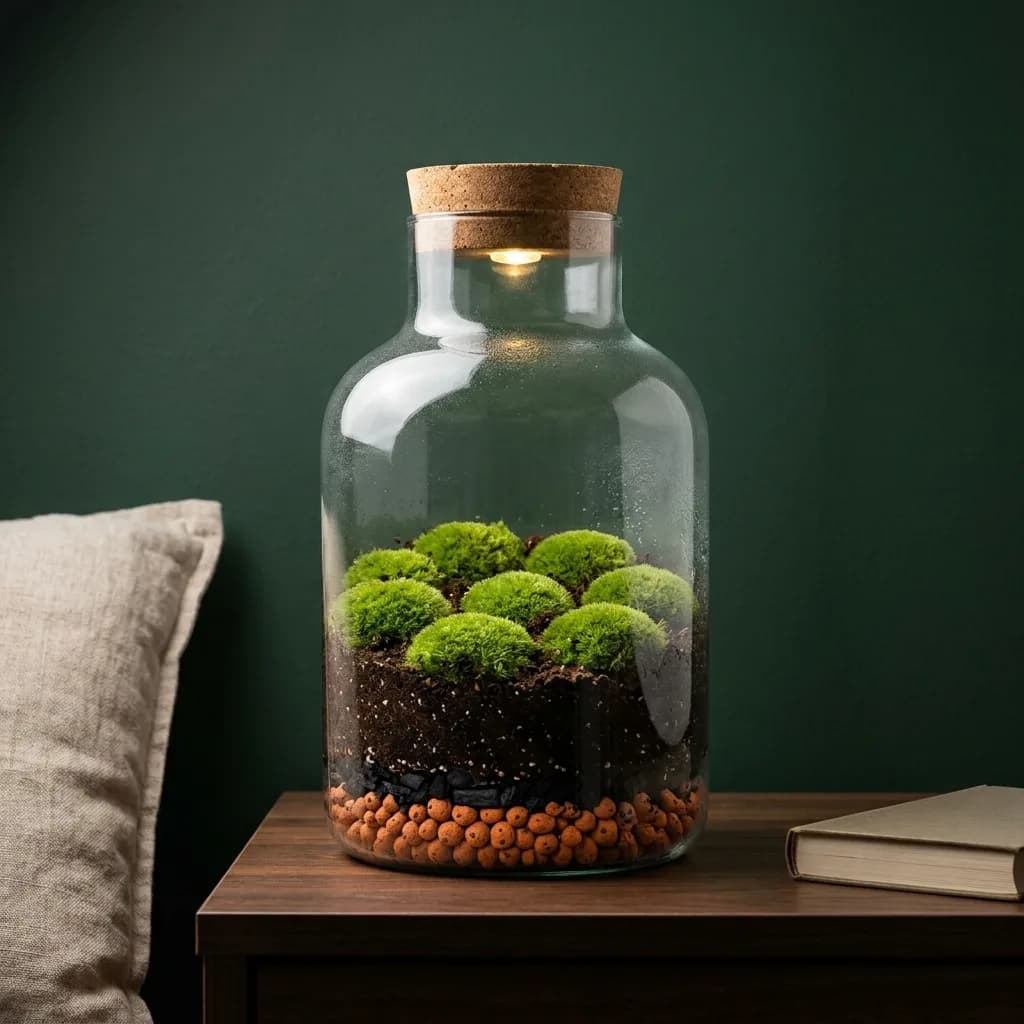
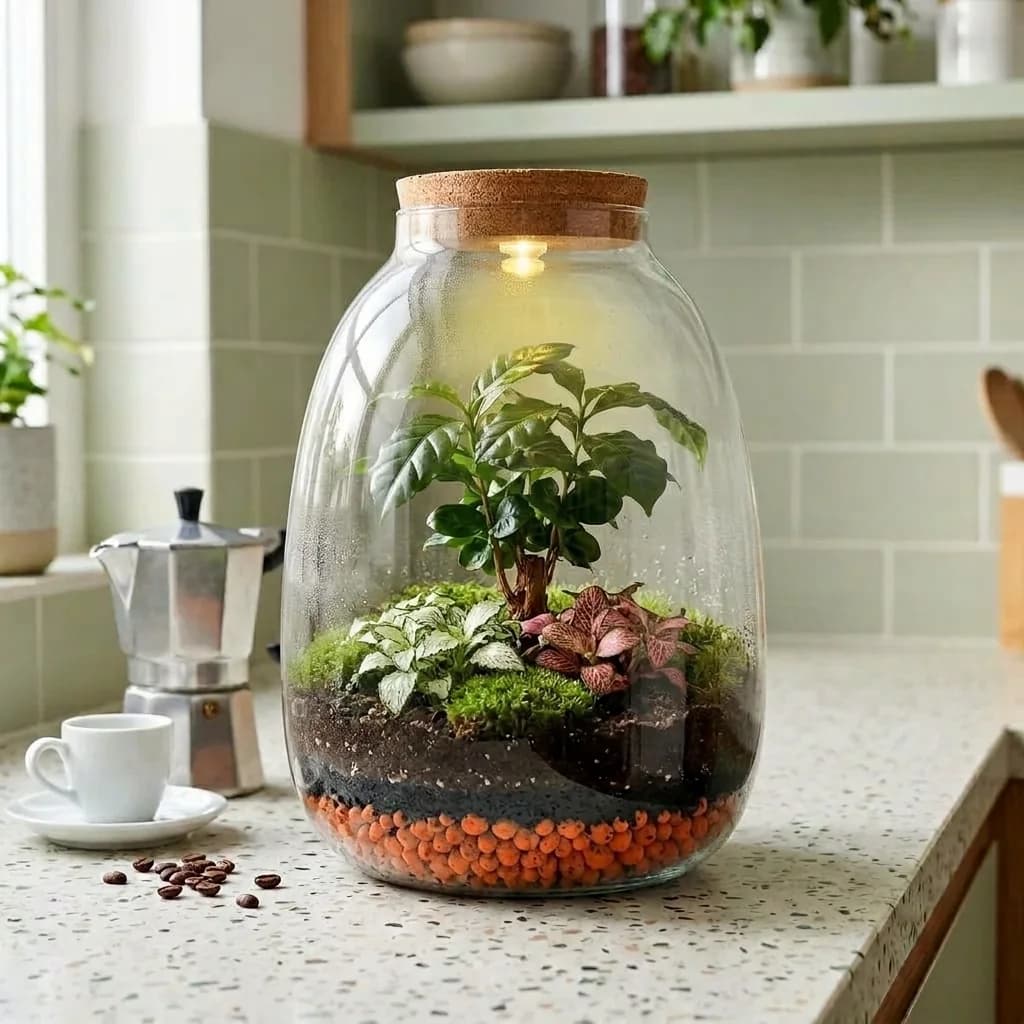
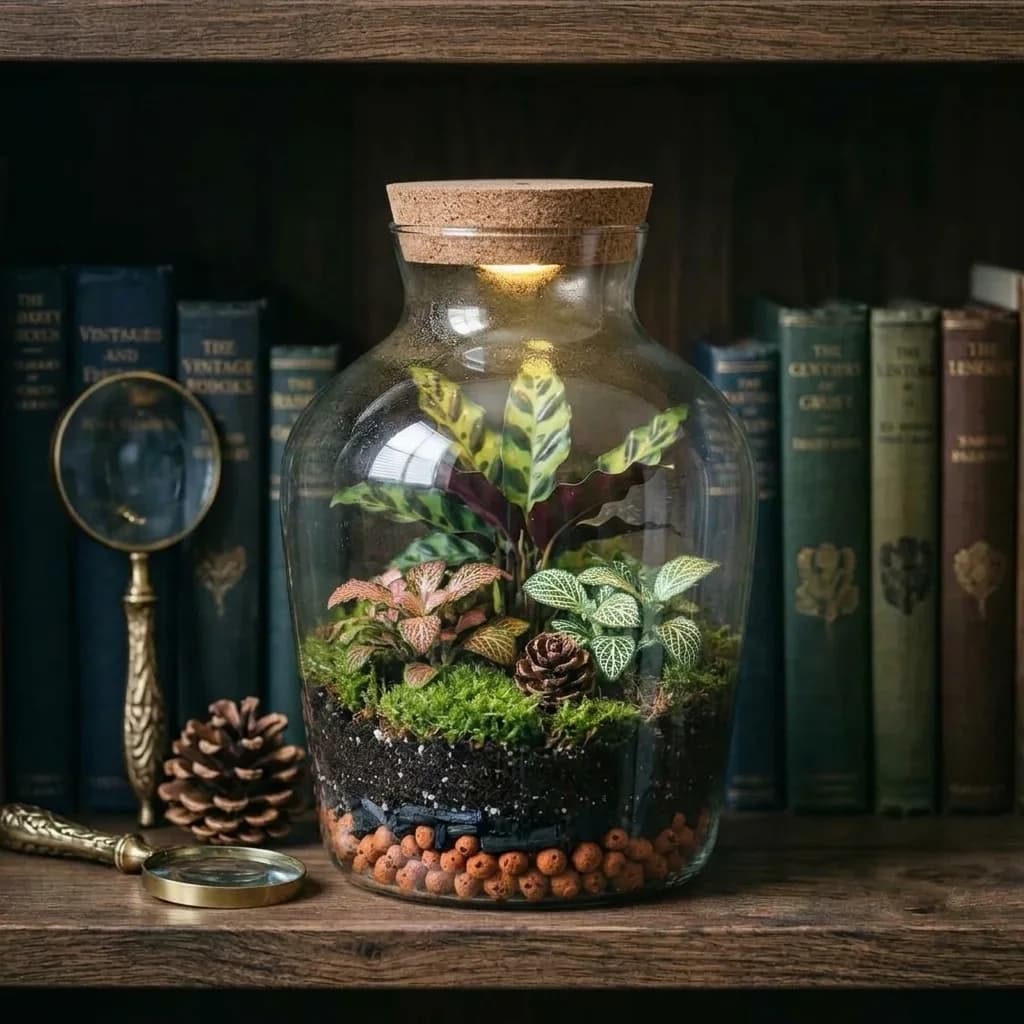
A closed terrarium lives without watering because it recycles its water in a closed loop: the water evaporates from the soil, leaves the foliage, condenses on the glass and runs back down. The plants, for their part, build their own matter out of light, and the soil breaks down whatever dies so that it can go back into circulation. Three cycles, and a single input of energy — light. That is what makes a closed jar fascinating, and it also explains its limits.
This guide explains how it works. For the step-by-step build, see How to create a closed terrarium.
The water cycle, in miniature
This is the most visible of the three, and the easiest to watch.
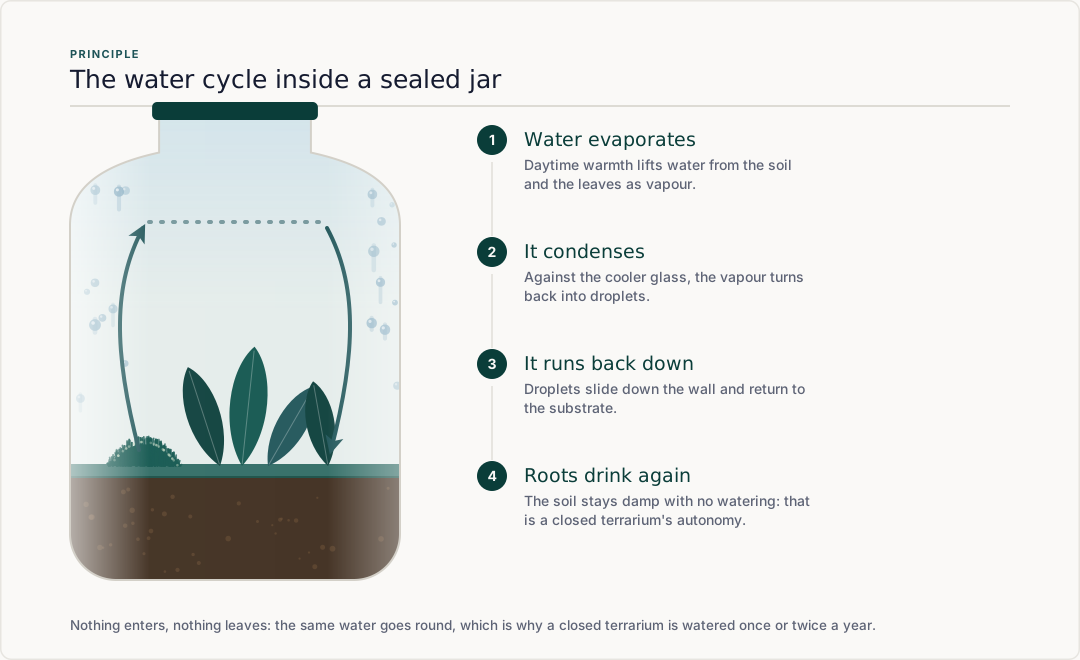
Evaporation. The water held in the substrate turns into vapour, and does so faster as the temperature rises. It mixes with the air inside the jar.
Transpiration. The plants release water too. It comes in through the roots, travels through the plant, and leaves through the tiny openings in the leaves — the stomata. Put the two phenomena together and you have what is called evapotranspiration.
Condensation. The air in the terrarium becomes saturated. Against the glass, which is cooler than the air inside, the vapour turns back into a liquid: that is the mist. The droplets grow, run into each other, and eventually trickle down.
The return to the soil. The water runs down the wall, rejoins the substrate, and the cycle starts again.
It is exactly the water cycle of the planet — ocean, cloud, rain, river — reduced to twenty centimetres. With one difference: nothing leaves. In a container that really does seal, the same water goes round indefinitely.
It is also why the mist is your measuring instrument. Light in the morning, gone by the middle of the day: the balance is right. Running down the glass all the time: too much water — see Terrarium too wet. Absent for days on end: the terrarium is drying out, or it no longer seals — see Terrarium too dry. The full reading is in Condensation in a terrarium.
Photosynthesis: the only input the system has
A closed terrarium is not an isolated system: it receives light, and that is its only input of energy.
Plants use that light to combine water and the carbon dioxide in the air into organic matter, releasing oxygen as they do. This is photosynthesis, and it is what builds every bit of matter in the terrarium — every new leaf comes from it.
Alongside that, plants also respire: by day and by night they consume oxygen and release carbon dioxide. The organisms in the soil do the same. As long as the plants are healthy and receive enough light, photosynthesis wins by a wide margin and the oxygen balance stays positive.
That explains the commonest symptom of too little light: everything pales, the stems stretch in search of the source, and variegated plants lose their colours. The system is ticking over slowly for want of fuel — see Yellow leaves in a terrarium.
Decomposition: the third cycle
A leaf falls. In a flowerpot, you pick it up. In a terrarium, it disappears on its own within a few weeks.
The decomposers are at work: bacteria, microscopic fungi, and, in a bioactive terrarium, a microfauna introduced on purpose — springtails in particular. They break down dead matter and return the mineral elements to circulation, where the roots use them again.
This cycle is why a terrarium almost never needs fertiliser: it recycles its own matter. The subject is covered in detail in The bioactive terrarium.
It also explains something important: this cycle has a limited capacity. One leaf a month, it absorbs. A whole plant collapsing at once, it does not — decomposition races ahead, oxygen runs short at the bottom, and fermentation takes over, with the smell that goes with it. See My terrarium smells bad.
What the glass does, and what people underestimate
The glass is not just a wall. It plays three parts:
- it holds the water vapour in, which is what makes the cycle possible;
- it lets the light through, which is what makes photosynthesis possible;
- it holds the heat in, which is a problem.
It is that third point that causes the most damage. Under a beam of direct sunlight, a terrarium behaves like a small greenhouse: the temperature inside climbs far above that of the room, in a single afternoon. Woodland-floor plants have no adaptation to that at all — see Terrarium too hot.
The real limits of self-sufficiency
A closed terrarium is often described as "self-sustaining". The word is true of the water, and misleading about everything else. Four conditions have to hold:
Light, every day. Without it, the system has no energy input left and slowly goes out.
A steady temperature, between 18 and 26 °C. No radiator, no sun, no cold draught.
A closure that seals. A stopper that has dried out lets the vapour escape, and the cycle empties.
Suitable plants, kept in check. A plant that reaches the glass rots against it; a plant that covers another one smothers it. Hence pruning two or three times a year — see Pruning a terrarium.
In other words: a closed terrarium needs no watering, but it does need the right place to stand and three interventions a year. That is not the same thing as doing nothing at all. The distinction is developed in The self-sustaining terrarium: how it works and its limits.
Watching it for yourself
That is what makes the object interesting: everything is visible. Keep a notebook, one line a week — mist present or not, new shoots, colours, fallen leaves. Within three months you will have the complete workings of an ecosystem in front of you, on the scale of a shelf.
It is also what makes it such a good experiment to run with a child: see Making a terrarium with a child.
Sources
Frequently asked questions
Does a closed terrarium produce its own oxygen?
The plants produce it by day through photosynthesis, and consume it at night as they respire, as do the organisms in the soil. The balance stays positive as long as the plants are healthy and receive enough light.
Where does the water on the glass come from?
From the substrate and from the plants themselves. Water evaporates from the soil and leaves the foliage by transpiration, condenses on the cooler wall, then runs back down. No water comes in or goes out while the container stays closed.
Can a closed terrarium really live for years?
Some last a very long time, but it is neither automatic nor guaranteed. It takes light, a steady temperature, a closure that seals and suitable plants. Any one of those four giving way is enough to tip the balance.
Should you open a closed terrarium to air it?
Not as a matter of principle. You open it to prune, to take out a dead leaf, or to bring down an excess of water. A balanced terrarium does not need airing: it is not an animal, it has no need of fresh air.