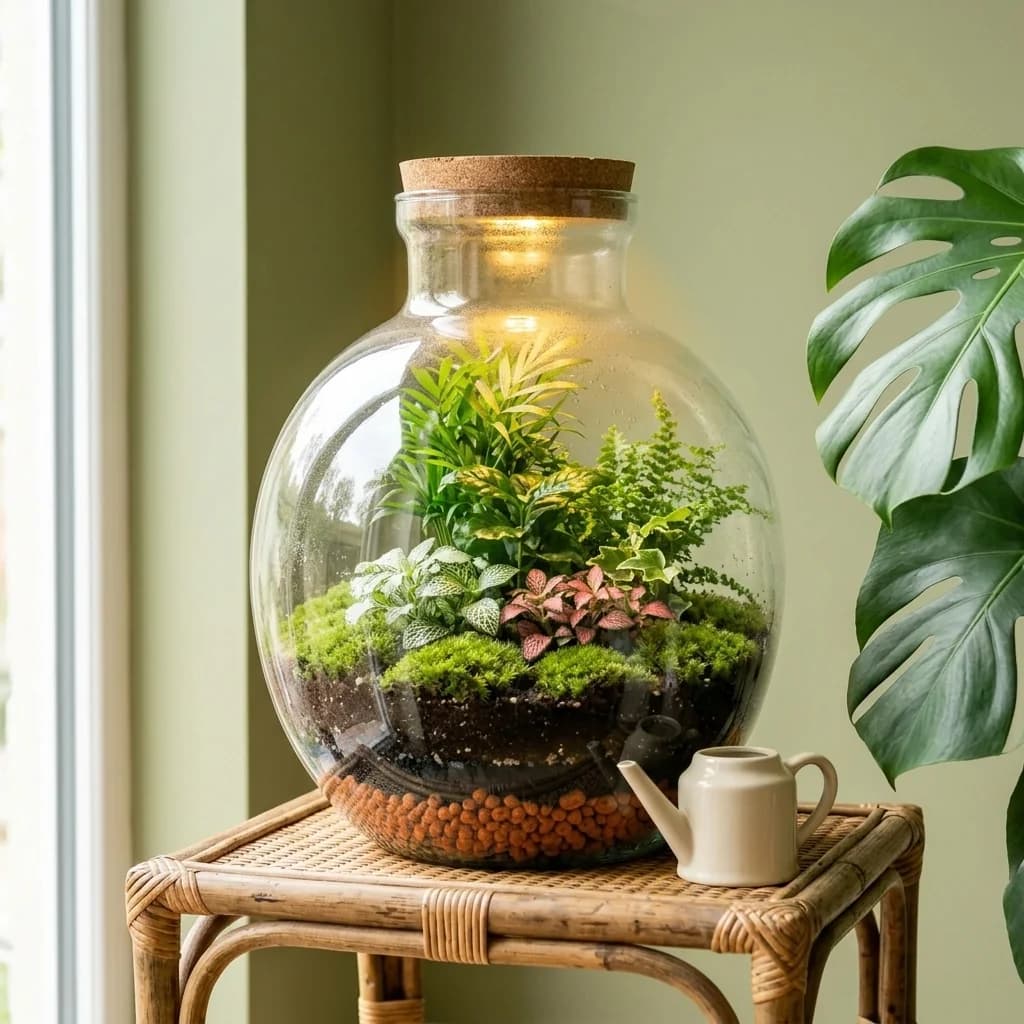
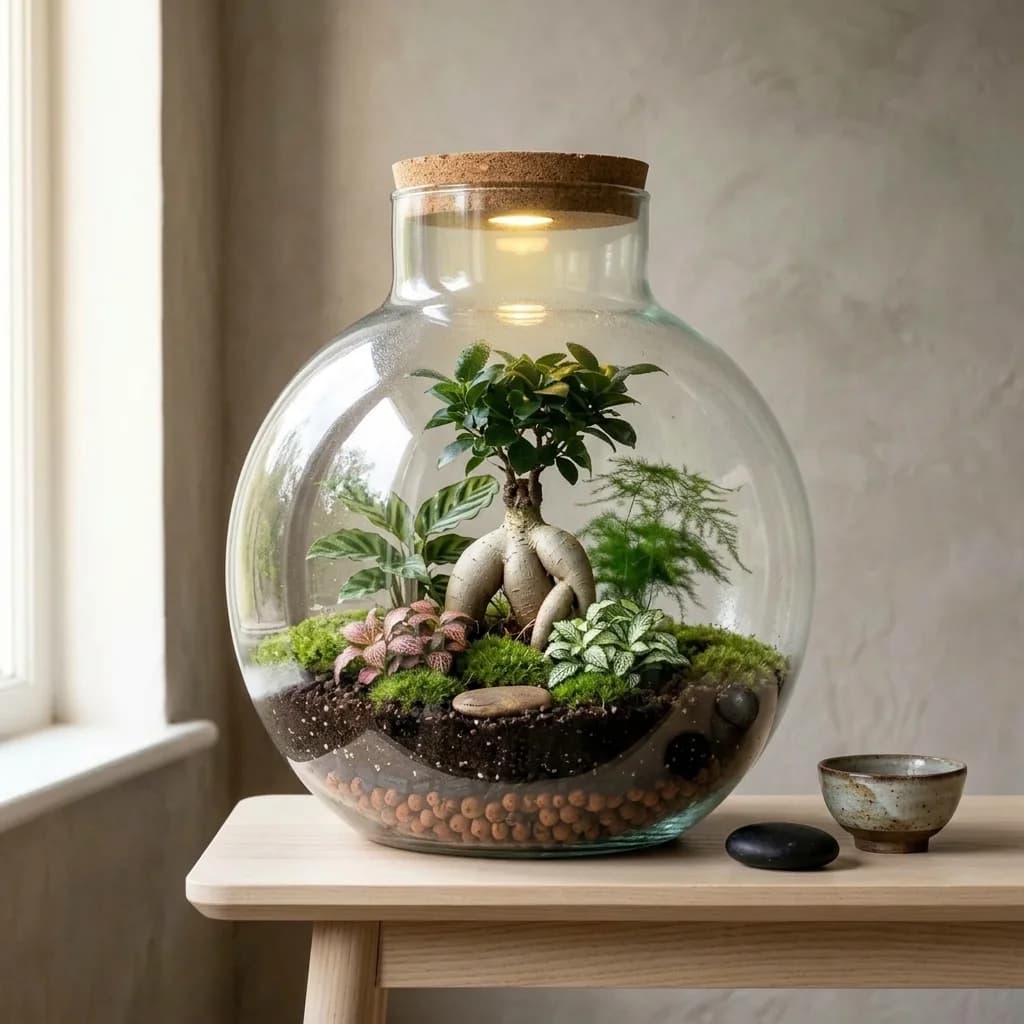


Self-sustaining terrariums: how they work and their limits
How terrariums recycle water and nutrients, why they need light and which care remains necessary despite their self-sustaining cycles.
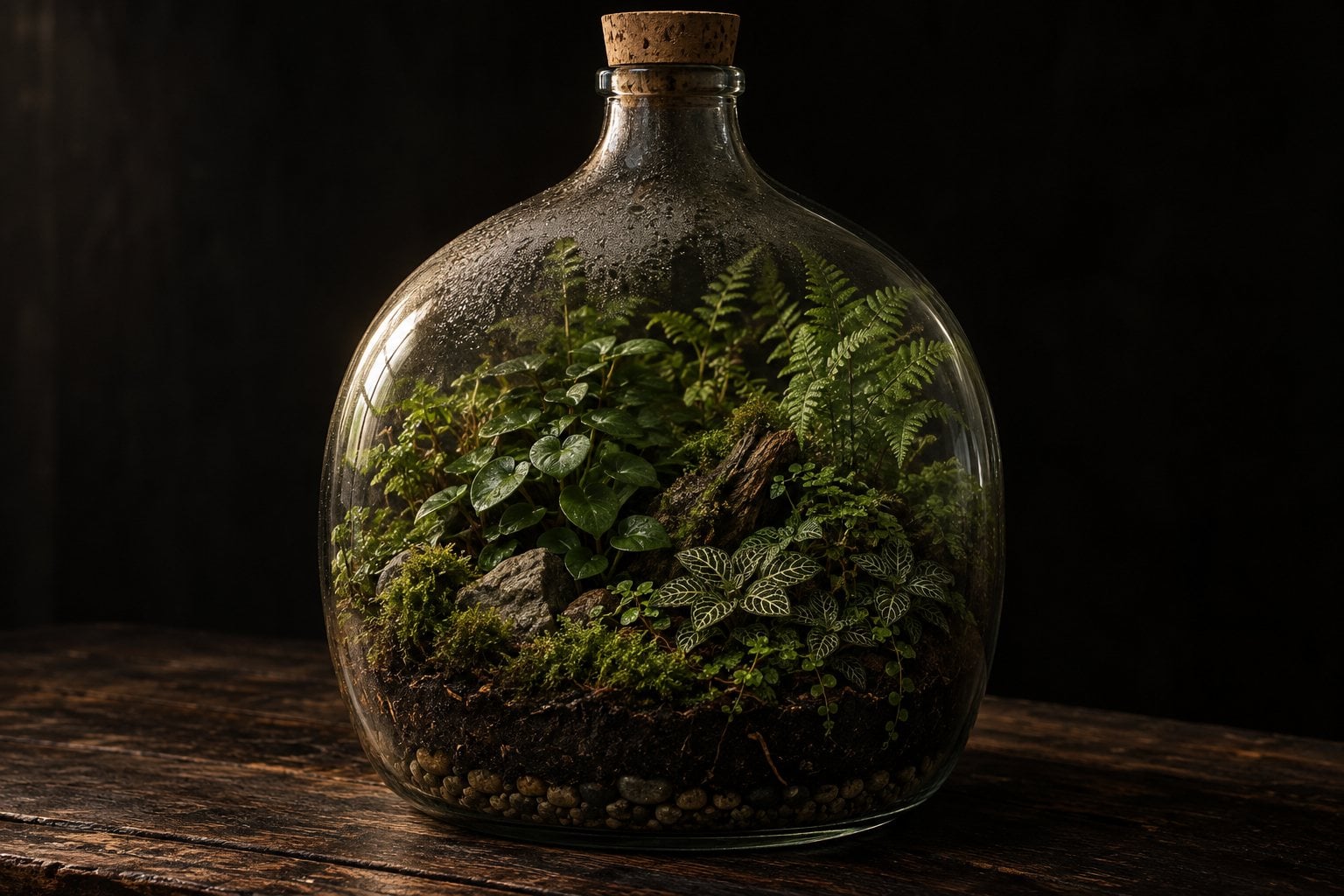
In this guide
A well-balanced closed terrarium needs very little maintenance, but not none at all. Water circulates in a loop inside it: it evaporates, condenses on the glass and falls back onto the substrate, so a light watering a few times a year is often enough. A few simple tasks remain: watching the condensation, removing dead leaves, trimming anything that touches the glass. Here's what "low-maintenance" really means, and what it doesn't.
Closed to water loss, open to energy
Water evaporates from soil and leaves and may condense on glass. Plants use light to make organic matter through photosynthesis; they also respire day and night. Soil organisms contribute to decomposition and gradually recycle some nutrients. Recycling is neither instant nor unlimited.
Glass admits light energy, so the terrarium is not independent of its surroundings. Closure alone guarantees neither balanced gas exchange nor a fixed lifespan. Observe these cycles by creating a closed jar ecosystem.
Why a closed terrarium needs so little
In a pot sitting on a shelf, water escapes into the room's air. In a closed container, it stays inside. The leaves and substrate release water vapour; this vapour settles on the glass, then trickles back down to the soil. The cycle starts again every day, without you.
As long as this cycle holds, there's almost nothing for you to do. The Royal Horticultural Society (RHS), the UK's leading horticultural society, states that a closed terrarium only needs water a few times a year, in small amounts.
Three conditions make this balance possible:
- Suitable plants: small, slow-growing, humidity-loving. Succulents and cacti have no place here.
- Bright but indirect light: without light, plants fade; in direct sun, the glass heats up and scorches them.
- The right amount of water at the start: a moist substrate, never waterlogged.
What's false, however, is the idea of something you set up and forget about forever. A closed terrarium is a small living environment. Plants grow, leaves die, humidity shifts with the seasons. These slow changes call for your hand every now and then.
The tasks that remain
Practical tasks are detailed in closed terrarium care. Autonomy reduces intervention but does not remove the need to observe soil and plants.
How long can a closed terrarium go without watering?
There's no fixed length of time. It all depends on how tightly the lid seals, the size of the container, the warmth of the room and the plants chosen. Published benchmarks range from a few weeks to several months:
- the University of Illinois states that a well-sealed container only needs water every four to six months;
- Penn State University mentions a terrarium needing watering every three weeks, and others every six weeks to two months;
- the RHS speaks of a few waterings a year, in small amounts.
The safest rule, then, is not to water on a schedule, but by the signs: water only if the condensation has gone, if the plants are wilting, or if the substrate is dry. And water sparingly: a few spritzes, then wait a day or two to see the effect. Our guide watering a terrarium covers the method and the choice of water in detail.
The plants that make upkeep truly minimal
The choice of plants matters more than anything else. A fast-growing plant will force you to trim often; a plant that likes dry conditions will rot.
Favour:
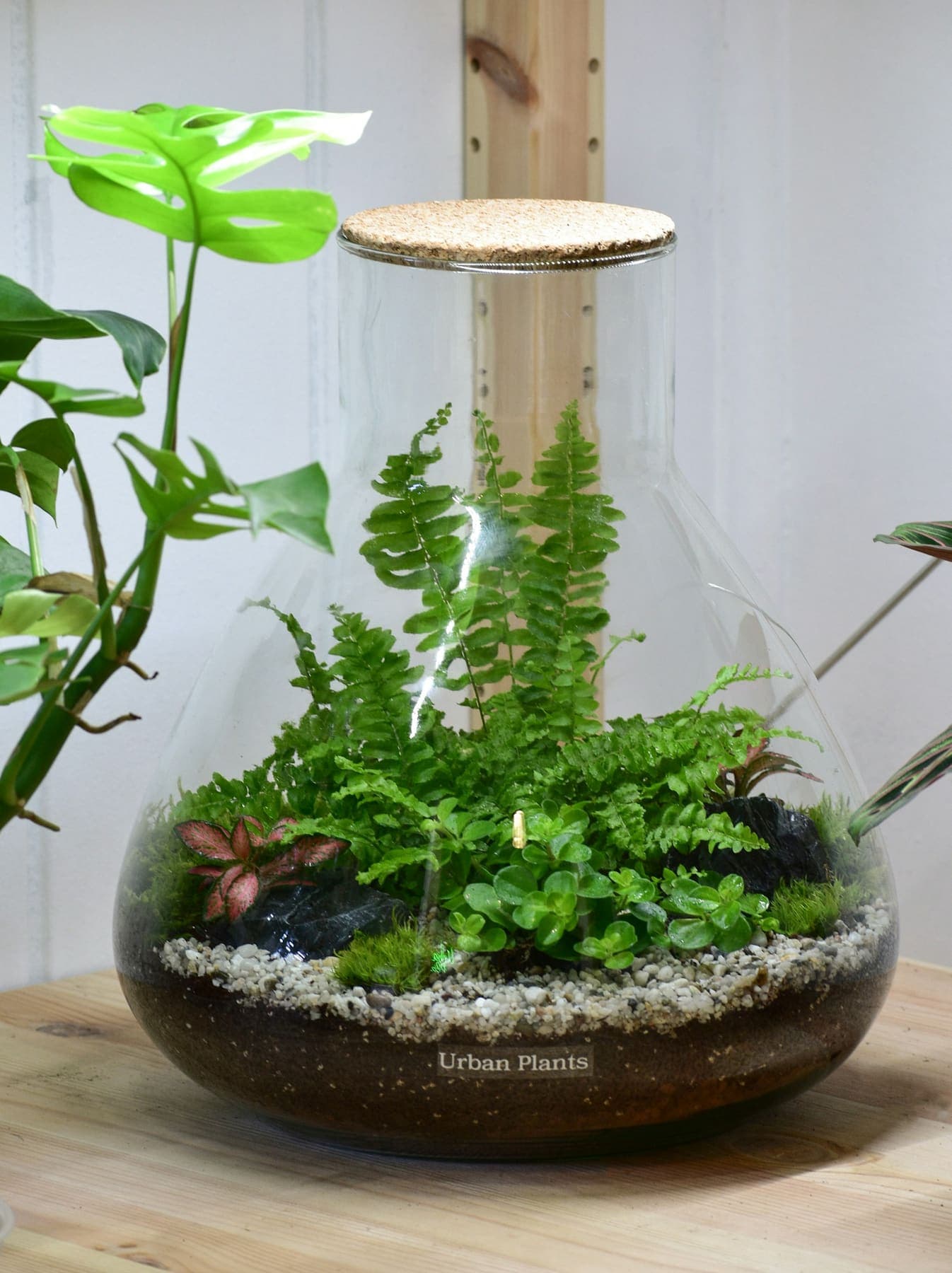
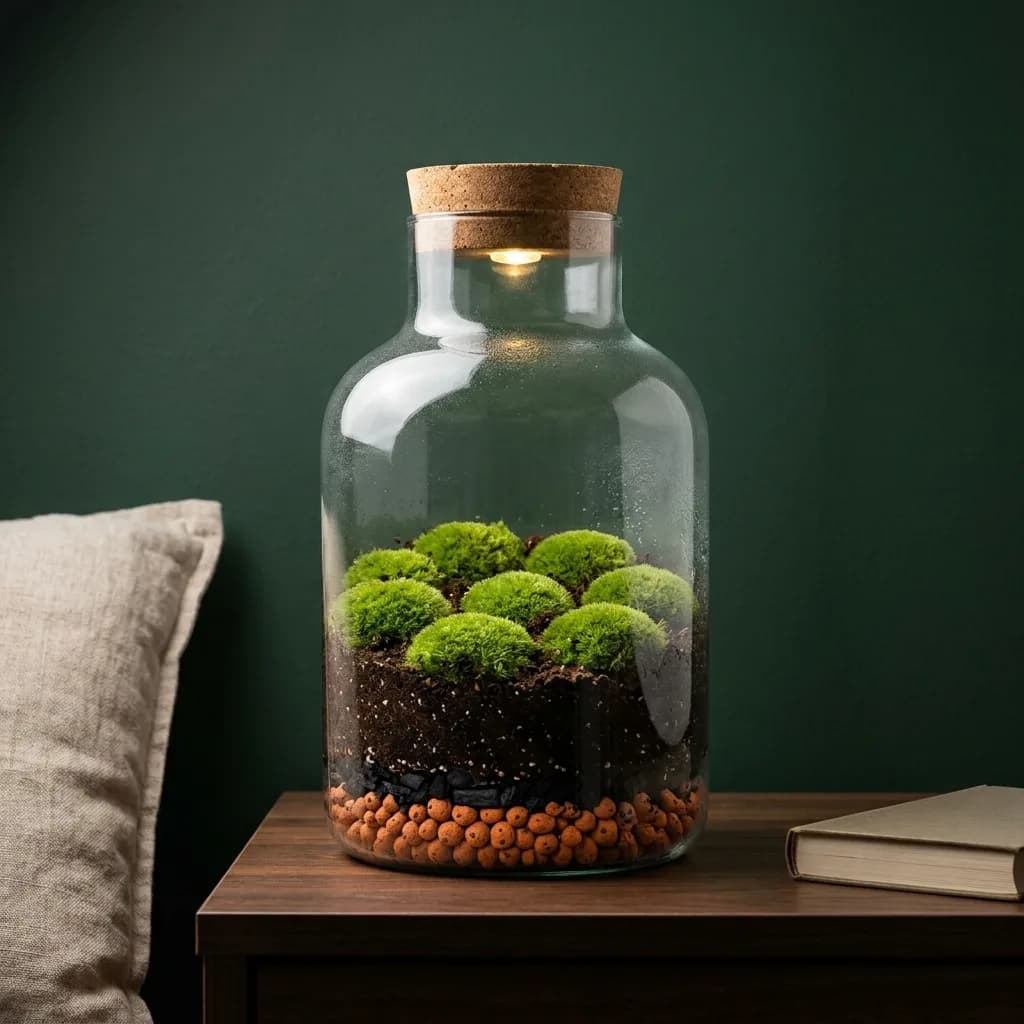
- Cultivated mosses: they cover the ground, hold in humidity and grow slowly. Our guide to terrarium mosses presents the species.
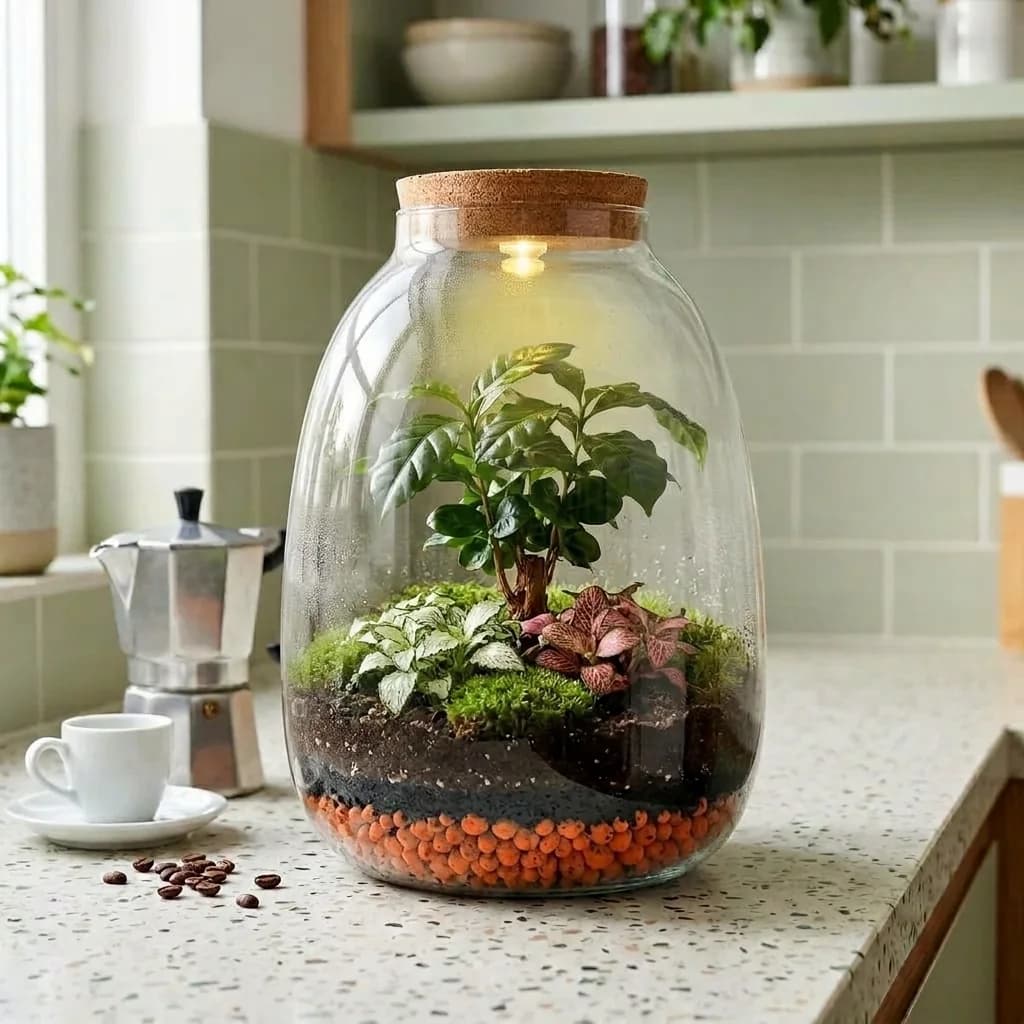
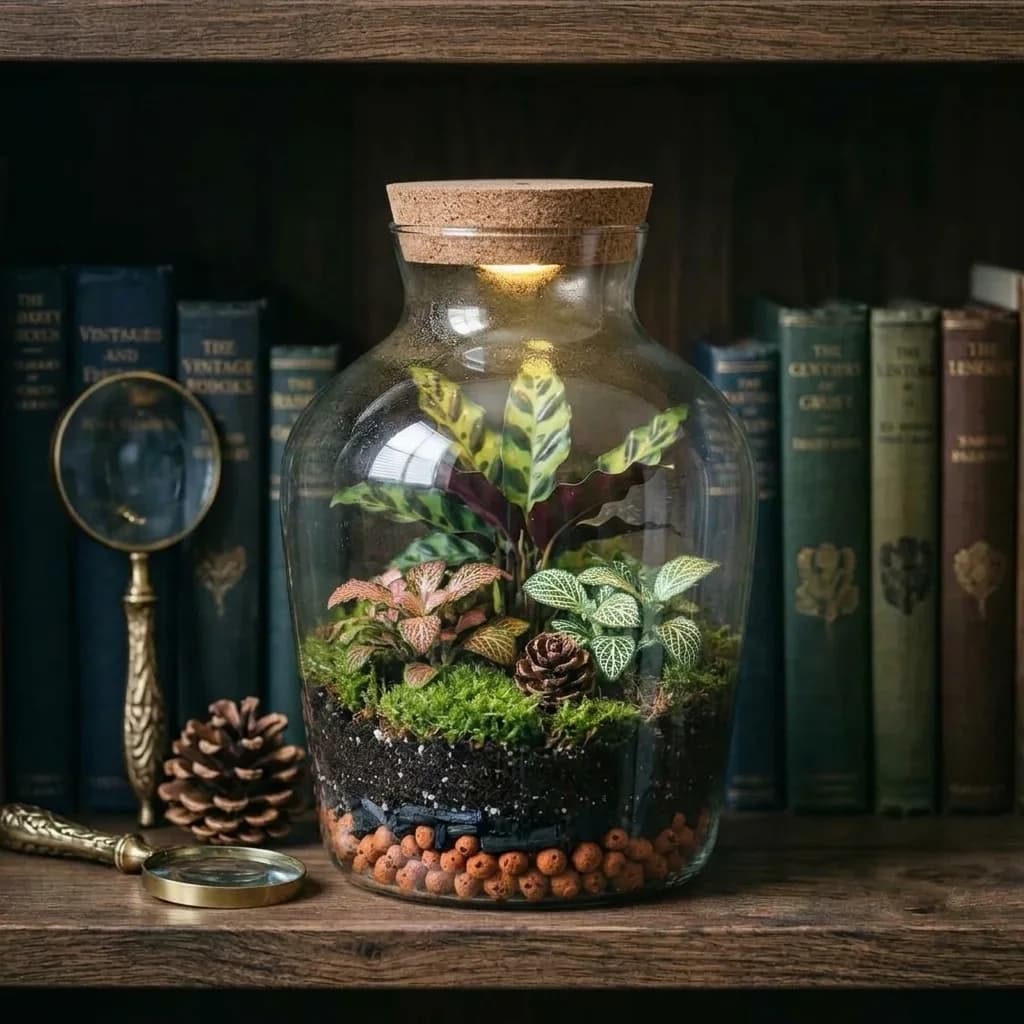
- Small fittonias: they love humidity, and their wilting leaves quickly signal a lack of water.
- Small ferns: they enjoy humid air. Keep an eye on their size over the years.
- Small foliage plants, such as certain peperomias and pileas, which the RHS lists among plants suited to closed terrariums.
Avoid:
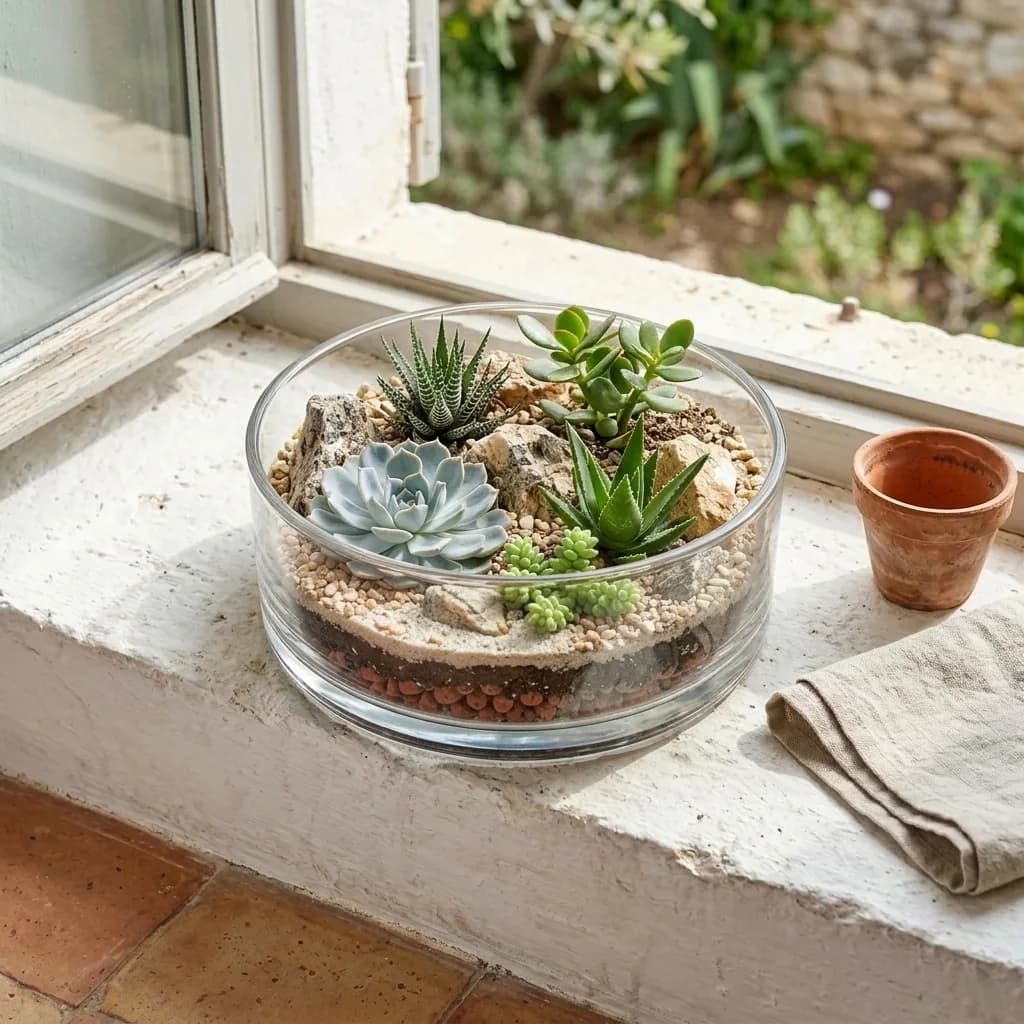
- succulents and cacti, which can't cope with permanent humidity;
- flowering plants, which the RHS advises against in closed terrariums;
- fast-growing plants, which soon reach the glass. Spikemoss, for instance, is very decorative but spreads fast: plan to trim it regularly.
To put together an easy first set-up, see our guide tropical terrarium for beginners.
Can you go on holiday and leave a closed terrarium behind?
Yes, that's actually one of its great advantages. A closed terrarium that's found its balance can go without you for several weeks. A few precautions before you leave:
- Don't water it "just in case". Too much water is far riskier than a slight shortage.
- Check the sun's path. A ray that doesn't reach the terrarium in the morning might reach it in the afternoon. In direct sun, the glass overheats.
- Remove dead leaves and seal it properly.
- Think about light if the shutters stay closed. The RHS recommends at least six hours of bright, indirect light a day. A grow lamp on a timer, kept away from the glass, can take over.
For an absence of several months, ask someone to check the condensation now and then and to mist a little if the glass stays dry.
The signs that call for action
One symptom is insufficient: inspect soil and roots before watering. The dying plants diagnosis distinguishes dryness, saturation and unsuitable light.
The kit
For everyday upkeep, a well-sealing container, long tongs and a mister are all you need.
Find every container in our terrariums section. And if yours isn't built yet, start with our tutorial how to create a closed terrarium.
Sources
Frequently asked questions
Can a closed terrarium live without ever being watered?
Rarely, forever. A very tight-sealing lid limits losses, but most closed terrariums need a little water a few times a year. Water only when the condensation clears for good or the plants start wilting.
Do you need to open a closed terrarium from time to time?
It isn't compulsory. Open it for a day or two if water is streaming constantly down the glass. Some gardeners also remove the lid for about fifteen minutes a week to refresh the air.
How long does a closed terrarium last?
Several years, if well looked after. A specialist at Penn State University reports terrariums that stayed healthy for nearly ten years. Over time, some plants grow too large and need trimming or replacing.
Should you feed a closed terrarium?
Not in the first year: fertiliser makes plants grow faster, meaning more frequent trimming. After that, Penn State University recommends a light spring feed, at a quarter of the recommended dose.