

Terrarium watering: how much and how often?
Match watering to soil and plants: frequency, gradual dosing and differences between closed, open and succulent terrariums.
In this guide
Going further: The choice of water deserves attention too: compare tap, rain and reverse-osmosis water.
A terrarium is watered very little, and not in the same way depending on its type. A closed terrarium recycles its water: once the balance is found, you only water it when the condensation disappears and the plants start to wilt, often months apart. An open tropical terrarium loses water through evaporation and needs misting more often. A succulent terrarium is never misted: you pour a little water at the base of the plants, only when the substrate is dry. In all three cases, the same rule applies: it's easy to add water, and hard to remove it.
How many millilitres should you add?
No volume per litre of container fits every setup: root balls, substrate and closure change needs. Measure small additions with a pipette or graduated container and record them. Check near roots before repeating. Misting leaves does not prove the root ball is hydrated.
Condensation is a clue, not a soil moisture meter. For pruning and cleaning, follow the closed terrarium care routine.
Why does a terrarium drown so easily?
A flowerpot has a hole in the bottom: excess water drains into the saucer. A terrarium doesn't. All the water you pour in stays in the container. The drainage layer at the bottom can absorb a small excess now and then. But if you water too heavily and too often, water sits at the bottom, the roots lack air and diseases set in.
That's why American university horticultural extension services all give the same starting advice: water gently, in small amounts, and wait to see the terrarium's reaction before adding more. A slightly too-dry terrarium can be fixed with a few sprays. A waterlogged terrarium needs days of airing, sometimes a complete dismantling.
How often should you water a closed terrarium?
There's no fixed schedule. Published guidelines vary widely: the University of Illinois Extension talks of watering every four to six months for a well-sealed container; Penn State states that some terrariums need it every four to six months, others every three weeks; the manufacturer of our closed kits states watering once or twice a year. The gap is explained by container size, lid tightness, room warmth and the plants chosen. Rather than following a date, observe.
At set-up
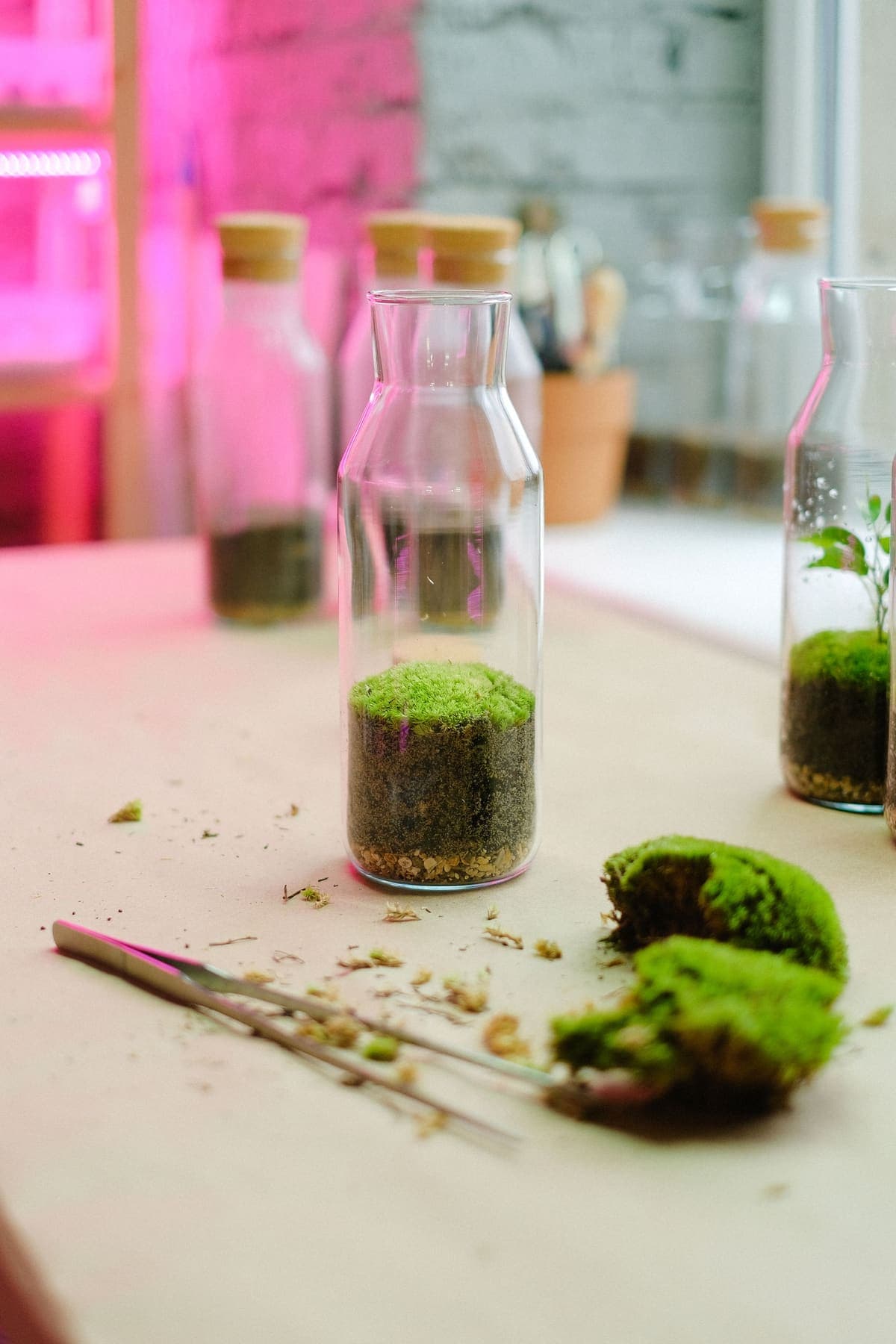
The first watering is the trickiest. Mist the substrate in small passes until it looks evenly damp, darker, but without water pooling at the bottom. It should be moist, never soaked. Also mist the mosses and foliage, then clean the inside of the glass and close it up.
The following days
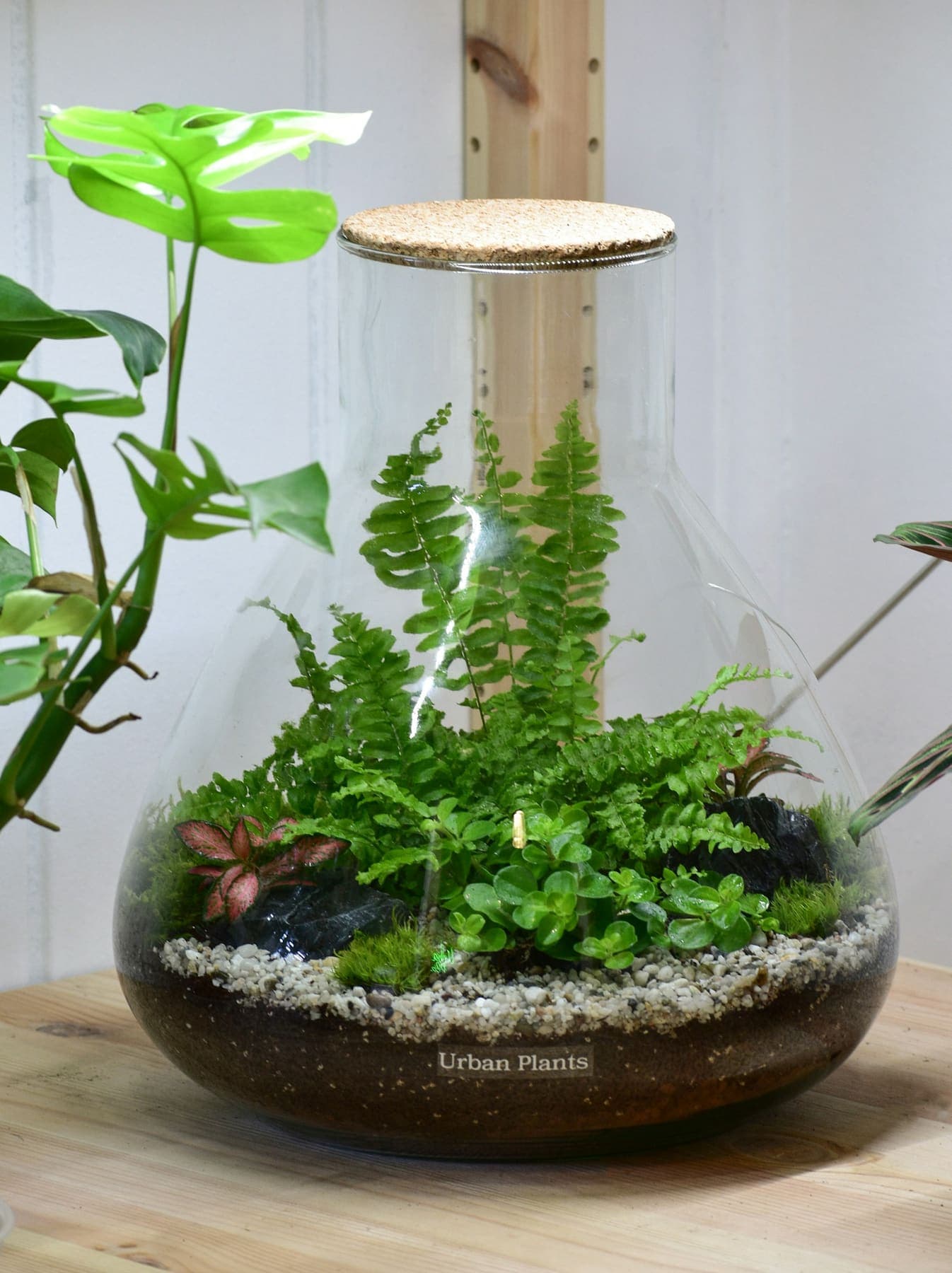
Watch the glass, especially in the morning. The goal, according to Penn State, is condensation that looks like a light mist. If large droplets form and run down, there's too much water: remove the lid, then close it again once the condensation becomes light again. Our guide to mould in a closed terrarium covers reading condensation in detail.
After that: water only on signal
Once the balance is found, a closed terrarium can go a long time without water. Water only when several signs come together: no condensation for several days, plants wilting, substrate that lightens and looks dry on the surface. Then mist lightly, close up, and wait until the next day before judging.
Should you open a closed terrarium from time to time?
Opinions differ. Some specialists cited by Penn State recommend removing the lid for a quarter of an hour a week to refresh the air; the manufacturer of our closed kits recommends opening it for a few hours once a month. In both cases, airing also helps regulate humidity: a terrarium that's dripping benefits from being opened longer, a dry terrarium should stay closed. If you're after a terrarium that asks the least of you, read our guide to a low-maintenance closed terrarium.
How do you water an open tropical terrarium?
In an open bowl or jar planted with fittonias, ferns or mosses, humidity escapes constantly. The pace depends mainly on the air in your home: a heated room in winter dries out an open terrarium far faster than a bathroom.
- Touch the surface of the substrate: if it's dry to the finger, it's time to act.
- Mist the plants and the surface, in several passes, rather than pouring a large amount at once.
- Watch the bottom: if water appears in the drainage layer, space out the waterings.
- Keep it away from radiators, which speed up evaporation and dry out the mosses.
An open tropical terrarium therefore needs more attention than a closed one. If you tend to forget it, a container with a lid will suit you better.
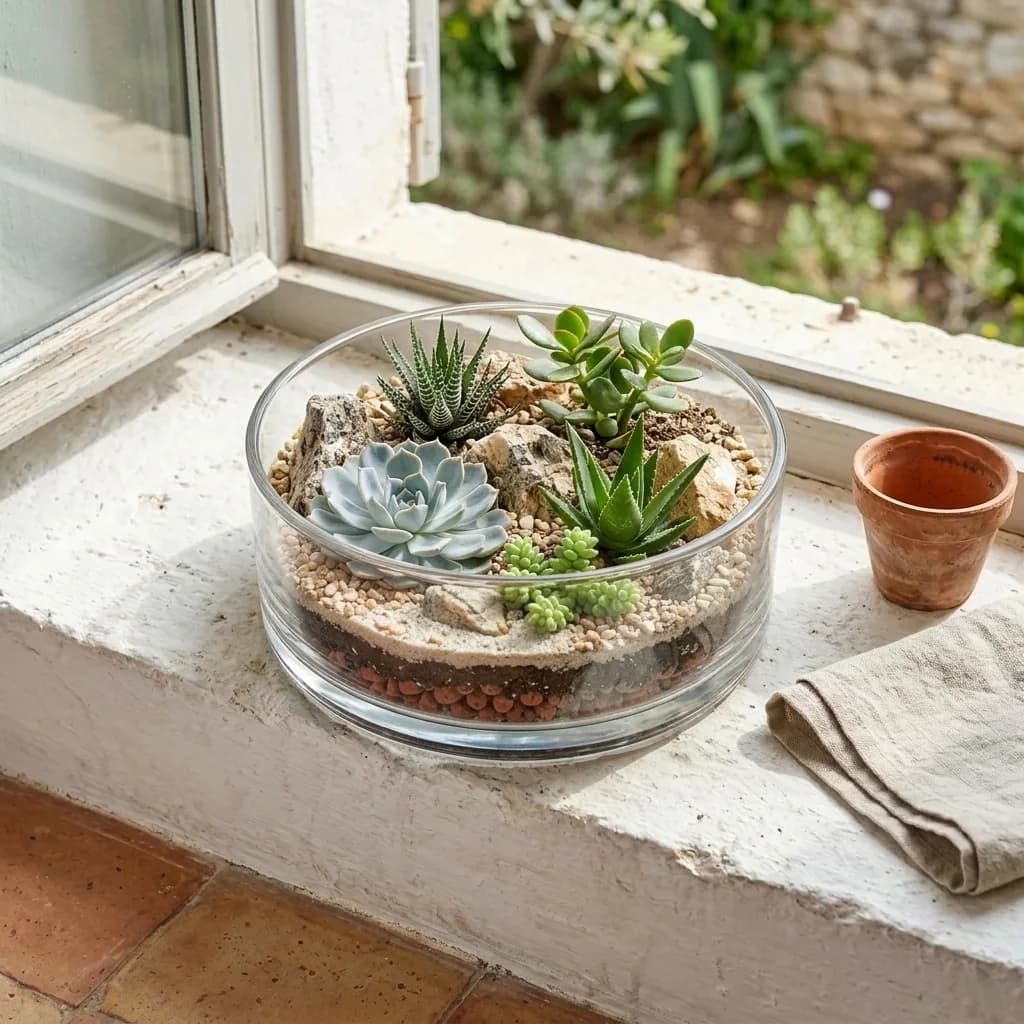
What about a succulent terrarium?
Succulents and cacti store water in their leaves and stems. They tolerate drought well and stagnant humidity very poorly. The Royal Horticultural Society, for indoor potted cacti and succulents, recommends watering when the surface of the substrate is dry to the touch in spring and summer, never leaving the plants standing in water, and giving them a rest from November to early March, with very little or no watering.
In a terrarium without a drainage hole, this advice becomes even stricter:
- Don't mist. Spraying wets the rosettes and the crown, without reaching the roots.
- Pour a little, at the base of each plant, with a small spoon, a pipette or a watering can with a fine spout.
- Check the substrate in depth, not just on the surface, before watering again.
- In winter, cut back sharply, or even stop watering altogether, in a cool room.
Our succulent terrarium tutorial explains how to measure out water with a spoon.
How do you know if you've overwatered?
- droplets constantly running down the glass of a closed terrarium;
- visible water in the drainage layer;
- a film of mould that keeps coming back or spreading;
- a musty smell when opening it;
- soft or blackened stem bases, leaves turning yellow and falling.
Start by removing the lid and letting the water evaporate: Penn State recommends one to two days open when condensation is heavy, Mississippi State University Extension recommends opening for about an hour, repeated until the mist becomes light. If water is visibly pooling at the bottom, remove it with a pipette or a syringe fitted with a flexible tube slid against the wall. Finally, trim off damaged leaves with tweezers.
And if the terrarium lacks water?
The signs are more subtle: glass that stays clear in a closed terrarium, leaves that soften and droop, mosses that dull and become brittle, pale substrate pulling away from the wall. Rehydrate gradually: a few sprays, then a check the next day. Three small waterings spread out are better than one big one all at once.
Misting or pouring: which gesture should you choose?
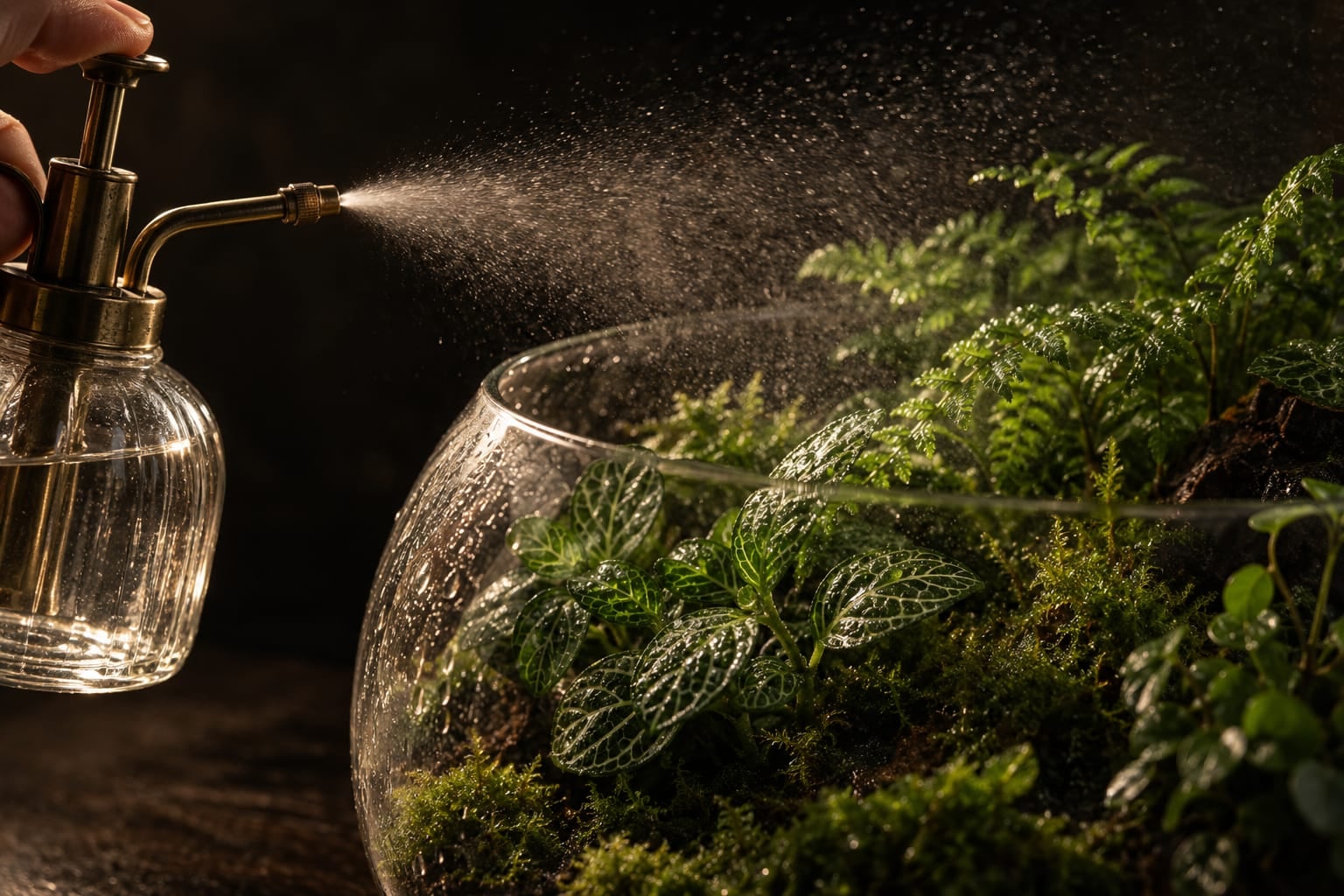
A mister suits tropical terrariums, closed or open. Its fine spray moistens mosses and foliage without digging into the substrate, and lets you dose the water spray by spray. Aiming the jet against the wall also rinses off soil stuck to the glass.
Pouring at the base is reserved for succulents and cacti, or a very dry tropical terrarium whose substrate no longer rehydrates on the surface. Use a long-handled spoon or a pipette to place the water exactly where the roots are.
Which water should you use?
Low-lime water is best: rainwater collected in a clean container, or demineralised water. In a container where water evaporates and condenses endlessly, lime eventually leaves white marks on the glass and the leaves. If you grow carnivorous plants, their needs are specific: see our guide carnivorous plants in a terrarium.
Does watering change with the seasons?
Yes, especially for open terrariums. In winter, heating dries the air and open tropical terrariums dry out faster, while succulents go dormant and need almost no water. In summer, watch the heat: a closed terrarium should never receive direct sunlight, as the glass raises the inside temperature to the point of burning the plants. Bright but indirect light limits both overheating and evaporation.
The substrate choice matters too: a light compost and good drainage forgive watering mistakes better. Our guide which substrate for a terrarium explains how to put it together.
Equipment
A fine-spray mister is enough for most tropical terrariums. Ours is in green-tinted glass, with a brass pump, and holds 250 mL.
For succulents, a small spoon or a pipette you already own will do the job.
Find misters and maintenance tools in the tools and maintenance section.
- Terrarium tool kit, 4 stainless steel pieces, 49 cm rake49 cm rake · 25 cm tweezers and scissors€26.90
- Terrarium mister, clear glass, 16 cmH 16 cm€15.90
- Terrarium mister, green glass, 16 cmH 16 cm€11.90
- Plant mister for terrariums, matte black stainless steel, 15.5 cmH 15.5 cm€30.90


Sources
- How to Design a Closed-System Terrarium — Mississippi State University Extension
- Creating a Closed Terrarium — Penn State Extension
- DIY bottle terrariums make great projects, gifts — University of Illinois Extension
- How to grow cacti and succulents — Royal Horticultural Society
- Noah, terrarium bottle garden DIY kit — urbanjngl
Frequently asked questions
Can a closed terrarium survive without ever being watered?
For a long time, yes, if it's well balanced: Mississippi State University talks of weeks to years without watering. But a loosely fitting lid or a warm room gradually lets the water escape: watch the condensation and the state of the plants.
Can you water a terrarium with tap water?
It's possible if your water is low in lime. Otherwise, prefer rainwater or demineralised water: lime leaves white marks on the glass over repeated evaporations.
Should you mist a succulent terrarium?
No. Misting wets the rosettes without reaching the roots and maintains a level of humidity succulents tolerate poorly. Pour a little water at the base, only when the substrate is dry.
How many sprays does it take to water a terrarium?
There's no set number: it depends on the size of the container and its condition. Spray in small bursts, check the colour of the substrate, and wait until the next day before adding more.