

Which water should you use in a terrarium?
Tap, rain, reverse-osmosis or softened water: compare the options for watering your terrarium and limiting deposits without upsetting its balance.
In this guide
The right choice depends on your plants and on the water you have at home. It does not depend on the price of the bottle. This guide is about water quality; to decide when and how much to add, read watering a terrarium.
Why minerals matter in a jar
When water evaporates, the dissolved salts do not evaporate with it. In a pot with a drainage hole, watering can carry some of those salts out. In a closed jar with no outlet, everything you add stays in the system. That is reason enough to limit needless additions, particularly with heavily mineralised water.
A white ring on the glass shows a deposit, but on its own it tells you nothing about the state of the roots. Clear water can also carry plenty of minerals. If you need to know, look up your water supplier's figures: hardness and composition tell you far more than how the tap looks.
Compare the options open to you
| Water | When to consider it | What to check |
|---|---|---|
| Unsoftened tap water | Tolerant plants, lightly mineralised supply | Local hardness and the deposits you see |
| Collected rainwater | Clean collection and proper storage | Cleanliness of the surface and the container |
| Reverse osmosis | Very hard local water, sensitive plants | No additives, and clean storage |
| Distilled without additives | Small occasional top-ups | The composition stated on the label |
| Bottled mineral water | Only if lightly mineralised | Dry residue, not the brand image |
| Sodium-softened | Best avoided for this use | Do not confuse it with reverse-osmosis water |
Tap water: standing does not remove the lime
Standing can let some free chlorine go, depending on how your water is treated. It does not turn hard water into soft water, and it is not a reliable way to deal with every disinfectant. So do not present a jug left overnight as the equivalent of reverse-osmosis water.
Rainwater: natural does not mean clean
Use a clean container, closed while it is stored, and avoid collecting from dirty or recently treated surfaces. Water that is cloudy, smelly or full of debris is worth replacing. For a few millilitres, a doubtful supply offers no advantage at all.
Demineralised water: read the composition
Products sold for household appliances may contain fragrance or other additives. The word "demineralised" is not enough to make them useful for plants. Choose water explicitly stated to be additive-free; if in doubt, another known source is better.
Applying water without hiding the problem
- Check that the substrate really needs water. The mist disappearing does not prove it.
- Let the water come back to room temperature.
- Add a small amount to the growing medium rather than drenching all the foliage.
- Watch how it spreads before adding more.
- Note the amount if you are trying to understand how a new set-up behaves.
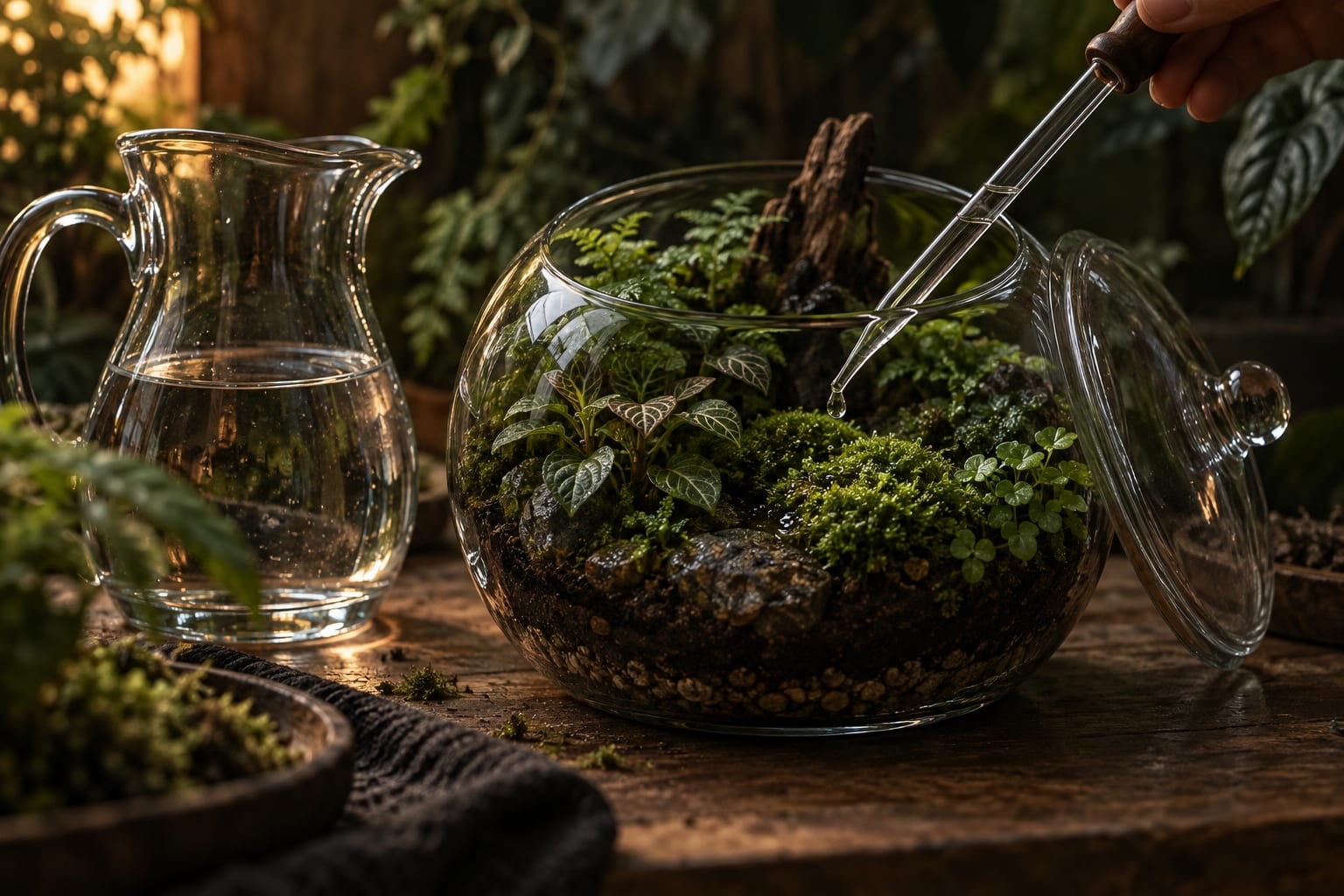
A mister helps you dampen a moss lightly, but it does not measure the volume you pour. A small pipette or a graduated container may be more useful for dosing. Do not flush a closed terrarium the way you would a drained pot: you would create a pool of standing water.
If the glass is already covered in white marks
Change the quality of the water, or the way you add it, first if the marks keep coming back. Clean only the walls you can reach, without letting any product run down into the substrate. The guide to dirty terrarium glass separates mineral deposits from a green film.
A crust in the substrate alongside plants in decline calls for a broader look: fertiliser, drainage and roots. The guide to redoing a terrarium helps you decide whether replacing part of it is enough. Switching to lightly mineralised water limits what you add from now on, but it does not undo what is already there.
Match the plants rather than a universal recipe
Carnivorous plants have particular requirements: read their dedicated guide before applying the habits of a tropical terrarium. For an ordinary composition, choose compatible plants and then keep a steady routine. Avoid changing water, light and substrate at the same time: you would no longer know which one had an effect.
Sources and scope of this advice
- University of Maryland Extension — Watering indoor plants: softened water and salt build-up.
- Iowa State University Extension — How to care for houseplants: water and the care of indoor plants.
These practices are adapted here to a container with no drainage hole; they do not replace the requirements of a particular species. Generated illustration, for editorial purposes.
Frequently asked questions
Can you use bottled mineral water?
Yes, if its mineral content suits the plants, but heavily mineralised water increases the salts you add. Compare the analysis on the label; price tells you nothing useful.
Should you add fertiliser to reverse-osmosis water?
Not automatically. Plants also take nutrients from the substrate. In a closed terrarium, avoid feeding out of habit.
Is water left to stand less hard?
No. Leaving a jug to stand does not remove the minerals that make water hard.