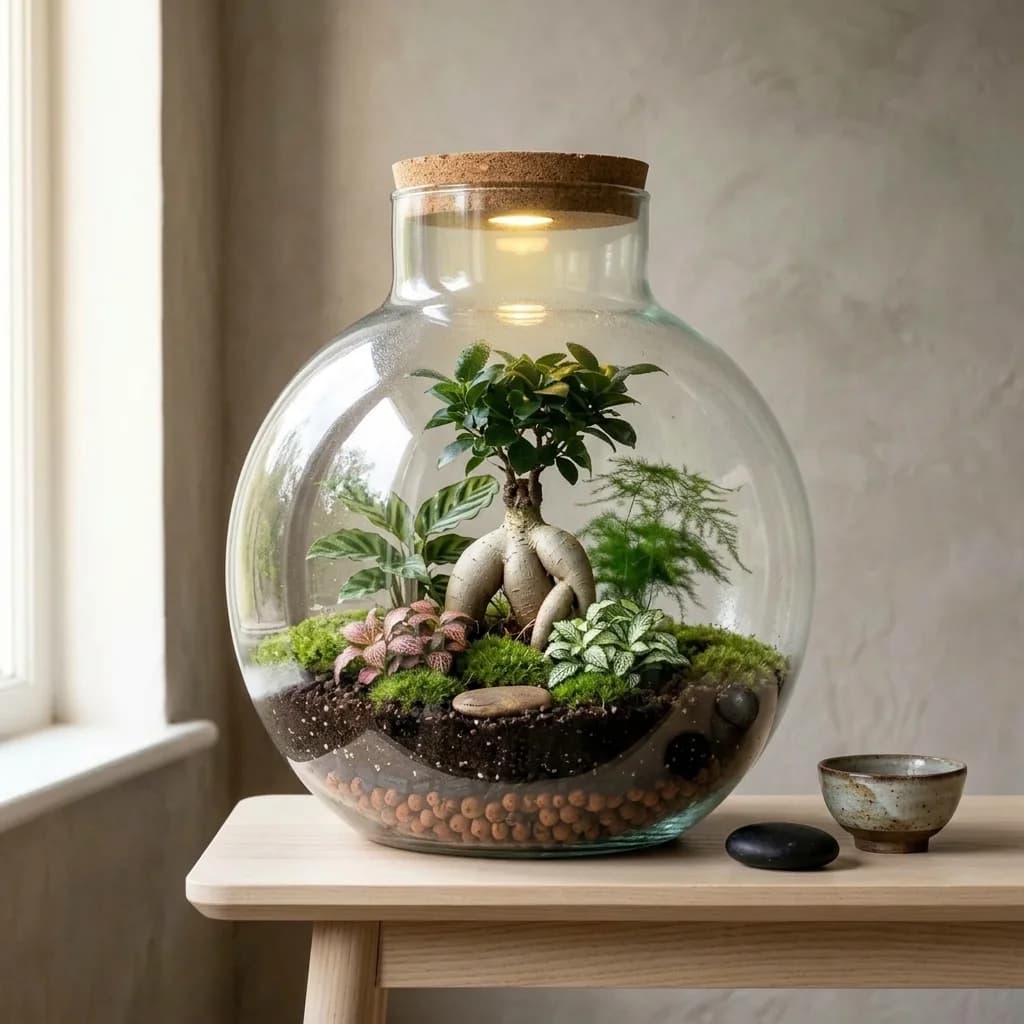


Carnivorous plants in a terrarium: which to choose, and in what container?
The Venus flytrap doesn't like closed jars, but some sundews thrive in them. Species by species: which container, which water, which light and which winter rest.
In this guide
Most carnivorous plants sold in garden centres aren't suited to a closed jar. The Venus flytrap and the pitcher plant need plenty of light and, often, a cool winter rest: a terrarium gives them nothing. The species that genuinely benefit from a humid environment are mainly certain subtropical and tropical sundews. For all of them, three rules never change: very pure water, a poor substrate with no fertiliser, and plenty of light.
Why the Venus flytrap doesn't belong in a closed jar
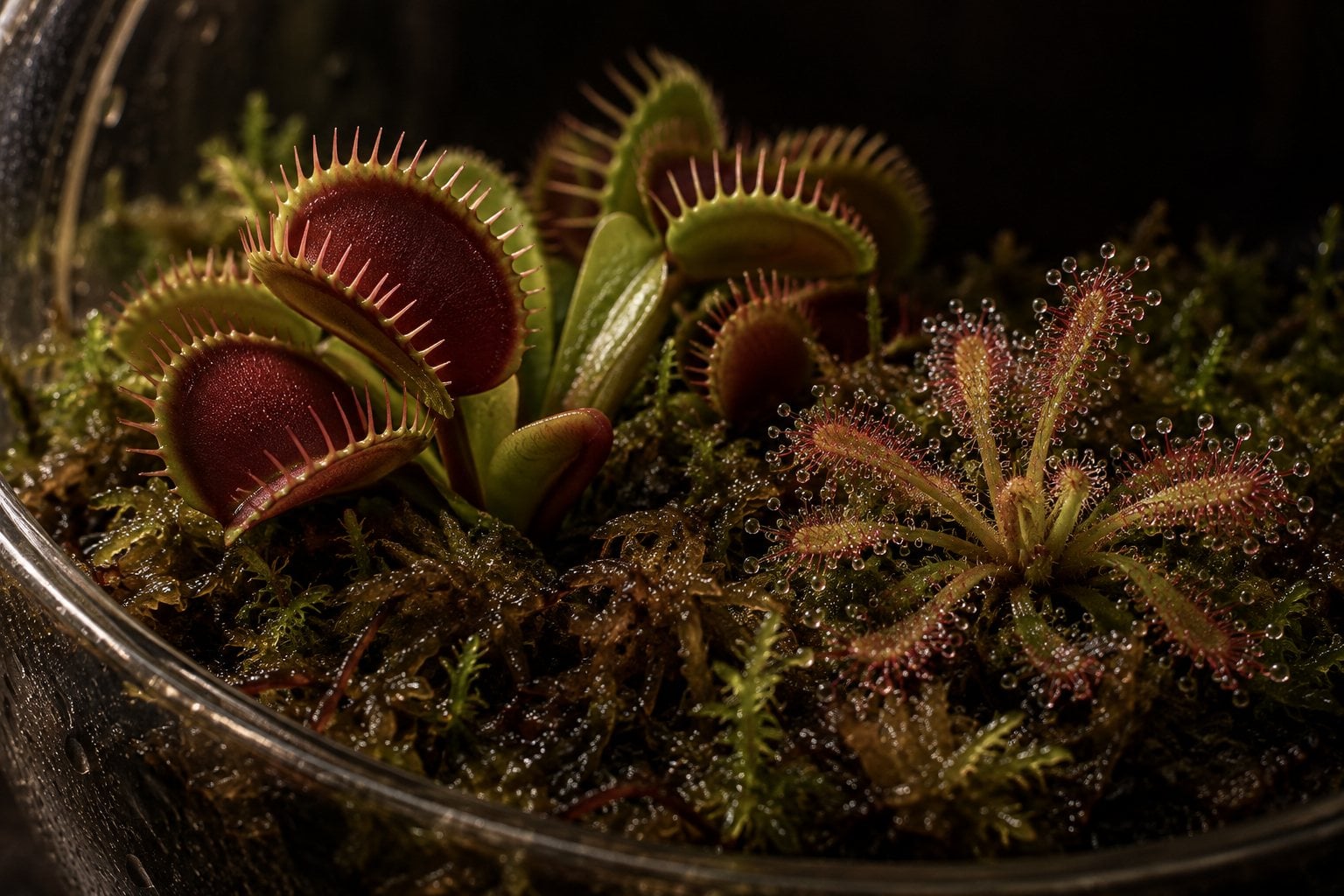
The Venus flytrap (Dionaea muscipula) is the best-known carnivorous plant, and the one most often put in a jar. Yet that's a bad idea.
The International Carnivorous Plant Society (ICPS) is very clear: the Venus flytrap doesn't need a terrarium. It grows well indoors, provided it gets a huge amount of light. The ICPS recommends, under artificial lighting, 15,000 to 25,000 lux of white LED light for around 14 hours a day. That's far more than a bright room provides.
A closed jar then creates two problems:
- Away from the window, the plant lacks light and weakens.
- In the sun, the glass concentrates heat and the trapped air overheats.
The Venus flytrap therefore does better in the open: on a very sunny windowsill, under a powerful lamp, or outdoors during the warm season. Its pot, which should have drainage holes, sits in a saucer of pure water.
And the pitcher plant?
Same answer, even more so. The pitcher plant loves full sun and must never dry out. The ICPS recommends leaving a few centimetres of water permanently under the pot, and only recommends two species for year-round indoor growing under a lamp: Sarracenia psittacina and Sarracenia rosea. The large trumpet pitcher plants remain balcony or garden plants.
Which carnivorous plants tolerate a terrarium?
Subtropical sundews
Sundews trap insects using sticky droplets at the tip of hairs. Among them, the so-called subtropical species, such as Drosera aliciae or Drosera natalensis, are the best candidates. According to the ICPS, these are generally the sundews best suited to a terrarium or greenhouse:
- they don't need a winter rest;
- they tolerate a wide temperature range, roughly 10 to 35 °C;
- they prefer higher humidity than a house normally offers;
- they need more light than a windowsill provides: a lamp above the terrarium is almost essential.
Drosera adelae, the woodland sundew
Drosera adelae is, according to the ICPS, one of the easiest sundews to grow. It needs a very humid atmosphere, which makes it a good candidate for a terrarium. It doesn't need the intense heat of its native region.
Watch out for its relatives: Drosera schizandra, for example, copes poorly with heat and intense lamp light. Look into each species before setting it up.
Nepenthes, young and well-chosen
Nepenthes, or pitcher plants, are tropical plants. The ICPS notes that lowland nepenthes and hybrids are relatively easy to grow, and that young plants can be placed in a terrarium or greenhouse. Many, however, eventually grow too large for a small container: plan for a tall terrarium, or moving it into a pot when the time comes.
And Mexican butterworts?
Mexican butterworts (Pinguicula) make excellent houseplants, on a bright window or under a lamp. They don't need a terrarium. In many species, the leaves change with the seasons: in winter, the plant forms a small rosette of fleshy, non-carnivorous leaves, and must then be kept cooler and drier. The ICPS notes that constant year-round lighting keeps these species stuck in their winter phase: they need to sense the seasons.
Which container to choose?
- *For subtropical sundews and Drosera adelae***: a glass terrarium with a lid left on or slightly ajar, under a grow lamp kept at a distance. The air stays humid without being completely sealed off.
- For a young nepenthes: a tall, bright, well-ventilated container.
- For the Venus flytrap, pitcher plant and butterworts: no terrarium. A pot with drainage holes, a saucer of pure water, a very bright window or a lamp, and the garden in summer for the pitcher plant.
An airtight jar is the riskiest container: little light, still air, and a higher risk of mould. If you're set on a closed terrarium, first read our comparison closed or open terrarium, and keep in mind our tips against mould in a closed terrarium.
The simplest approach in a terrarium is to leave the plant in its pot with drainage holes, standing in a saucer of water inside the container. This way you keep control of the water, and you can easily take it out.
Water, substrate, light: the three rules
Very pure water
This is the most important rule. Carnivorous plants grow in very poor environments, and the mineral salts in tap water build up in their substrate. The Royal Horticultural Society (RHS), the major British horticultural society, sums it up: tap water kills Venus flytraps.
Use clean rainwater, distilled water or RO water. The ICPS notes that tap water is only acceptable if its dissolved-salt content (TDS, measured in ppm) stays under 90 ppm, and that filtering water doesn't remove these salts.
The safest method is bottom watering: the pot sits in a saucer of water. For the Venus flytrap, the RHS recommends about 1 cm of water in spring and summer, and half a centimetre in winter.
A poor substrate, with no fertiliser
No multipurpose compost, and never any fertiliser: the ICPS is categorical, fertiliser can kill these plants. The classic mixes are sphagnum moss alone, or a mix of peat and sand. The RHS suggests a peat-free alternative: sustainably sourced sphagnum moss, but not other mosses. Mexican butterworts are the exception, with a more mineral, slightly limey mix.
Plenty of light
Almost all carnivorous plants live in full light. In a terrarium, a grow lamp is often essential. Keep it at a distance from the glass: a closed terrarium heats up quickly under a lamp that's too close.
Should you feed a carnivorous plant in a terrarium?
Not often. A plant that gets enough light lives mainly on photosynthesis. Opinions differ on dead prey: the RHS advises against giving dead insects, since the plant reacts to movement; the ICPS notes that you can give them if you gently massage the trap to trigger digestion. In any case: never meat, and don't close the traps just to play with them. Every closure costs the plant energy, the RHS points out.
Winter rest: who needs it?
- The pitcher plant: yes, if grown outdoors. The ICPS describes winter dormancy for sarracenias grown outside, but recommends Sarracenia psittacina and Sarracenia rosea for year-round indoor growing under a lamp — meaning no cold rest in that case.
- The Venus flytrap: it's its natural rhythm. The RHS advises putting it outside during the cold months: its leaves die back, then it starts growing again around March. The ICPS adds a nuance: indoors, under strong artificial light, it can grow without a rest, which is really only necessary if it spends winter outside in frost. On a windowsill, where light drops in winter, let it slow down in a cool spot.
- Mexican butterworts: a dry pause. More coolness and less water during their winter rosette phase.
- Subtropical sundews: no. They grow all year round.
Never collect a carnivorous plant from the wild
France has wild carnivorous plants, in fragile habitats such as peat bogs. The round-leaved sundew (Drosera rotundifolia) is a protected species in France, as the Parcs nationaux [French national parks] point out. Past collection has weakened its populations. Always buy plants grown in cultivation, and leave wild plants where they are.
Take it further
Glass containers can be found in the glass containers section. For sundews that love humidity, our guide on choosing a container will help you find the right format, between jar, cloche and open terrarium.
Sources
- Growing Dionaea muscipula — International Carnivorous Plant Society
- Growing subtropical Drosera — International Carnivorous Plant Society
- Growing Sarracenia — International Carnivorous Plant Society
- Drosera adelae, prolifera and schizandra — International Carnivorous Plant Society
- Growing Mexican Pinguicula — International Carnivorous Plant Society
- Growing Nepenthes — International Carnivorous Plant Society
- How to care for a Venus flytrap — Royal Horticultural Society
- Le drosera à feuilles rondes — Parcs nationaux de France
Frequently asked questions
Can a Venus flytrap go in a closed terrarium?
It's not advisable. The Venus flytrap doesn't need a terrarium, but it does need enormous amounts of light. In a closed jar, it lacks light away from the window, or overheats in the sun.
Which carnivorous plant suits a terrarium?
Subtropical sundews, such as Drosera aliciae, and Drosera adelae are the best choices: they like humidity and have no winter rest. Plan for a grow lamp and a lid left slightly ajar.
Can you water a carnivorous plant with tap water?
Generally not: its mineral salts build up and damage the plant. Use clean rainwater, distilled water or RO water. Filtering tap water doesn't remove these salts.
Why is my Venus flytrap turning black in winter?
If it's kept cool, this is often its winter rest: the leaves die back, then the plant starts growing again in spring. Traps that stay black all year round point instead to a lack of light, water that's too hard, or traps closed too often.