

Pruning a terrarium: when, how and how far
A plant against the glass, a fittonia running away, moss being buried: when to step in, what with, and the cuts that cannot be undone.
In this guide
Further reading: Healthy prunings can be used to propagate your terrarium plants.
You prune a terrarium when a plant touches the glass, when it grows over another, or when a leaf is dead. That is all. Two or three sessions a year are enough for a balanced composition, more in the first year and for vigorous species. The cut itself is simple; what matters is taking the clippings out of the terrarium.
The three signals
A plant touches the glass. This is the most urgent. A leaf pressed against a damp wall stays wet permanently, browns, then rots, and becomes a seat of mould — see Mould in a closed terrarium.
A plant grows over another. The vigorous ones — ficus pumila, soleirolia, fittonia — smother slow growers within months. Underneath them, peperomia or moss fades away for no obvious reason.
A leaf is dead. Yellow, brown, shrivelled: it comes out. In a closed environment nothing carries dead matter away, and it feeds fungi.
What to use
For a wide-mouthed jar: fine dressmaking scissors and your fingers are enough.
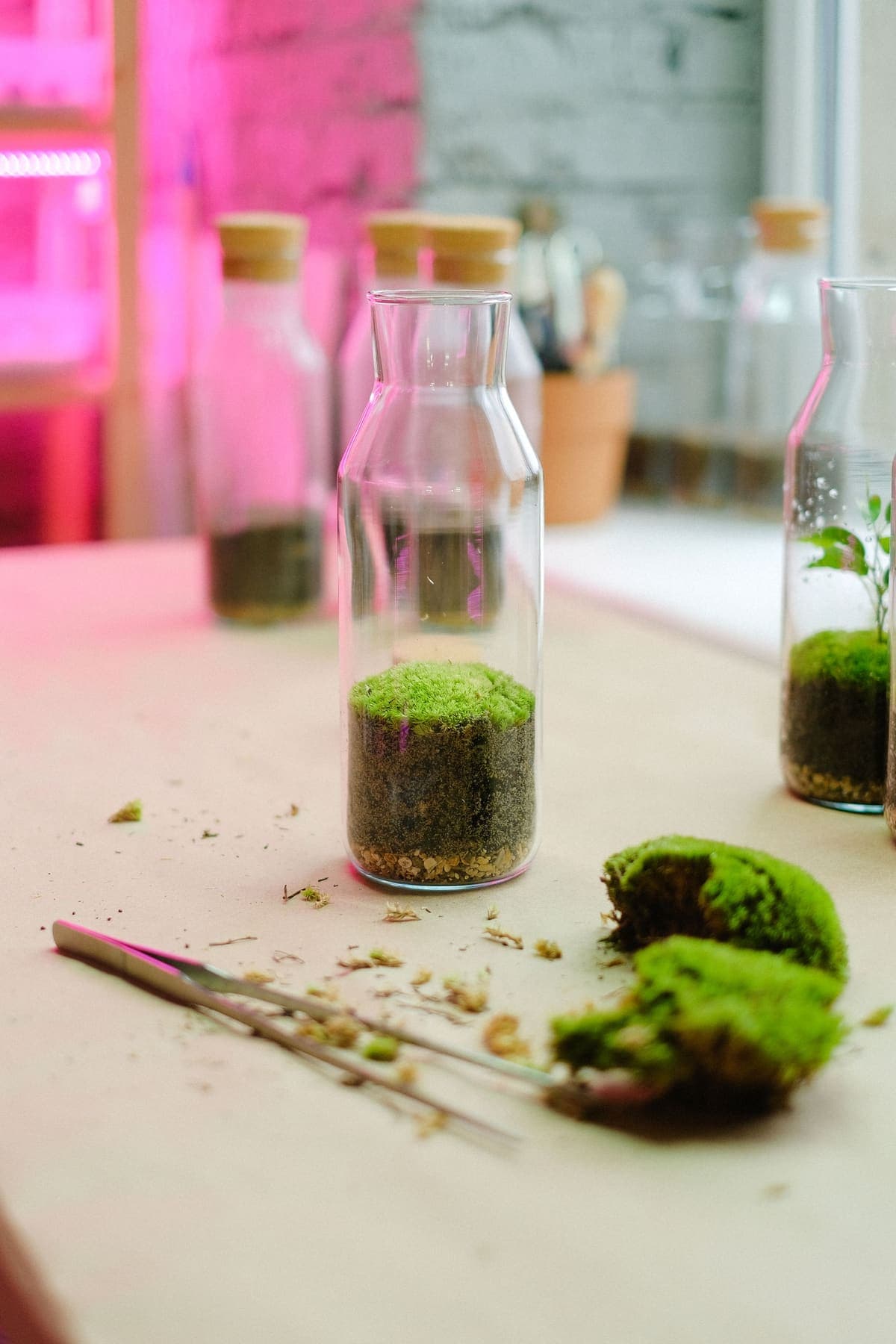
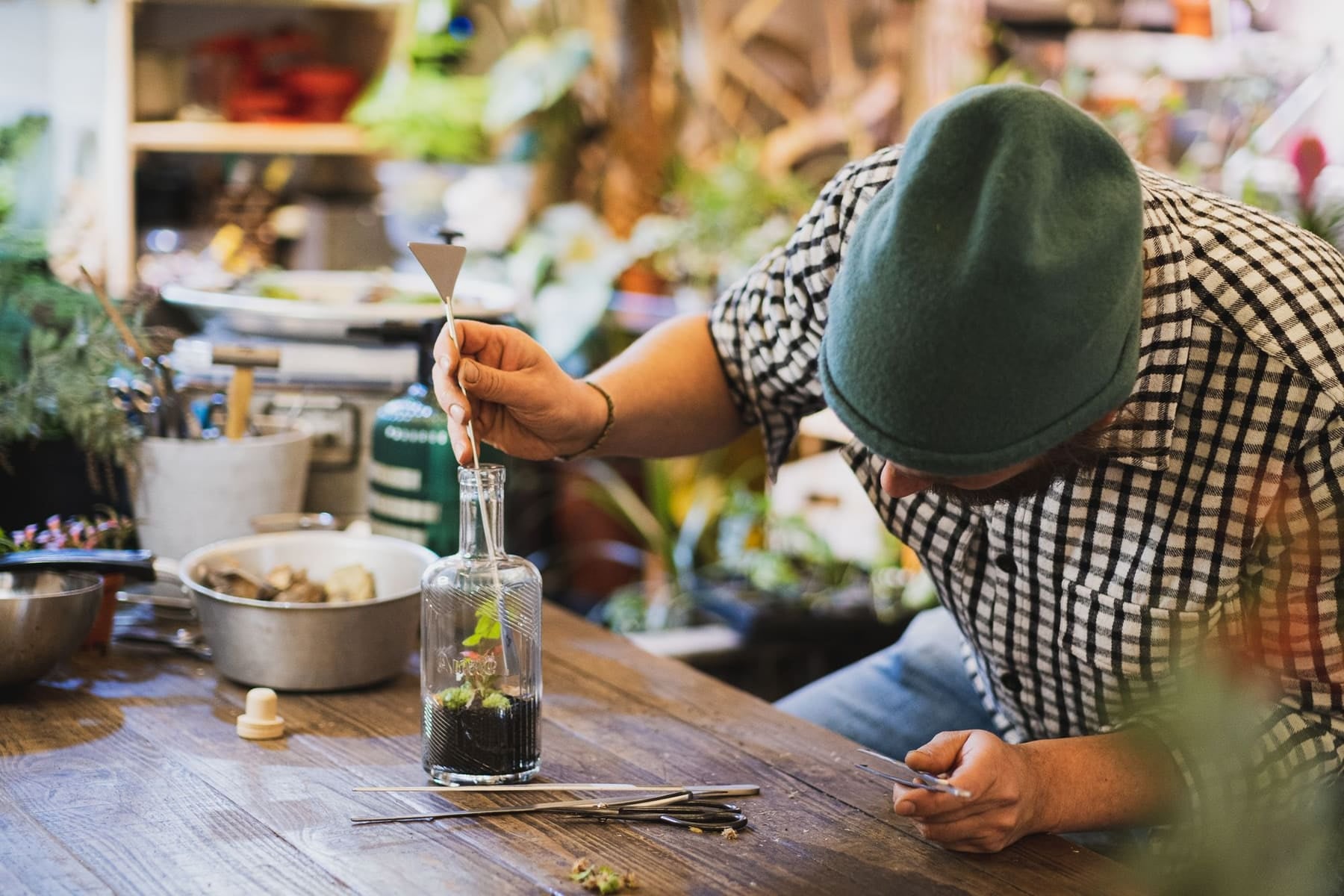
For a narrow neck — carboy, bottle — you need reach: long-handled scissors and long tweezers to catch the clippings and lift them out. Those are the two tools that genuinely matter; the rest is comfort.
One thing before you start: wipe the blades. Scissors that have just cut through a mouldy patch carry spores.
The cuts, plant by plant
Pinching the tips
This is the most useful kind of pruning, and the least understood. Cutting the end of a stem, just above a pair of leaves, forces the plant to branch: two new shoots start from the buds in the leaf axils.
The result is a plant that thickens instead of running away. On a fittonia or a hypoestes, it is the difference between a dense cushion and a bare stem with three leaves on top.
Cutting back hard
For a plant that has gone bare at the base, or a cushion of soleirolia browning in the middle: cut short, without hesitation. These species regrow from the base in two to three weeks.
Not to be done on a fern: see below.
Cutting at the base
With ferns, you never shorten a frond halfway along — the cut section browns and does not regrow. Cut the whole frond as close to the crown as you can. The plant produces new ones from its centre. See Terrarium ferns.
Easing it off the glass
Ficus pumila grips the wall with tiny rootlets. Ease it away gently, then cut the stem back a few centimetres so it does not return straight away.
Moss
Moss is trimmed with scissors like fabric, flat. You cut it to give it a shape again, or to take out a brown, soft patch — see Moss turning brown.
The cuts that cannot be undone
Cutting a fern frond halfway along. The cut section browns, permanently.
Cutting a stem flush with the substrate on a rosette plant such as peperomia: with no growing point left, it does not come back.
Pruning a plant that is already struggling. If the leaves are soft and the substrate sodden, the problem is water, not growth. Deal with that first — see Terrarium too wet — and prune once the plant has steadied.
Pruning everything at once. A composition cut back wholesale takes months to recover its volume. Work in stages, a few weeks apart.
After pruning
Take every clipping out. This is the step people forget, and the most important one. Go round with tweezers, including under the moss and in the corners.
Clean the glass while your hands are in there: a soft brush or a clean cloth, no product.
Do not water. The plant has just lost foliage, so it transpires less: it needs less water, not more.
Close it up again. The terrarium finds its balance again within days.
The bonus: cuttings
Clippings are not waste. A few centimetres of fittonia, ficus pumila, peperomia or hypoestes stem, laid on damp substrate, roots in two to three weeks in the humidity of a closed terrarium.
It is the simplest way to fill out a composition, or to start a second terrarium without buying anything. The build is covered in How to create a closed terrarium.
Sources
Frequently asked questions
How often should a terrarium be pruned?
Two or three times a year for a balanced terrarium, more in the first year while the plants settle in. Vigorous species such as ficus pumila or soleirolia need pinching every couple of months.
Can terrarium plants be pruned at any time of year?
Yes. Under glass there is no marked winter rest: temperature and humidity stay steady. Prune when the plant needs it.
Do the clippings need to be removed?
Always. In a closed environment, a leaf or stem left on the substrate breaks down and feeds mould. Lift everything out with tweezers.
Can a plant that has grown too large be replaced?
Yes, and sometimes that is the right call. Lift it out with tweezers, fill the hole with substrate and plant a young one. It is quicker than cutting back an exhausted plant.