

Terrarium ferns: which species and how to grow them well
Asplenium, nephrolepis, pteris, adiantum: the miniature ferns that hold their place under glass, the ones that outgrow it, and the habits that make the difference.
In this guide
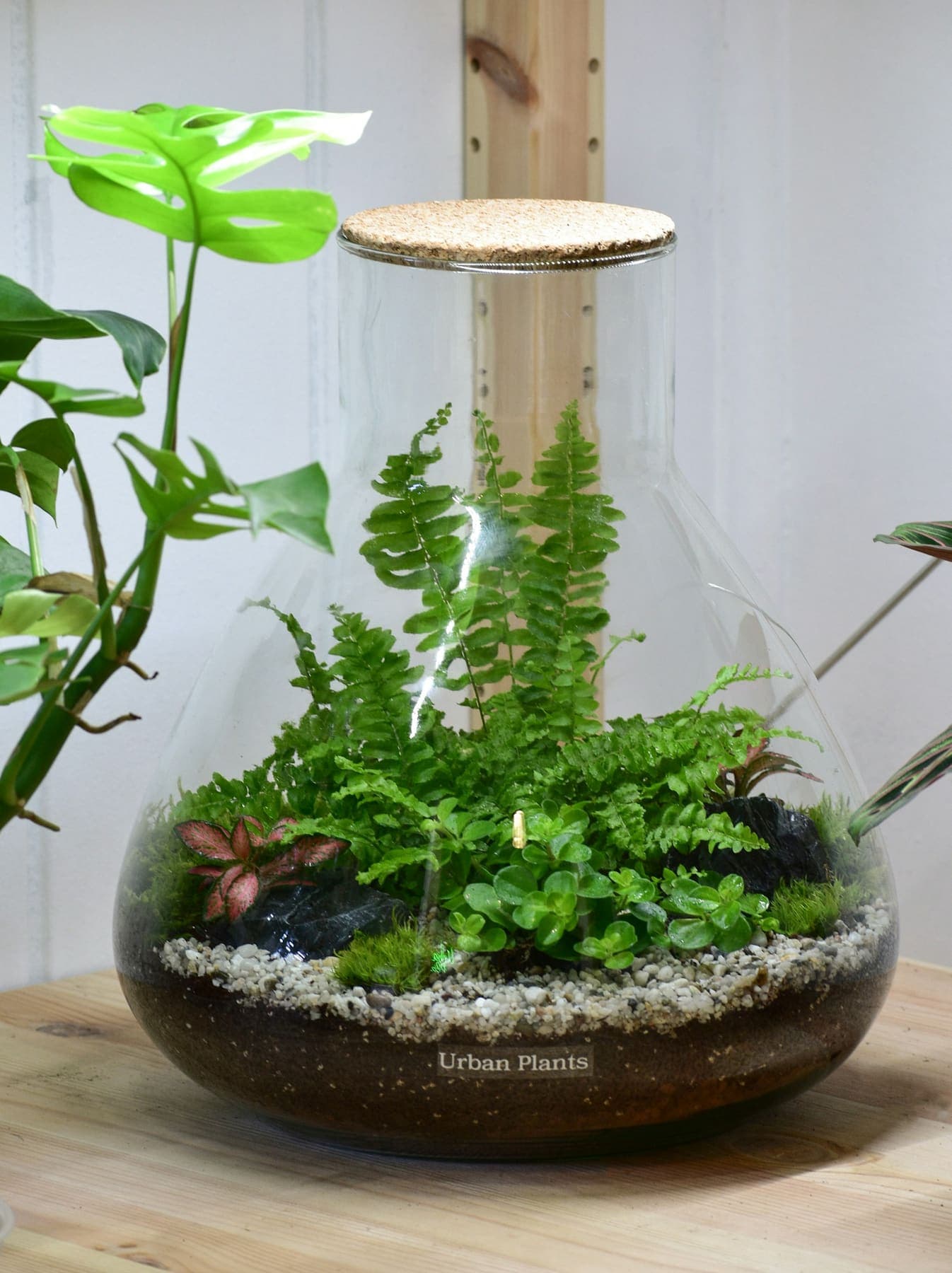
A fern gives a terrarium what no other plant does: the vertical and a sense of movement. It is what turns a carpet of moss into a piece of woodland. The only real choice to make is the species: the usual houseplant ferns reach 40 cm and more, which is unmanageable in a jar. You need dwarf forms, and they do exist.
The species that hold their place under glass
Asplenium (spleenwort), dwarf forms. Whole, glossy fronds in a rosette. Compact habit and faultless presence. It is the safest fern for a first terrarium, and the one we carry in the catalogue.
Pteris, compact forms. Divided fronds, often variegated in cream white. Brings lightness and a contrast of colour. Moderate growth.
Miniature nephrolepis. A scaled-down Boston fern, with finely divided arching fronds. Superb for height, but do check that it really is a dwarf form: the standard variety is far too large.
Adiantum (maidenhair). The finest and most elegant of all, on thread-like black stems. Beautiful, but the most demanding: the slightest drop in humidity turns it brown. Keep it for a closed terrarium that seals perfectly.
To avoid: any fern sold on the houseplant shelf of a garden centre without the word dwarf or miniature. It will be too big within six months.
General profile
| Size under glass | 10 to 20 cm depending on species |
| Growth | Slow to moderate |
| Closed terrarium | Yes, this is their element |
| Open terrarium | No, not in a heated room |
| Light | Partial shade to bright indirect light |
| Humidity | High, 60 to 80% |
| Temperature | 18 to 25 °C |
| Difficulty | Easy for asplenium, demanding for adiantum |
Why they do well in a terrarium
Woodland ferns live under the tree canopy, in shade and permanent damp. They have no thick cuticle: their water evaporates freely through the fronds, which makes them dependent on the surrounding air.
That is precisely why they fail in a flat and thrive under glass. The closed terrarium gives them back exactly the conditions they came from.
Light
Partial shade to bright indirect light. Ferns are among the terrarium plants that best accept a weak position — good news for a terrarium set well away from a window.
Never direct sun: the fronds scorch in a single afternoon and do not recover. See Terrarium too warm.
Substrate and planting
An airy substrate that holds moisture: coir, fine bark, a little sphagnum. Fern roots are shallow and spreading.
Rinse the root ball in lukewarm water to wash off the nursery compost. Do not bury the centre — the crown the fronds grow from must stay level with the substrate, or it rots.
Plant it at the back or on a high point of the landscape: this is the structural plant, the one that gives the silhouette. The full build is in How to create a closed terrarium.
Care
Cut old fronds off at the base, as soon as they yellow. It is the only genuinely necessary task, and it counts double in an enclosed environment: a dead frond left in place feeds mould.
Watch the size. If the fronds start touching the glass, cut the longest ones off at the base rather than shortening them — a frond cut halfway browns along the cut.
Do not mist the foliage as a matter of course: in a closed terrarium the air is already saturated, and water standing on the fronds encourages spotting.
Common problems
Brown, dry fronds, starting at the tips. Air too dry — see Terrarium too dry.
Limp fronds, blackened centre. Too much water, or a crown buried at planting. See Terrarium too humid.
Slow, general yellowing. Not enough light, or see yellow leaves for the full diagnosis.
Scattered brown dots. Not to be confused with sori, the orange-brown clusters of spores lined up under the fronds: those are normal and mark a plant in good health.
What to pair them with
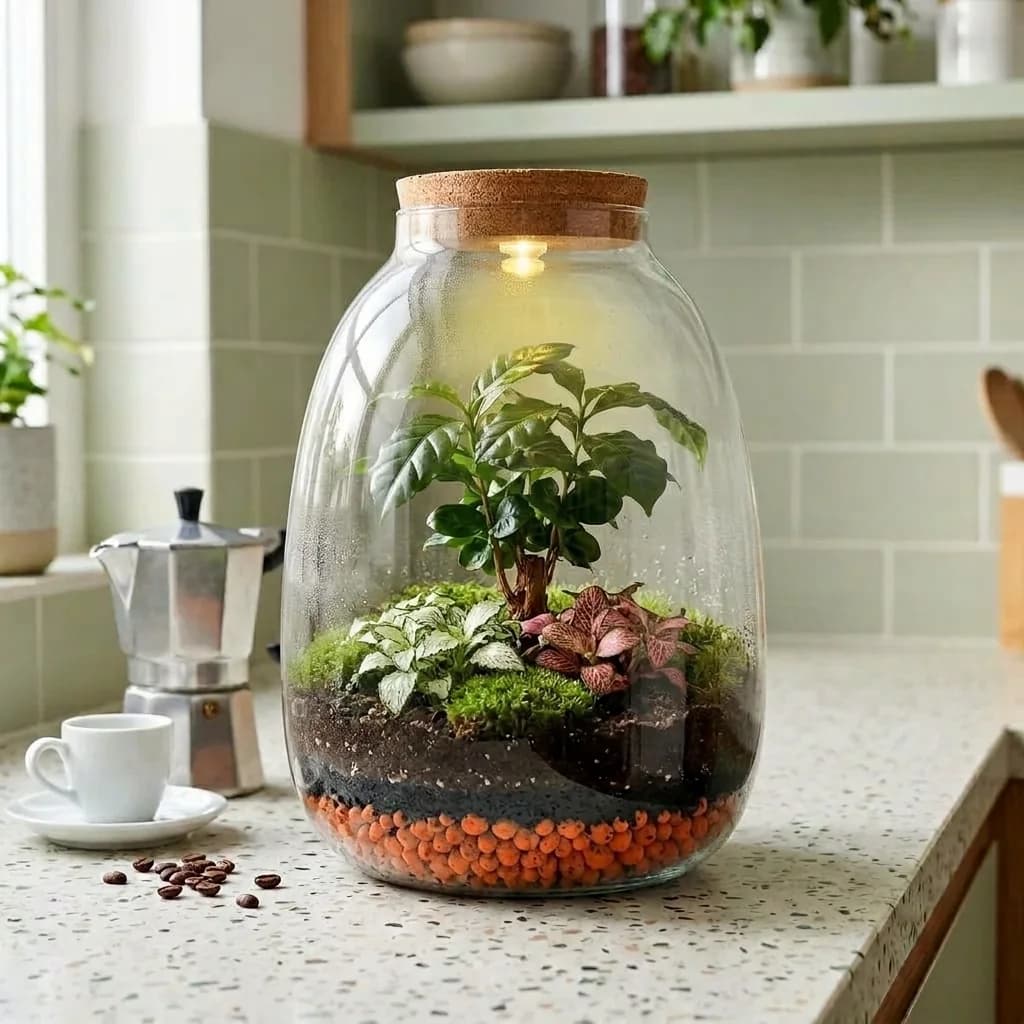
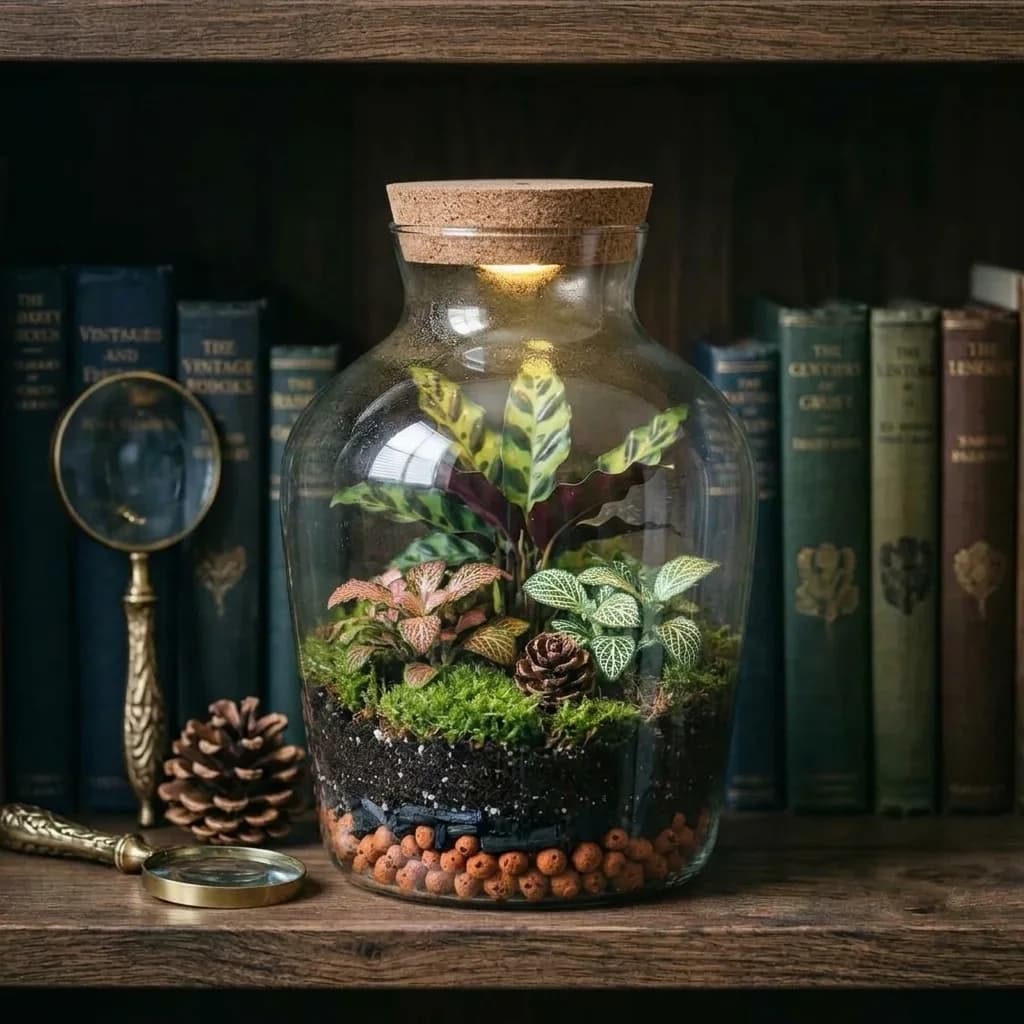
They occupy the upper storey. Fill in with fittonia and peperomia in the middle, selaginella or soleirolia on the ground, and moss to tie it all together.
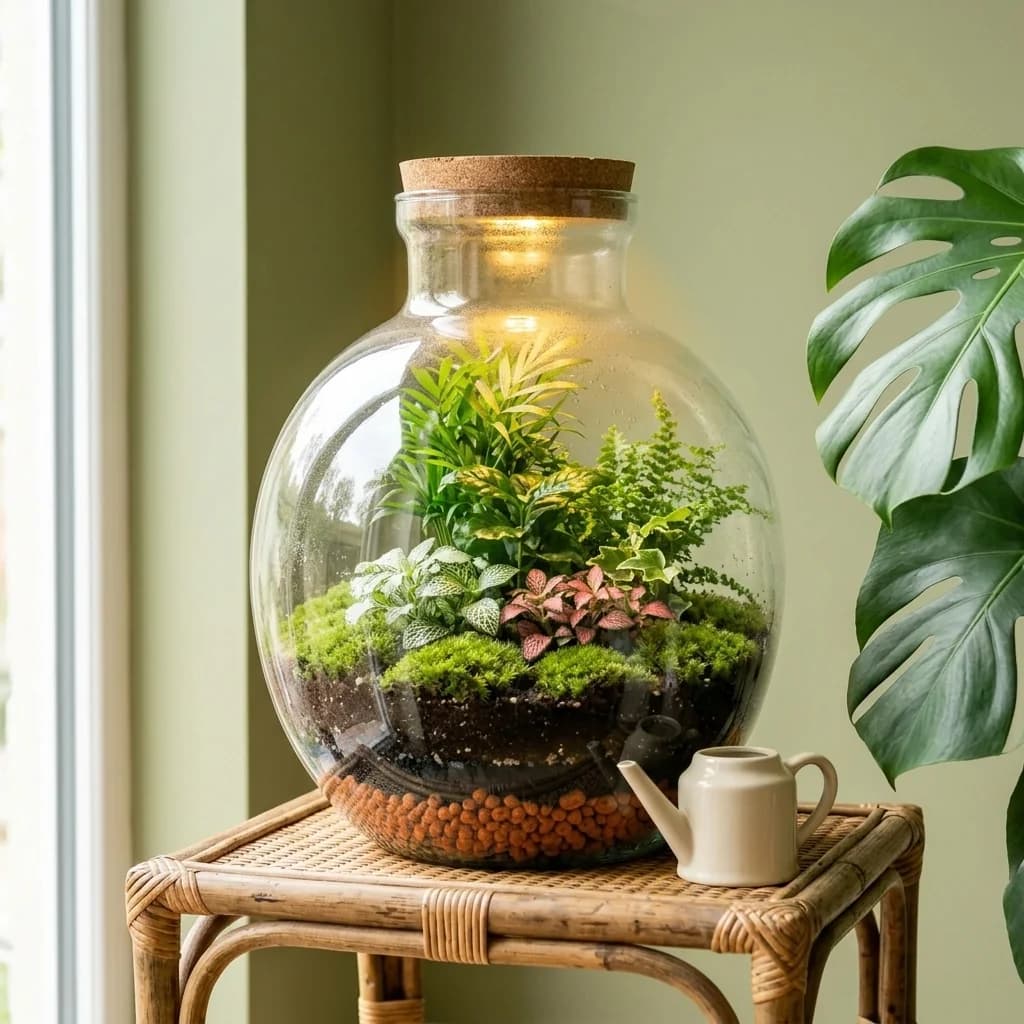
The project A tropical terrarium in a carboy puts ferns in the foreground, and the tropical plants shelf gathers our species.
Sources
Frequently asked questions
Which fern should you choose for a small terrarium?
A dwarf form: dwarf asplenium, compact pteris or miniature nephrolepis. The usual houseplant ferns reach 40 cm and more, which is unmanageable in a 20 cm jar.
Why are my fern's fronds turning brown?
Usually the air is too dry, or the terrarium has caught the sun. A browned frond will not turn green again: cut it off at the base and the plant will push new ones from the centre.
Should old fronds be cut off?
Yes, at the base, as soon as they yellow or brown. In an enclosed environment, a dead frond left in place feeds mould.
Do ferns grow fast in a terrarium?
More slowly than in a pot, because the light is filtered and the root volume limited. That is an advantage: they keep their place for a season or two with no intervention.