

Peperomia in a terrarium: the complete guide
Thick foliage, slow growth, tolerance of neglect: peperomia is the safest plant in a closed terrarium. Light, substrate, watering and the traps.
In this guide
Peperomia is the most forgiving plant in a closed terrarium. Its thick foliage stores water, it grows slowly, and it forgives the lapses that would make a fittonia flop. Its one requirement is the flip side of that quality: because it carries its own reserves, it copes very badly with permanently soaked ground. A free-draining substrate and rare watering, and it lasts for years.
Identity card
| Botanical name | Peperomia spp. |
| Suitable species | P. caperata, P. prostrata, P. rotundifolia |
| Origin | Tropical woodland floors of Central and South America |
| Size under glass | 8 to 15 cm depending on the species |
| Growth | Slow |
| Closed terrarium | Yes, with a free-draining substrate |
| Open terrarium | Possible, with moderate humidity |
| Light | Bright indirect |
| Humidity | Medium to high |
| Temperature | 18 to 26 °C |
| Difficulty | Very easy |
Choosing the right species
The genus has more than a thousand species, many of them sold as houseplants that become too large under glass. For a terrarium, keep to the compact ones:
- *Peperomia caperata*: quilted leaves, often dark green or purple, a clumping habit. The most common and the most decorative.
- *Peperomia prostrata*, known as string of turtles: tiny round marbled leaves, trailing. Superb along the edge of a container.
- *Peperomia rotundifolia*: small round light-green leaves, creeping, an excellent slow ground cover.
What it brings
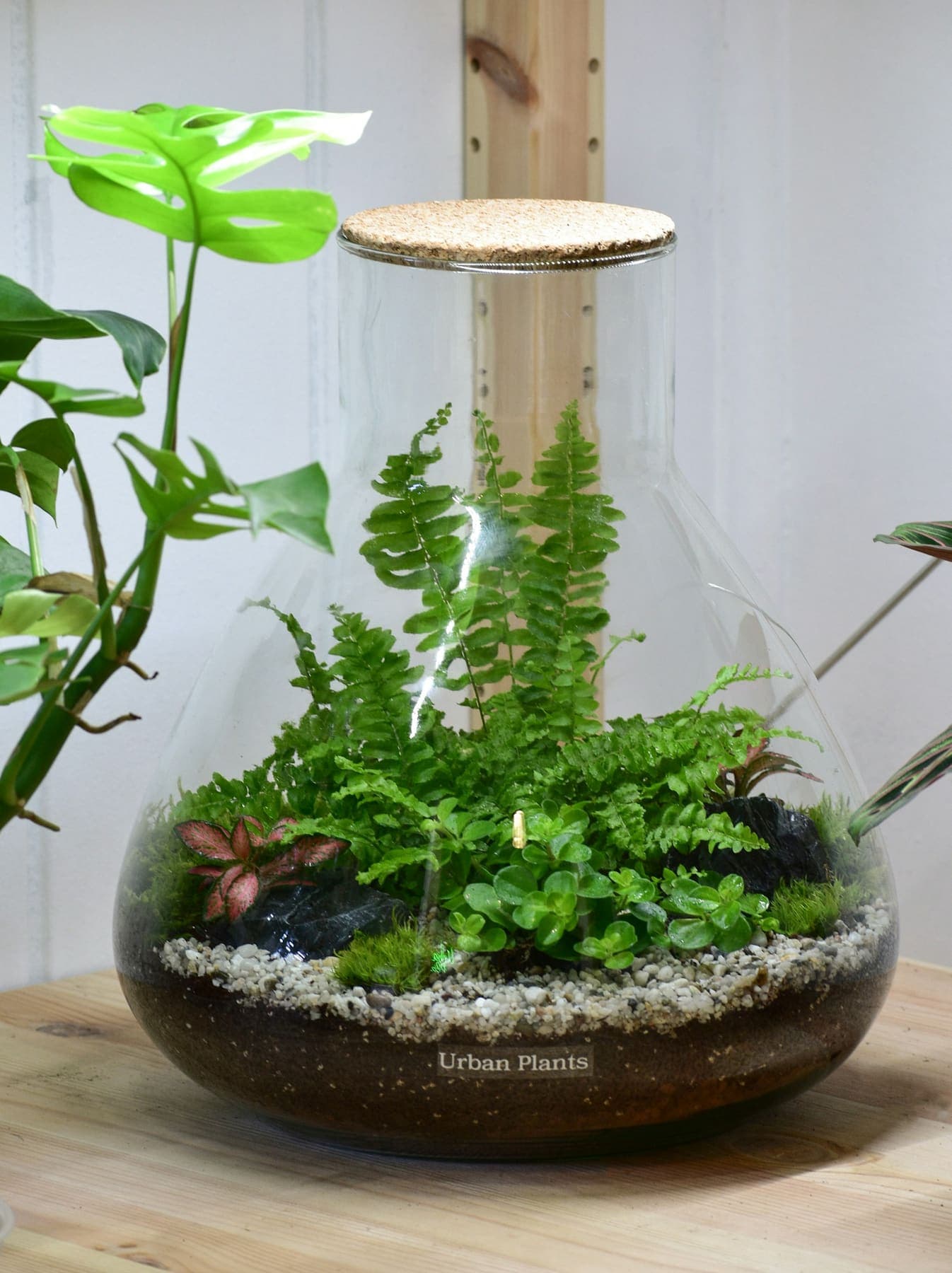
Volume and substance. In a composition it occupies the middle storey, between the moss on the ground and the ferns that give height. Its thick foliage catches the light and contrasts with the fine textures of selaginella or of ferns.
Above all, it is slow. Where Ficus pumila needs pinching every two months, peperomia keeps its place for several seasons. In a small volume, that stability is worth a great deal.
Light
Bright and indirect. It takes a moderate aspect, but under too little light the stems stretch and the leaves space out, which spoils its compact habit.
No direct sun: its fleshy leaves mark quickly. See Terrarium too hot.
Substrate: the deciding point
This is where everything is settled. Peperomia has fine, sparse roots that are sensitive to suffocation. It needs a thoroughly airy substrate: coir, fine bark, perlite, and certainly not shop-bought compost on its own.
When planting, rinse the root ball in lukewarm water, ease the roots apart, and do not bury the crown. A buried stem rots.
Real drainage at the bottom of the container is not optional with this plant — see The layers of a terrarium.
Watering
Less than its neighbours. In a balanced closed terrarium it asks for nothing for months. When the mist has gone for some time and the substrate lightens, a few sprays are enough.
The warning sign to know: leaves dropping all at once, still green. That is not thirst, it is the opposite — the roots are rotting. Stop adding anything, air it for a few hours a day, and follow Terrarium too humid.
Trimming and cuttings
Little trimming: remove damaged leaves and shorten any stem that stretches. A whole leaf with its stalk, planted in damp substrate, roots within a few weeks under glass. It is one of the easiest cuttings there is.
Common problems
Leaves dropping while still green. Too much water, roots starved of air. The most urgent thing to correct.
Stretched stems, widely spaced leaves. Not enough light. Move it closer to a bright window.
Soft brown patches on the leaves. Water left on the foliage in saturated air. Mist the substrate, not the leaves.
Leaves yellowing from the base. See Yellow leaves in a terrarium.
What to pair it with
Any woodland-floor plant: fittonia, Ficus pumila, selaginella, a small fern, moss on the ground.
One precaution: do not plant it in a hollow of the relief, where water gathers. Put it instead on a slightly high point of the substrate.
The tropical plants section brings together the species we stock that suit it.
Sources
Frequently asked questions
Which peperomia should you choose for a terrarium?
The compact small-leaved species: Peperomia caperata, prostrata or rotundifolia. The large houseplant varieties quickly become too bulky under glass.
Does peperomia take a closed terrarium?
Yes, as long as the substrate drains well. Its fleshy leaves store water: it is the woodland-floor plant that most dislikes permanently soaked ground.
Why do its leaves drop all at once?
Almost always too much water. Peperomia lets its leaves go when its roots rot. Air it out, stop watering, and check that no water is standing at the bottom.
Does it grow fast?
No, and that is an advantage. It keeps its place for several seasons without trimming, unlike Ficus pumila or fittonia, which need pinching every two months.