

Yellow leaves in a terrarium: the diagnosis
Yellowing from the base, at the leaf tip or all at once: each pattern points to a different cause. The reading table and the corrections.
In this guide
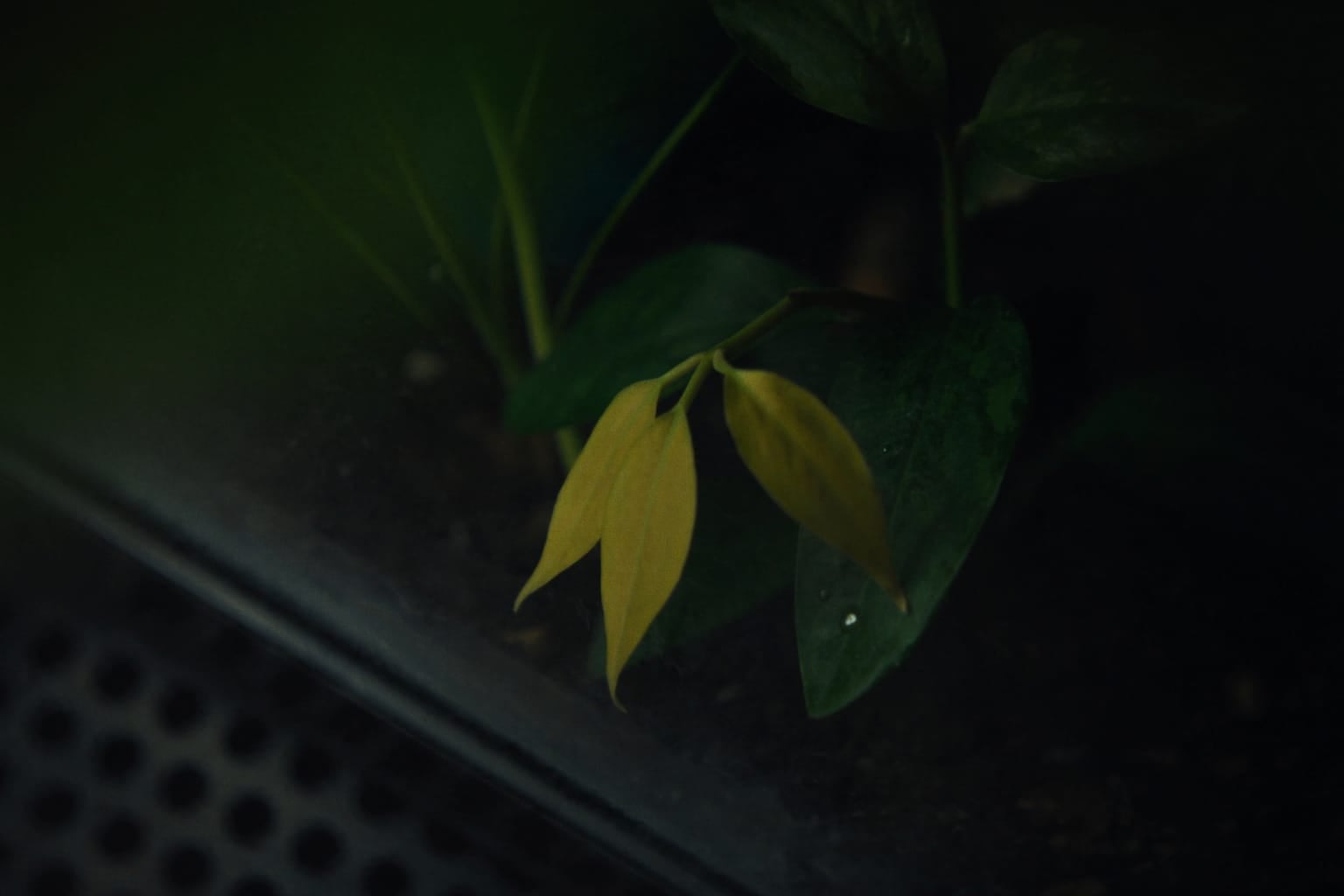
In a terrarium, leaves that turn yellow almost always point to one of five causes: too much water, not enough light, a leaf reaching the end of its normal life, shock after planting, or water that is too hard. The pattern of the yellowing tells you which. A yellow leaf never turns green again: the aim is not to save it, but to stop the next ones going the same way.
Reading the yellowing
| What you see | Likely cause | What to do |
|---|---|---|
| Lower leaves, one by one, slowly | Too much water, roots suffocating | Air the jar, remove the water at the bottom |
| One or two leaves a month, plant vigorous | Normal renewal | Remove the leaf, nothing else |
| Pale, general yellowing, stems stretching | Not enough light | Move closer to a bright window |
| Yellow tips and edges, then brown and dry | Air too dry | Rehydrate, check the lid |
| Leaves yellow all at once, two weeks after planting | Transplant shock | Wait, add nothing |
| Yellow between the veins, veins still green | Hard water, deficiency | Switch to rainwater |
| Soft yellow leaves, soaked substrate, a smell | Rot has set in | Emergency treatment |
Cause 1: too much water
By far the most common, and a deceptive one: a drowned plant looks like a thirsty plant. The lower leaves yellow one by one, then go soft. The reflex to water makes everything worse.
The test is simple: look at the bottom of the container. A layer of free water in the drainage, a black, compacted substrate, sometimes a stagnant smell — that is it. A terrarium has no drainage hole: every drop you pour in stays there.
What to do: air it for a few hours a day, draw the water off the bottom with a pipette, and stop watering. The detail is in Terrarium too humid, and if a smell has set in, in My terrarium smells bad.
Cause 2: not enough light
The picture is different: the yellowing is general and pale, the stems stretch, the gaps between leaves widen, and variegated plants such as polka dot plant lose their colours.
Move the terrarium closer to a bright window, without putting it in the direct beam — see Terrarium too warm. In a dark room, a small grow lamp at a distance, six to eight hours a day, does the job.
Cause 3: it is normal
A plant renews its foliage. One or two yellowed leaves at the base each month, on a plant that is otherwise putting out fresh green shoots, are not a problem.
What should worry you is the rate: several leaves a week, or yellowing that works its way up the plant.
In every case, remove the yellowed leaf at the base. In a closed environment, dead matter feeds mould — see Mould in a closed terrarium.
Cause 4: planting shock
Two weeks after building the terrarium, a few leaves turn yellow. This is common: the plant has changed substrate, light and humidity all at once.
Do nothing beyond removing the affected leaves. Above all, do not add water to help: that is how a harmless shock turns into a lasting excess of water.
One precaution limits this shock: rinse the root ball in lukewarm water when planting, to wash off the nursery compost, which holds far too much moisture.
Cause 5: hard water
Yellowing between the veins, with the veins themselves staying green, together with a whitish film on the glass and the substrate, points to water that is too hard.
Switch to rainwater or deionised water. The leaves already affected will not go green again, but the new growth will be healthy. See Watering a terrarium.
What about feeding?
Rarely the answer. A closed terrarium recycles its organic matter: the leaves that fall, the microfauna and the substrate itself supply most of what is needed. Feeding at the dose you would use on a potted plant burns roots that are used to very little, and turns the glass green with algae.
If a plant that has been settled for more than a year shows general yellowing with no excess water and no lack of light, a very dilute feed — a tenth of the stated dose — is worth trying once. No more than that.
Species by species
Each plant has its own signal. The individual guides set out the specific symptoms: fittonia, creeping fig, peperomia, selaginella, soleirolia, ferns.
If the plant is not yellowing but is clearly failing, the general diagnosis is in Why my terrarium plants are dying.
Sources
Frequently asked questions
Can a yellow leaf turn green again?
No. Yellowing is irreversible: the leaf has lost its chlorophyll. Remove it at the base and correct the cause so that the new growth stays healthy.
Is it normal for a plant to drop a few leaves?
Yes. One or two yellowed leaves at the base every month, on a plant that is otherwise producing new growth, is normal renewal. It is the rate that should worry you, not the fact.
Should you feed a terrarium?
Very rarely, and never at the dose you would give a potted plant. A closed terrarium recycles its own matter; too much feed burns the roots and makes algae spread over the glass.
The leaves turned yellow after repotting, is that serious?
It is a common reaction to a sudden change of conditions, and it passes within two to three weeks. Remove the yellowed leaves, and above all do not add water to help.