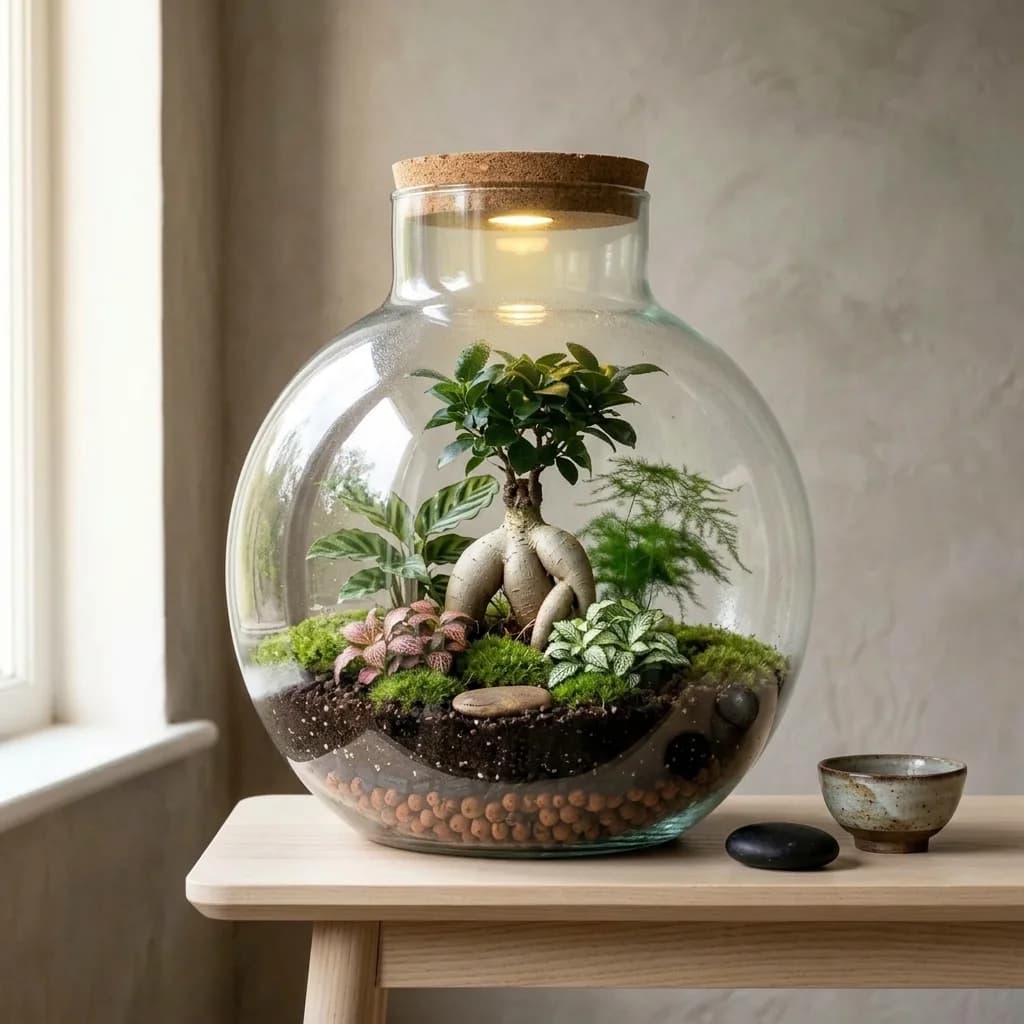


Cryptanthus in a terrarium: the earth star
A flat rosette in vivid colours, few roots, and the workings of a bromeliad that change everything. Light, watering, offsets.
In this guide
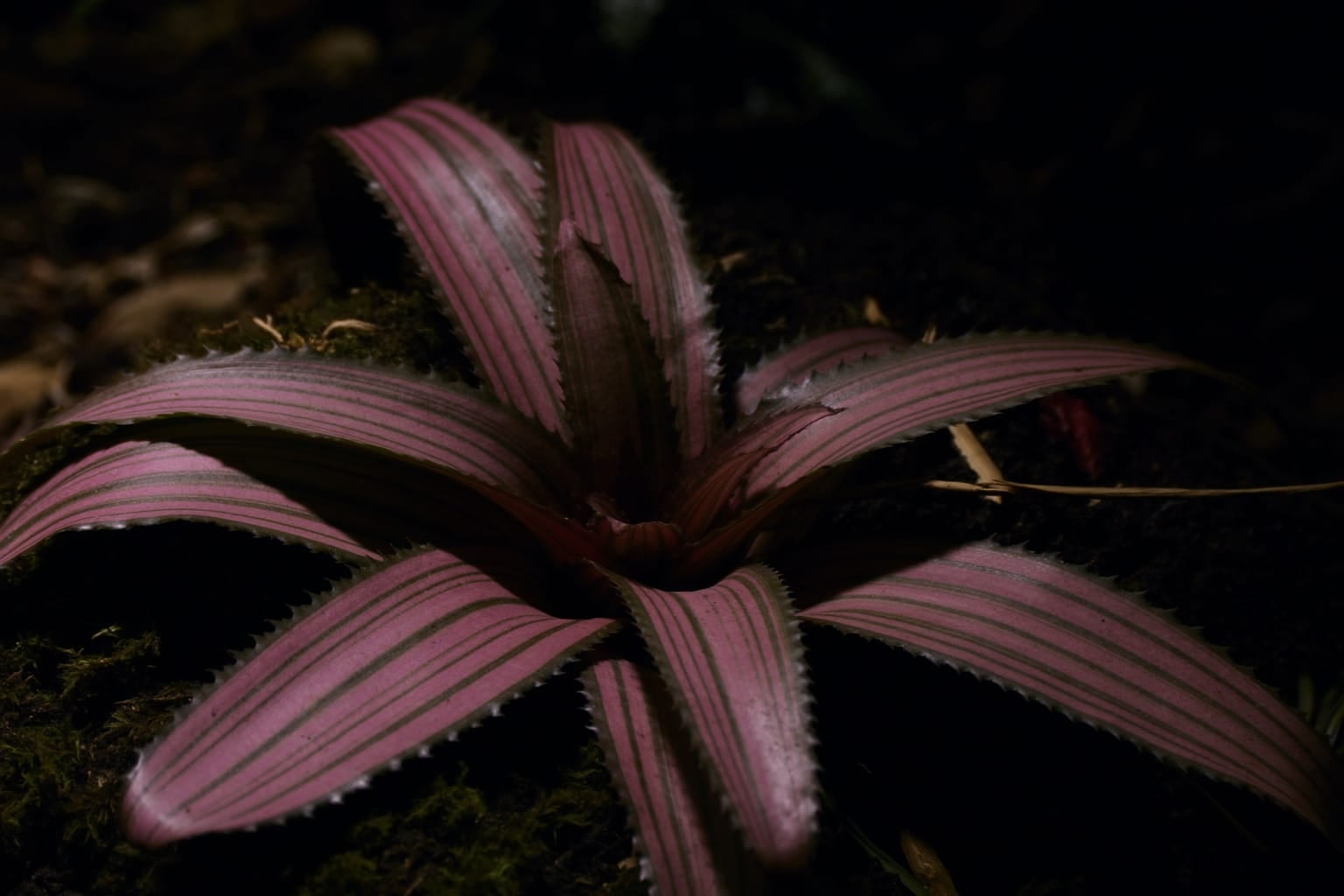
The cryptanthus, or earth star, is a terrestrial bromeliad: a flat, radiating rosette with leaves banded in pink, red or bronze depending on the variety. It works differently from other terrarium plants — its roots mainly serve as an anchor, and it takes up most of what it needs through its leaves. In practice: very little substrate, no watering at the base, and enough light to keep its colours.
Identity card
| Botanical name | Cryptanthus spp. |
| Other names | Earth star, starfish plant |
| Family | Bromeliads |
| Origin | Brazil, forest soils and rocky outcrops |
| Size under glass | 8 to 20 cm across depending on the variety |
| Growth | Slow |
| Closed terrarium | Yes |
| Open terrarium | Possible with decent humidity |
| Light | Bright indirect — essential for the colour |
| Humidity | High |
| Temperature | 18 to 27 °C |
| Difficulty | Easy |
What it brings
A shape. That is its main interest: in a terrarium made of upright foliage and carpets, the flat, symmetrical rosette of a cryptanthus stands out at once. Seen from above, it draws a star.
And a frank colour — pink bands, deep red, bronze, at times almost fluorescent — quite unlike that of a fittonia or a hypoestes.
How a bromeliad works
This is what changes everything, and what most people do not know.
Bromeliads have a reduced root system, which is there first of all to hold them in place. Water and minerals are largely taken up by specialised scales on the leaf surface.
Three practical consequences:
- Little substrate is enough: two to three centimetres. It can even be mounted on a piece of wood with a little sphagnum, like an epiphyte.
- No watering at the base. In a closed terrarium, the humidity of the air is more than enough.
- No water in the centre. Unlike its tank-forming cousins, the rosette of a cryptanthus is flat: it stores no water, and standing water in the middle makes it rot.
Light: what makes the colour
As with hypoestes, the variegation depends on the light. In low light the bands fade and the plant turns plain green — it survives, but the point of it is gone.
Bright, indirect light is therefore necessary: a metre from a bright window, or under a grow light at a distance.
Never direct sun, which marks the leaves under glass — see Terrarium too hot.
Planting
Rinse the root ball, and plant at the surface: the base of the rosette must stay level with the substrate, never buried. That is the mistake that kills this plant.
A very free-draining substrate suits it better than a rich mix. It will even accept a poor substrate, as long as it does not stay sodden.
Place it where it can be seen from above: its shape is meant to be looked down on.
Offsets: how it renews itself
A bromeliad flowers only once. The flower of a cryptanthus is discreet and whitish, at the centre of the rosette. After it, the mother plant declines slowly over several months — that is normal, it is not a disease.
Before declining, it produces offsets at its base: small daughter rosettes. Let them grow to a third of the size of the mother, then separate them gently with a few roots, and replant them.
A well-managed cryptanthus renews itself in this way indefinitely in the same terrarium.
Common problems
Colours fading, back to green. Not enough light. Problem number one.
Brown, soft centre. Standing water in the middle, or a base buried at planting. This is often fatal: take healthy offsets if there are any.
Dry brown leaf tips. Air too dry — see Terrarium too dry.
Mother plant declining after flowering. Normal. Turn your attention to the offsets.
Soft leaves at the base, sodden substrate. See Terrarium too damp.
What to grow it with
Its shape stands out all the better for being surrounded by fine textures: moss, selaginella, soleirolia, a small fern in the background.
One piece of advice: set it slightly higher, on a mound or a stone. A flat rosette lost at the bottom of a jar goes unseen.
Our selection is in the tropical plants section, and the overview is in Which plants for a terrarium.
Sources
Frequently asked questions
Does a cryptanthus need much substrate?
No. Its roots mainly serve as an anchor: two to three centimetres of substrate is enough. It can even be fixed to a piece of wood with a little sphagnum.
Should you fill its centre with water like other bromeliads?
Not with a cryptanthus, whose rosette is flat and forms no tank. In a closed terrarium the humidity of the air is enough; standing water in the centre would make it rot.
My mother plant is dying after flowering, is that normal?
Yes. A bromeliad flowers once and then declines, producing offsets at its base. Let the offsets grow, then separate them: the plant renews itself.
Why are its colours fading?
Not enough light. The pink, red or bronze bands of a cryptanthus depend directly on the light it receives. In low light it turns green again.