

Terrarium too dry: the signs and how to rehydrate it
No more mist, pale moss, brittle leaves: how to recognise a terrarium that is drying out, rehydrate it without drowning it, and find the leak.
In this guide
A closed terrarium that is too dry shows three signs: no mist at all on the glass when you wake up, moss that pales and turns brittle to the touch, and leaves with dry, brown edges. Putting it right is simple and quick — mist in small bursts, aiming at the substrate, close it again, check the next day. It is the opposite excess, water poured in all at once, that you need to avoid: it sinks to the bottom, where you can no longer take it back.
Recognising a lack of water
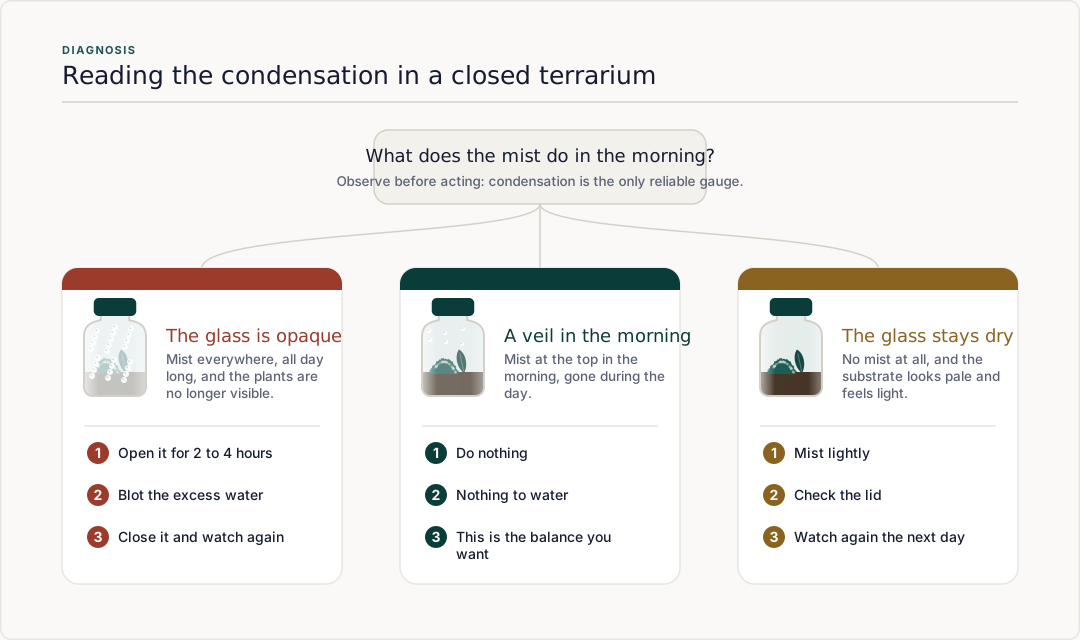
The first indicator is the glass. A closed terrarium in good balance carries a light mist in the morning, which clears during the day. When that mist stops coming back altogether for several days, the water has escaped faster than it circulates.
The second is the moss. It pales, going from a clear green to a greyish green, then turns brittle under the finger instead of being soft and fresh.
The third is the foliage. Take care not to confuse the two: a plant short of water has drooping but firm leaves, or dry, brittle edges. A drowned plant has soft, translucent leaves. These are two opposite pictures, and watering the second finishes it off. The full diagnosis is in Why are my terrarium plants dying.
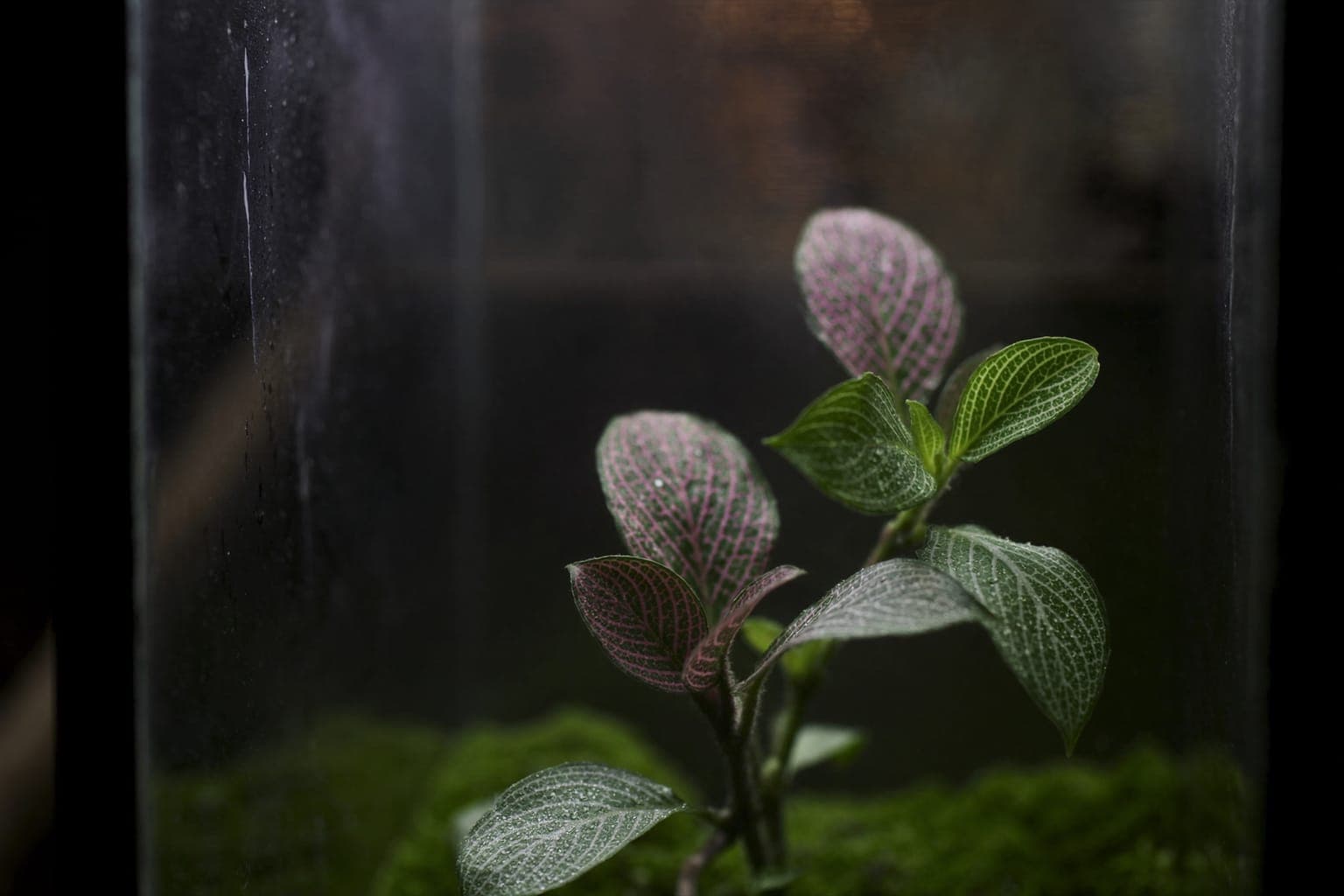
Fittonia is very useful here: its leaves droop within a few hours when it is thirsty and pick themselves up after watering. It is a living indicator, described in its own page.
Rehydrating without drowning
In small bursts
Mist the substrate, not the foliage, in bursts of a few sprays. The substrate should darken evenly without any water gathering at the bottom.
Close it again, then wait until the next morning. If the mist is back, the job is done: add nothing. If the glass is still dry, do another burst. Two or three passes over two or three days are better than one generous watering in a single go.
Why you should not pour water in
A terrarium has no drainage hole. A glass of water poured in goes through the substrate, settles in the drainage layer, and only leaves by evaporation — that is to say, slowly. You then move from today's problem to that of Terrarium too wet, which takes longer to correct.
Which water
Rainwater or demineralised water if your tap water is hard: limescale leaves white marks on the glass with every evaporation, and they build up. The amounts and the rhythms are set out in Watering a terrarium.
Finding out why it is drying out
Rehydrating deals with the symptom. If the mist disappears again a few weeks later, look for the leak.
The seal. This is the most common cause. A cork stopper that has dried out and no longer fits, a lid simply resting on top, a hardened rubber seal. A container that does not really close behaves like an open terrarium, whatever you put in it.
Heat. A terrarium standing near a radiator, or on an exposed windowsill, loses its water much faster. The glass also concentrates the sun's heat: see Terrarium too hot.
The season. In winter, the heating dries the air in the room and speeds up exchange through the smallest gap. A terrarium that lasted six months in summer may need a drink in January.
The volume. Below 5 litres the balance is unstable by design: there is too little water in circulation to absorb the swings. That is one more argument for choosing a container of at least 5 litres — see closed terrariums.
The case of dried-out moss
Moss that has dried out is not necessarily dead. Restore the humidity, mist it directly, and give it two to four weeks: it starts again from its tips. The parts that have already browned, on the other hand, will not turn green again — leave them in place, they will be covered by the new growth, or cut them out with scissors.
If it browns while the humidity is correct, the cause lies elsewhere: see Moss turning brown in a terrarium.
Sources
Frequently asked questions
How long does a closed terrarium last without watering?
As long as a mist keeps coming back on the glass, it needs nothing. Depending on the container, how well it seals and the room, that ranges from a few weeks to several months. The mist decides, not the calendar.
My terrarium has no mist at all, is that serious?
It is the first sign of drying out, and it is easily put right if caught early. Mist in small bursts, close it again, and check the next day that the mist has come back in the morning.
Should you pour water in or mist?
Mist, in small bursts, aiming at the substrate and not the foliage. A volume of water poured in all at once ends up at the bottom, where you can no longer take it out.
Can dried-out moss recover?
Often, yes, if it has not stayed dry for too long. It greens up again from its tips within two to four weeks once the humidity is restored. The browned parts, however, do not turn green again.