

Pilea in a terrarium: which species, and how to keep them
Not every pilea belongs under glass. The miniature species that work, the ones that get too big, and the trimming that keeps them compact.
In this guide
The pilea genus contains very different plants, and that is the source of a common mistake: the best-known pilea, Pilea peperomioides, is not at all suited to a terrarium. The ones that work are the miniature creepers and trailers — glauca, depressa, involucrata — which stay under ten centimetres and either cover the ground or spill over a stone.
The species that work
*Pilea glauca*, known as silver sparkle or blue tears. Tiny round leaves with a blue sheen, carried on fine reddish trailing stems. The most decorative in a terrarium: it spills over a raised feature and gives a cascading effect.
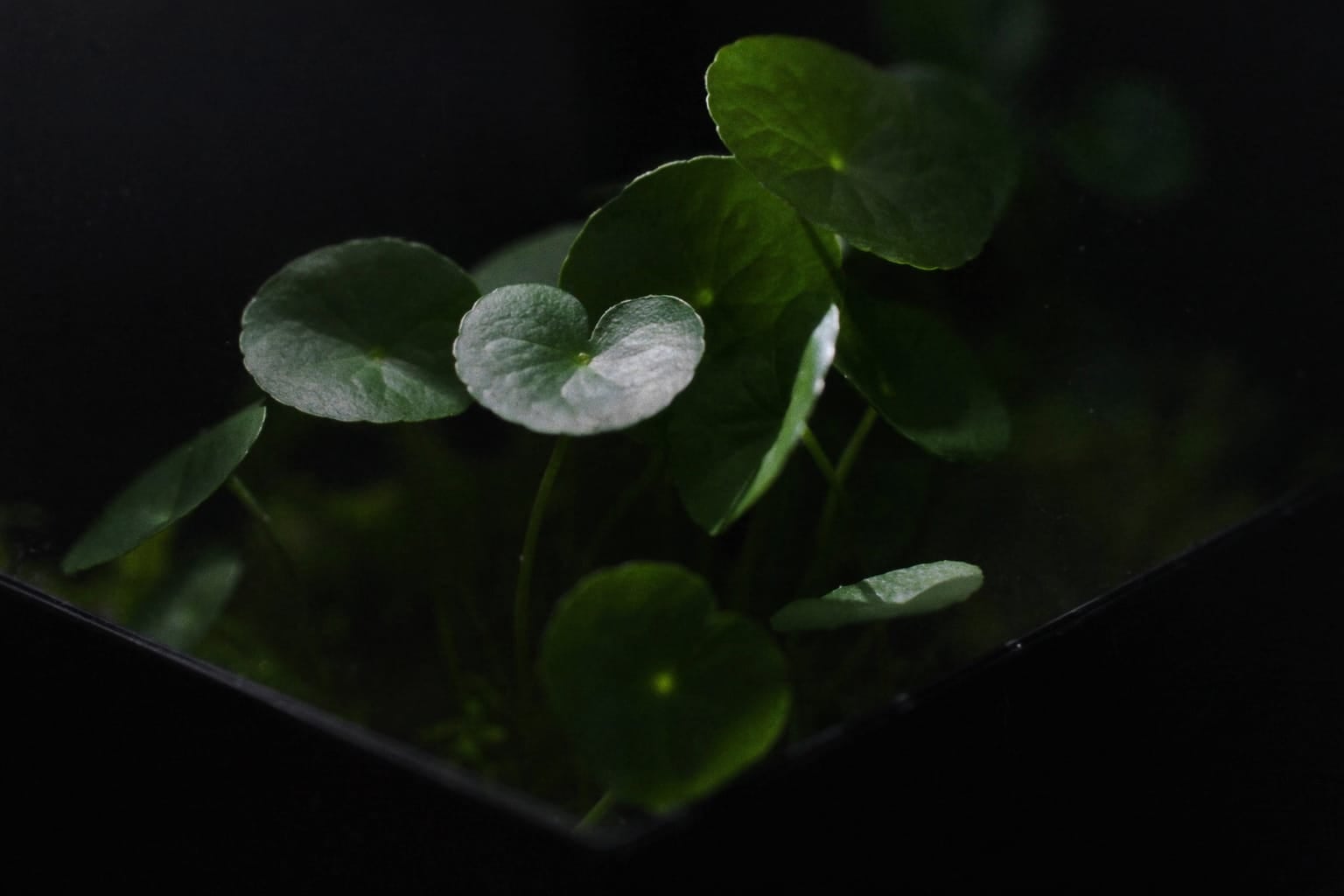
*Pilea depressa*, known as the creeping pilea. Small round light-green leaves, a strictly creeping habit. An excellent ground cover, faster than moss.
*Pilea involucrata*, known as the friendship plant. Quilted bronze or coppery leaves, a clumping habit. It brings texture and an unusual colour under glass. A little taller, 12 to 15 cm.
The one not to choose
*Pilea peperomioides*, the Chinese money plant. This is the one everybody has seen, with its large round leaves on long stalks. It reaches 30 to 40 cm, needs bright light, and touches the glass of a jar within a few months. It is made for a pot on a shelf, not for a terrarium.
Identity card
| Suitable species | P. glauca, P. depressa, P. involucrata |
| Origin | Humid tropical regions of America and Asia |
| Size under glass | 5 to 15 cm depending on the species |
| Growth | Fast |
| Closed terrarium | Yes |
| Open terrarium | Not advised in a heated room |
| Light | Bright indirect |
| Humidity | High |
| Temperature | 18 to 26 °C |
| Difficulty | Easy |
What they bring
Movement. Where peperomia makes a block and moss makes a surface, a Pilea glauca trails, spreads and escapes. It is the plant that breaks the stiffness of a composition.
Colour too: the blue of the glauca and the bronze of the involucrata step outside the usual plain green, without the very strong statement of a red fittonia.
Light
Bright and indirect. Under light that is too weak, the stems stretch and the leaves space out — the characteristic habit is lost and the plant becomes straggly.
No direct sun, which marks the leaves under glass — see Terrarium too hot.
Substrate and planting
An airy terrarium substrate that holds a little moisture. Rinse the root ball in lukewarm water to remove the nursery compost.
Plant a trailing pilea on a high point of the relief or along an edge: that is where it will give its effect. A creeping pilea, on the other hand, is planted flat, and spreads on its own.
Trimming, at least twice a year
They grow fast. Without trimming:
- the stems stretch and go bare at the base;
- the plant reaches the glass, where the leaves rot on contact;
- it covers its slower neighbours.
Pinch out the tips above a pair of leaves roughly every two months: the plant branches out and thickens. The clippings root by themselves on damp substrate. See Trimming a terrarium.
Common problems
Long stems, widely spaced leaves. Not enough light, or not enough trimming. Most often both.
Leaves dropping while still green. Too much water, roots starved of air — see Terrarium too humid.
Dry leaves at the stem tips. Air too dry — see Terrarium too dry.
Yellowing from the base. See Yellow leaves in a terrarium.
What to pair them with
Any woodland-floor plant: fittonia, peperomia, selaginella, a small fern.
One precaution: Pilea depressa and soleirolia occupy the same niche on the ground and compete for the space. Choose one or the other.
Our selection is in the tropical plants section, and the overview is in Which plants for a terrarium.
Sources
Frequently asked questions
Is Pilea peperomioides suitable for a terrarium?
No. The Chinese money plant reaches 30 to 40 cm and needs bright light: it is made for a pot, not a jar. Choose Pilea glauca, involucrata or depressa instead.
Which pilea for a small terrarium?
Pilea glauca, with tiny blue-tinged leaves on trailing stems, or Pilea depressa, a creeper with round light-green leaves. Both stay under 10 cm and cover well.
Why is my pilea stretching, with widely spaced leaves?
Not enough light, and not enough trimming. Move it closer to a bright window and pinch out the tips: the plant branches out and becomes dense again.
Do pilea take easily from cuttings?
Very easily. A stem a few centimetres long, laid on damp substrate, roots within two to three weeks under glass.