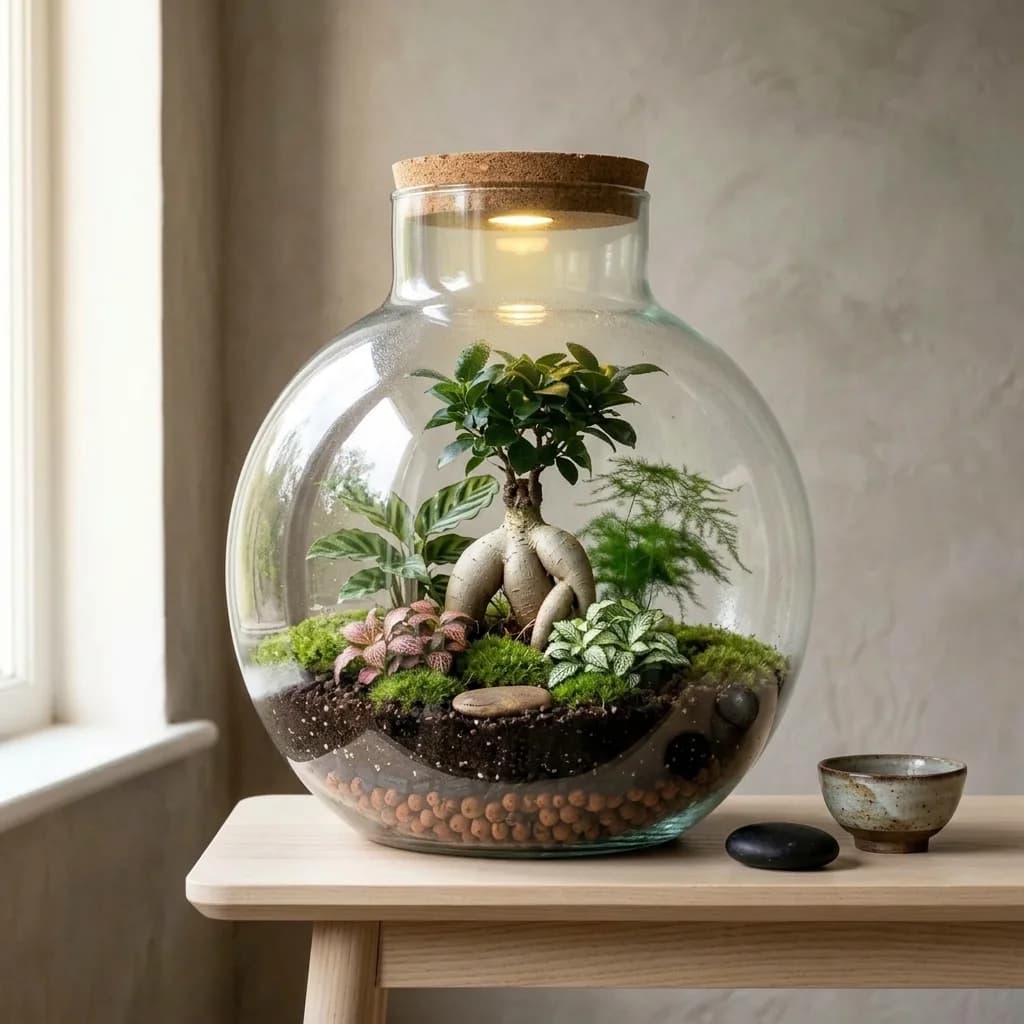


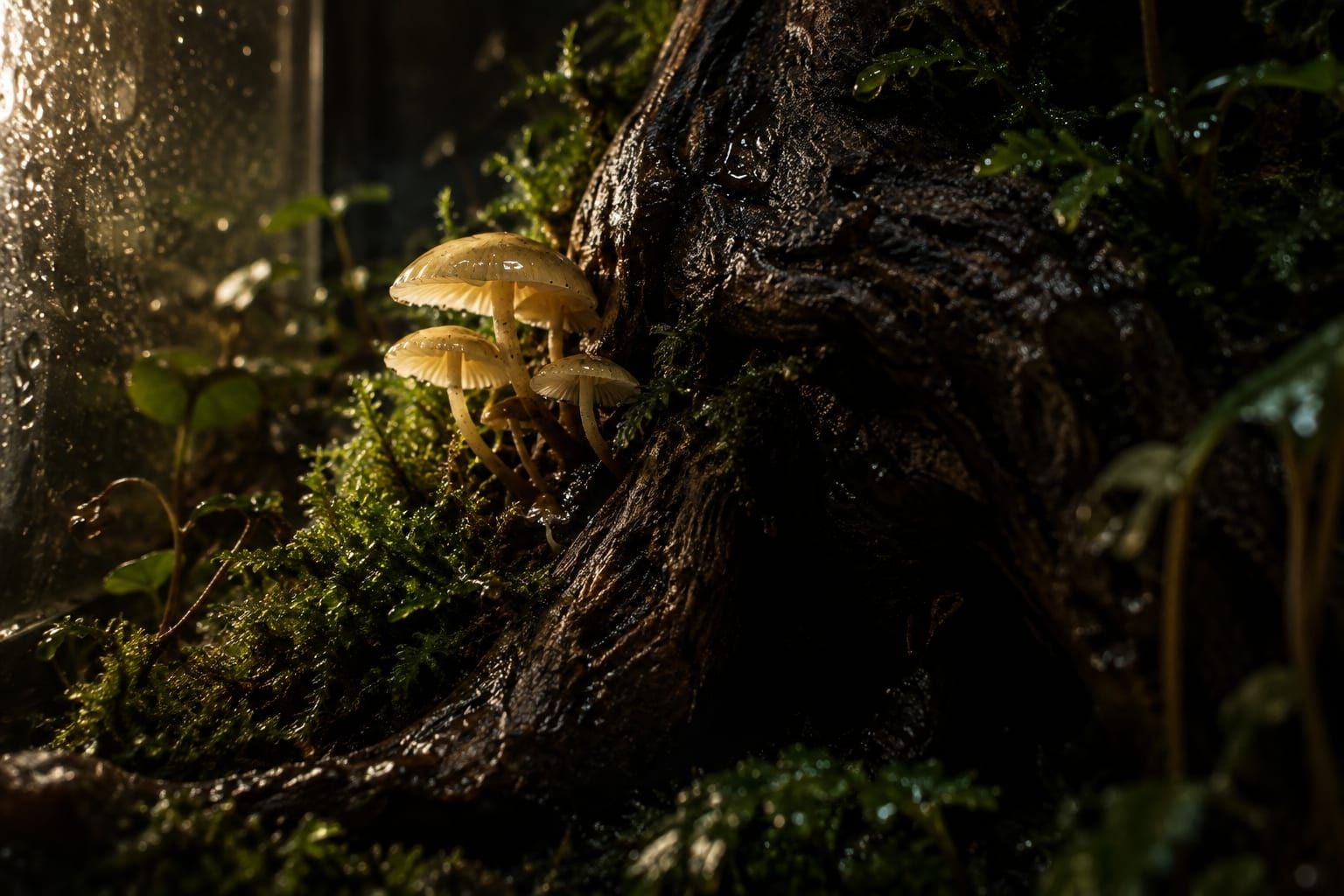
Mushrooms are growing on the wood in my terrarium
Small yellow or white mushrooms on a root or in the substrate: why this is normal in a bioactive terrarium, how to tell them from mould, and when to act.
In this guide
Further reading: To replace a degraded piece, see how to choose and prepare terrarium wood.
A mushroom coming out of the wood or the substrate of a closed terrarium, in the first few weeks, is normal and harmless. It is not a disease and it is not the result of a mistake in the build: it is the decay of dead wood beginning, exactly as it does on a forest floor. There is nothing to do but watch. The only case that calls for action is mould, which has neither the same shape nor the same cause, and which you can recognise in seconds once you know what to look for.
Why wood produces mushrooms
A root, a branch or a piece of driftwood is never sterile. It holds spores and mycelium, those almost invisible white threads that have been running through the wood for months. Shut that wood in a warm, damp jar and you give it exactly the conditions it was missing in order to fruit. The mushroom you see is only the reproductive organ of an organism that was already in the piece of wood when you put it in.
Three conditions trigger it, and a closed terrarium brings all three together:
- Steady humidity, never interrupted by a dry draught;
- A mild temperature, that of a house, between 18 and 26 °C;
- Dead matter to work on: wood, leaf litter, bark, freshly cut roots.
It is the same mechanism that drives a bioactive terrarium, where the decay of dead matter is a deliberate part of the system, not an accident.
The three most common visitors
| What you see | Appearance | Where | What to do |
|---|---|---|---|
| Bright yellow mushroom | Slender stem, pleated cap, 1 to 4 cm | Tropical substrate, base of the wood | Nothing, or lift it out with tongs |
| Small brown caps | Tight cluster, pale stem | Wood, leaf litter | Nothing |
| White crust on the bark | Flat, clinging veil, no fuzz | Root, driftwood | Nothing |
| Cottony fuzz | Blurred patch, threads, no shape | Dead leaf, waterlogged soil | Remove and air it |
The first three rows are fungi that fruit. The last is mould, and it is the only one that calls for action.
The yellow compost mushroom
It is by far the most common, and the one that worries people most. It comes out of the substrate overnight, raises a yellow or pale yellow cap a few centimetres across, then collapses within two or three days. It lives on the organic matter in the compost, does not touch living roots, and disappears on its own once the fresh matter has been used up. You can leave it. Lift it out with tongs only if you dislike it, or if young children open the jar.
The small caps on the wood
They grow in tufts straight from the bark or the cut end of a root. They confirm that the wood is slowly decaying, which is what natural decor is there to do in a living setting. They do not spread to the plants. They often appear after a slightly generous watering or a mild spell, and they dry out where they stand within a few days. You can remove them with tongs once they have collapsed, so they do not turn into soft matter against the moss.
The flat white veil
Often taken for mould, it is in fact exposed mycelium: a network of threads colonising the surface of the wood. It is flat, clinging, and follows the grain. Mould, by contrast, stands above the surface, as a fuzz, and lifts off with a breath.
The difference that counts: fungus or mould
Three criteria are enough.
- The shape. A mushroom is built: a stem, a cap, or a crust with clean edges. Mould has no shape, it spreads like a cloud.
- What it grows on. Fungi come from the wood, the bark or the litter. Mould settles on a fallen dead leaf, on a decorative fruit, on a patch of sodden soil.
- What happens next. A mushroom rises, releases its spores and collapses within days. Mould spreads, gains ground every day, and returns to the same spot after you remove it.
If your patch ticks the boxes for mould, the guide Mould in a closed terrarium sets out what to do: remove the affected matter with tongs, air the container, and correct the watering. A musty smell when you open the jar points to the same excess of water.
When you should be concerned after all
The fungus itself is almost never the problem. It becomes a signal when it comes with something else:
- The substrate stays sodden and water sits at the bottom of the container. The fungus is not the cause, but it thrives on that ground. Read Terrarium too damp.
- Leaves blacken at the base or stems go soft: that is no longer dead wood decaying, it is living tissue rotting, and the guide My terrarium plants are dying sorts through the causes.
- The wood crumbles within a few months. That is the normal course of things, simply sped up by a soft wood. Next time choose a dense, dry wood, such as those in the Wood and roots selection.
What not to do
- Do not use a fungicide. An antifungal product in a closed jar also kills the useful microfauna, springtails included, and settles nothing, since the mycelium is inside the wood.
- Do not pour hydrogen peroxide or cinnamon onto the substrate. These widespread remedies unbalance a setting that was not ill in the first place.
- Do not take the wood out to boil it after the event. You would destroy the composition without lastingly sterilising anything: the spores are already in the terrarium and in the air of the room.
- Never taste a terrarium mushroom, and wash your hands after working inside the jar.
Living with them, and even putting them to work
In a bioactive build, fungi work for you: they turn wood and dead leaves into matter the plants can use. The springtails moving through the substrate eat a share of them, which naturally keeps their appearances in check. It is this trio — dead wood, fungi, microfauna — that makes a well-built terrarium need so little upkeep, as Caring for a bioactive terrarium explains.
Two habits are enough to keep the upper hand. Remove the dead leaves that fall on the substrate, because they mainly feed mould. And keep a measured watering rhythm, described in Watering a terrarium: a substrate that is fresh and never sodden lets fungi play their part without letting rot set in.
Sources
Frequently asked questions
Are the mushrooms in a terrarium dangerous?
For the plants, no: the ones growing on wood break down dead wood and do not attack living tissue. Like any unknown fungus, they are not to be eaten or handled bare-handed, above all around children or pets. Close the jar and wash your hands after working inside it.
Should you remove the yellow mushroom growing in the substrate?
There is no need. The small bright yellow mushroom of tropical composts feeds on dead matter and disappears on its own within days. Remove it with tongs only if it bothers you visually or if children can reach the terrarium.
How do you tell a mushroom from mould?
A mushroom has a built shape: a stem, a cap, or a clearly bounded crust on the wood. Mould is a cottony fuzz, with no structure, that spreads as a patch and returns to the same spot. Mould signals too much moisture, a mushroom simply signals wood breaking down.
Do the mushrooms always come back?
They appear mostly in the first weeks, while the wood and the substrate still hold fresh matter to break down. They then become rarer, and stop once the setting settles. Reappearing after a generous watering is normal.