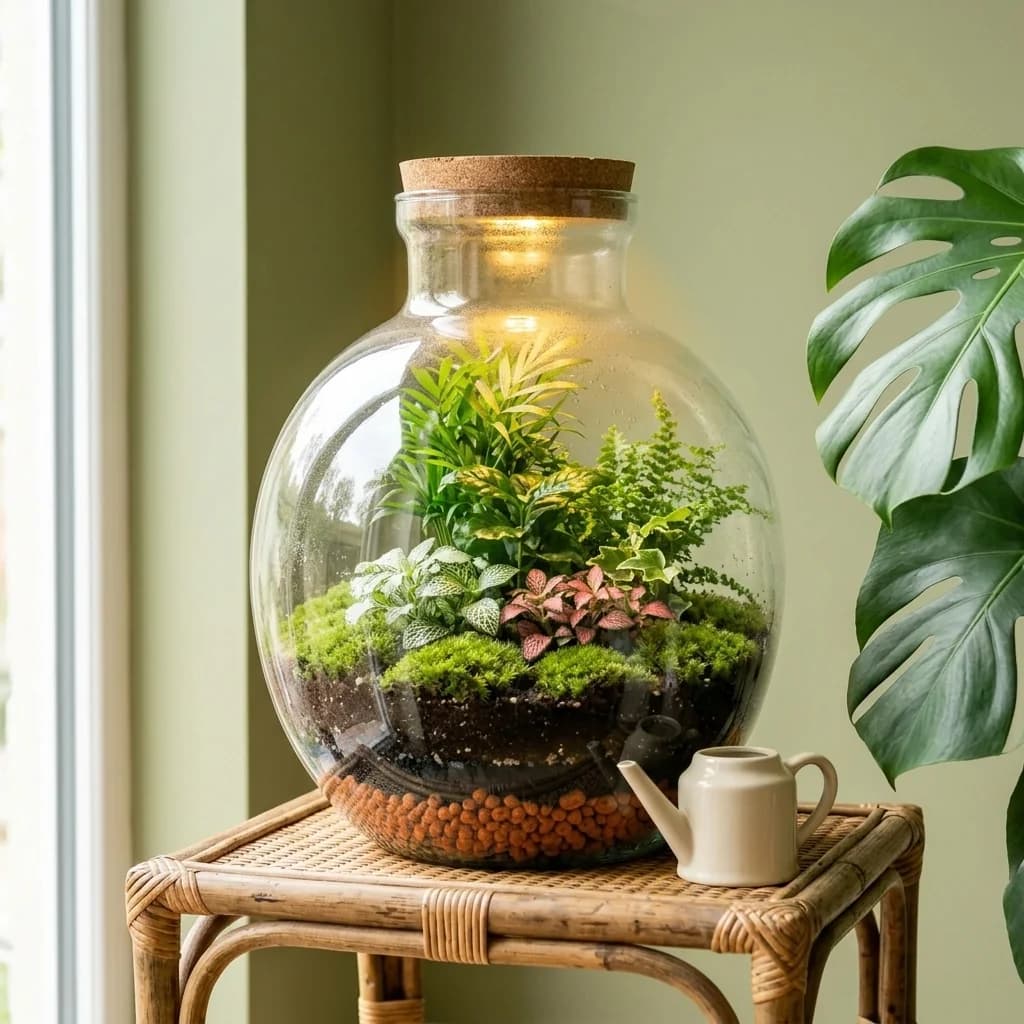
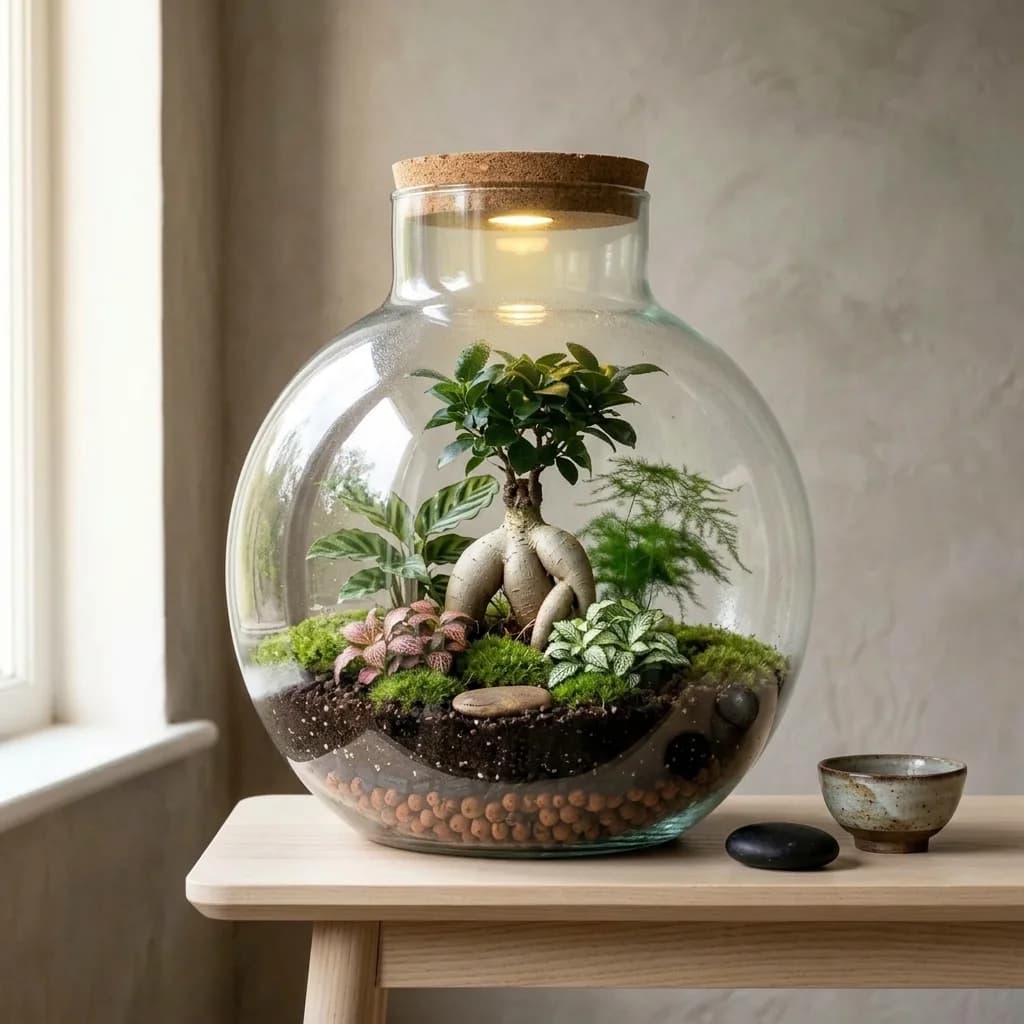


Should you put fertiliser in a terrarium?
A terrarium grows slowly: does it need feeding? Learn to check light, roots and substrate before you add any fertiliser at all.
In this guide
Advice given for a large potted plant does not transfer directly to a jar. The volume is small, the roots have no outlet for water, and rapid growth can turn the composition into a mass of leaves that is hard to maintain.
Why slow growth is not a deficiency
A decorative terrarium is not a crop grown for maximum yield. Healthy leaves, the occasional new shoot and firm roots are worth more than growth that quickly reaches the lid. A seasonal drop in light also slows things down.
Do not confuse nutrients with energy: minerals do not replace the light needed for photosynthesis. If the stems are stretching towards a window, look first at terrarium lighting. Adding nutrients without fixing the cause does not solve that problem.
Work through the diagnosis in the right order
Look at the symptoms
Note which leaves are changing: old ones, new ones, a single plant or the whole composition. A lower leaf ageing does not necessarily announce a deficiency. General yellowing can also come from too much water, from stress after planting, or from damaged roots.
Check the environment
- Is the substrate moist, or genuinely waterlogged?
- Are the roots you can see firm or soft?
- Does the light reach the new growth?
- Did the mix already contain fertiliser?
- Have you repeatedly added heavily mineralised water?
The guide to terrarium plants that are dying gives you a cross-cutting diagnosis. A sick plant should not be fed "to strengthen it" with no identified cause.
Situations worth telling apart
| Situation | A sensible decision |
|---|---|
| Recent build, fresh substrate, healthy plants | Do not feed |
| Plants too large or growing fast | Prune and review the selection |
| Damaged roots, saturated medium | Fix the environment before feeding |
| Old terrarium, active growth, plausible deficiency | Look at the species' needs and the history |
| Mounted orchid or specialist plant | Follow its own protocol, without generalising to the jar |
In an older set-up, carefully replacing part of the medium you can reach may be easier to control than a run of doses. But a rebuild is not something to schedule arbitrarily every year: look at the structure and at the health of the roots.
If feeding really is justified
Choose a product suited to the plant in question, and read its concentration, how it is applied and its restrictions. There is no universal dose in drops for "a terrarium": formulations and volumes vary far too much. Do not treat the dose for a large pot as an automatic reference for a small jar.
Work on a medium that is already suitably moist, without saturating the build, and measure the total amount you add. Note the product, the dilution and the date. Do not string doses together to speed up a result: look at the new leaves first. If you are unsure whether it is needed, hold off.
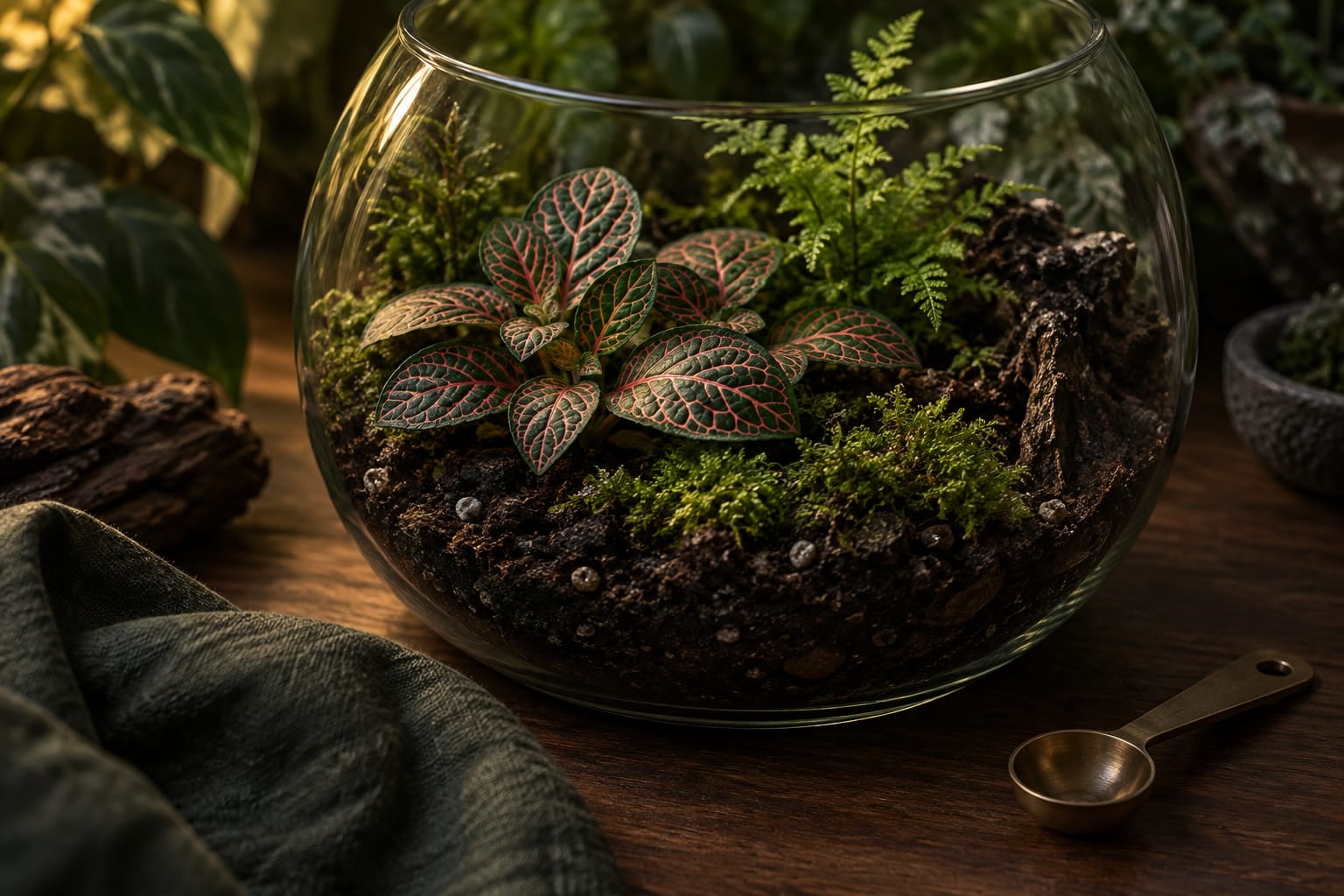
Keep fertiliser off sensitive foliage and off mosses, unless it is explicitly intended for that. The requirements of a miniature orchid are not those of a composition of mosses and fittonias.
The home-made recipes to leave alone
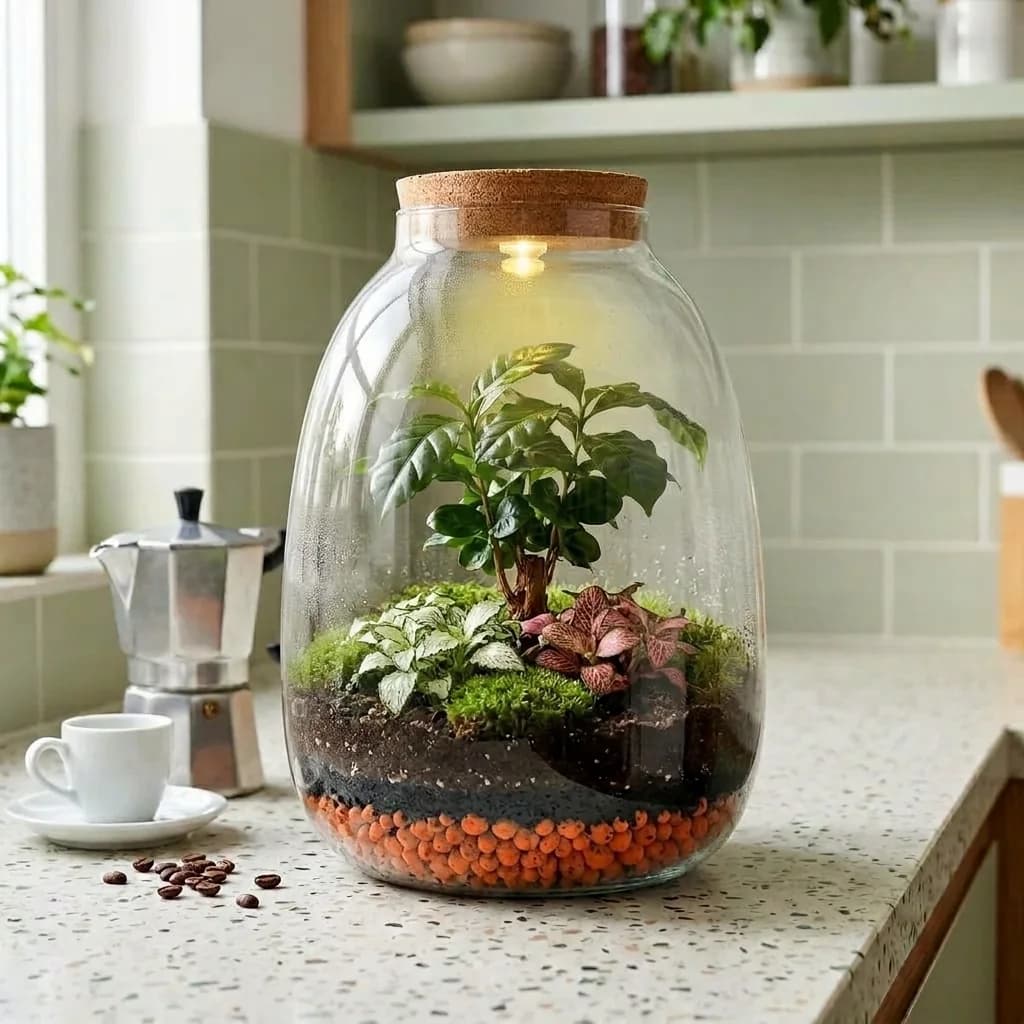
Coffee grounds, sugared water, milk and kitchen scraps are not measurable fertilisers for this small volume. They add organic matter whose decay is hard to control. Salted cooking water has no place in the jar.
Leaf litter chosen for a bioactive system serves a different purpose. It is no reason to tip food scraps into just any terrarium. The guide to the bioactive terrarium explains what the decomposers do.
If you have added too much
Stop feeding and examine the plants. Do not try to dilute the problem by filling the jar with water: there is nowhere for it to go. Depending on how serious it is and how well you can reach in, take the plant out to work on it in a drained pot, or replace the affected medium. Read redoing a terrarium before you strip the whole thing out.
For a new project, favour a suitable substrate whose composition you know, and small-growing plants. Buying fertiliser is not a compulsory step in building a terrarium.
Sources and scope of this advice
- Iowa State University Extension — Create and care for a terrarium: why limiting growth and avoiding routine feeding makes sense.
- Mississippi State University Extension — Closed-system terrarium: how a closed system works and how to maintain it.
The diagnosis stays conditional: one symptom on its own does not prove a deficiency. Generated illustration, for editorial purposes.
Frequently asked questions
Can a terrarium live without added fertiliser?
Yes. The substrate and the cycles of decay can be enough for a long time in an undemanding composition. That does not guarantee it will be self-sufficient for ever.
Do yellow leaves prove a lack of fertiliser?
No. Water, light, roots, stress and simple ageing can all produce similar symptoms. Look for the cause before you feed.
Can you use coffee grounds?
Avoid them in a small closed terrarium: they do not provide a controlled supply of nutrients, and their decay can complicate maintenance.