

Miniature orchids in a terrarium: the species that last
Lepanthes, dwarf Masdevallia, Haraella: the small orchids that really take a closed terrarium. Mounting on wood, bark and sphagnum, light, ventilation.
In this guide
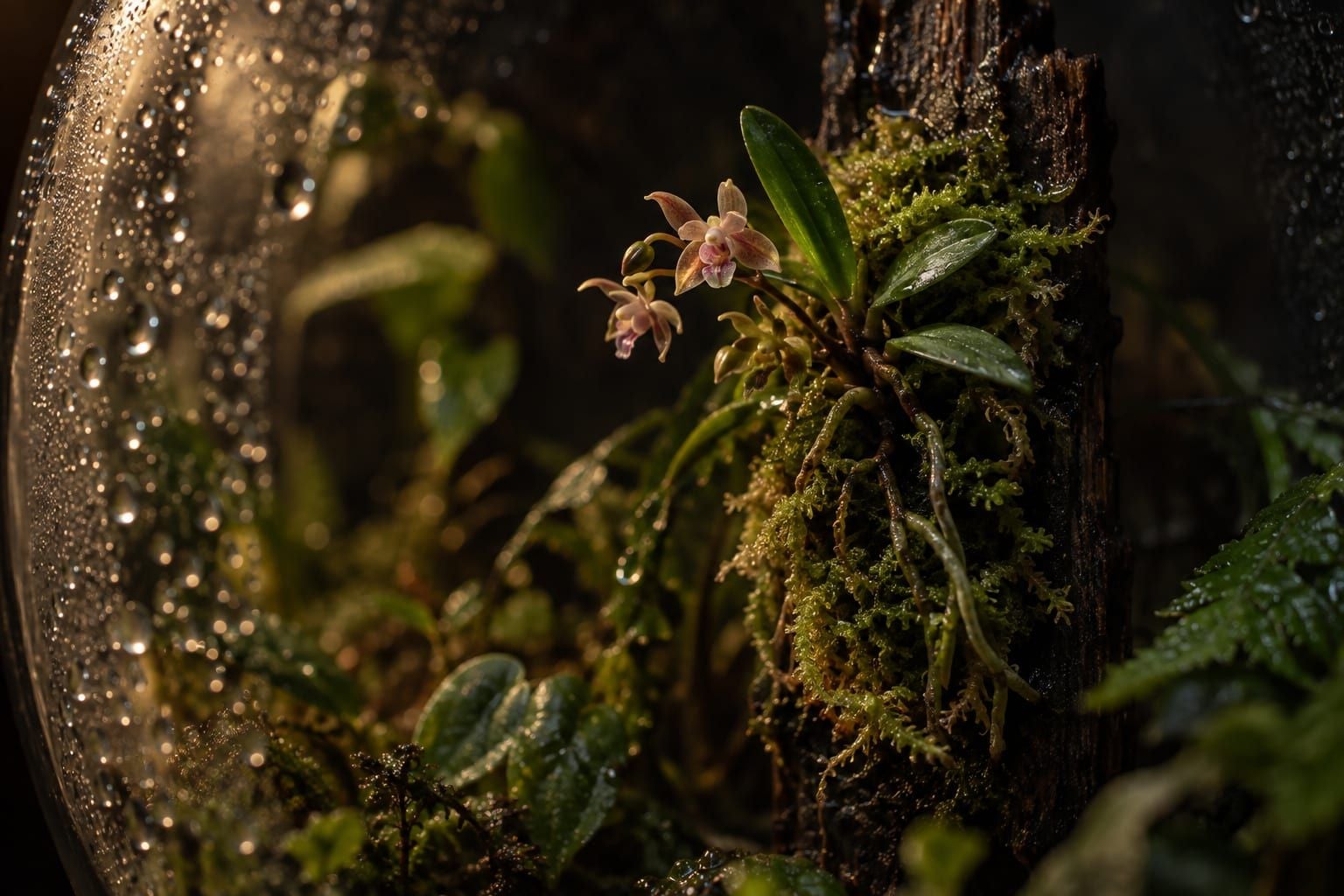
Yes, some orchids live in a closed terrarium, and flower there several times a year. But not just any of them, and not planted in soil. The species that last are the miniatures of the cloud forests of Central America and Asia: they grow clinging to trunks, in an almost permanent mist, and that is exactly the environment a closed jar knows how to reproduce.
The rest of this guide says which ones to choose, how to mount them — never in soil — and why this project belongs to a second or third terrarium, not a first.
Identity card
| Suitable species | Lepanthes, dwarf Masdevallia, Haraella retusa, miniature Pleurothallis |
| Origin | Cloud forests of Central and South America, tropical Asia |
| Size under glass | 3 to 15 cm depending on the species |
| Growth | Slow |
| Closed terrarium | Yes, for cloud-forest species |
| Open terrarium | Miniature Phalaenopsis only |
| Light | Partial shade to bright indirect |
| Humidity | Very high, 70 % and above |
| Temperature | 18 to 26 °C, with a drop at night |
| Substrate | No compost: fine bark, sphagnum, mounting on wood |
| Watering | A fine mist on the sphagnum when it turns pale |
| Difficulty | Experienced |
The four safe choices
The Lepanthes. The smallest of the group, often under 5 cm. A single leaf per shoot, with a tiny, strongly coloured flower sitting on it. They need constant humidity and cannot take drying out even for a few hours — so a closed jar suits them perfectly.
Miniature Masdevallia. The triangular flowers characteristic of the genus, on plants of 8 to 15 cm. Choose carefully: many Masdevallia come from altitude and want cool conditions. Pick a variety described as intermediate-temperature, and keep the terrarium away from any heat source.
Haraella retusa. Probably the best way in. A small clump of soft leaves, yellow flowers marked with brown, repeating for much of the year, and a light lemon scent. It takes a humidity that drops a little better than the others do.
Miniature Pleurothallis. Thick foliage, discreet and regular flowering, grown much like the Lepanthes.
The one exception is the miniature Phalaenopsis, the one sold in garden centres as a mini orchid. It does not belong in a closed jar: its broad leaves and hollow crown hold water and rot in saturated air. It does very well, on the other hand, in an open container set near a bright window.
They do not go in soil
This is the point on which almost every first attempt fails. These orchids are epiphytes: in the wild, their roots run bare over the bark of a trunk, exposed to the air, green with chlorophyll. Buried in a tropical substrate, they suffocate and turn brown within a few weeks.
Two mountings work.
- On a piece of wood. Take a root or a piece of dry, bark-free wood from the wood and roots section. Lay a thin layer of damp sphagnum, place the plant on it with its roots spread out, and tie the whole thing with fishing line in turns spaced apart. Within three to six months the roots bite into the wood and the line becomes unnecessary.
- In a pocket of bark. In a small hollow of the composition, a handful of fine-grade pine bark, mixed with sphagnum if you like. The plant is simply wedged in, never pushed down. This mounting is simpler, but it holds more water: keep it for the thirstiest species.
In both cases, keep the crown — the junction between leaves and roots — above the level of the sphagnum.
Light
These orchids grow under the cover of trees: they have never seen direct sun. Bright but indirect light is enough for them, the same as for a calathea or a woodland fern.
In practice, put the terrarium one or two metres from a bright window, out of the sun's beam. Behind a south-facing pane, the temperature under glass rises by several degrees within an hour, and these plants cope very badly with heat spikes.
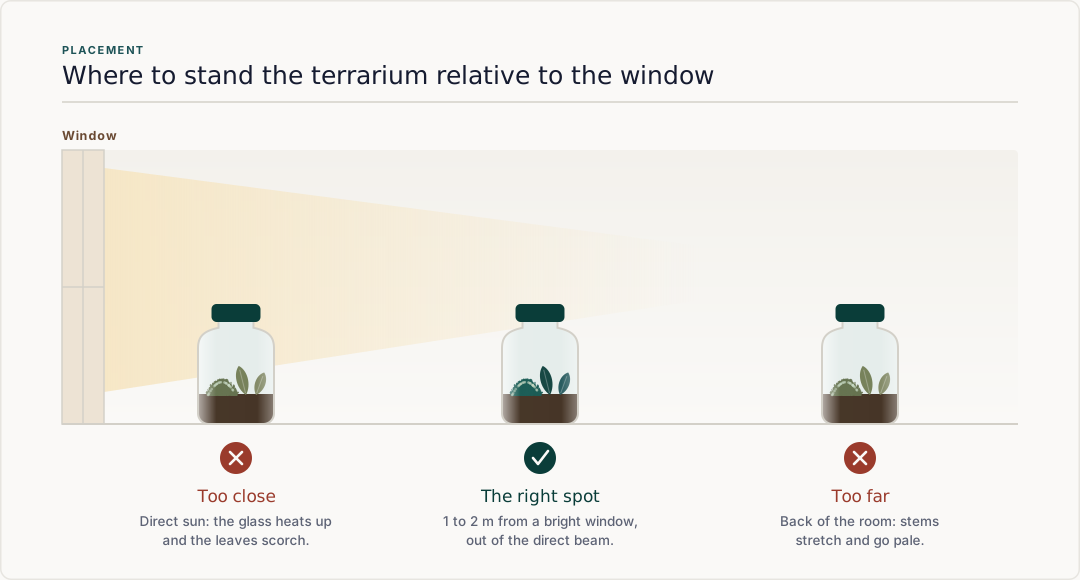
In a dark room, a small grow lamp set to ten or twelve hours a day, placed back from the glass, replaces the window without heating it.
Ventilation: the setting that makes the difference
Very high humidity with no air movement at all is an invitation to rot and mould. Cloud forests are saturated with moisture, but the wind blows through them constantly.
In a living-room terrarium, that comes down to one simple habit: open the container for ten to fifteen minutes every day, preferably in the morning. The air is renewed, the excess water on the leaves evaporates, and the condensation goes back to a fine veil instead of running down the glass.
The glass should stay lightly misted, never opaque. Terrarium condensation sets out what each kind of mist means.
Watering
Nothing like a conventional pot of orchids. In a well-set closed terrarium, the water travels in a loop and the mounting stays damp by itself. Your part comes down to a fine mist over the roots and the sphagnum when the sphagnum turns pale and feels brittle — often once a week, sometimes less.
Use soft water, rainwater or deionised water. These orchids are sensitive to salts: hard water leaves white deposits on the roots and burns their tips.
Never pour water straight into the bottom of the container. A terrarium has no outlet, and water building up under the drainage eventually rises again.
Why this is not a first terrarium
Three reasons, and they add up.
The price first: a collector's miniature costs several times as much as a common woodland plant, and is hard to replace. Then the sensitivity to heat: a radiator switched on under the shelf, a south-facing window in July, and the plant declines without recovering. And finally the margin for error is narrow — too much water and the roots blacken, too little and they dry out within two days.
What goes wrong
Black, soft roots. Too much water, or a plant that has been buried. Take it out, cut away the dead parts with fine scissors, mount it again on wood and space out the misting.
A white veil on the sphagnum. Surface mould, encouraged by still air. Air it more and remove the affected area; the full procedure is in Mould in a closed terrarium.
Leaves yellowing all at once after a hot spell. Heat damage. Move the terrarium away from the heat source, and do not expect flowers this season.
What to pair them with
It is best to leave them room. Moss on the ground, a small fern for height, and nothing else: vigorous plants such as fittonia or Ficus pumila would cover the mounting within a few months. To choose companions, our selection is in Which plants for a terrarium.
Frequently asked questions
Which miniature orchid should you choose for a closed terrarium?
The cloud-forest orchids, used to permanent humidity: Lepanthes, small Masdevallia, Haraella retusa, miniature Pleurothallis. A miniature Phalaenopsis, on the other hand, is grown in an open container.
Can you plant an orchid in the substrate of a terrarium?
No. They are epiphytes: their roots live in the air and rot when buried. Mount them on a piece of wood with a little sphagnum, or set them in a pocket of fine bark.
Does a terrarium orchid really flower?
Yes, and often several times a year in Haraella retusa or the Lepanthes. The flowers are small, sometimes less than a centimetre, and you have to come close to the glass to see them.
Is this a good first terrarium?
No. These plants are expensive, cope badly with swings in temperature and need careful ventilation. First keep a classic tropical terrarium going for a full season.