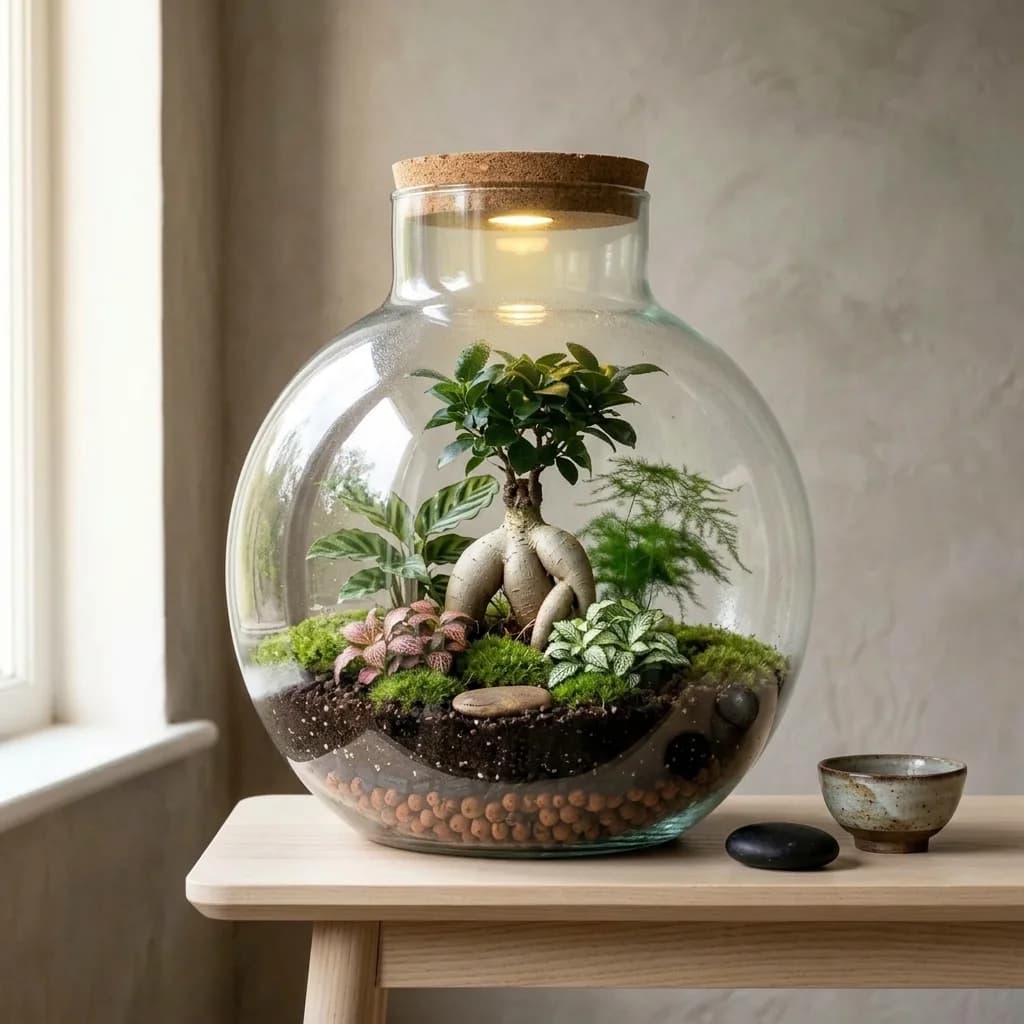


Minimalist terrarium: composing with very little
Odd numbers, deliberate empty space, a single species of moss, one well-set stone, a clean horizon line: the simple rules that hold a spare composition together, and the moves that clutter it.

In this guide
A minimalist terrarium is not composed by taking things away at the end, but by deciding at the outset how little you will put in. Three or four decisions are enough: a dominant species, a mineral accent, a horizon line, and empty space around it all. Everything else is an addition, and every addition has a price.
Empty space is part of the composition
In a crowded composition the eye has nowhere to settle. In a spare one, empty space does the work: it isolates the subject, gives it scale, and leaves the gaze somewhere to rest.
In practice, aim for one third of the surface occupied and two thirds bare. In a jar twenty centimetres across, that means a planted area of about seven centimetres, with the rest in close-cropped moss, sand or visible substrate. It is very little. It is also what gives the scene its calm.
Empty is not the same as nothing: it is a worked surface. A sheet of moss trimmed short, raked sand, dark substrate smoothed with a spoon — these continuous textures are the silence of the composition.
The rule of odd numbers
Set down two stones of similar size: the eye compares them and looks for the axis of symmetry. Set down three, of different sizes, and it reads them as a group, with one main stone and two satellites.
The rule applies to everything countable in the terrarium.
- One main subject: the dominant stone, or the tallest plant.
- Three elements in a mineral group, in three clearly different sizes.
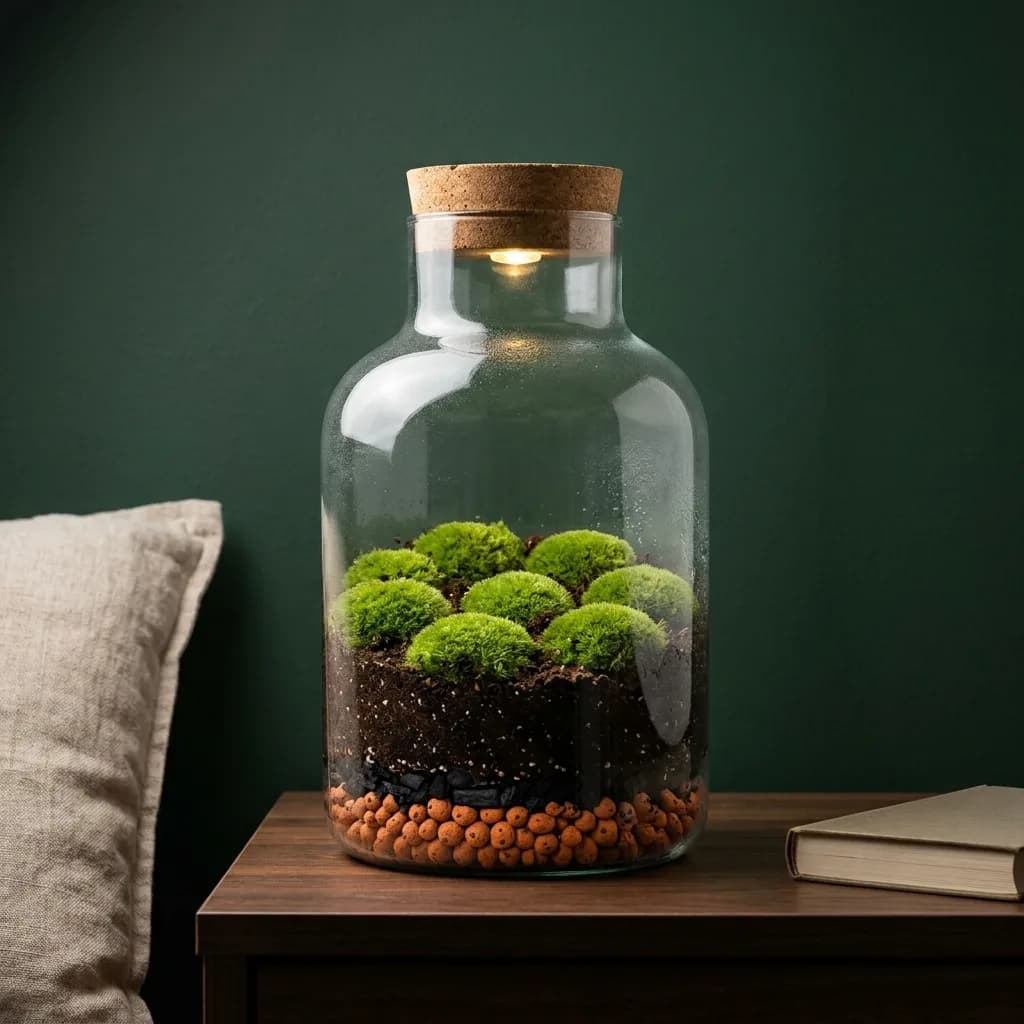
- Five cushions of moss at most in a small container, if you are after relief.
The other side of the rule is asymmetry. Never place the subject at the exact centre of the container: offset it by about a third of the width, and leave the empty space on the opposite side. In a round jar this creates a focal point that works from every angle.
A single species of moss
This is the choice that changes everything. A terrarium mixing three different mosses shows three greens, three textures, three heights — it becomes a sampler rather than a landscape.
A single species, laid as a continuous sheet, gives a calm, readable surface. The two main families behave differently:
- cushion moss (Leucobryum) forms rounded grey-green domes that keep their relief for months. It sculpts the ground and suggests hills;
- flat moss (Hypnum) carpets, follows the shapes beneath it, and underlines existing relief without creating any.
The comparison Cushion moss or flat moss sets out the choice, and the Moss range the species available. If you want a second texture, take it from elsewhere: a small fern, a selaginella, never a second moss.
The stone, and why it goes in at an angle
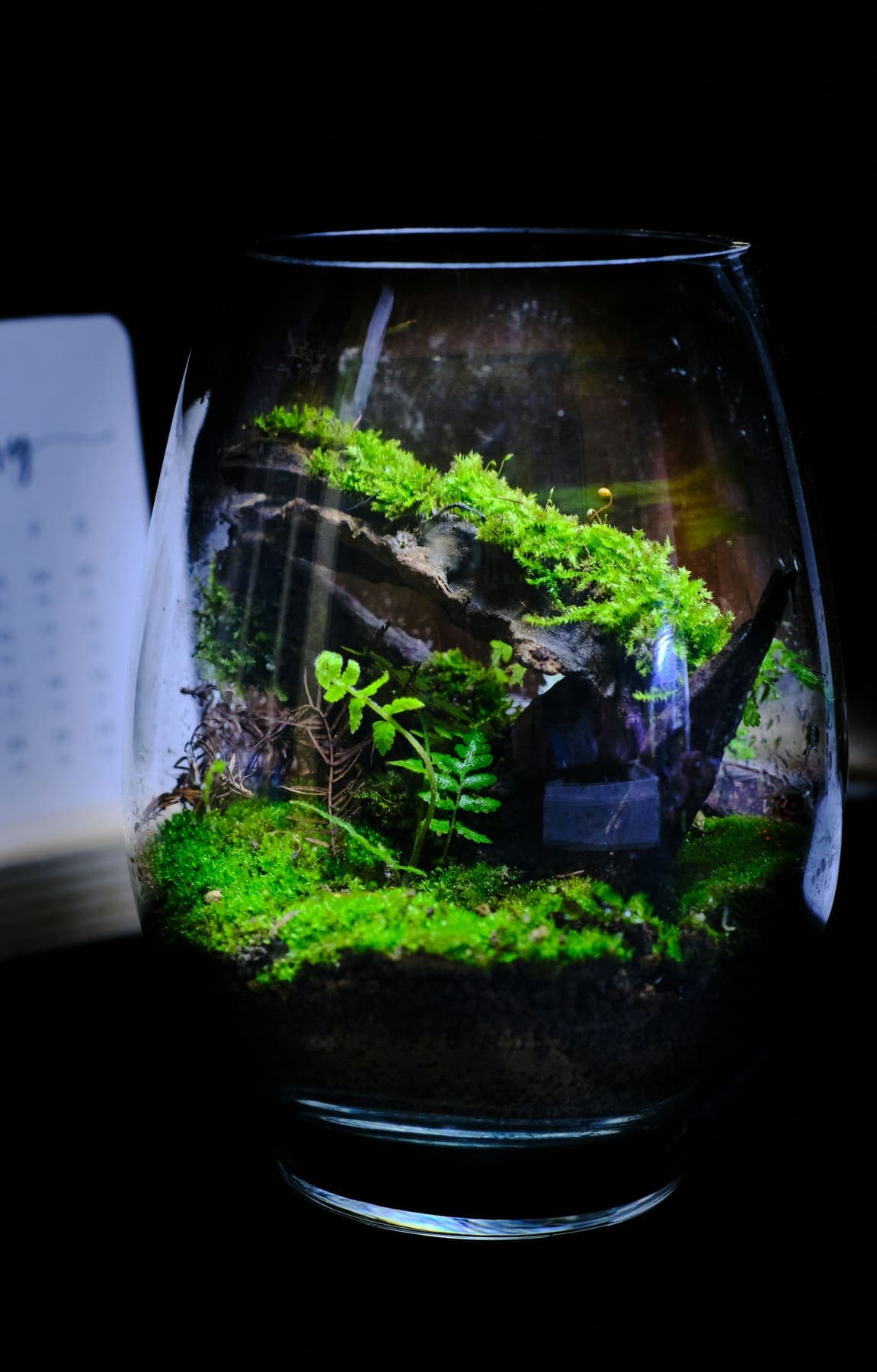
A stone set square, flat on its base, looks like an object put down. A stone tilted slightly, a third of it sunk into the substrate, looks like an outcrop: the ground seems to have carried it there.
Three moves are enough to make it convincing.
- Bury it. A third of its volume below the substrate. A rock touching the ground only at its base floats visually.
- Tilt it. Five to fifteen degrees, in the direction of the general slope of your composition.
- Line up the grain. If the stone is banded, orient its lines the same way as those of the other stones. In nature, a single geological layer always surfaces in the same direction.
Choose rock with pronounced texture, dark for preference: a mossy stone, a piece of volcanic rock, a slate. Round pale pebbles, very easy to find, are the hardest to integrate — they read as decoration, not as terrain.
The horizon line
This is the detail people notice without being able to name it. In a spare terrarium the surface of the substrate should not be flat and level: it should fall slightly to one side, like a hillside.
A slope of 10 to 20 per cent is enough, that is two to four centimetres of drop over twenty centimetres of width. Raise the substrate at the back and lower it at the front: the apparent depth doubles, and the eye enters the scene instead of stopping at the glass.
Keep that line clean against the wall. Substrate rising in an uneven wedge along the glass looks like a landslide. A stroke of a soft brush along the wall, once the build is finished, straightens the line in seconds. The guide The layers of a terrarium is a reminder of the build order below that visible line.
The five mistakes that clutter a composition
Figurative decoration. A figurine, a miniature bridge, a little bench: they impose a scale and tell a story on your behalf. A minimalist landscape lives precisely on an undetermined scale.
Coloured gravel. White sand or turquoise gravel pulls the eye harder than any plant. If you want sand, take it in the tones of the substrate, one or two shades lighter.
Filling the corners. The urge to fill the bare areas near the glass is strong. It is exactly what you should not do: those empty margins are what give the scene air.
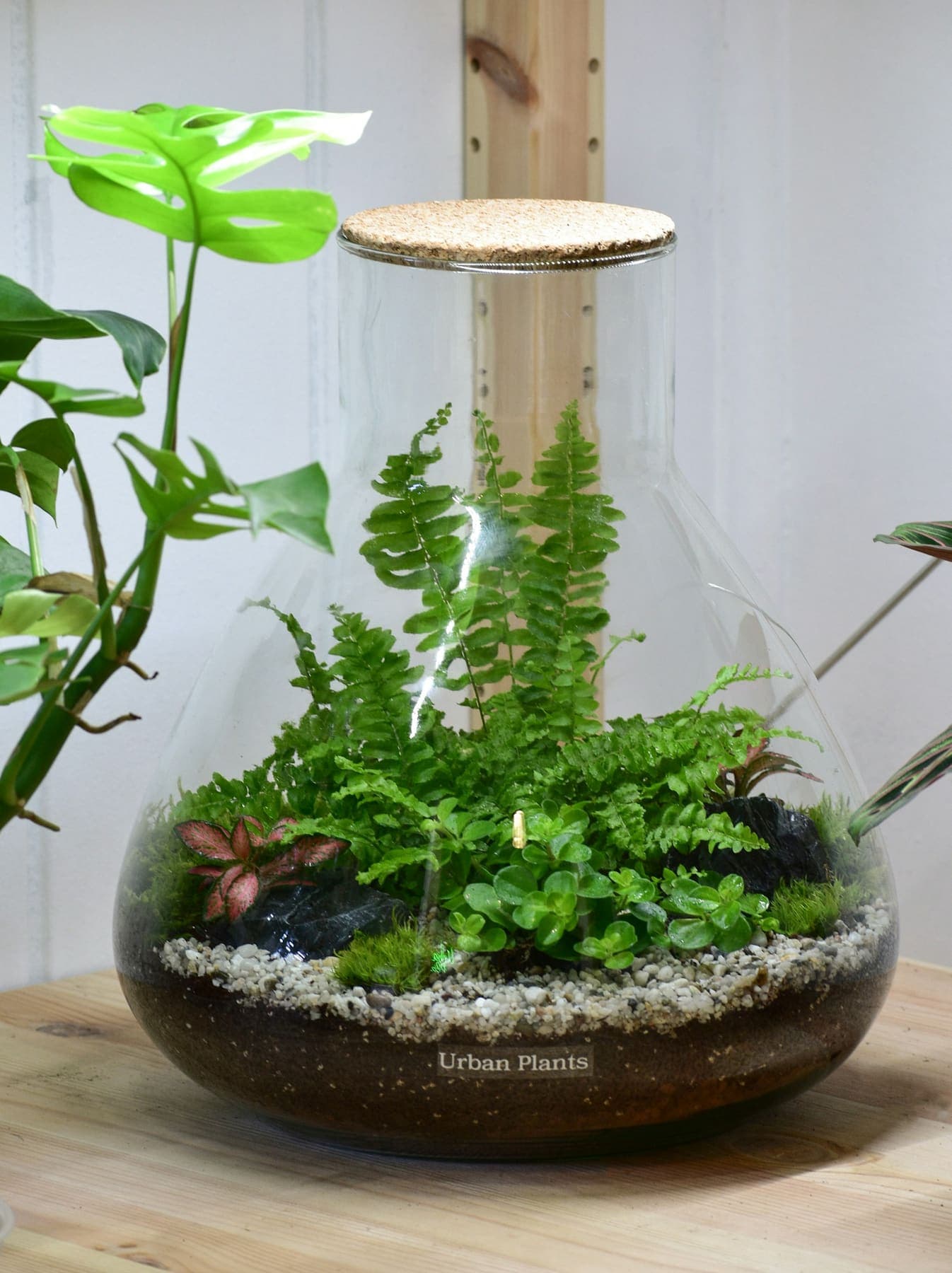
Three fittonias in three colours. One coloured plant at most, and one colour. Two accents cancel each other out.
Wood that is too large. A root running the whole width of the container becomes the subject in spite of you. A short piece, set diagonally and partly buried, suggests more.
The container counts as much as its contents
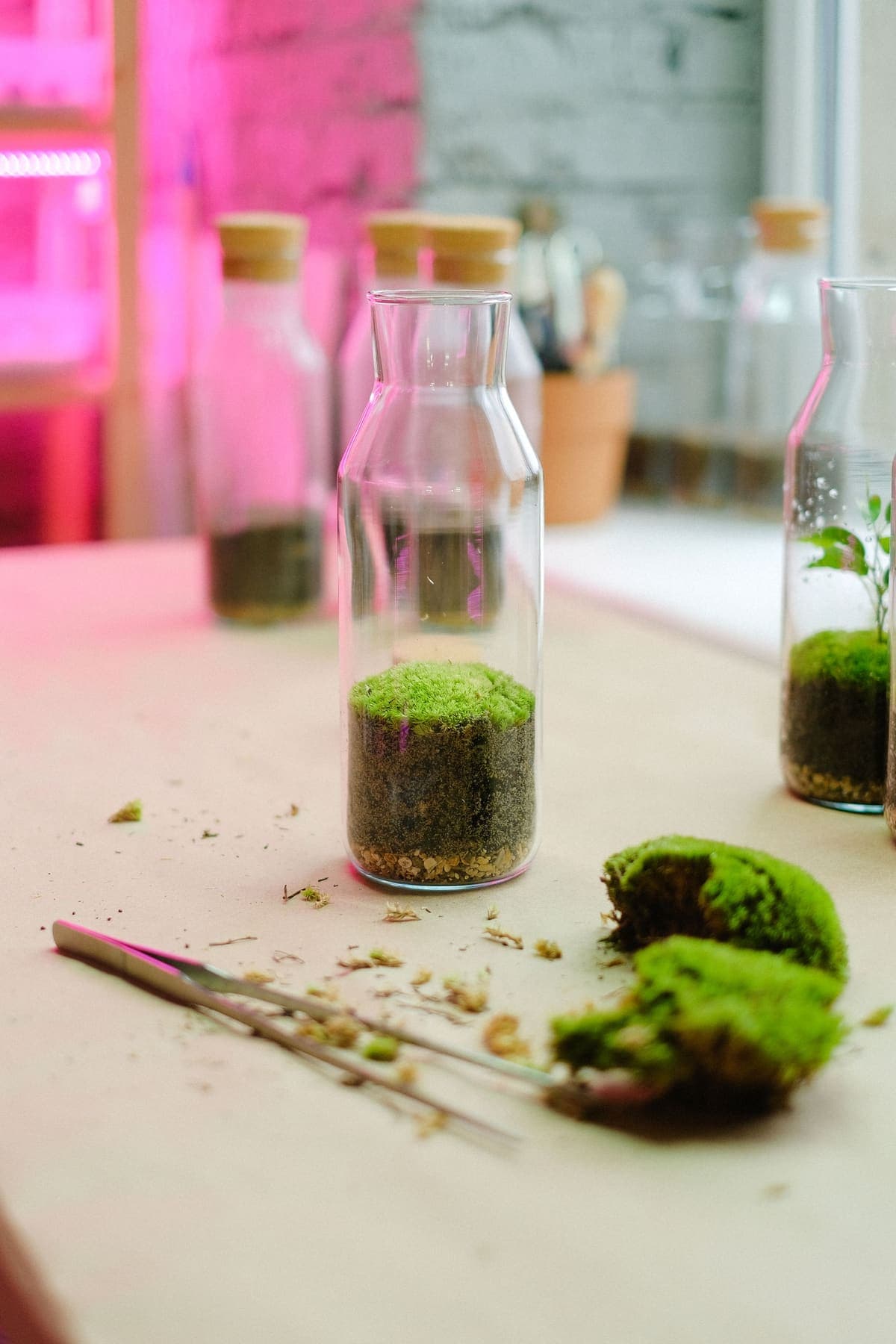
Thick, greenish glass with uneven walls blurs a spare composition. Thin, clear glass in a simple shape — a cylinder, a sphere, a straight flask — disappears and lets the scene be seen.
Narrow-necked shapes suit minimalism particularly well: they physically forbid putting in too much, and their reduced opening frames the landscape like a lens. The comparison Carboy or jar sets out what each shape allows, and the Closed containers range gathers the suitable models.
To keep a spare composition over time, pruning counts for more than watering: one shoot too many breaks the balance within weeks. The guide Pruning a terrarium gives the rhythm and the technique, and Terrarium ideas offers other scenes if this one feels too austere to you.
Frequently asked questions
How many plants go in a minimalist terrarium?
One to three, never more. In a container under five litres, a single species of moss and one accent — a stone, a small fern — is enough. The effect comes from the empty space left around them, not from the number of elements.
Why odd numbers?
An even number invites the eye to pair the elements and look for symmetry. An odd number — three stones, five cushions — reads as a natural group, with a main subject and its companions. It is a convention of composition, not a botanical rule.
Are a Japanese terrarium and a minimalist terrarium the same thing?
The principles overlap: asymmetry, active empty space, restrained materials, a single dominant plant. The Japanese tradition of kokedama and moss landscapes goes further in restraint, often with no flowers or bright colour at all. A minimalist terrarium borrows from it freely.
Does a spare terrarium need less care?
A little less, since a single species has a single need. On the other hand every flaw shows: a yellow leaf, a mark on the glass, a stone out of place. Care is lighter but more regular.