

Small creatures in a terrarium: which to keep, which to treat
White dots that jump, mites on the wood, gnats, aphids, mealybugs: identifying what lives in your terrarium and knowing what to do, family by family.
In this guide
Faced with a white dot moving in a terrarium, the short answer fits in three lines. If it jumps and has no wings, it is a springtail: keep it, it is working for you. If it crawls slowly on the wood, it is a harmless mite: leave it alone. If it flies, if it is green and clustered on a new shoot, or if it forms a cottony mass in the crook of a leaf, then there is a real problem, and each one is treated differently. A terrarium is not a sterile environment, and it was never meant to be.
The identification table
| What you see | What it is | Verdict |
|---|---|---|
| White dot that jumps, no wings | Springtail | Keep |
| Grey armoured creature, under the wood | Woodlouse | Keep |
| Slow white dot on damp wood | Detritus-feeding mite | Harmless |
| Small black fly in flight | Fungus gnat | Treat |
| Green clusters on new shoots | Aphid | Treat |
| White cottony mass in a leaf crook | Mealybug | Treat quickly |
What to keep
Springtails
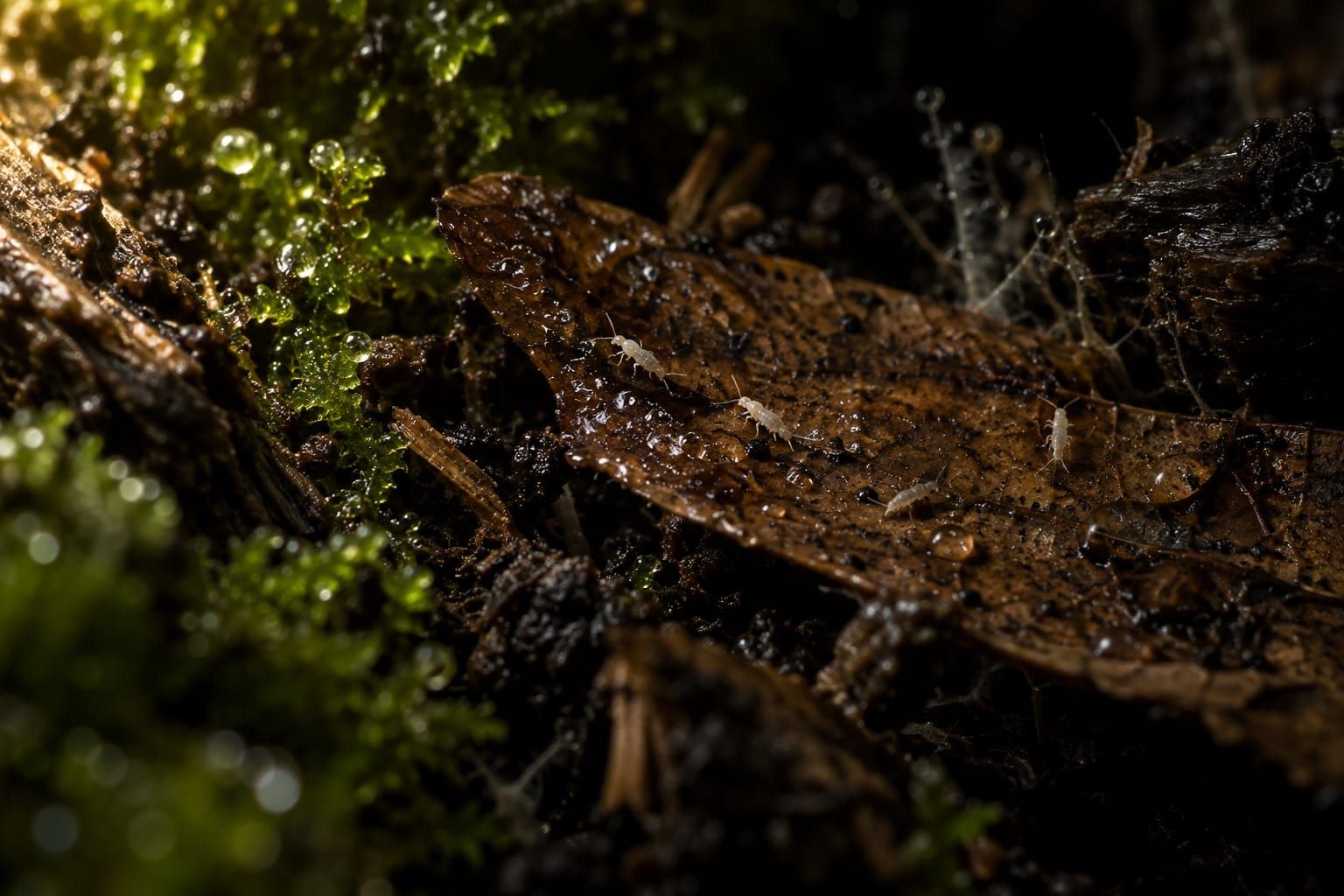
These are the most numerous and the most useful. Tiny, wingless, often white but not always, they live at the surface of the substrate and under fallen leaves. Many of them jump suddenly when you lift the lid, which gives them away.
What they eat: decaying organic matter, microscopic moulds, fungal spores. They leave roots and living foliage alone.
What to do: nothing. Their population regulates itself according to the food available. A sudden explosion simply means there is a lot of dead matter, so often an excess of humidity to correct. The guide devoted to springtails in a terrarium covers introducing them deliberately, and the limits of doing so.
Woodlice
Grey, armoured, three to ten millimetres, they hide under the wood and the leaves and only come out in the dark. They are crustaceans, not insects. They grind up the dead plant matter that springtails cannot tackle, and produce a very fine compost.
What they eat: dead wood, fallen leaves, decaying bark.
What to do: leave them, with one reservation. In a small volume with little leaf litter, too dense a population ends up nibbling tender new shoots and the moss. Add dry fallen leaves rather than reducing the population. This is how things work in The bioactive terrarium.
What is harmless
White mites on the wood
On a freshly installed root that stays constantly damp, you sometimes see a white dust that moves very slowly. These are detritus-feeding mites, which live on the microscopic fungi and the decaying wood. They do not bite, do not fly and do not attack plants.
What to do: nothing, other than wait. Their numbers drop by themselves once the surface layer of the wood has been eaten and the surface humidity falls. They often come along with small fungi on the wood, which are part of the same process of decay.
One exception to know about: red or brown mites, together with very fine webs between the stems and leaves speckled with pale dots, are spider mites. Those are harmful, but they hate humid air and practically never settle in a closed terrarium. Their presence signals an environment that has become too dry, dealt with in Terrarium too dry.
What is a real problem
Fungus gnats
Small black flies of two to four millimetres, which fly sluggishly and land on the glass. The adults are harmless; it is their larvae, in the first few centimetres of substrate, that eat the fine roots and weaken young plants.
Why they are there: a substrate kept damp at the surface all the time. That is exactly where they lay.
What to do: let the top two centimetres of substrate dry out between waterings, water with a pipette against the wall rather than over the surface, and remove the dead leaves that feed the larvae. The guide Fungus gnats in a terrarium gives the full procedure.
Aphids
Green, black or pink, in tight clusters on new shoots and under tender leaves. They pierce the tissue, draw out the sap, distort the new leaves and leave a sticky honeydew on which black moulds then settle.
What to do: act early, the numbers double within a few days. Take off the most heavily colonised shoots with tweezers and throw them out of the house. Wipe the rest with damp cotton wool, leaf by leaf. Repeat every three days for two weeks, long enough for the eggs to hatch and be removed in their turn. In a small enclosed volume, this patient removal by hand gives better results than any treatment.
Mealybugs
These are the most stubborn. They appear as small white cottony masses, in the crook of leaves, at the base of stems, sometimes on surface roots. Under the cotton hides a motionless insect drawing out sap. An affected plant weakens for no obvious reason, and people spend a long time looking for the cause in their watering.
What to do: touch each mass with a cotton bud dipped in 70 % alcohol, which dissolves the waxy protection and kills the insect on contact. Work plant by plant, without letting the alcohol run onto the substrate. Check every week for a month: the young larvae, mobile and tiny, always escape the first pass. A badly affected plant in a small terrarium is better taken out than treated.
Three habits that prevent most of the trouble
- Inspect plants when you buy them, under the leaves and in the crooks of the stems, before putting them in. That is where everything comes in.
- Keep the surface of the substrate on the dry side and the inside fresh. That one habit alone gets rid of fungus gnats and calms the mites. The amounts are in Watering a terrarium.
- Remove dead matter every month, with tweezers, as set out in Caring for a closed terrarium. Less dead matter means fewer larvae and less mould.
A terrarium inhabited by a few springtails and two or three woodlice is not a dirty terrarium: it is a terrarium that works. The long-handled tools that let you work without putting your hands into the bottom of the jar are in the Tools section.
Sources
Frequently asked questions
Are the small white creatures that jump harmful?
No, they are almost always springtails. They eat dead matter and the microscopic fungi in the substrate, leave living plants alone, do not bite and do not leave the jar. Their presence is a good sign in a closed terrarium.
How do you tell a springtail from a fungus gnat?
A springtail has no wings: it moves about on the substrate and jumps when disturbed. A gnat flies, circles the glass and lands on the pane. If something flies, it is not a springtail, and the treatment is not the same.
Should you treat a terrarium with an insecticide?
In a closed container, an insecticide is almost always a bad idea: it also kills the useful microfauna and stays trapped in an enclosed volume. Real problems are settled by removing pests by hand, drying the surface of the substrate and, for mealybugs, a cotton bud dipped in 70 % alcohol.
Where do these creatures come from if the terrarium is closed?
They arrive with the plants, the substrate, the moss or the wood, as invisible eggs or larvae. A closed terrarium is not sterile, and it does not have to be. The question is not how to keep them out, but which ones to let live.