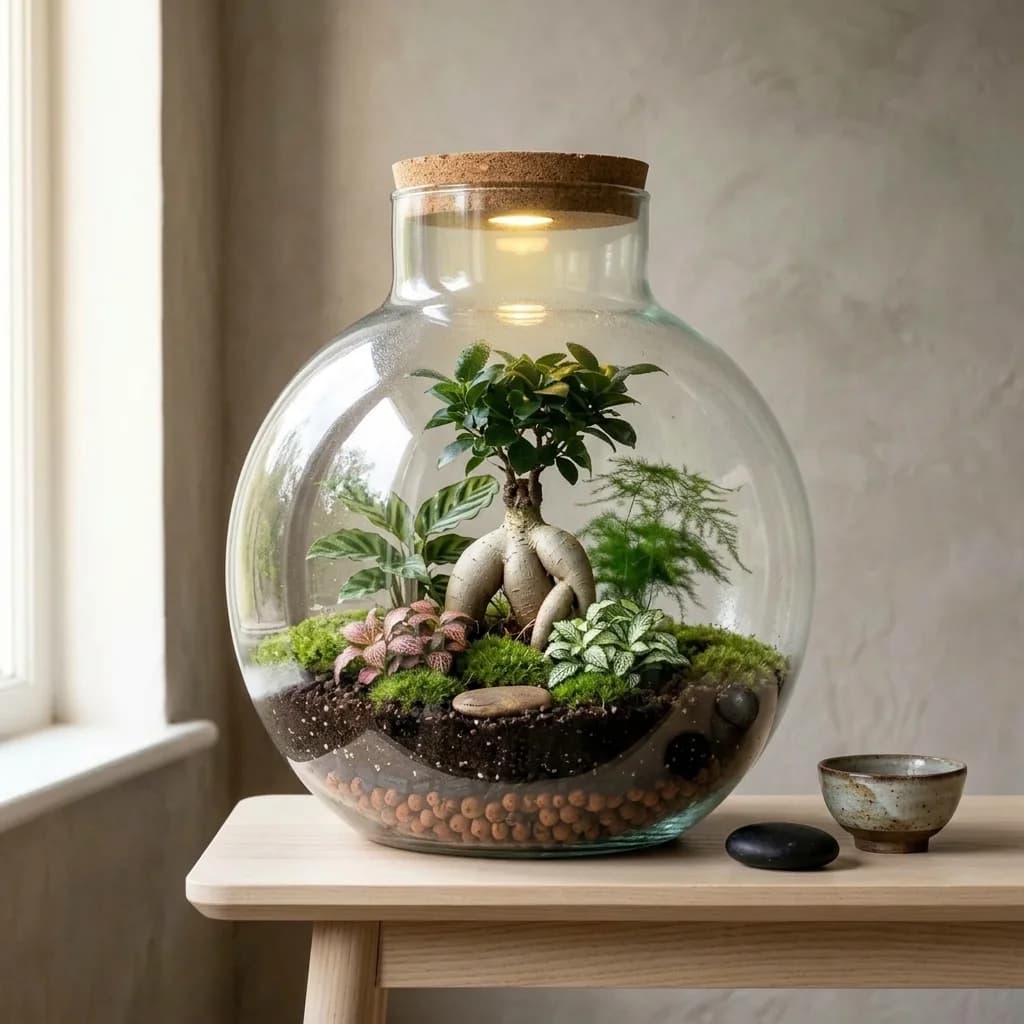


Demijohn or jar: which container for a terrarium
Narrow-necked demijohn, wide-mouthed jar, cloche on a base, geometric terrarium: what you can build in each, how hard the work really is, upkeep over the years and the price.
In this guide
The container decides almost everything: the plants you can use, the difficulty of the build, how often you will need to step in, and how long the composition lasts. For a first terrarium, the wide-mouthed jar is the right choice in more than nine cases out of ten. The narrow-necked demijohn makes the finer object, but it asks for tools, method and a tolerance for imperfection.
The comparison at a glance
| Container | What you can build in it | Build | Usual price |
|---|---|---|---|
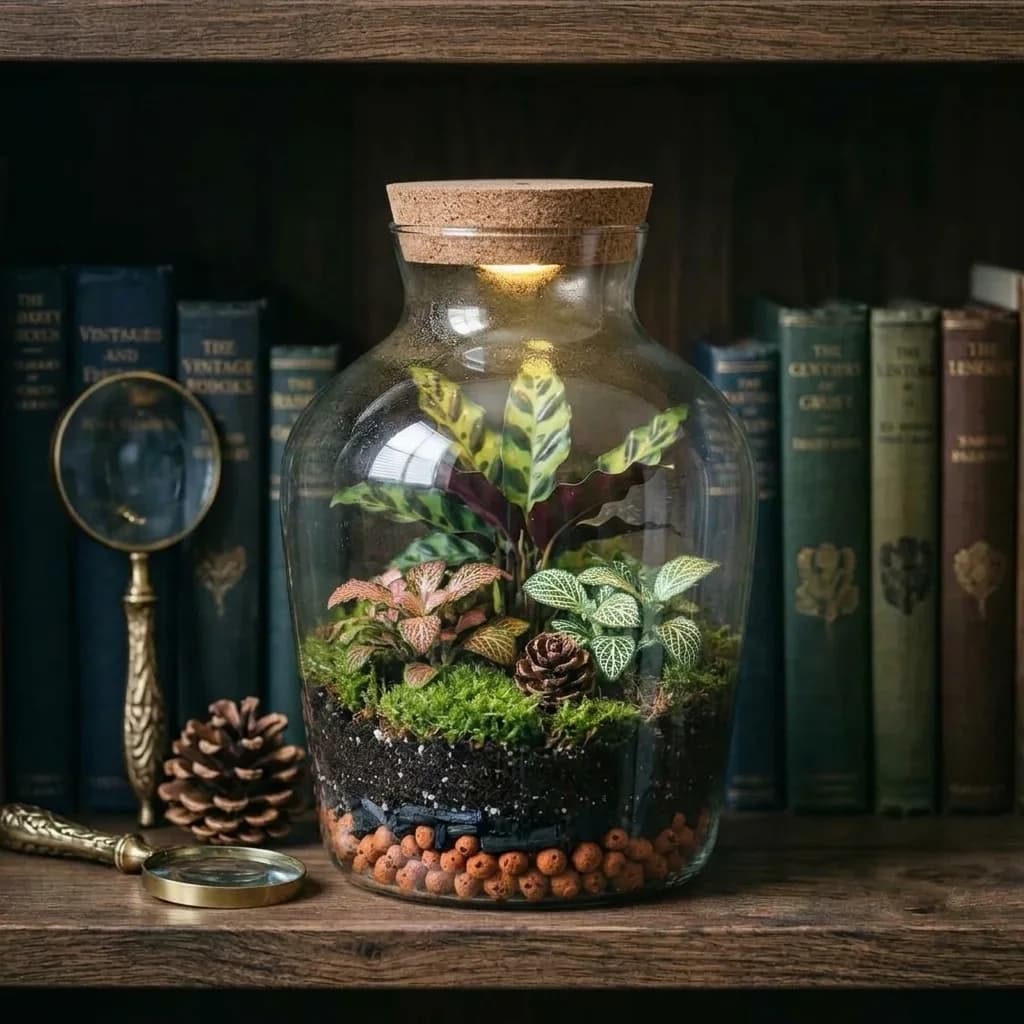
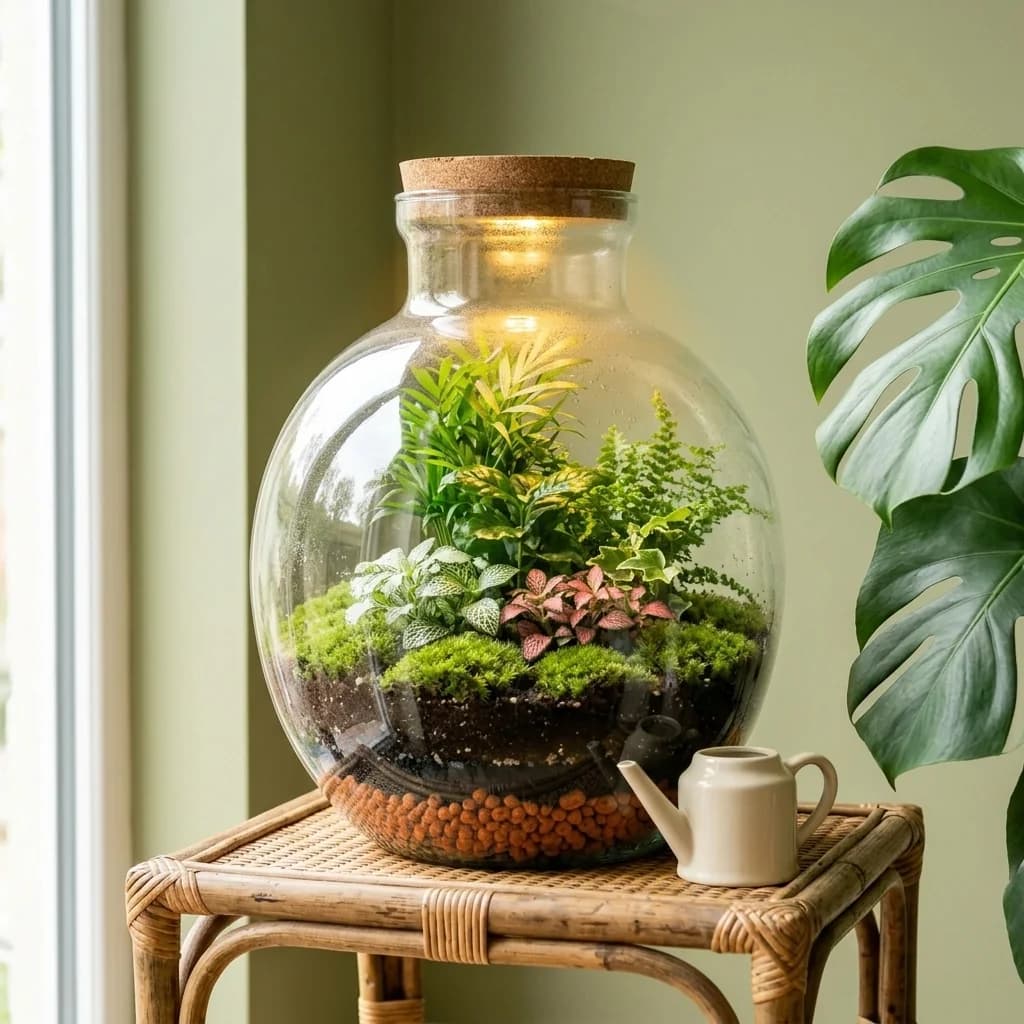
| Narrow-necked demijohn | Mosses, small ferns, closed forest floor | Difficult, with tongs | 30 to 90 € |
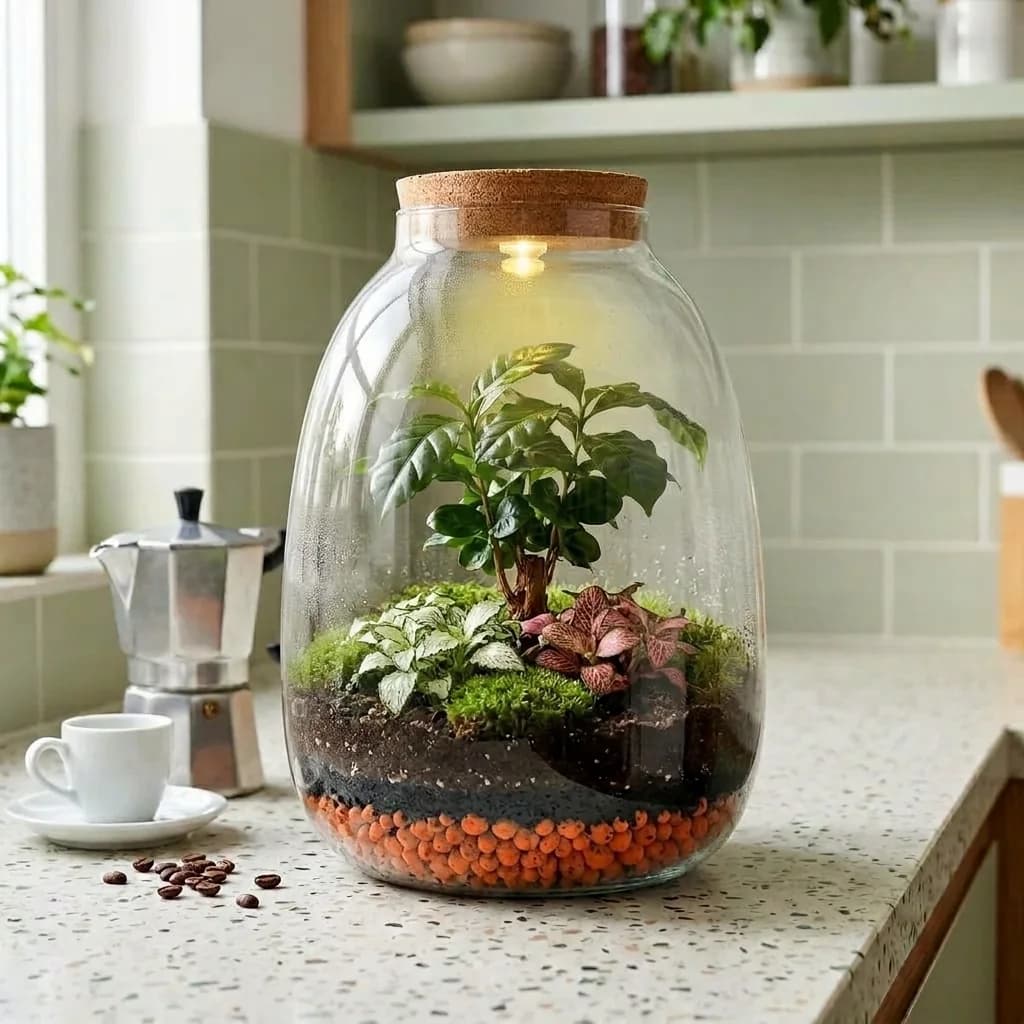
| Wide-mouthed jar | Any closed tropical terrarium | Easy, by hand | 15 to 50 € |
| Cloche on a base | Mosses, one feature plant | Very easy | 25 to 70 € |
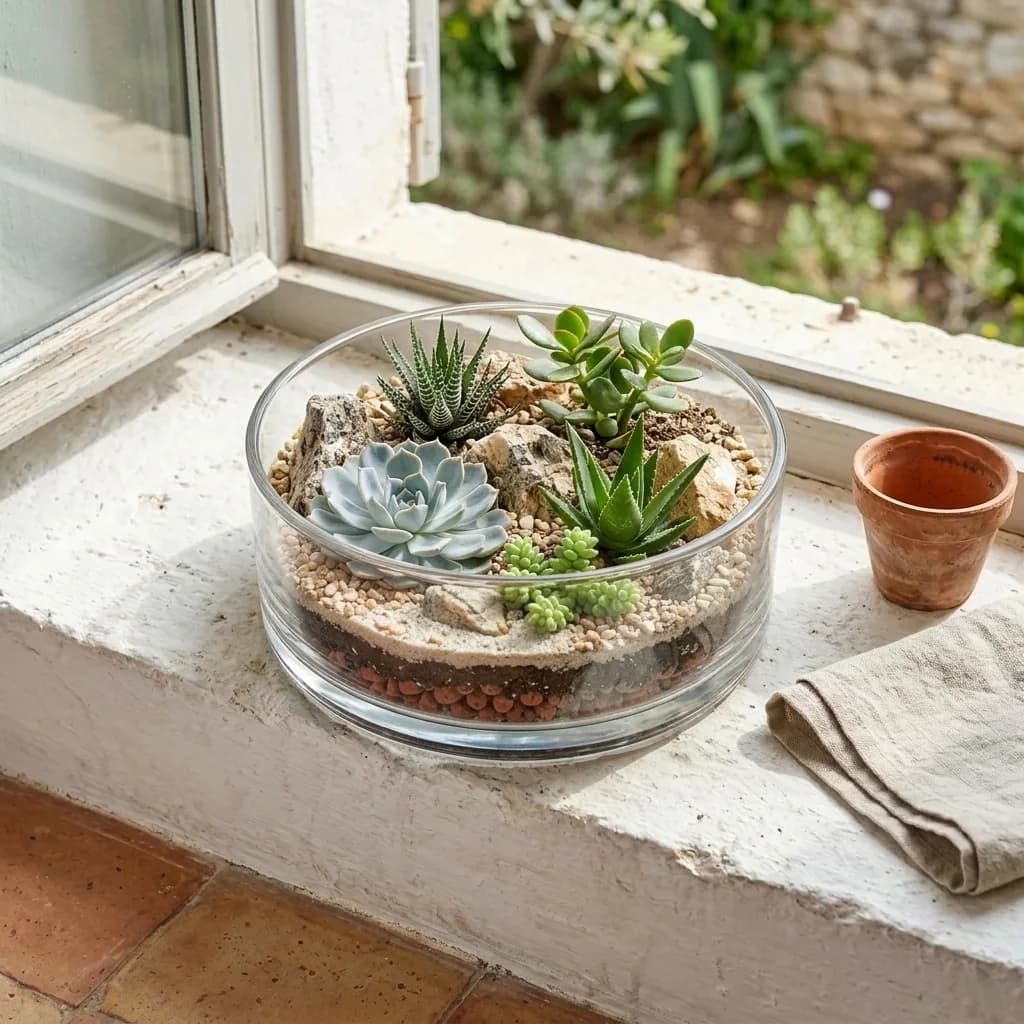
| Geometric terrarium | Succulents, cacti, air plants | Easy | 25 to 80 € |
Three criteria sit behind that table, and they are worth naming before going into detail.
How well it seals decides the humidity regime, and so the plants you can use. A lid with a gasket sets up a complete water cycle; a cloche resting on a slate leaks slowly; a panelled metal structure holds nothing back.
Access decides how hard the build and the upkeep will be for the whole life of the terrarium. It is the criterion most often overlooked at the point of purchase, and the one people regret fastest.
Proportion decides the look. A container twice as tall as it is wide gives a vertical well of greenery; one twice as wide as it is tall gives a panorama. At equal volume, they call for different compositions and different plants.
The narrow-necked demijohn
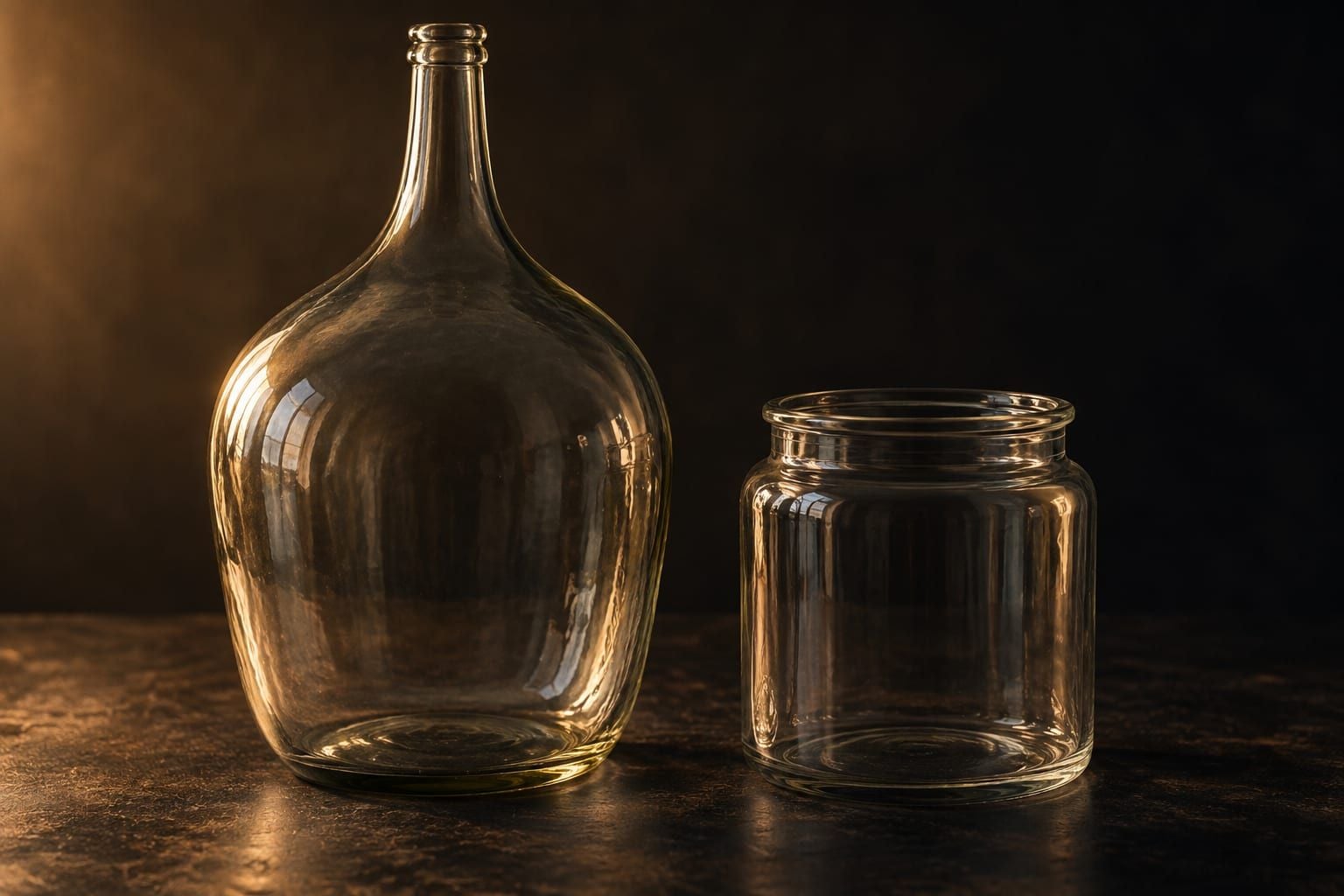
This is the shape that fascinates: a landscape shut away behind a five-centimetre neck, impossible to reach.
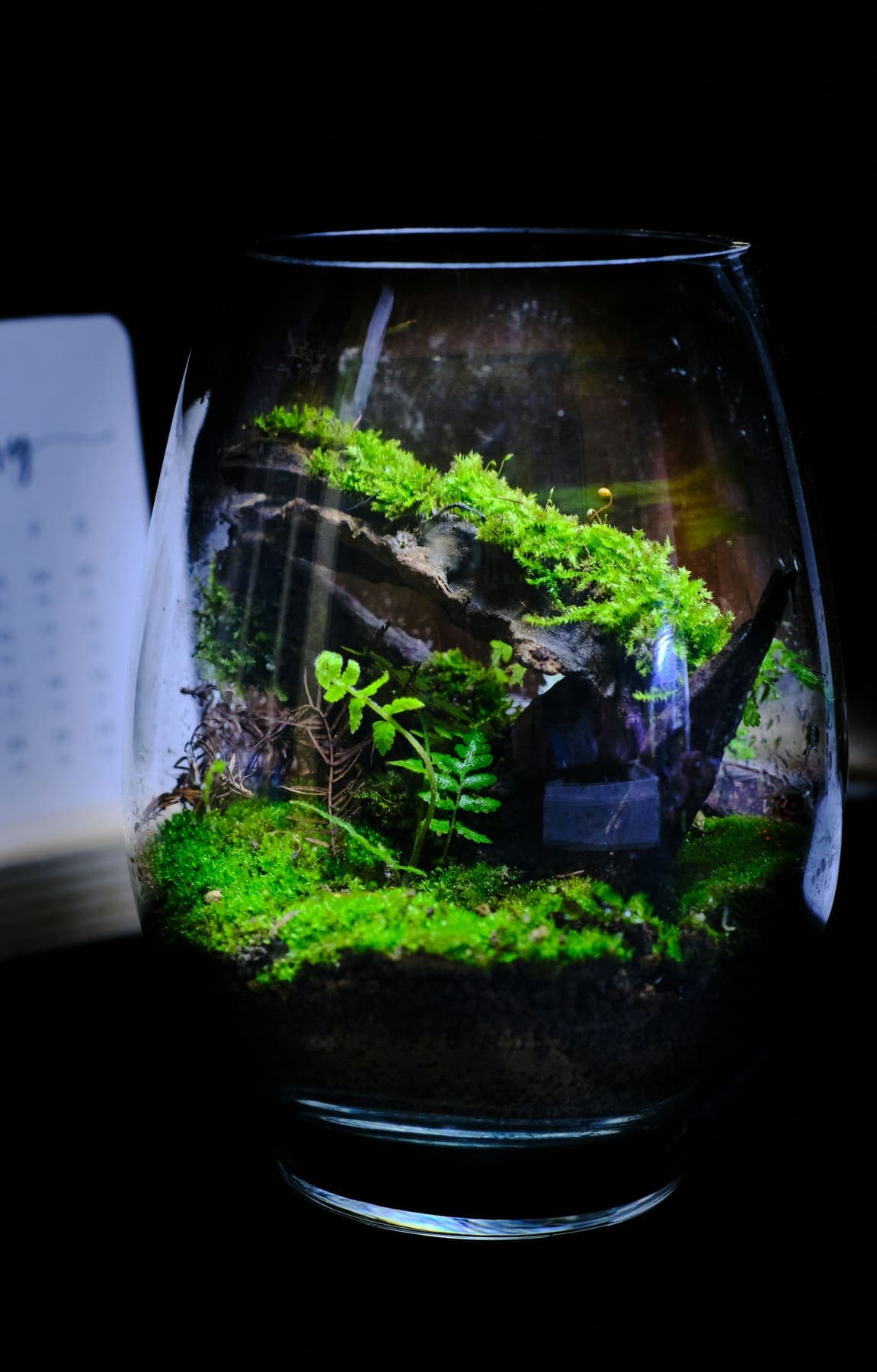
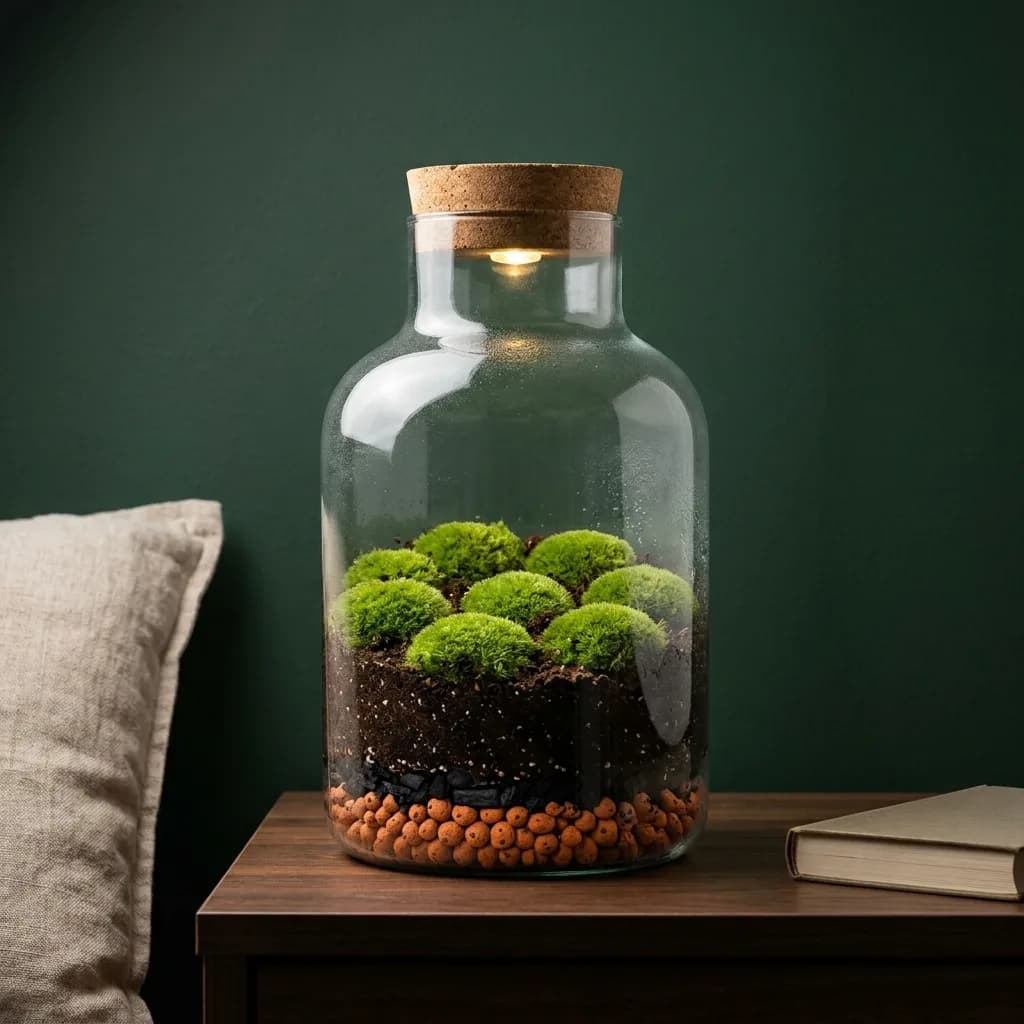
What you can build in it. A closed forest floor, and nothing else: mosses, selaginella, small ferns, one fittonia. The large volume — often 5 to 20 litres — gives it great inertia, and the tiny opening limits the exchange of air. It is the most stable container there is, the one that lasts longest without intervention.
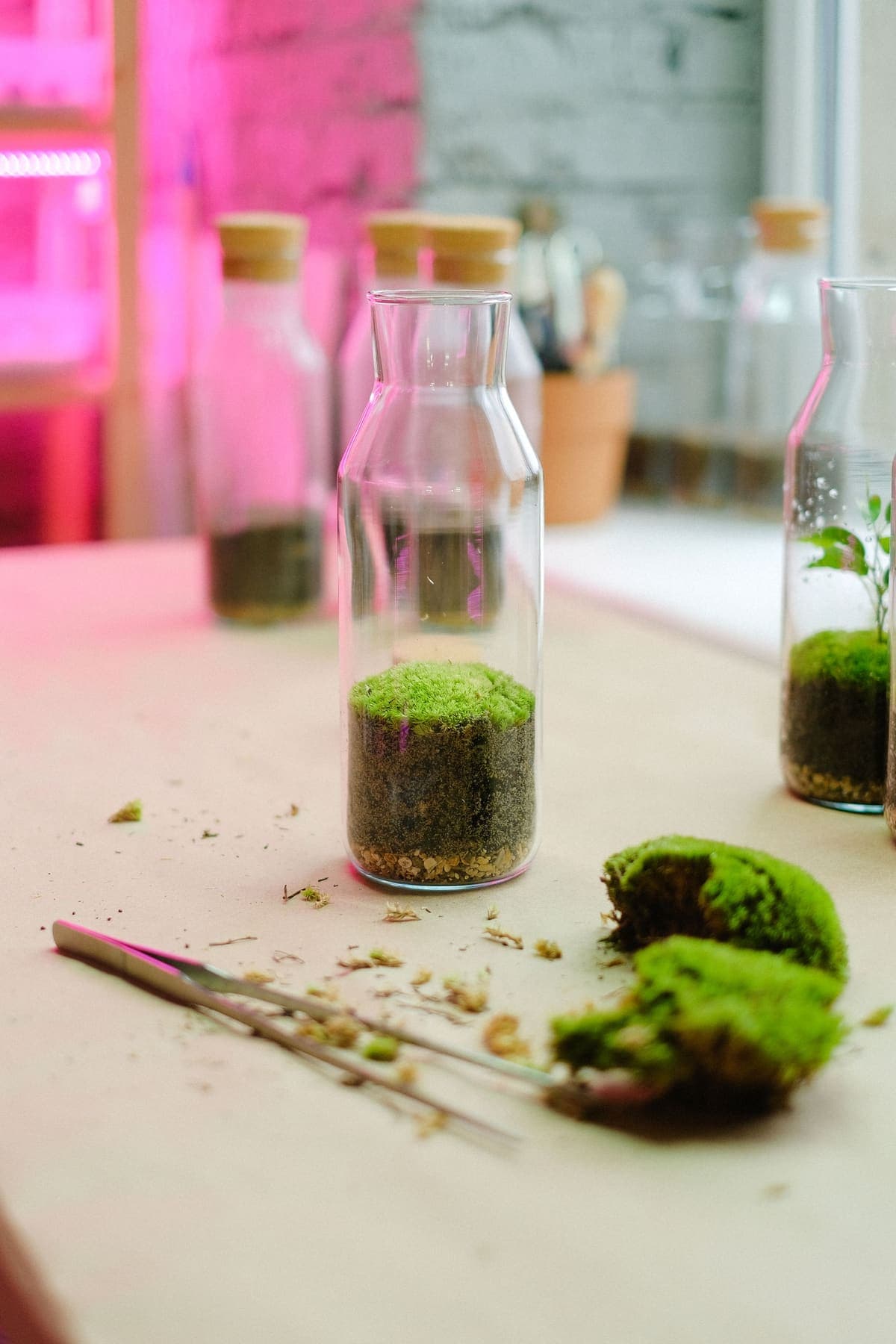
How hard it really is. People underestimate it. Everything goes in through a rolled paper funnel: drainage, charcoal, substrate. The plants go down one at a time, wrapped in a strip of paper, then unfold and are planted with long tongs. Allow two to three hours for a first build, and accept that one plant will end up crooked. The bottle terrarium tutorial covers each step, and the Tropical demijohn terrarium project shows a complete build.
Upkeep over the years. This is where it shines and where it punishes. Built well, such a terrarium lives for years without being opened. Built badly, it becomes unreachable: removing one mouldy leaf from the bottom of a ten-litre demijohn takes sixty-centimetre tongs and a great deal of calm.
The wide-mouthed jar
The sensible container, and by far the best-selling one.
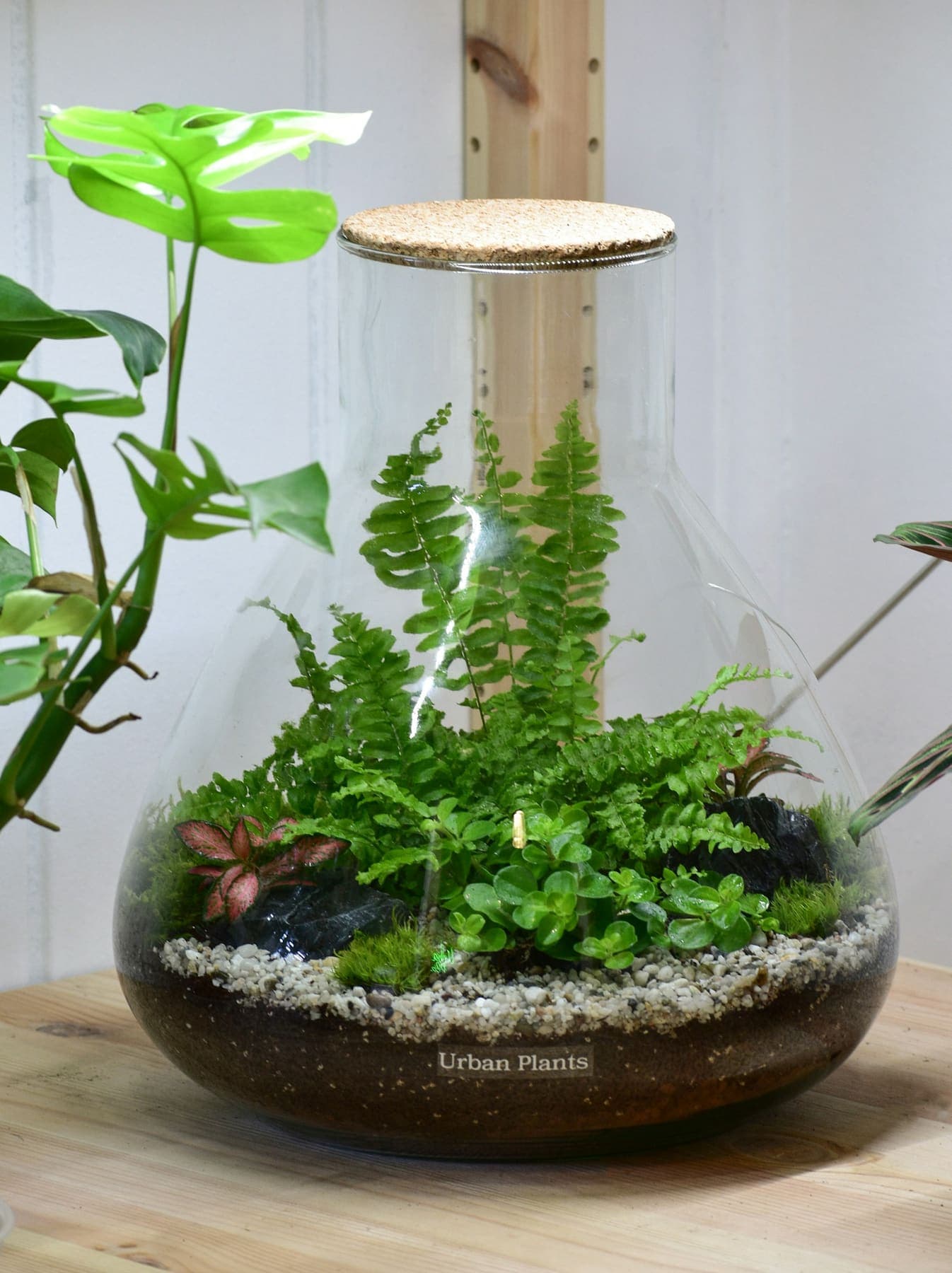
What you can build in it. Anything that lives in a closed tropical terrarium. An opening of 12 to 20 centimetres lets you shape a relief, set a stone by hand, and place a moss to the millimetre. You can also leave it open for a while to dry out surplus water.
How hard it really is. Not very. Both hands go in, tools are optional, and a mistake is corrected immediately. It is the only container that forgives improvisation.
Upkeep over the years. Excellent. Pruning, removing a dead leaf, cleaning the inside of the glass: all of it takes two minutes, with nothing to dismantle. The trade-off is slightly less stability than a demijohn, since a wide lid lets more air through. That is only a flaw on paper: most jar terrariums live happily for years.
The price. It is also the cheapest, especially if you reuse one: a five-litre preserving jar, well rinsed and stripped of its rubber seal, costs almost nothing. The Closed containers section gathers the new models, with clearer glass and better-fitting lids.
The cloche on a base
A glass dome set on a board, a slate or a shallow dish.
What you can build in it. A simple, vertical scene: a carpet of moss, one feature plant, a stone. The cloche puts a single element forward, which makes it the container of the minimalist terrarium.
How hard it really is. The easiest of all. You compose the scene flat, on the base, entirely by hand and in the open — no access constraint at all. The cloche goes on at the end.
Upkeep over the years. Simple, but more frequent. The join between the cloche and its base is never airtight: humidity escapes slowly, and the substrate needs damping every few weeks. In exchange, this half-enclosure clearly reduces the risk of mould. Mind the stability: a tall cloche on a smooth base tips over at a brush of the sleeve.
The geometric terrarium
Glass panels set in a metal frame, often brass or matt black.
What you can build in it. Succulents, cacti, air plants. Never mosses or tropical plants: the joints let air through, no water cycle sets in, and the air stays dry. It is an open container with a door, not a closed terrarium.
How hard it really is. Not very, once you understand its constraint: the side door limits access, and the sharp corners are hard to fill neatly. The mineral substrate goes in with a spoon.
Upkeep over the years. Little watering — once a month on average, less in winter — but two things to watch: the metal joints corrode if you mist them, and the inside of the glass soon dirties in the corners where you cannot easily wipe it.
The price. It varies with the finish; a brass model often goes past fifty euros. The Open containers section brings these shapes together, and the succulent terrarium tutorial gives the matching build.
How to decide
Ask yourself three questions, in this order.
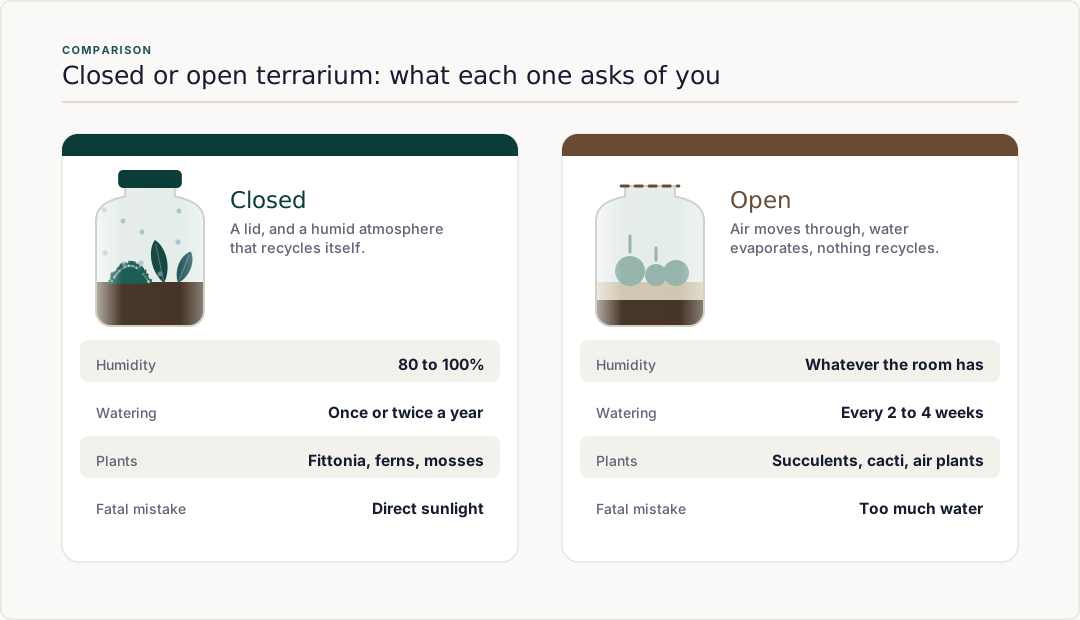
- Which plants do you want? Mosses and ferns call for a container that closes. Succulents call for one that breathes. This point is not negotiable, and the comparison Closed or open terrarium explains it in detail.
- Have you built a terrarium before? If not, take a wide opening. The demijohn is a pleasure for the experienced, not a first exercise.
- Do you want to step in often, or never? A demijohn asks for a long build and then years of being left alone. A jar asks for a short build and then regular pruning. These are two different relationships with the object, and neither is better.
To go further into materials, the guide Which container for a terrarium reviews glass quality, lids and seals.
Frequently asked questions
Demijohn or jar for a first terrarium?
The wide-mouthed jar, without hesitation. You work in it by hand, you correct a badly placed plant in seconds, and upkeep needs no special tools. The narrow-necked demijohn is an exercise in patience, best earned after one successful build.
What is the minimum opening diameter?
Below 6 cm your hand does not fit and everything is done with long tongs. Between 6 and 10 cm you work with two fingers and a paper funnel. Above 12 cm the whole hand goes in and the build becomes comfortable.
Does a glass cloche make a true closed terrarium?
Almost. A cloche resting on a base lets a little air through the join, which gives a very humid but not fully sealed setting. It is a good compromise: condensation stays moderate and the risk of mould drops.
Can a geometric terrarium stay closed?
No, its panels are set in a metal frame and the joints are never airtight. It behaves like an open container, which suits succulents, cacti and air plants rather than tropical mosses.