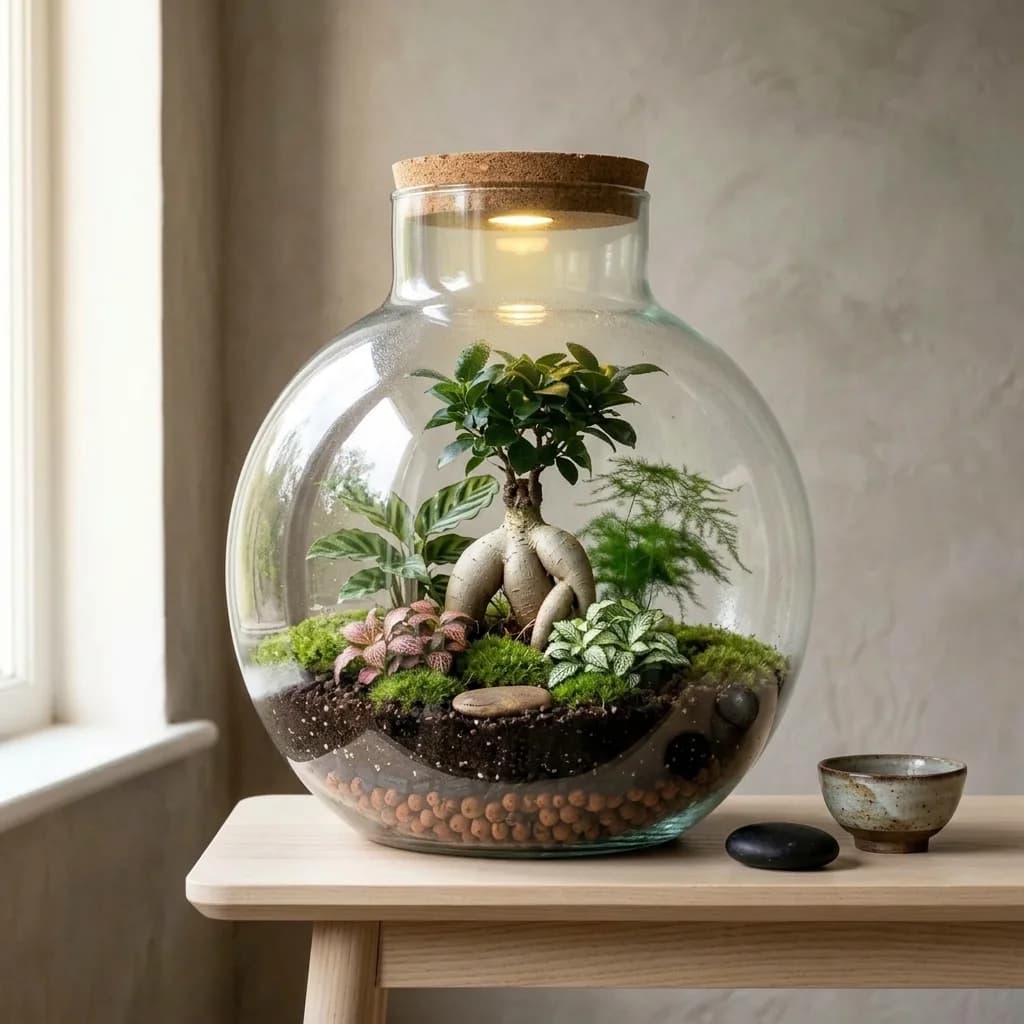


What size of terrarium should you choose to start with
A very small terrarium is harder to keep than a large one, and that is physics rather than skill. The sensible minimum volume, the opening your hand actually needs, and how many plants per litre.
In this guide
The answer comes down to two figures: five litres of volume, twelve centimetres of opening. That is the size that forgives the most mistakes, fits almost anywhere and can be built by hand without tools. The one-litre jar, so often chosen for a first attempt because it costs less and takes up less room, is in fact the most demanding format of all.
Why small is harder than large
It is a question of inertia, exactly as with a saucepan of water and a bathtub.
Thermal inertia. A one-litre jar holds roughly 600 grams of damp substrate. Leave it in a shaft of sunlight for an hour and it climbs ten degrees; by evening it drops back just as fast. A ten-litre container takes half a day to make the same journey, and the swing stays two to three times smaller. Tropical plants cope badly with rapid change: it is the swings that damage leaves, not the average temperature.
Water inertia. In a small volume, five millilitres too much amounts to a flood; in ten litres it goes unnoticed. The drainage layer of a mini terrarium is two centimetres deep and saturates after a single clumsy watering. The guides Terrarium too wet and Terrarium too dry describe the two faces of the same problem, and small formats swing from one to the other within days.
Room to grow. A fittonia reaches ten centimetres in a year. In a one-litre jar it touches the lid after four months; in ten litres it is still comfortable two years on. Small formats call for frequent pruning, as described in Pruning a terrarium.
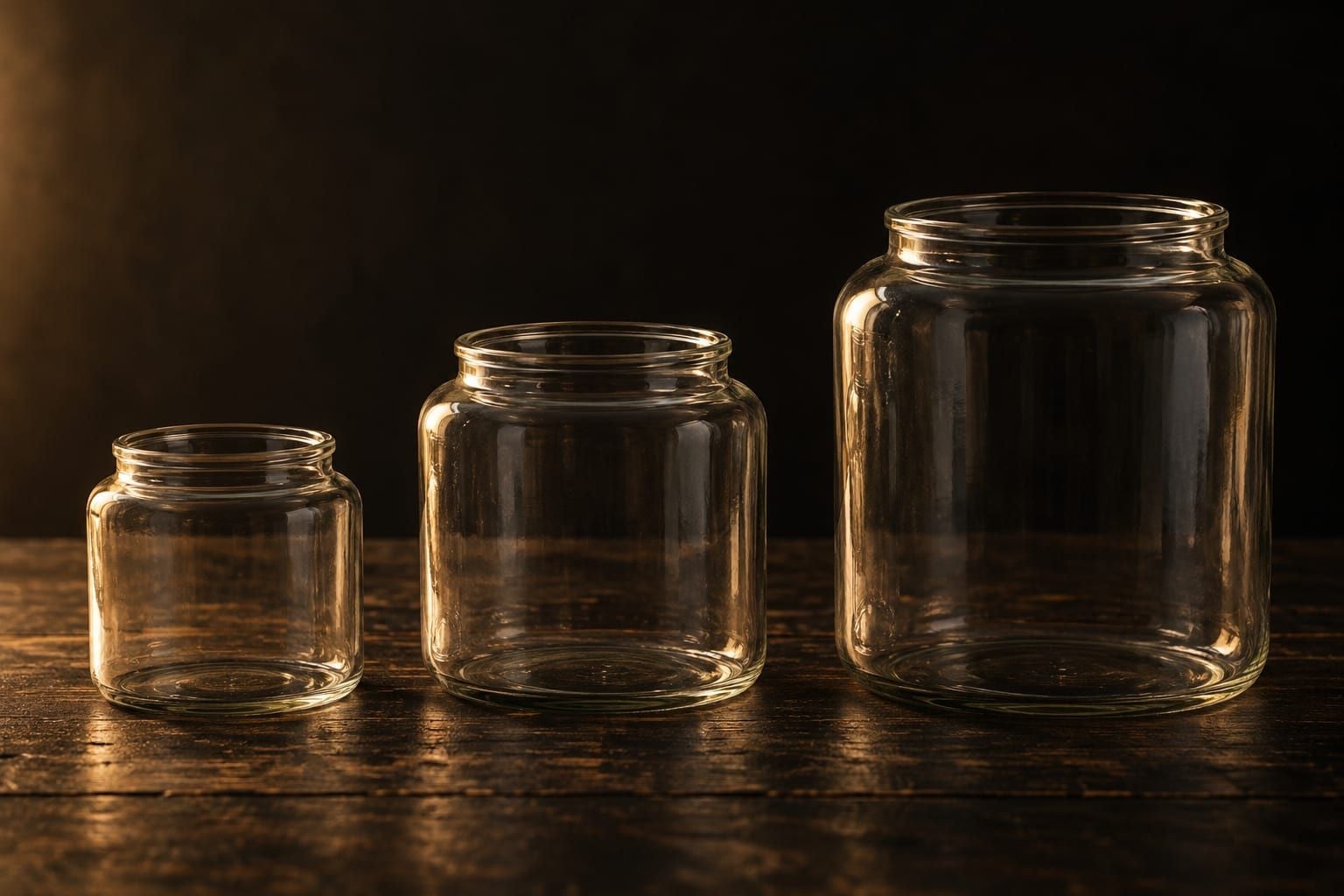
The volumes, from hardest to most comfortable
| Volume | Usable opening | Plants | Who for |
|---|---|---|---|
| 1 to 2 L | 5 to 8 cm | 1, or moss alone | Experienced hobbyist, display piece |
| 3 to 5 L | 10 to 14 cm | 2 to 4 | First terrarium, flat |
| 6 to 12 L | 12 to 20 cm | 4 to 7 | The best compromise |
| 15 L and up | 20 cm and up | 7 to 12 | Living-room piece, ambitious project |
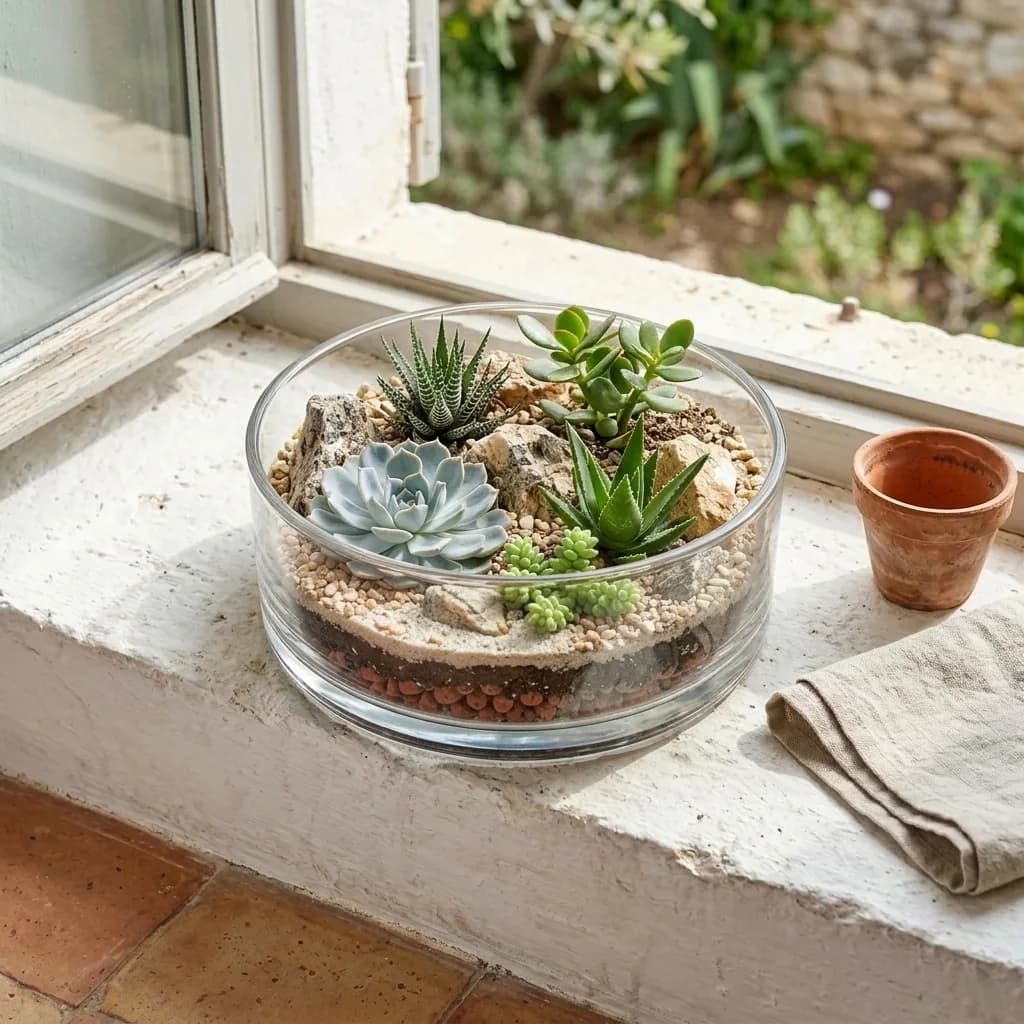
1 to 2 litres. For moss alone, or a single small plant. Charming, and very exposed. If you are set on one, never place it near a sunny window or a radiator.
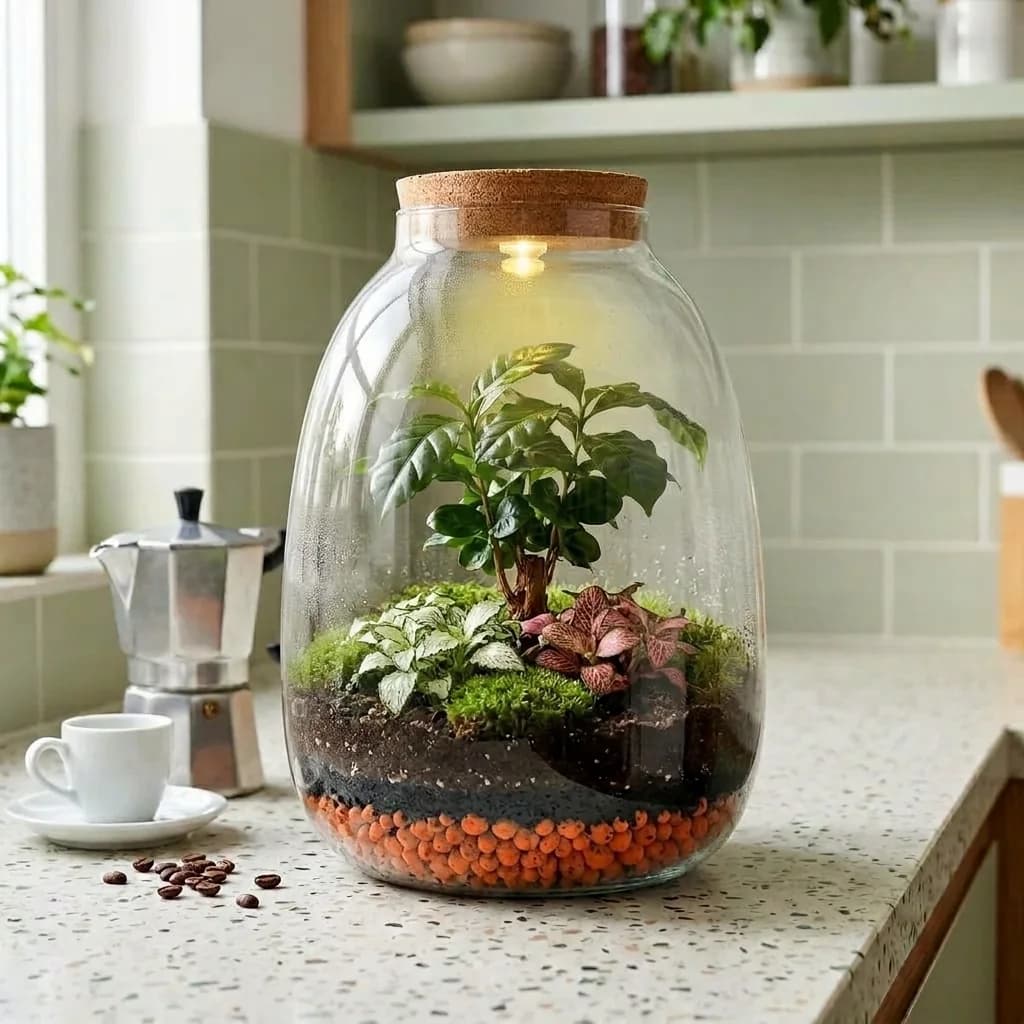
3 to 5 litres. A sound minimum for a first build. The environment holds, your hand fits through the opening, the price stays modest and the piece sits on a thirty-centimetre shelf. This is the format recommended in Terrariums in a flat.
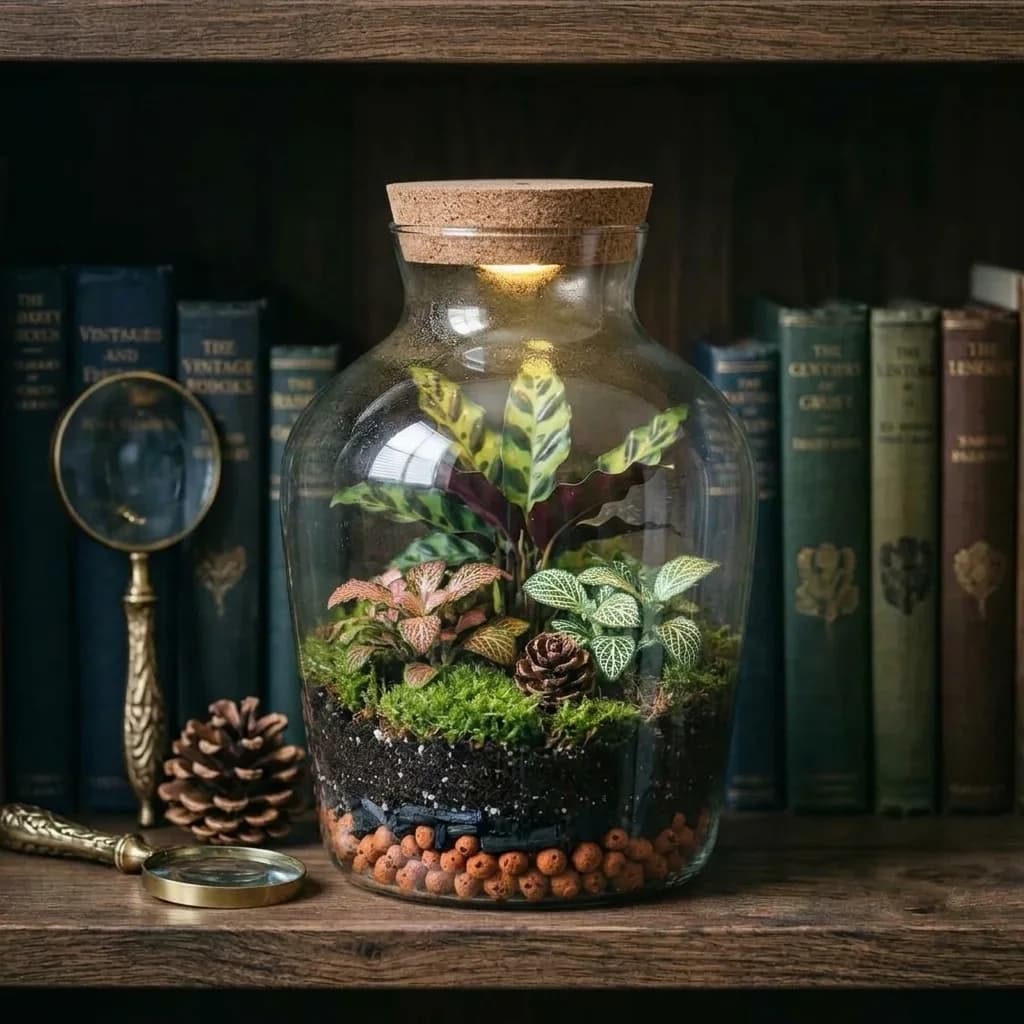
6 to 12 litres. The ideal compromise where space allows. Stability is excellent, relief becomes possible — a mound, a slope, a half-buried stone — and care comes down to two or three prunings a year.
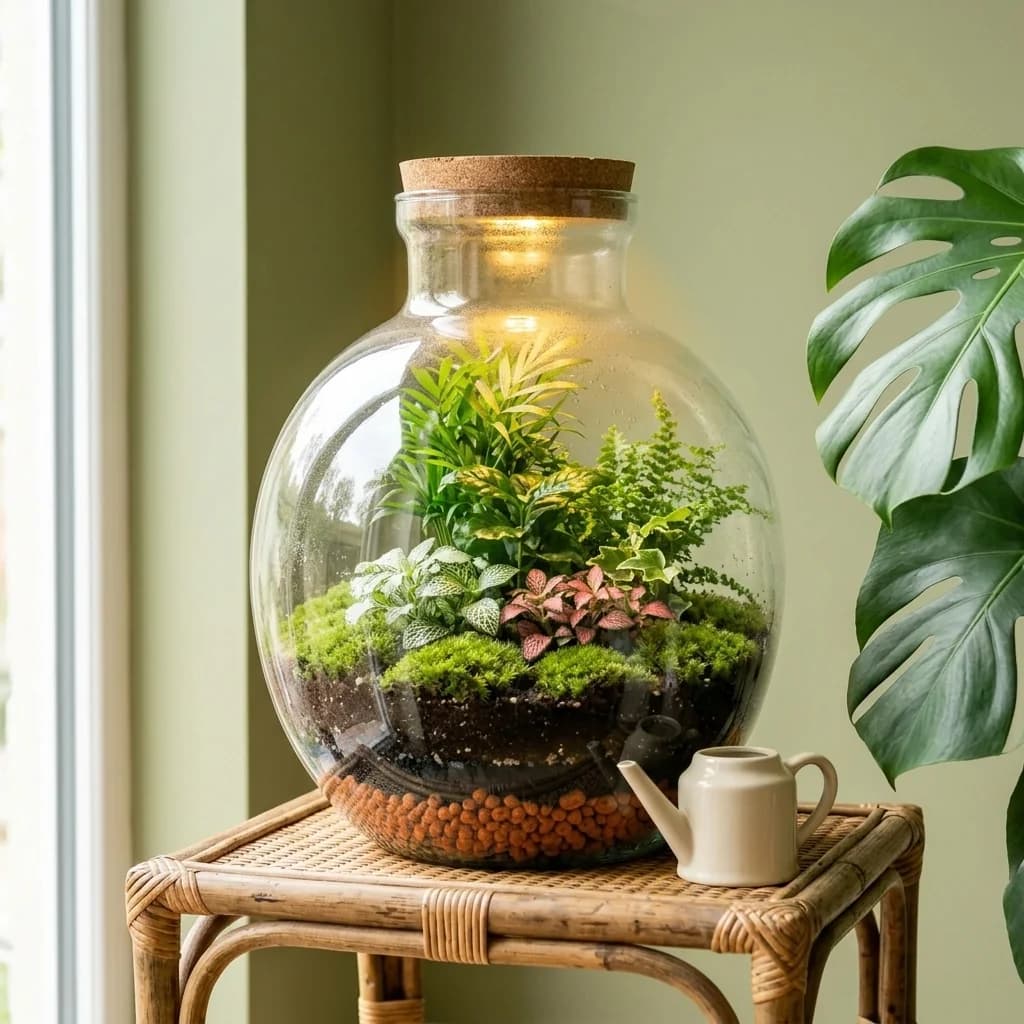
15 litres and up. A real landscape, and a real commitment: ten to twenty kilos once built, the cost of glass and plants, and no way to move it alone. Magnificent, but not a first terrarium.
The opening, and the hand working inside it
Volume tells you nothing about how easy the build will be. The diameter of the opening decides that, and the difference is stark.
- Under 6 cm: nothing fits. A paper funnel for the substrate, long tweezers for each plant, a cork on the end of a stick to firm things down. Two to three hours of work.
- 6 to 10 cm: two fingers fit. You can set a small plant by hand and finish with tweezers. About an hour.
- 10 to 14 cm: a flat hand fits, though not with a plant in it. You alternate between hand and tweezers. This is where comfort begins.
- Over 14 cm: your hand fits with the plant between your fingers. Building becomes a pleasure, and care needs no special tools.
One simple rule: the opening should measure at least half the widest diameter of the container for the build to stay enjoyable. A thirty-centimetre carboy with a five-centimetre neck is a beautiful object and a difficult exercise, as the comparison Carboy or jar explains.
If you go for a narrow neck anyway, choose tweezers longer than the container is tall — see the Tools range.
How many plants for what volume
Density is the second great beginner's mistake, after watering. People plant tightly to get the catalogue picture straight away, and six months later the terrarium is a solid mass with no air moving through it.
Allow one plant per litre and a half, not counting the moss covering the ground.
- 3 litres: 2 plants
- 5 litres: 3 to 4 plants
- 10 litres: 6 to 7 plants
- 20 litres: 12 plants at the very most
Leave a third of the surface clear as well: that is the room the composition will grow into over the next year. The guide Which plants for a terrarium helps you pick species of similar growth rates, so no single one takes over.
Height, the forgotten dimension
Volume is not enough: you also need clear height above the substrate. Drainage, charcoal and substrate take up six to ten centimetres on their own, as Terrarium layers sets out.
Allow at least fifteen centimetres between the surface of the substrate and the lid for woodland plants. Below that, leaves press against the glass permanently, condensation collects on them, and brown patches appear.
A wide, low container makes a fine panoramic landscape but limits you to plants a few centimetres tall. A tall, narrow one allows a fern but leaves little ground area. At equal volume, the middle ground — a cylinder roughly as tall as it is wide — stays the easiest to compose.
And the budget in all this
Price follows volume, but not only: extra-clear glass, a ground-glass lid and a thick base cost more than a preserving jar of the same capacity. Expect plants and substrate to account for about half the total budget of a five-litre terrarium. The guide What a terrarium costs gives the ranges item by item.
One last point about volume that has nothing to do with botany: a terrarium is something you look at. A three-litre jar on a long console disappears into the furniture; the same jar on a bedside table becomes an object. A fifteen-litre container in a small room overwhelms everything around it. Before buying, measure the spot you have in mind and keep ten centimetres clear around the glass on every side: that is what lets you wipe the wall, turn the terrarium a quarter turn now and then to even out growth, and lift it without spilling anything.
Finally, weigh before you place. A ten-litre terrarium, built and damp, often exceeds twelve kilos, which rules out a light wall shelf or a thin glass ledge. The weight is easy to estimate: allow roughly one kilo per litre of container once the layers are in.
Frequently asked questions
What is the minimum volume for a closed terrarium?
Three litres is a sensible minimum for a beginner, and five litres genuinely comfortable. Below two litres, temperature and humidity move too fast: the terrarium needs daily attention instead of running itself.
Why is a small terrarium harder?
Inertia. A small volume of air and substrate heats, cools and dries far faster than a large one. An hour of sun, a radiator switched on or one watering too many is enough to unbalance a one-litre jar, while a ten-litre jar takes it in its stride.
How many plants go in a five-litre terrarium?
Three to four, plus the moss covering the ground. The natural instinct is to use twice that for an instantly full look: it is the leading cause of a smothered terrarium six months on.
What opening diameter do you need to work by hand?
Twelve centimetres lets an adult hand pass flat with a plant between the fingers. Below eight, you work with two fingers or tweezers. Below six, everything goes in on the end of a tool.