

Begonia in a terrarium: the finest foliage under glass
Begonia rex, bowerae, pavonina: the most striking foliage of the closed terrarium. Humidity, filtered light, pruning, leaf cuttings and the powdery mildew trap.
In this guide
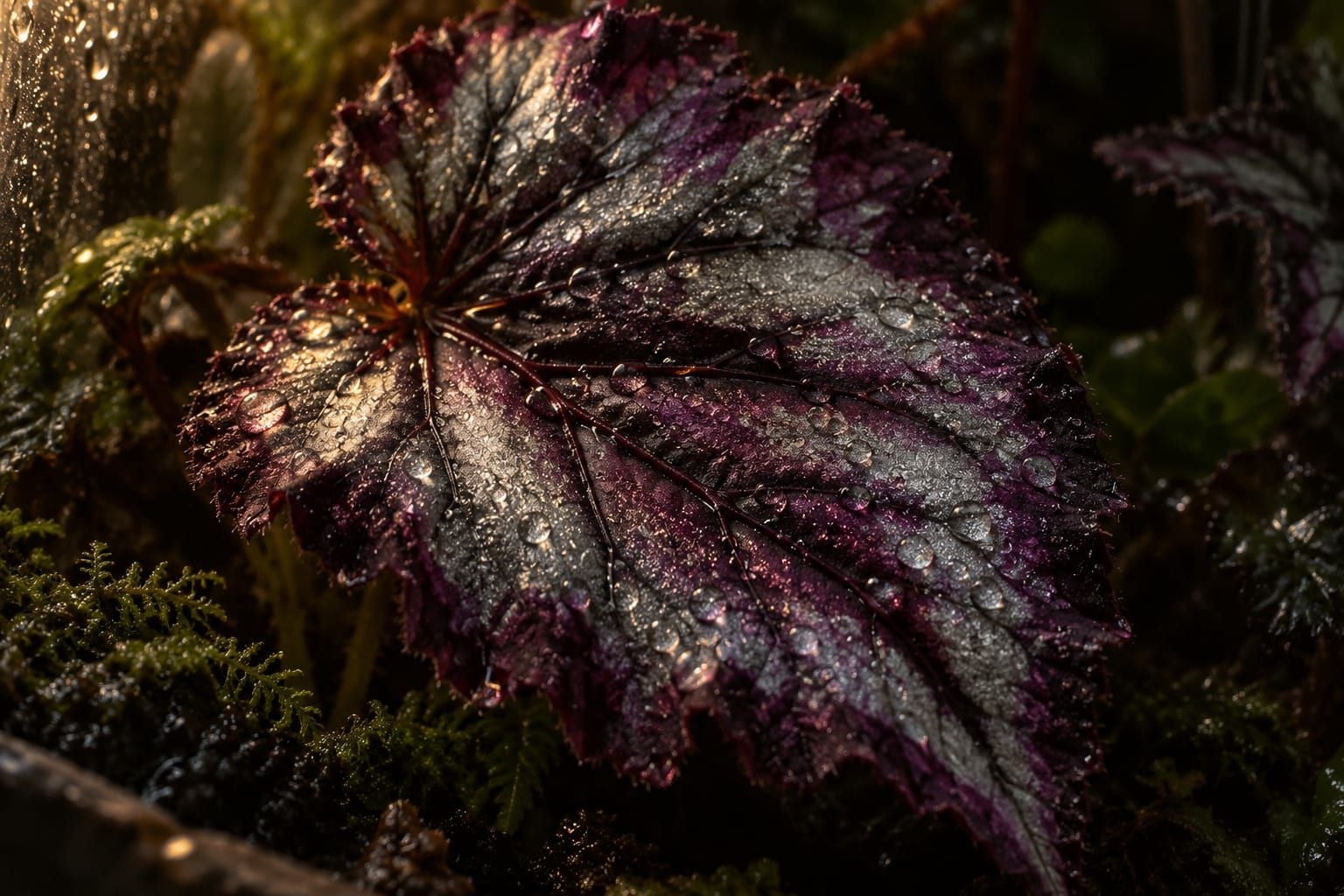
The foliage begonia is probably the finest plant you can put under glass. Asymmetric leaves shaped like a butterfly wing, silver spirals, purple sheens, and in Begonia pavonina a metallic blue that barely exists anywhere else in the plant world. Its natural home is the closed terrarium: it needs very high humidity and soft light, two things a heated living room does not provide.
In exchange, it asks for three precautions: filtered but sufficient light, water at the base and never on the leaves, and an eye on powdery mildew, the fungus that waits for the air to stop moving.
Identity card
| Botanical name | Begonia spp. (foliage begonia group) |
| Suitable species | Dwarf B. rex, B. bowerae, B. pavonina |
| Origin | Tropical forest floors in Asia and South America |
| Size under glass | 12 to 25 cm depending on the variety |
| Growth | Moderate |
| Closed terrarium | Yes, this is its ideal setting |
| Open terrarium | No, not in a heated room |
| Light | Partial shade to bright indirect light |
| Humidity | Very high, 70 % and above |
| Temperature | 18 to 26 °C, away from cold draughts |
| Substrate | Tropical, airy and free-draining |
| Watering | At the base only, never on the foliage |
| Difficulty | Intermediate |
The three groups worth knowing
The rex begonia. The most common and the most varied: broad leaves marked with spirals, silver bands and deep purple. Watch the size — many cultivars sold in pots reach 40 cm and overwhelm a composition. Look for dwarf varieties, listed at around 15 to 20 cm.
The bowerae begonia. Small green leaves edged with a brown fringe, compact and spreading. It is the easiest of the group, and the best choice for a first attempt under glass.
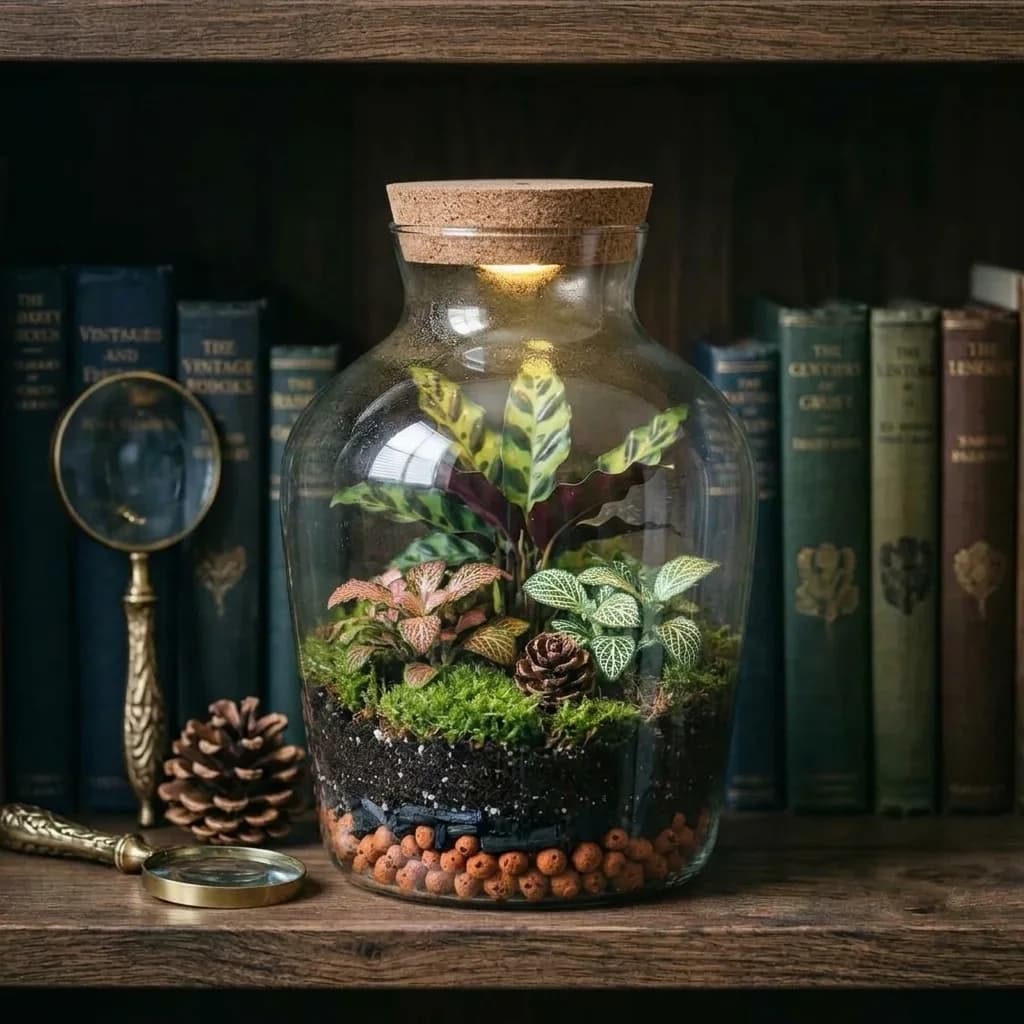
The pavonina begonia, or peacock begonia. Its foliage throws back an iridescent blue in low light — an optical effect of its surface cells, which capture the scarce light of the forest floor. It is also the most demanding: it needs humidity that never drops, and decidedly filtered light, or the blue disappears.
Why the closed terrarium suits it
These begonias come from tropical forest floors, where the air stays saturated all year and the light arrives filtered through several storeys of leaves. A closed terrarium reproduces both without effort.
In an ordinary pot, the same begonia struggles: the air of a heated flat often drops below 40 % humidity, leaf edges turn brown and the plant wears itself out. This is not a temperamental plant, it is a badly housed one.
Light: filtered, but not dim
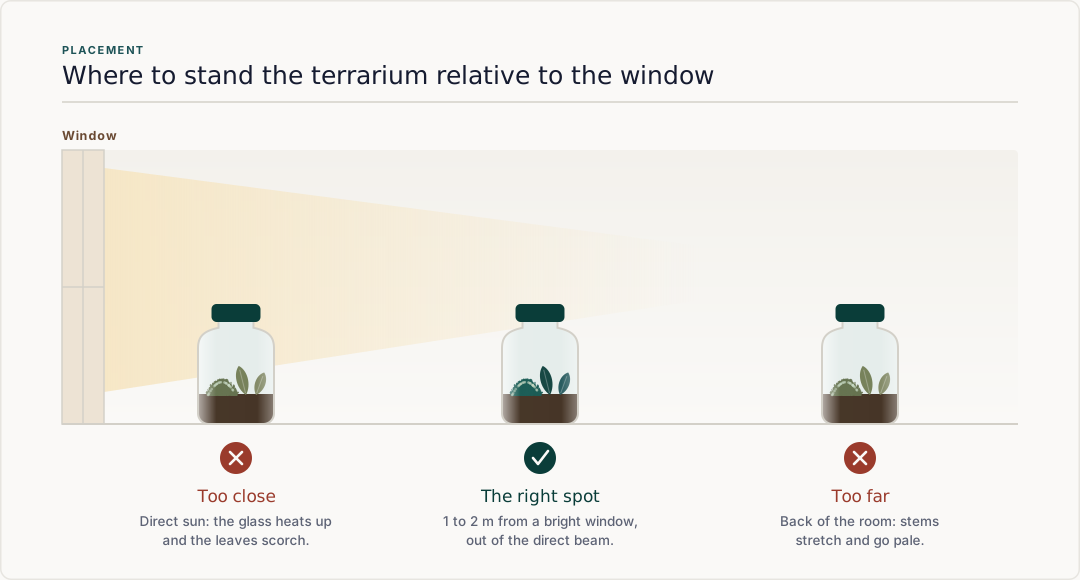
The balance is more delicate than for a fittonia. Too much light and the colours wash out, the leaves scorch in dry patches. Too little, and the leaf stalks stretch, the plant thins at the centre, and the silver or blue sheens fade.
Aim for bright but always indirect light: an east-facing window, or one to two metres back from a brighter one. The glass of the terrarium already filters part of the intensity.
Substrate and planting
An airy tropical substrate, based on coir, fine bark and perlite, suits it well. Begonia roots are shallow and fine: they need air as much as water.
When planting, rinse the root ball in lukewarm water to remove the nursery compost, which holds too much water in a closed setting and is often behind the first patches of mould. Plant without pushing the rhizome down, as it should sit on the substrate rather than under it: new leaves come from the rhizome, and it rots if covered.
Allow a single begonia in a 20 cm container — it will soon fill the space. The full build, layer by layer, is described in How to create a closed terrarium.
Watering without wetting the leaves
This is the rule specific to this plant. The leaf surface is downy and slightly quilted: it holds droplets instead of letting them run off. A drop that sits still leaves a pale mark, then a brown spot, then a way in for fungus.
In a balanced closed terrarium, water circulates on its own and you will have almost nothing to do. When the condensation stays away from the glass and the substrate goes pale at the surface, mist the substrate around the base, angling the spray towards the ground, never above the foliage. Amounts and rhythms are set out in Watering a terrarium.
If condensation regularly drips from the lid onto the leaves, move the plant across by a few centimetres, or lower the humidity by airing it a little longer.
Pruning and taking cuttings
The begonia spreads, then thins at the base. Pinch the stems above a node two or three times a year, with fine scissors: the plant branches instead of running towards the glass. In the same motion, remove every yellowed or damaged leaf — a dead leaf left in a closed setting feeds fungus. The technique is described in detail in Pruning terrarium plants.
Leaf cuttings are one of the particular pleasures of this plant, and they nearly always work.
- Choose a mature, healthy leaf and cut it with a centimetre of leaf stalk.
- Nick the main veins on the underside with a blade, every two or three centimetres.
- Lay it flat, cut side against a damp substrate, in a small closed container.
- Place it in indirect light at room temperature, and open it only to air it briefly.
Plantlets appear at the cuts in four to eight weeks. Pot them on once they carry two true leaves.
The powdery mildew trap
This is the number one problem for begonias in still air. Powdery mildew shows as a white, dusty felt on the upper side of the leaves — a veil of flour, dry to the touch, quite unlike the cottony fuzz of substrate mould.
It thrives in exactly the conditions of a poorly aired terrarium: high humidity and perfectly still air.
If the veil returns even so, the composition is too dense: sacrifice a neighbouring plant. The other fungi and white veils of the terrarium are covered in Mould in a closed terrarium.
What to grow it with
The begonia needs the same humidity as other forest-floor plants, but it needs air around it. Pair it with low, slow neighbours: moss on the ground, a compact peperomia, a small fern set back. Avoid Ficus pumila and fittonia, both too vigorous, which would press their foliage against its own.
Frequently asked questions
Which begonia should you choose for a closed terrarium?
Small-leaved foliage begonias: dwarf forms of Begonia rex, Begonia bowerae and its hybrids with brown-edged leaves, and Begonia pavonina for its blue sheen. Avoid the flowering bedding begonias, which have different needs.
Why should you not wet the leaves?
Their surface is downy and holds water. A droplet that sits still marks the leaf, then opens the way to fungus. Mist the substrate around the plant rather than the foliage.
Can you take a cutting from a begonia leaf?
Yes, it is one of the few terrarium plants that can be propagated this way. A leaf nicked along its main veins and laid flat on damp substrate in a closed container produces plantlets in four to eight weeks.
Does a terrarium begonia flower?
It does, but discreetly: small pink or white flowers on a slender stem. These species are grown for the leaf. Many people cut the flower stems off so the plant keeps its energy for the foliage.