

Terrariums in winter: what the season changes
Heating that dries the room, light cut by half, a freezing windowsill at night, mist behaving differently: what to adjust from November to March, and above all what to stop doing.
In this guide
Winter does not put a terrarium in danger, it changes its rules. Light falls by half, growth almost stops, the room is heated by day and cold at night, and the mist no longer behaves as it did in September. Good winter practice mostly means doing less: less water, less pruning, fewer interventions.
Light, halved
Between noon in June and noon in December, the light in a north-facing room is three to four times lower. Days are short, the sky is overcast, and the sun stays low.
The effects show on the plants:
- growth stops, or becomes imperceptible;
- some lower leaves yellow and drop, which is normal;
- stems sometimes stretch towards the light source, paling as they go.
The first two need nothing. The third, etiolation, signals a genuine shortfall: move the terrarium closer to the window, even if that undoes your summer setting.
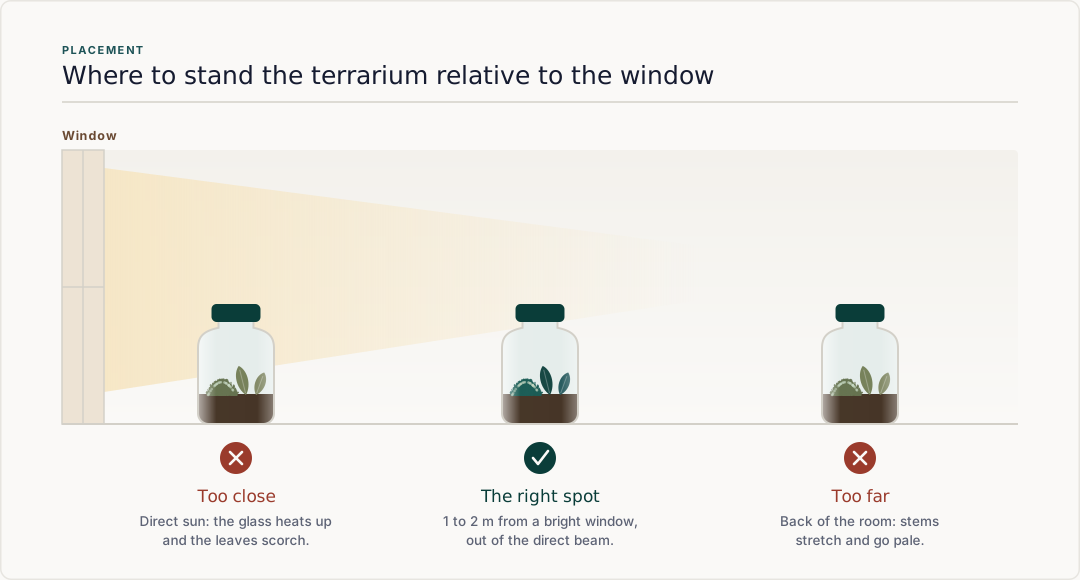
This is the only season when a closed terrarium can safely stand less than a metre from a south-facing window, winter sun being too low and too weak to overheat the glass. Note the date of the move somewhere: you will need to reverse it at the end of March, before the first genuinely sunny afternoons.
What heating actually does
You often read that heating dries terrariums out. That is true of an open terrarium and false of a closed one.
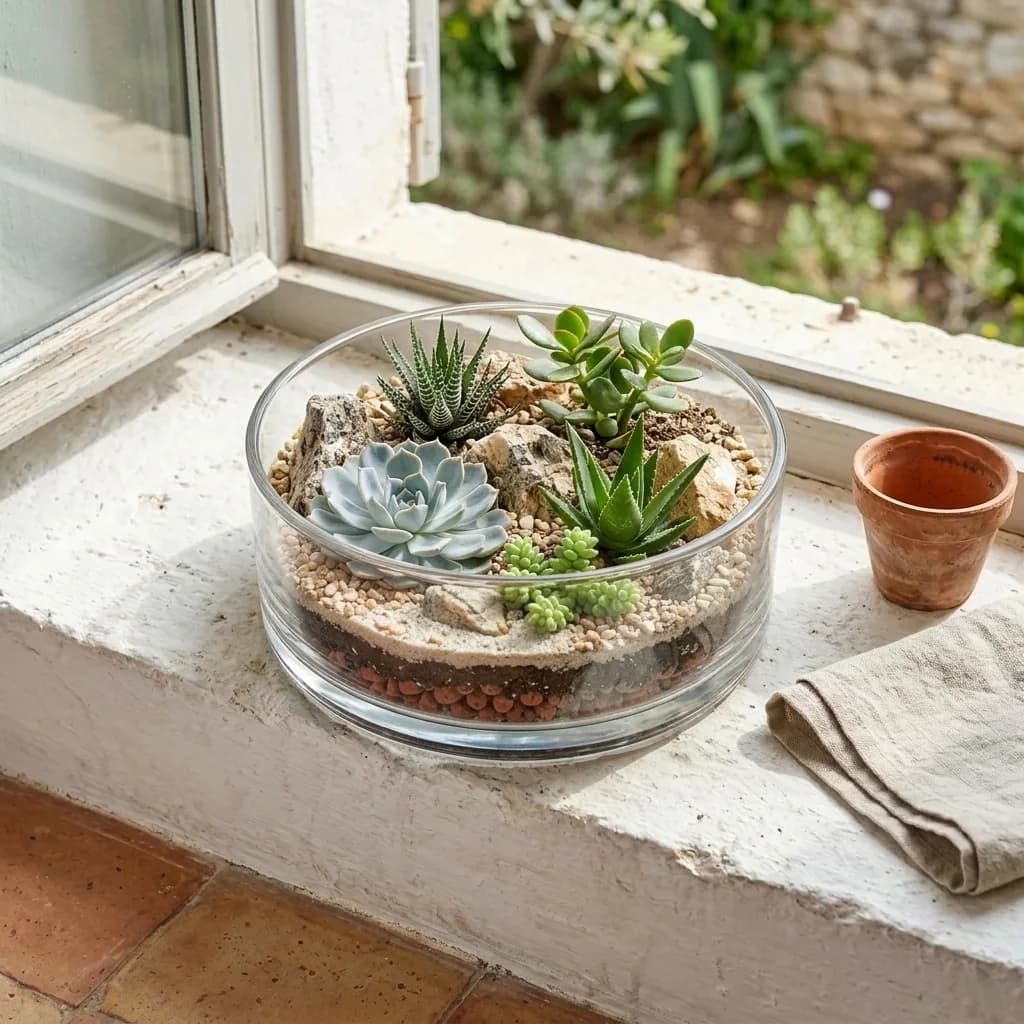
Open terrarium. The air of a heated room drops to between 30 and 40 per cent relative humidity, sometimes less with forced-air heating. Ferns and woodland plants grown in the open brown at the tips. This is the one case where regular misting is justified in winter, and even then: lightly, early in the day, so the leaves dry before nightfall.
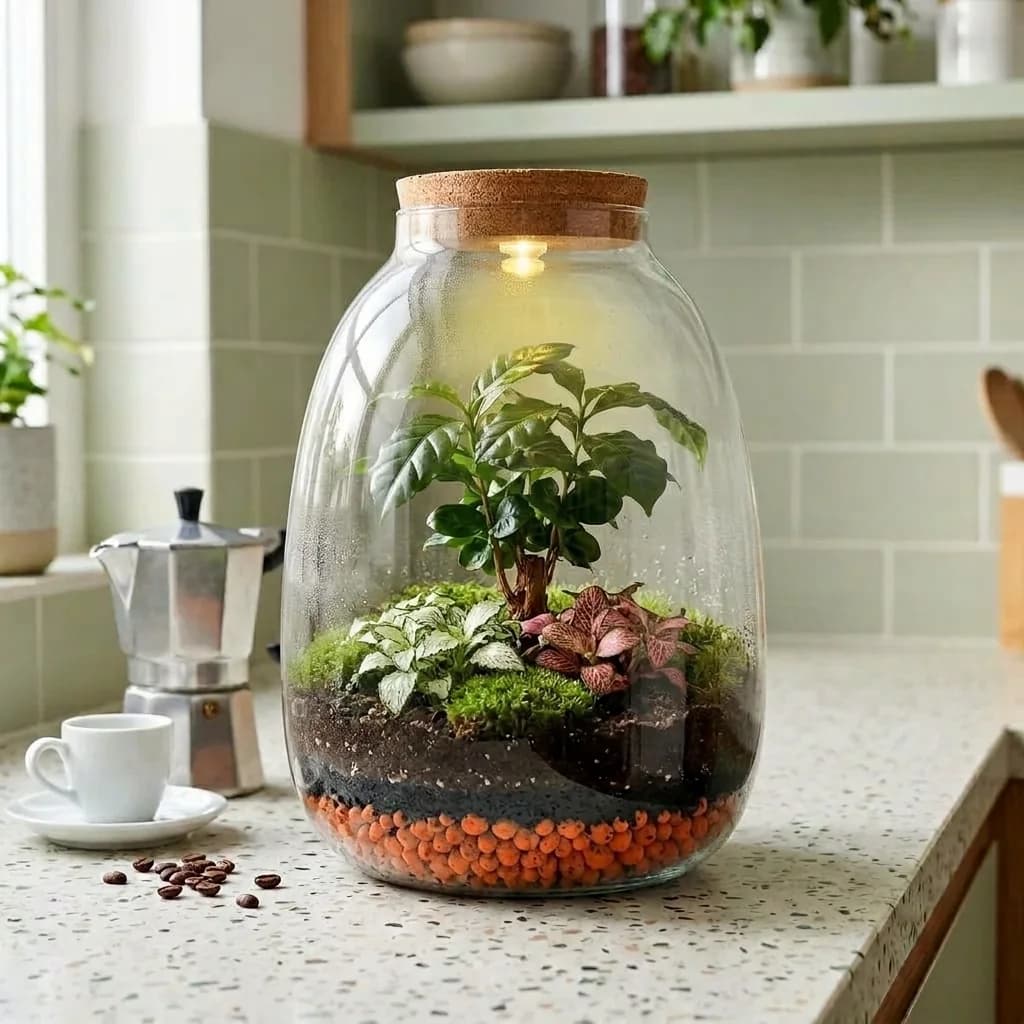
Closed terrarium. Its air does not communicate with the air of the room. Heating acts through temperature, not humidity: a jar near a radiator climbs to 28 or 30 °C when its tropical plants would rather have 18 to 24 °C. The symptoms are those described in Terrarium too hot — permanent condensation, soft leaves, browning moss.
The rule does not change from season to season: a metre between the glass and any heat source. It is simply harder to keep in winter, because windowsills — the best place for light — are almost always above a radiator.
The windowsill, warm by day and freezing at night
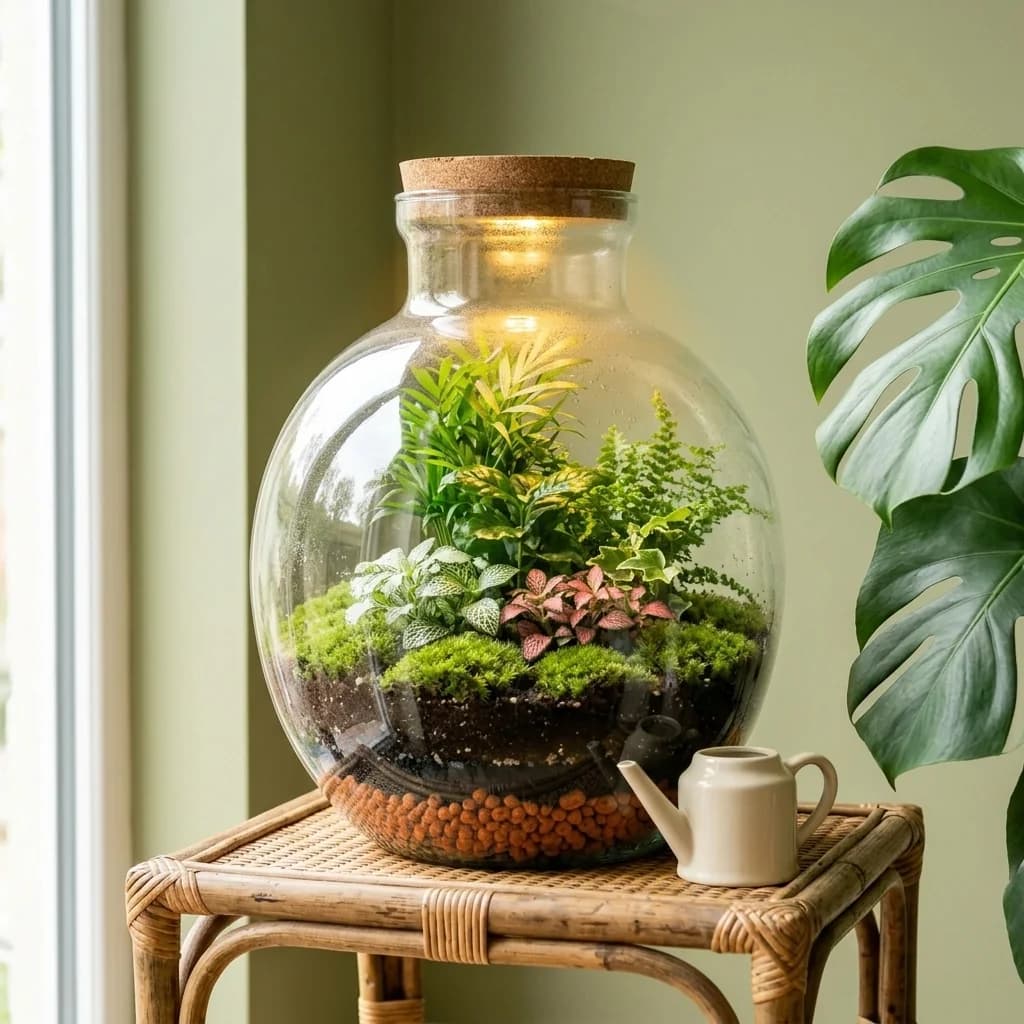
This is the most common trap of the season. By day, the radiator below raises the temperature; at night, the radiator cuts out, the curtain is drawn, and the pane radiates cold.
With single glazing, the air against the pane drops 8 to 10 °C below the temperature of the room. A terrarium pressed to the glass therefore takes a daily swing of fifteen degrees or more. Tropical plants do not tolerate that repeated shift: the leaves spot brown within weeks, then fall.
Three steps are enough:
- Move the terrarium twenty centimetres back from the glazing. It costs almost nothing in light and removes the cold zone.
- Do not let the curtain close between the terrarium and the room: the jar would end up shut in on the cold side.
- Move the terrarium away before airing the room — a winter draught straight onto warm glass causes thermal shock, above all on a thin container.
Mist behaves differently
In winter the difference in temperature between the inside of the terrarium and the wall grows: the glass is colder, the air inside stays warm. Condensation therefore appears faster, more abundantly, and takes longer to clear.
That is not a sign of excess water. A terrarium perfectly balanced in October may show a fully veiled wall in January without anything having changed in the substrate.
How to tell the difference:
- mist that forms at night and fades during the day: normal, leave it be;
- permanent mist with running drops and a visible pool in the drainage: genuine excess water, see Terrarium too wet;
- mist concentrated on one side only: that is the coldest face, usually the one turned towards the window. Moving it back a few centimetres reduces it.
The guide Condensation in a terrarium covers how to read these signs throughout the year.
What to stop doing in winter
Stop watering by the calendar. A closed terrarium needs nothing from November to March. An open terrarium goes from weekly watering to once every two or three weeks, and only when the substrate is dry two centimetres down. The guide Watering a terrarium gives the finger test.
Stop pruning hard. A plant cut back in December does not regrow: it has neither the light nor the warmth for it, and the cut stays an open wound for months. Limit yourself to removing dead leaves and whatever touches the glass. Shaping waits for March, as Pruning a terrarium explains.
Stop repotting and replanting. The roots of a resting plant heal badly. A new build, on the other hand, goes very well in winter: it is the established plants you leave undisturbed.
Stop worrying about zero growth. Four months without a centimetre of growth is normal for a fern or a fittonia indoors. Growth resumes on its own at the end of March.
The case of the festive weeks
Two situations specific to December deserve a word.
An empty home with the heating off. Many households drop the thermostat to 15 or 16 °C while they are away. A tropical terrarium takes that without harm: growth stops, nothing dies. Below 10 °C, however, woodland plants suffer, and the guide Terrarium too cold describes the damage. If the heating is off entirely in a poorly insulated home, move the terrarium away from the windows and towards the middle of the flat.
The terrarium as a gift. It is a common December present, and it often arrives after a car journey in cold weather. Leave it an hour or two in the room before opening the lid, so the glass comes back up to temperature: a freezing wall in a heated living room instantly covers itself in heavy condensation, striking but harmless.
Building a terrarium in midwinter
It is a good season to start. Plants bought in December travel better than in a heatwave, the work is done in the warm, and the terrarium has three quiet months to settle before growth resumes in March.
Two precautions specific to the season: let the plants recover for an hour at room temperature before handling them, because foliage straight out of the cold snaps; and do not set the new build directly on a windowsill. The guide Terrarium for beginners covers the steps, and Terrariums in a flat helps choose the room. If you are away over the holidays, Terrariums and holidays answers the question of leaving.
Frequently asked questions
Should you water a terrarium less in winter?
Yes, markedly. Growth slows, the plants transpire less, and water stays longer in the substrate. A closed terrarium generally needs nothing from November to March; an open terrarium often goes from weekly watering to once every two or three weeks.
Does heating dry out a closed terrarium?
No, the air inside the container is isolated from the air of the room. Heating acts differently: it raises the temperature of the glass and speeds up exchange at the opening of a poorly sealed container. An open terrarium, however, does genuinely dry out.
Is a windowsill dangerous at night in winter?
With single glazing, yes. The temperature there drops 8 to 10 °C below that of the room overnight, and prolonged contact between the glass and the pane can freeze the substrate locally. Twenty centimetres back removes the risk.
Should you add a lamp in winter?
Not in a room that gets daylight. A tropical terrarium accepts four months of slowed growth. A small grow light is only justified in a very dark room, or when stems clearly stretch and pale.