

Going on holiday: getting your terrarium ready
A closed terrarium gets through weeks with nobody there — that is exactly the point of it. What to do before you leave depending on how long, the case of the open terrarium, and the just-in-case watering that does more harm than the absence.
In this guide
The answer fits in one sentence: in nearly every case, you do nothing. A closed terrarium is designed precisely to manage without you, and most of the damage found on return from holiday comes from the precautions taken before leaving, not from the absence itself.
Why a closed terrarium needs nobody
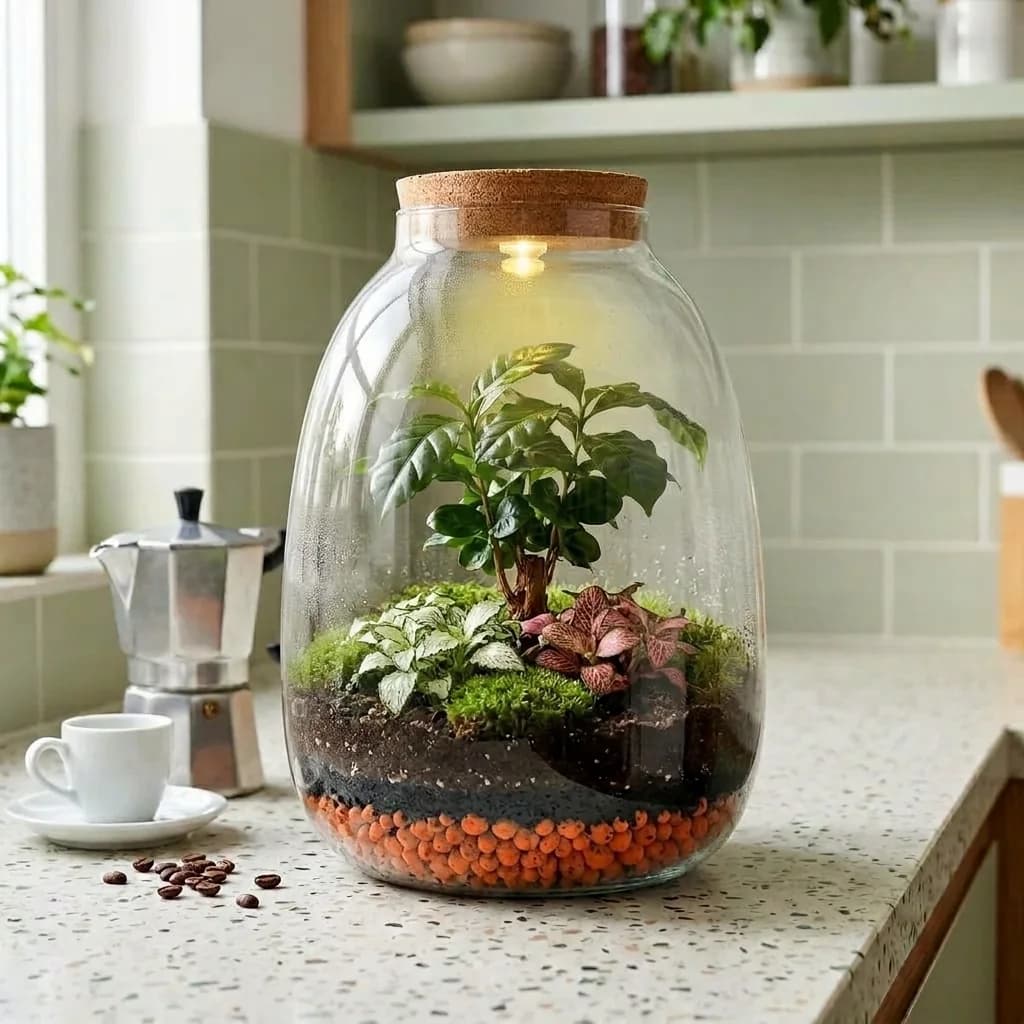
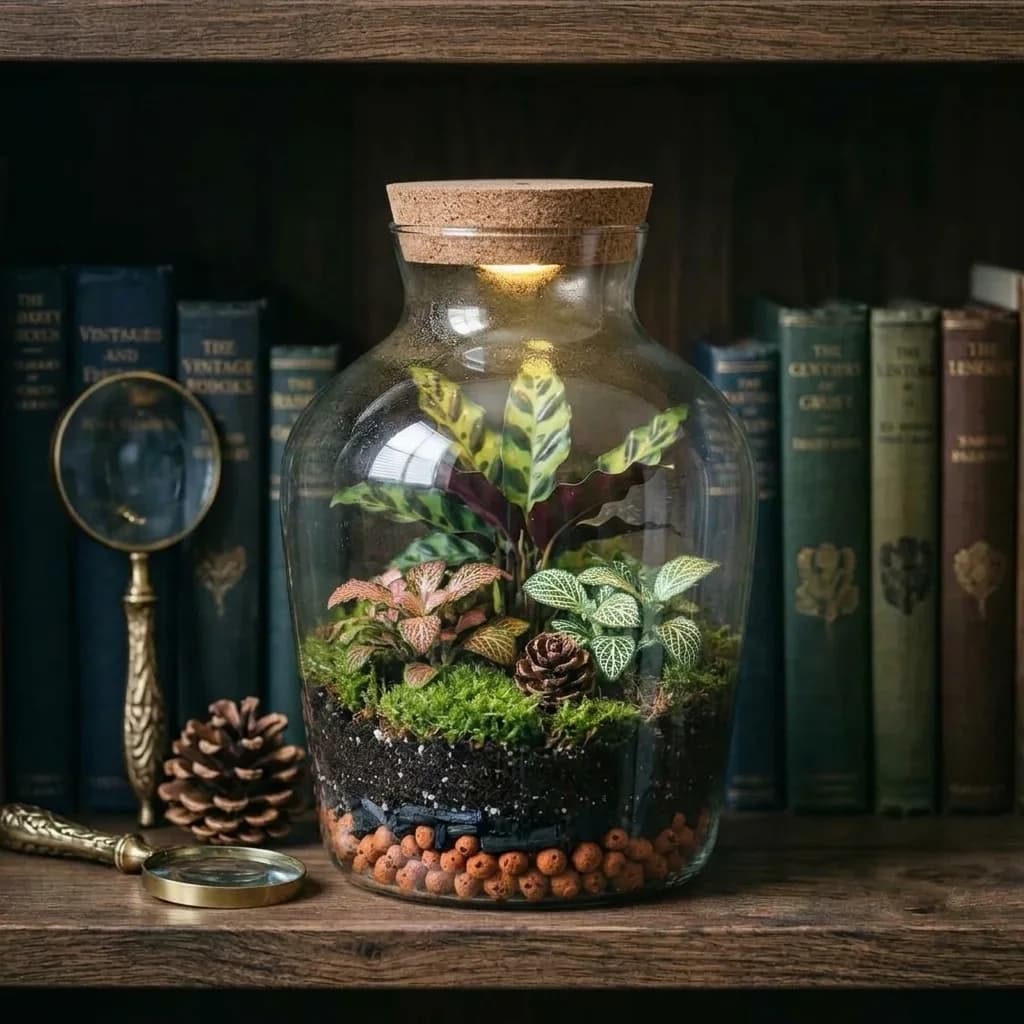
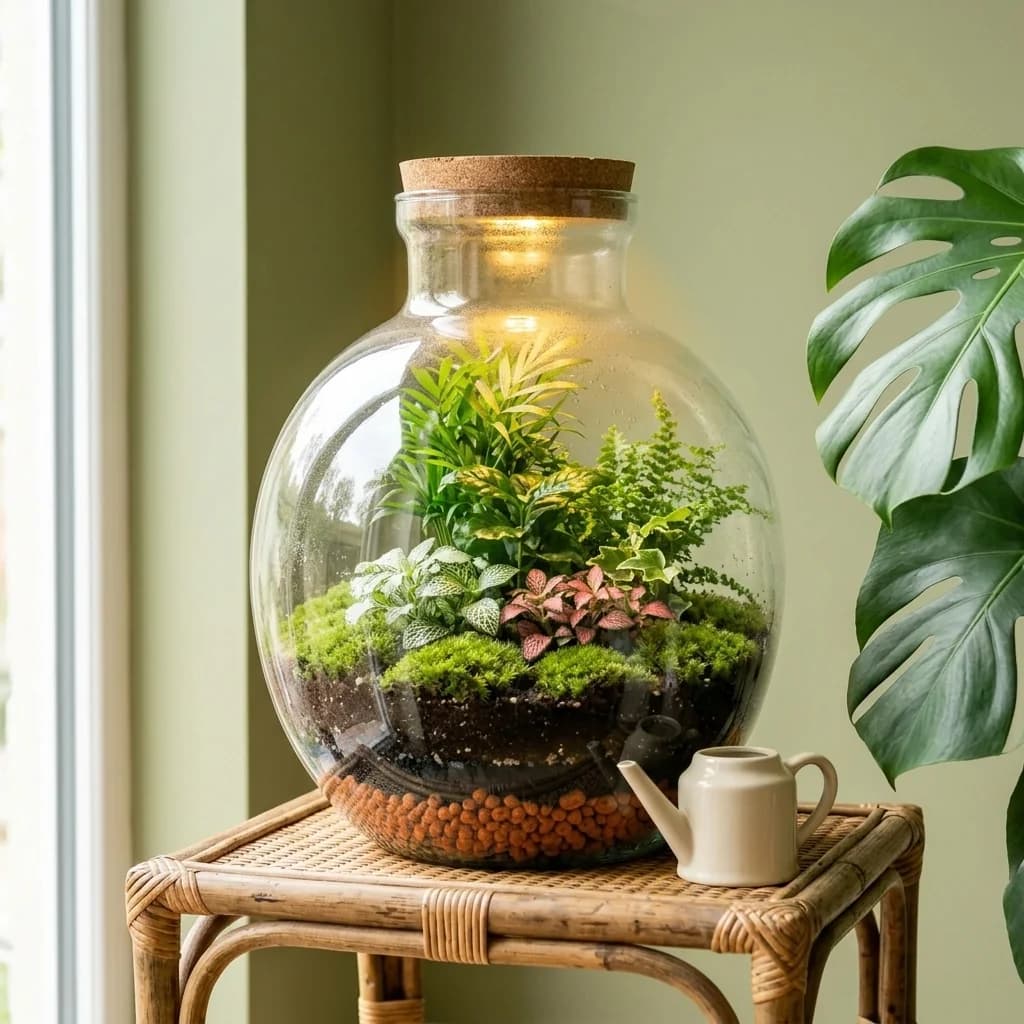
The water in a sealed terrarium does not get out. It evaporates from the substrate and the leaves, condenses on the glass against a cooler pane, then runs down and returns to the soil. That cycle repeats every day, indefinitely, as long as the container stays closed.
A closed terrarium that has been in balance for a few months is therefore not a plant you forget to water: it is a system that uses nothing up. Documented sealed bottles have lived for decades. Three weeks are nothing on that scale. The guide Maintenance-free closed terrarium explains how this works.
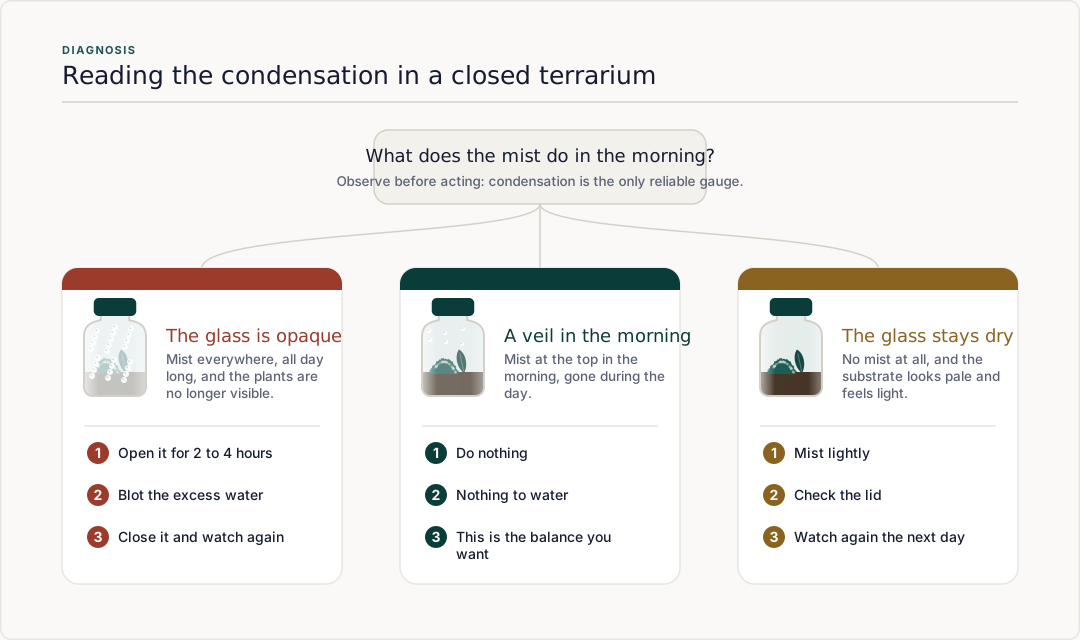
Before you leave, the only useful check is the mist. A light veil that appears in the morning and clears during the day means the balance is right. A pane running with water all the time means an excess to correct before you go, not after: see Terrarium too wet. Perfectly dry glass over several days means the opposite, and that is the only case in which you water a little before going away — see Terrarium too dry.
By length of absence
One week. Nothing to do. No watering, no moving, no opening. Close the shutters if the room catches the sun, and that is all.
Two to three weeks. Check the mist about ten days before you leave, so you have time to correct an imbalance. Move the terrarium another metre away from the window if you are going in summer. Take out yellow or damaged leaves: they would break down while you are away and feed a mould. Cut back anything already touching the glass, as explained in Pruning a terrarium.
One to two months. The same steps, plus a firm prune: a plant that fills half the container when you leave will fill all of it by the time you return. Cut back to a third of the space available. If your terrarium holds springtails, they feed themselves on dead matter and need nothing.
Beyond three months. This is no longer an absence but a temporary abandonment. Leave the terrarium with someone rather than leaving it alone: not so it gets watered, but because a heating leak, a heatwave or building works call for someone to be there.
The trap of the just-in-case watering
This is the gesture that destroys the most terrariums every summer. The reasoning looks sound: I am going away for a while, so I will give it a head start. It is wrong for one simple reason: water added to a sealed container never leaves.
In a potted plant, excess water drains through the hole then evaporates. In a closed terrarium, it sinks, builds up in the layer of clay pebbles, rises again by capillary action, and saturates the substrate. The roots, deprived of air, rot within ten to fifteen days. You come home to a jar whose leaves are soft and translucent, and whose bottom smells of pond mud.
The rule is clear: you never water a closed terrarium because you are going away. You water it because it is dry, and on that ground alone, following the signs described in Watering a terrarium.
The open terrarium, a different case
An open container loses its water by evaporation, so absence genuinely counts.
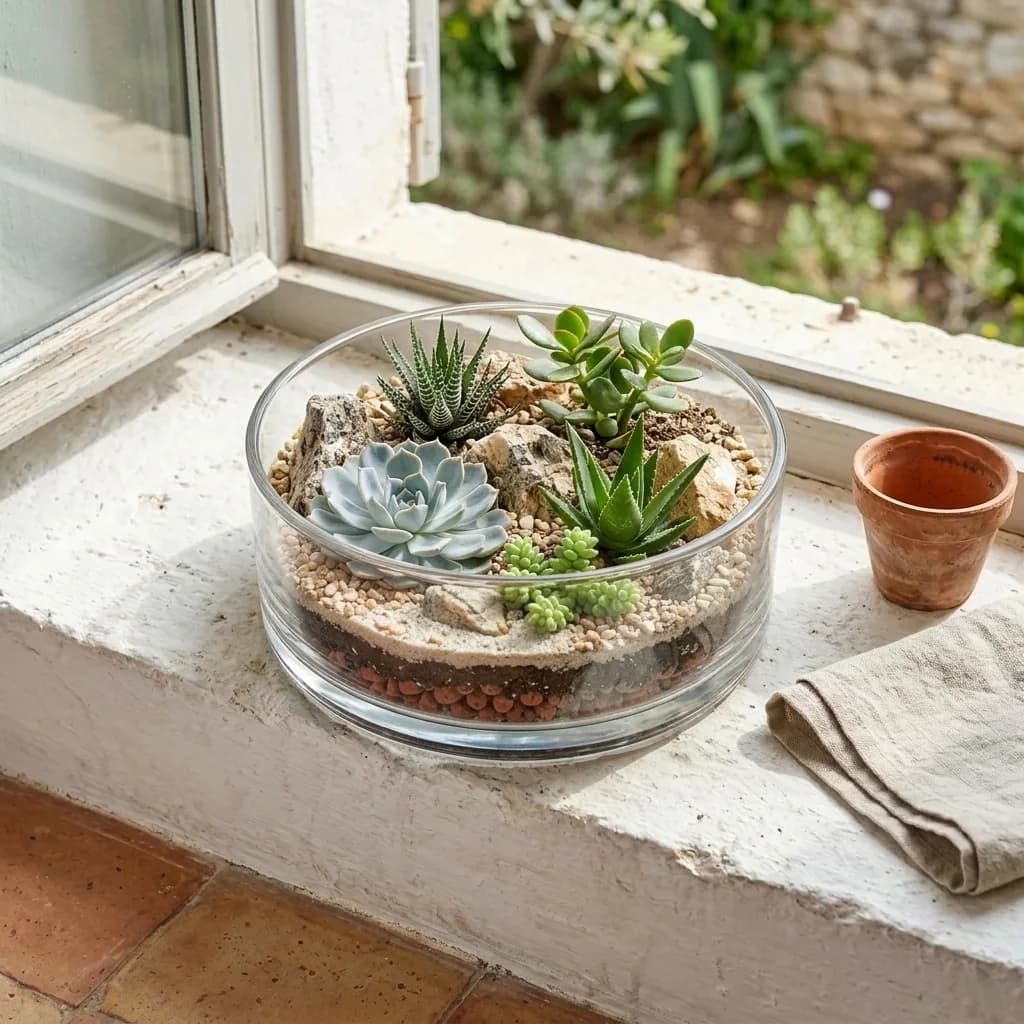
Succulents and cacti. They store water in their tissue and take three to four weeks without anything at all. Water moderately the day before you leave — the substrate should be damp, not soaked — and move the container away from the window, because direct July sun on uncovered glass is the real danger. The succulent terrarium tutorial sets out their normal regime.
Tropical plants in an open container. They will not last beyond about ten days. Two solutions: leave the terrarium with someone, or put a temporary lid on it — a plate, or cling film pierced with two or three holes — to create a water cycle for the length of your absence. Take it off as soon as you get back, otherwise plants used to open air will suffer from the continuous humidity.
Summer, heatwaves and shutters
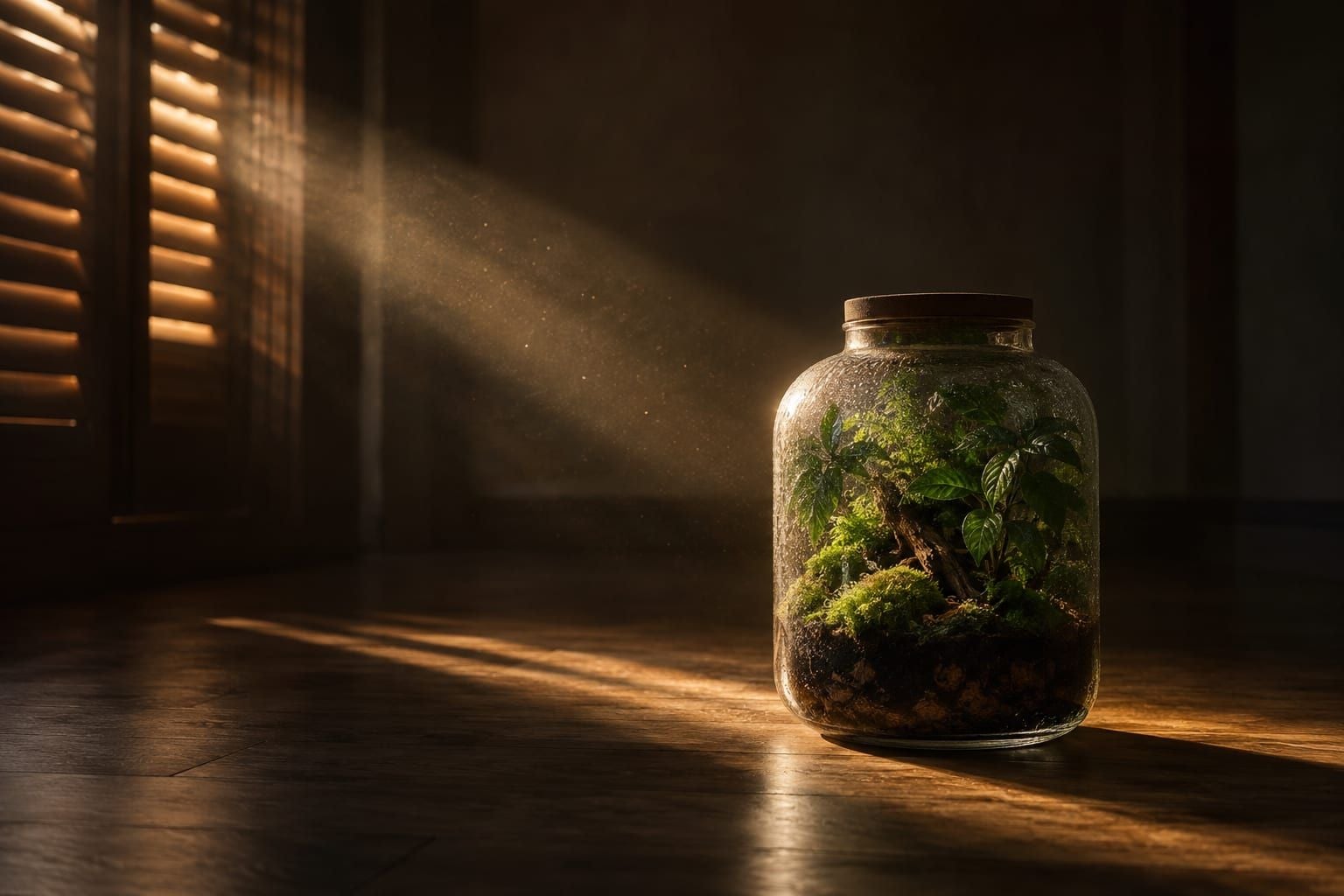
Heat does more damage than thirst. A closed terrarium left behind a patio door during a heatwave reaches 45 to 50 °C inside: the leaves break down, the moss goes white, and nothing recovers. The guide Terrarium too hot describes the damage and what follows.
Three precautions before a summer departure:
- Close the shutters or draw the curtains. The room gains three to five degrees less, and the glass no longer receives any direct radiation.
- Move the terrarium back another metre from its usual place, or shift it to a north-facing room.
- Never stand it on the floor against a patio door on the assumption that it will be cooler there: that is where the low evening sun strikes for longest.
The residual light in a room with the shutters closed is weak, but a closed terrarium gets through two to three weeks of gloom without consequence: growth stops, it does not die.
What to prepare a week before, not the day before
The few useful steps are better done in advance, because they all need time to observe the result.
Correcting an excess of water takes five to ten days: you open the container, let evaporation do its work, and close it when the mist becomes light again. Done the day before you leave, it leaves the terrarium open or badly rebalanced for the whole absence.
Treating early mould also means seeing whether it comes back. Remove the affected area, air it, then watch for three or four days: mould that reappears points to an underlying problem to sort out before you go.
Moving the terrarium to a cooler spot is worth doing a week ahead, to check that the new place suits it. A last-minute move to a dark, untried room is a gamble.
Pruning, finally, needs a few days of healing while you are there. A cut made the day before a departure stays an open wound in an environment saturated with humidity, which is exactly the situation in which mould takes hold.
On your return
Open it, look, and touch nothing for two days. A terrarium that has spent three weeks in a dark room takes a few days to pick up. Take out fallen leaves, prune whatever has grown against the glass, and put the jar back in its usual place.
If white mould has appeared on the wood or the substrate, it is easily dealt with: remove the affected area, air it for a few hours, close it again. The guide Mould in a closed terrarium sets out what to do. And if winter is on its way, Terrarium in winter explains what the cold season changes for the same jar.
Frequently asked questions
How long does a closed terrarium last without watering?
A closed, balanced terrarium lasts several months with no intervention, because its water circulates in a closed loop. In practice, an absence of a week to two months needs no particular preparation beyond getting the placement right.
Should you water a little more before leaving?
No, and this is the most common mistake. Water added to a sealed container does not evaporate away: it builds up at the bottom, floods the drainage and rots the roots. A closed terrarium is left exactly as it lives happily the rest of the year.
What should you do with an open terrarium for three weeks?
A succulent terrarium takes three to four weeks without water quite happily, as long as it is kept away from direct sun. An open terrarium of tropical plants will not last: leave it with someone, or put a temporary lid on it for the length of your absence.
Should you close the shutters before leaving?
Yes, and it is the single best summer measure. Closed shutters lower the room temperature by several degrees and remove any risk of direct sun on the glass. The residual light is ample for a closed terrarium over two to three weeks.