

Tillandsia in a terrarium: open, never closed
The air plant rots in a closed jar. Here is where to put it, how to soak it, why upside-down drying decides everything, and the species to choose when starting out.
In this guide
Let us say it before anything else: a tillandsia has no place in a closed terrarium. The plant rots there, almost always, and often in under a month. It is not a matter of skill or of fine adjustment — it is an incompatibility of environment. The air plant is an epiphyte of branches and rocks, living in air that moves and dries between two rainfalls. A closed jar offers it exactly the opposite.
The good news is that it grows very well in an open container, hung from a thread or set on a piece of wood. It needs no soil, no pot and no repotting. It needs one soak a week and a serious dry-off. This page explains both.
At a glance
| Botanical name | Tillandsia spp. |
| Other names | Air plant, soil-free plant |
| Family | Bromeliaceae |
| Origin | Central and South America, on branches and rocks |
| Size under glass | 5 to 20 cm depending on the species |
| Growth | Slow |
| Closed terrarium | No — the plant rots in one |
| Open terrarium | Yes, this is where it belongs |
| Light | Bright indirect, never scorching sun |
| Humidity | Ambient air, the water comes from the soak |
| Temperature | 18 to 26 °C |
| Substrate | None |
| Watering | Weekly soak of 20 to 30 minutes |
| Difficulty | Easy in an open container |
Why a closed jar kills it
In a closed terrarium, the water goes round in a loop: it evaporates from the substrate, condenses on the glass, falls back. The humidity stays high day and night, and the air barely renews itself. Those are the ideal conditions for woodland plants, which take up water through their roots and have nothing against permanently damp leaves.
The tillandsia works differently. Its leaves are covered in microscopic scales, the trichomes, which absorb the water of a shower or a fog within minutes, then let the plant dry. That wet-dry cycle is not a comfort detail: it is how the plant feeds. Deprived of the dry phase, water sits between the tightly packed leaves of the heart, the tissue softens and the rosette comes away from its base in one piece. By the time that happens, it is too late.
The difference between the two regimes is summed up here, and it holds for every plant in the range, not just this one.
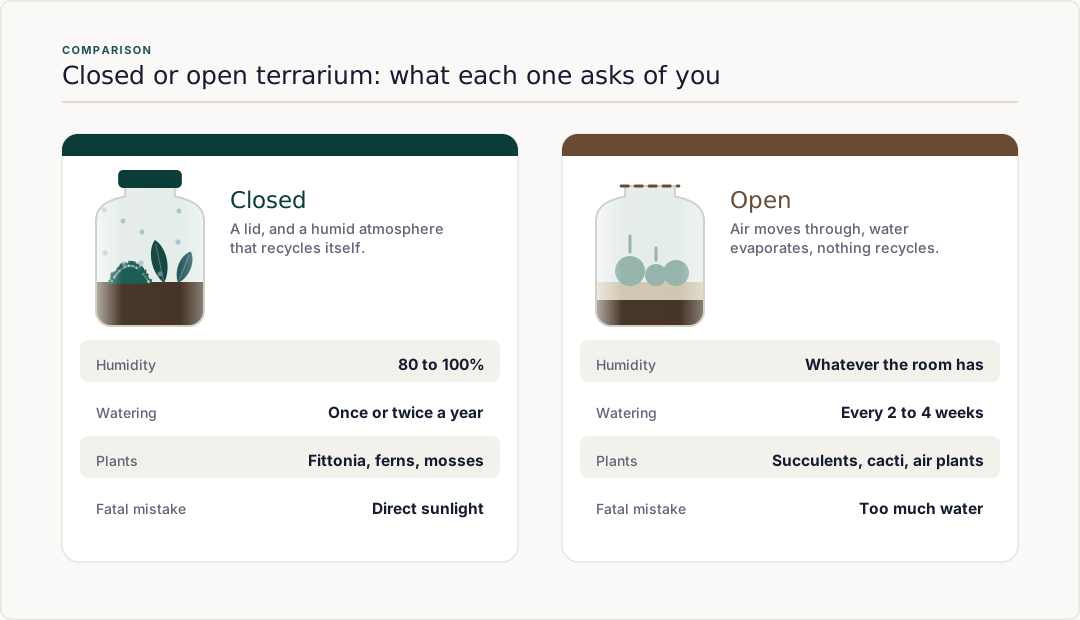
If you are still unsure which type of container to build, the guide closed or open terrarium puts the question both ways round.
Three builds that work
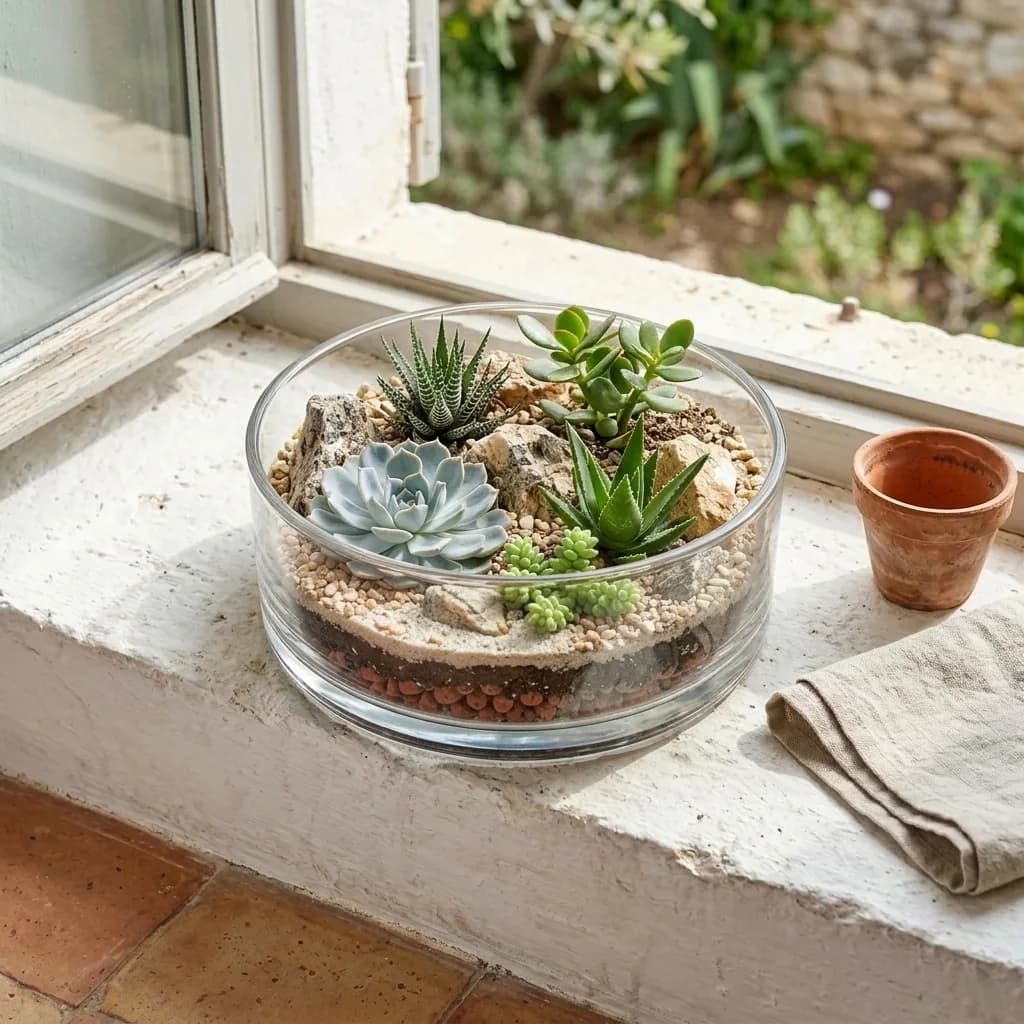
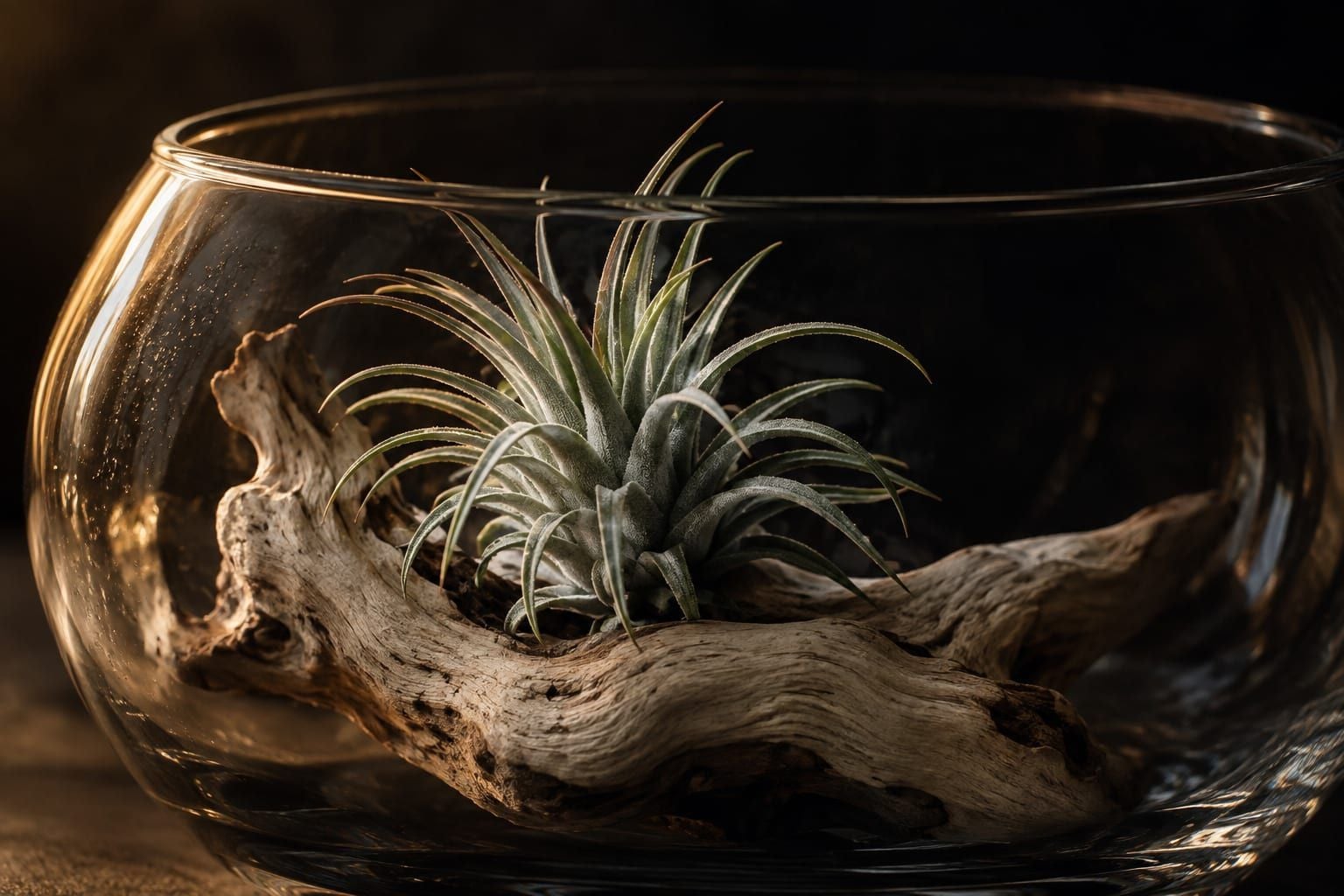
The open bowl. A shallow bowl, a cloche stood upside down, a wide glass: any open container will do, as long as the opening is generous. Set the plant on a bed of gravel or dry sand, never on damp substrate. The container's role is decorative — it holds the scene, it does not create a microclimate.
Wood. This is the truest build, because it reproduces the plant's natural position. Choose a dry, bark-free piece from the wood and roots range, and fix the tillandsia with clear nylon thread or a dab of hot glue on the basal disc alone. Within a few months its holdfast roots settle in on their own and the thread can be cut.
Hanging. A thread, a brass ring, a hollowed-out bulb: the tillandsia is the only plant of this family that agrees to live in mid-air. It is also the build that dries best.
The weekly soak
Once a week, plunge the whole plant into a bowl of water at room temperature, for twenty to thirty minutes. Rainwater or demineralised water suits it better than very hard tap water, which leaves a white veil on the trichomes and eventually hinders absorption.
Between two soaks, a fine mist is enough to get through a dry spell — the heating running, a week of heatwave. The humidifying range brings together fine-jet misters, the only useful kind here: a coarse jet wets without penetrating.
Two signs guide you better than a calendar. A thirsty plant curls its leaves inwards, and they hollow into a gutter shape. A well-hydrated plant opens them out and recovers its suppleness within the hour following the soak.
Drying, the rule that decides everything
This is the step most people skip, and it is the one that kills tillandsias.
After every soak, shake the plant sharply, then stand it upside down on a tea towel or in a draining rack, for three to four hours. The rosette then empties itself of the water held in its heart. Only put it back in place once the leaves are dry to the touch.
A gentle draught speeds up the drying. A closed, cold room slows it down: in winter, soak in the morning rather than the evening.
Light
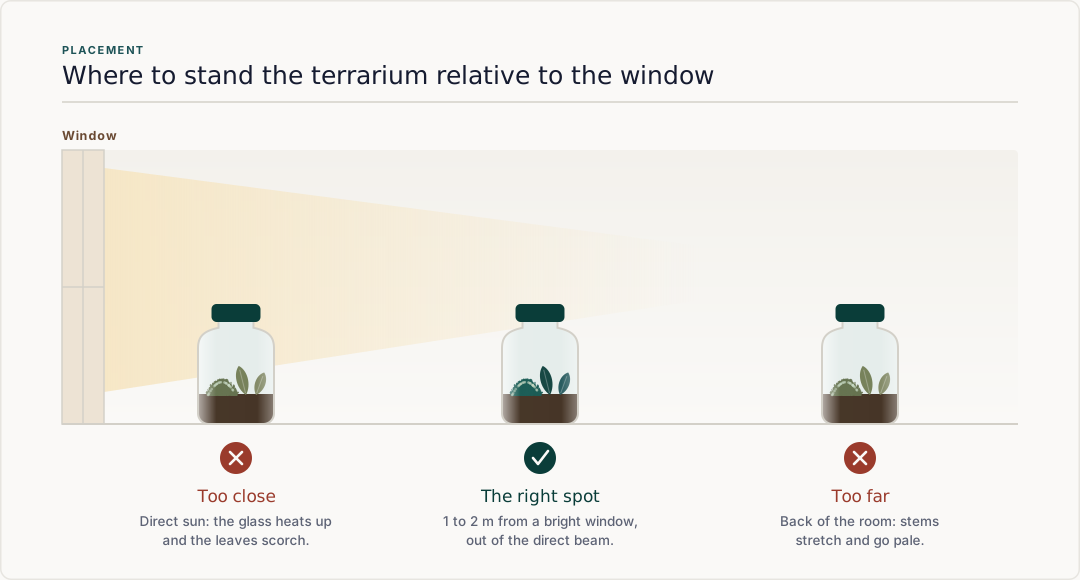
The tillandsia wants bright, indirect light. An east-facing window, or a metre back from a south-facing window, suits it. Direct afternoon sun behind glass heats too much and scorches the tips.
Conversely, a plant placed at the back of a room grows weak without showing it straight away: it does not die, it simply stops growing and loses its silvery tone. The right distance from a window is the same as for a classic terrarium.
Which species to start with
The species covered in silvery scales, known as the grey ones, come from the driest environments and are the most forgiving of a lapse.
- *Tillandsia ionantha*. The safest. A small compact rosette of 5 to 8 cm, which reddens at flowering. It dries quickly, which leaves it little exposed to rot.
- *Tillandsia caput-medusae*. Thick, twisted leaves on a hollow bulb. Very tolerant, and striking set on wood.
- *Tillandsia stricta*. A little more demanding for water, but generous with its flowers.
To avoid for a first attempt: the green species with fine, soft leaves, such as T. bulbosa or T. butzii, which need high air humidity and faultless drying. And above all T. usneoides, Spanish moss, whose dense tufts hold water at the heart.
What goes wrong
The base browns and the rosette comes away. Rot. It comes from insufficient drying or from a closed container. Nothing can be saved; start again with another plant and change the build.
Dry, brittle tips. Long-standing thirst, or water that is too hard. Cut the tips at an angle with fine scissors and go back to soaking in soft water.
A plant that has not moved for months. Lack of light, almost always. Move it closer to the window in stages.
What to show it with
The tillandsia does not share the water regime of woodland plants: do not mix it with fittonias or with the tropical plants of a closed jar. It does, on the other hand, go very well with a dry mineral scene — sand, rock, bare wood — or with succulents, which accept the same air. If a build has already gone wrong, Why are my terrarium plants dying goes through the causes one by one.
Frequently asked questions
Can I put a tillandsia in a closed terrarium?
No. That is the only honest answer. In a closed container the water stays on the leaves and at the heart of the rosette, the air stops moving, and the plant rots from the base within a few weeks. A tillandsia is grown in an open container, hanging or set on wood.
Does a tillandsia need soil?
None at all. Its roots serve only to hold on, not to feed. It takes water and minerals through its leaves. Planted in substrate, the base stays damp and the rosette comes away.
How often should you soak a tillandsia?
Once a week as a rule: twenty to thirty minutes in water at room temperature, then an upside-down dry-off. In very dry air, or in summer, add a misting between two soaks.
How do you know a tillandsia is thirsty?
Its leaves curl inwards and hollow into a gutter shape, and the rosette loses its suppleness. After a soak, it opens out again within a few hours. Dry, brittle tips point to a thirst that has been there a long time.