

Sphagnum in a terrarium: what it does and how much to use
Tell live sphagnum, dry fibre and peat apart. Find out where sphagnum earns its place in a terrarium and how to avoid a sodden growing medium.
In this guide
The word "moss" covers very different materials on the terrarium shelf. Before you choose a quantity or a thickness, identify what you are buying. This guide treats sphagnum as a material; for a decorative green cover, read the guide to moss species.
Live sphagnum, dried sphagnum and peat: three distinct products
Live sphagnum
This is a moss in growth, with living tips. What it needs depends on the species: water, light and temperature all have to suit it. A warm tropical jar is not automatically a good home for every sphagnum. Ask for its identification and its growing conditions rather than going by colour alone.
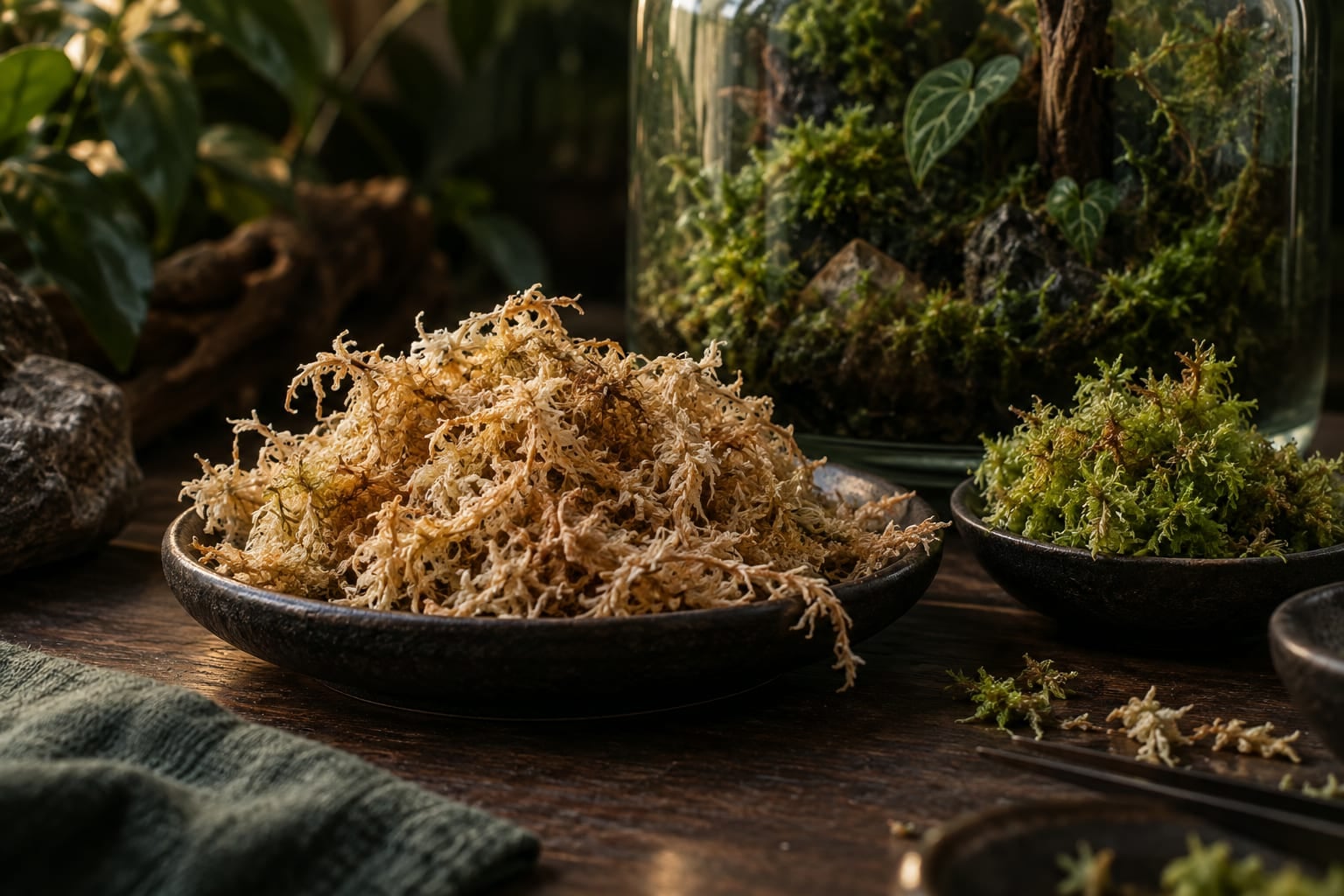
Dried long-fibre sphagnum
Sold dehydrated, it works mainly as an absorbent material. Rehydrating gives it back its suppleness; that is no guarantee it will become a living moss again. Choose an undyed horticultural product, with no decorative treatment and a stated origin.
Sphagnum peat
Peat is matter formed by ancient accumulation and partial decay. It has neither the form nor the use of long fibres. The issues around extracting peat from bogs are reason to look for alternatives and for documented cultivated-sphagnum supply chains, rather than treating every bag as equivalent.
The uses that earn their place in a terrarium
| Use | Benefit | Limit |
|---|---|---|
| Around an epiphyte mount | Holding humidity locally | Do not smother the roots |
| A separate small propagation container | Watching and managing the moisture | Transplant according to what the plant needs |
| A component in a mix | Changing how much water it holds | Adjust the other ingredients |
| A thick decorative layer everywhere | Little universal benefit | Hides the state of the soil and holds too much water |
A mounted miniature orchid is managed differently from a fittonia rooted in a mix. Do not add sphagnum under every plant simply because one set-up uses it.
Preparing dry fibre
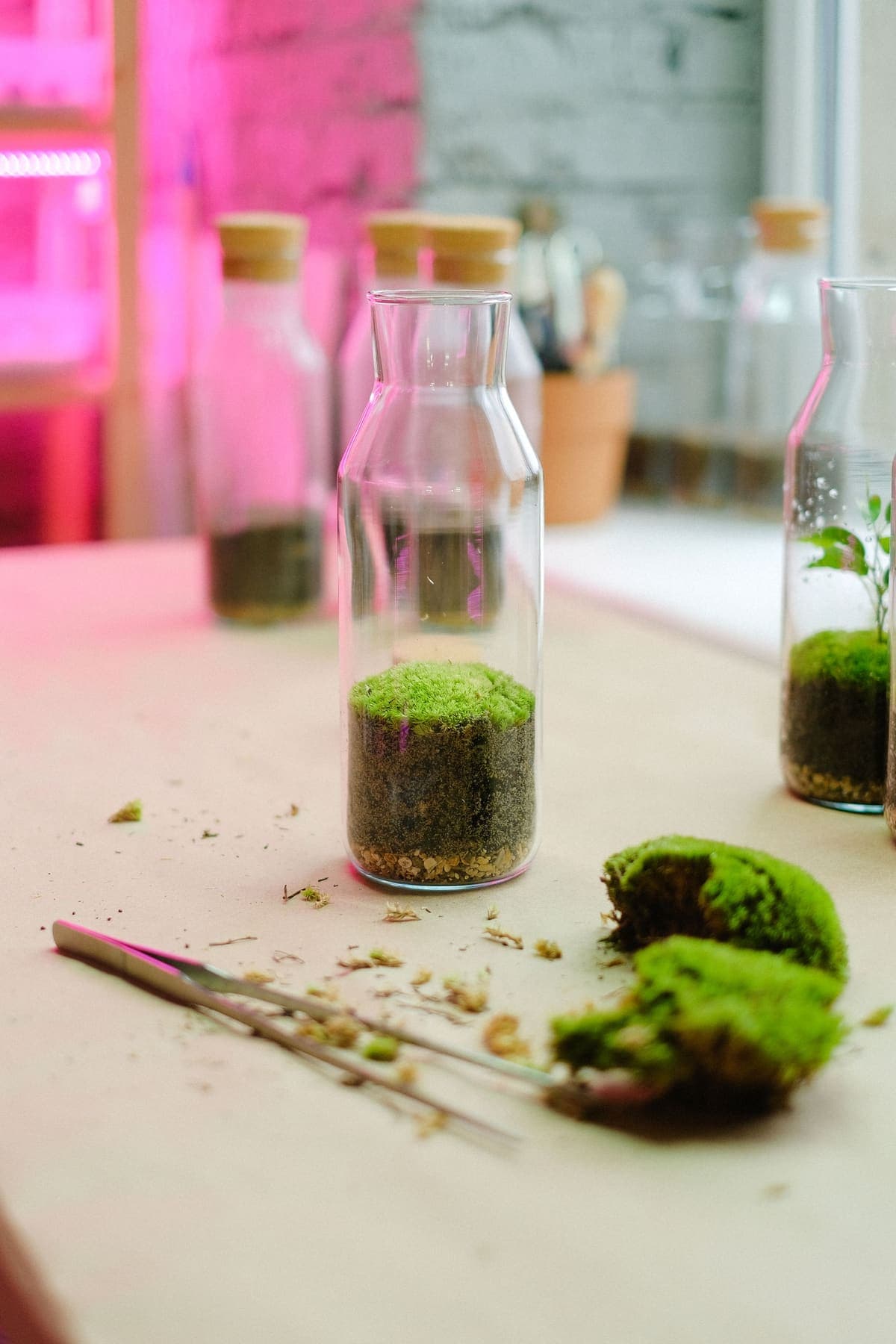
- Take a small amount: rehydrated fibres take up more space.
- Moisten it in a clean container with suitable water.
- Let the fibres soften, then press gently to squeeze out the free water.
- Pick out any unwanted debris and tease the handful apart with your fingers.
- Lay down only the volume you need, without forming a compact plug.
The material should stay damp, not run when you handle it. That observation is more useful than a soaking time supposedly valid for every product. Follow the supplier's instructions as well.
Why an extra layer does not fix drainage
Sphagnum can hold water against the roots. It does not create an outlet in a jar with no hole. Laying it over already sodden soil risks prolonging the problem. Go back to the guide on terrarium layers for the overall structure, and to the substrate guide for the root mix.
If you already use a ready-made tropical substrate, check what it contains before adding an absorbent material. A coherent recipe beats a pile of layers.
Watching it and replacing it at the right time
Look at the texture, the smell and the roots. Compacted fibres, standing water or an unusual smell all call for a check of the whole build. Brown colour in rehydrated dried sphagnum does not automatically mean rot; the product was not necessarily alive to begin with.
When roots have grown into the fibres, do not tear the whole handful away. Moisten it lightly if you need to, free the fibres you can reach and leave whatever cannot come out without injuring healthy roots. A struggling plant can be watched separately, in a suitable medium, before it goes back in.
To take cuttings, work in a small separate box: you will control the medium better and will not risk changing the humidity of your whole miniature forest project.
Sources and scope of this advice
- RHS — Alternatives to peat: materials and cultivated sphagnum.
- University of Missouri Extension — Terrariums: using fibrous materials in a build.
The quantities depend on your plants and your mix; no single proportion is presented as essential. Generated illustration, for editorial purposes.
Frequently asked questions
Does dried sphagnum come back to life?
That is not guaranteed. Rehydrating gives the fibres back their suppleness; it does not prove they can start growing again.
Can you replace all the compost with sphagnum?
Some specialist growers do use it that way, but it is not a general recipe for a terrarium of mixed plants.
Is it essential under moss?
No. The support has to suit the species of moss. Routinely adding an absorbent reserve can hold too much water.