Open terrarium care: the routine, plant by plant
Succulents or tropical plants, an open terrarium dries out faster than a closed jar: when to water, how to clean the glass, prune, get through winter and spot what is going wrong.
In this guide
An open terrarium is cared for with three habits: water according to the plants it holds, keep the glass clean for the light, and remove whatever dies or overgrows. Because nothing holds the moisture in, it dries out far faster than a closed jar. An open succulent terrarium needs a few spoonfuls of water every two to three weeks in the growing season. An open tropical terrarium needs compost that stays slightly moist. The rest is a matter of watching.
Two kinds of open terrarium, two routines
"Open" covers two very different builds.
| Dry open terrarium | Tropical open terrarium | |
|---|---|---|
| Plants | Succulents, cacti, haworthia | Fittonia, calathea, small ferns, moss |
| Container | Low bowl, wide opening | Jar or vase, lid resting loosely on top |
| Substrate | Mineral, dries fast | Compost that holds a little moisture |
| Watering | Rare, on dry substrate | Regular, compost slightly moist |
| Misting | Never | Possible, light |
| Light | As bright as possible | Bright, no direct sun |
So before anything else, identify the plants in your terrarium. A cactus and a fittonia do not live in the same container, and they are not cared for the same way. If you are still choosing between formats, our comparison of a closed or open terrarium sets out the differences.
Watering an open succulent terrarium
A glass container has no drainage hole. Any excess water stays at the bottom, against the roots. That is the main reason succulents are lost. The Royal Horticultural Society (RHS) points out that indoor succulents should never be left standing in water.
- In spring and summer: a few spoonfuls of water at the base of each plant, every two to three weeks, when the substrate is dry all the way down.
- In autumn and winter: once a month at most, or not at all in a cool room.
To check, push a wooden skewer down to the bottom, against the glass. If it comes out damp, wait. Pour the water at the base, with a spoon or a pipette, never onto the rosettes. The build and the choice of plants are covered in our succulent terrarium tutorial.
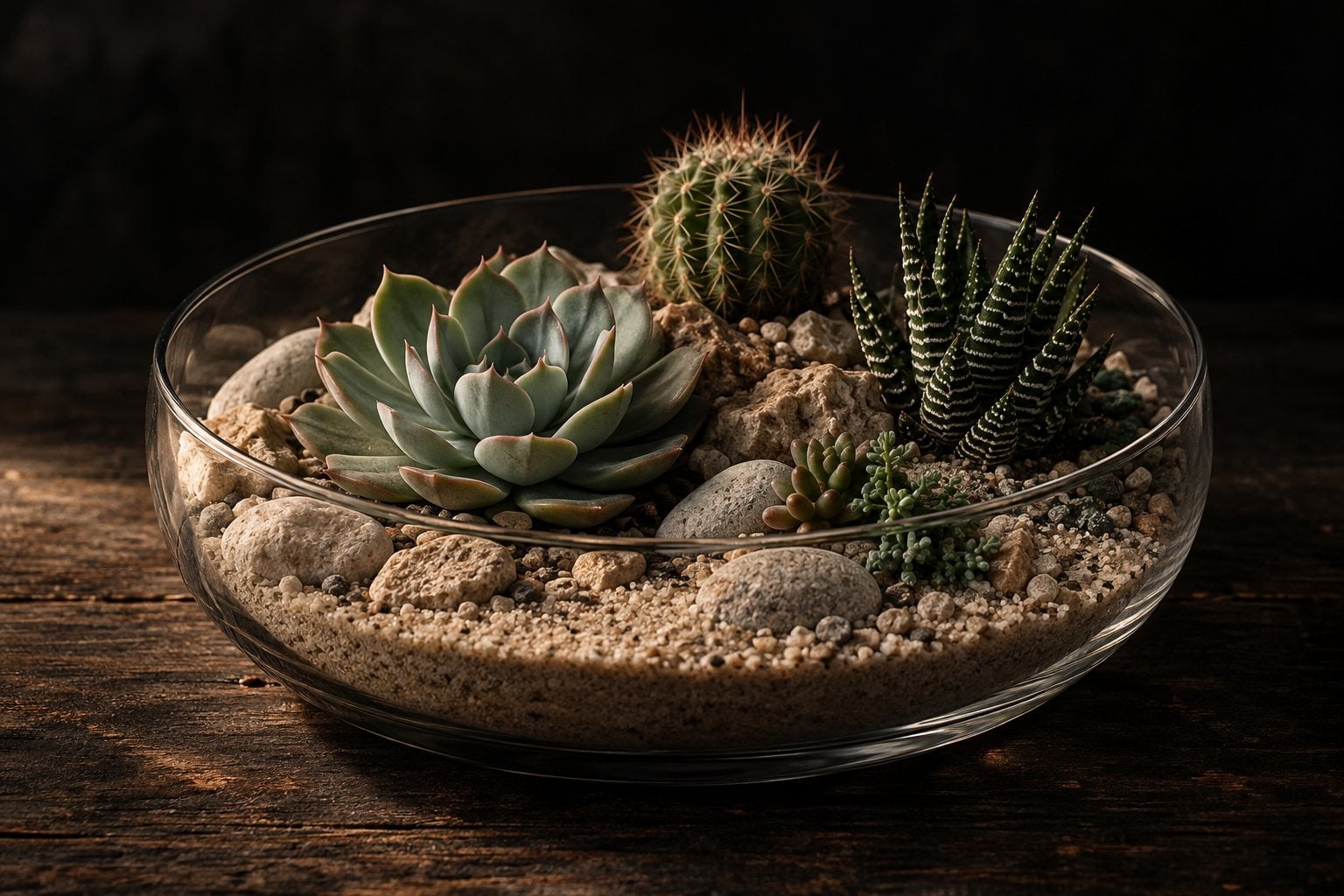
Our Desert kit is an open succulent terrarium: a glass bowl 20 cm across and 8 cm high, with no stopper, five live succulents and everything to fill it. The varieties change with each harvest.
Watering an open tropical terrarium
Tropical plants drink more, and water evaporates through the opening. Keep the compost slightly moist without soaking it. Touch it: if the surface is dry, pour a little water at the base of the plants. If water is still visible in the drainage layer, add nothing more until it has gone.
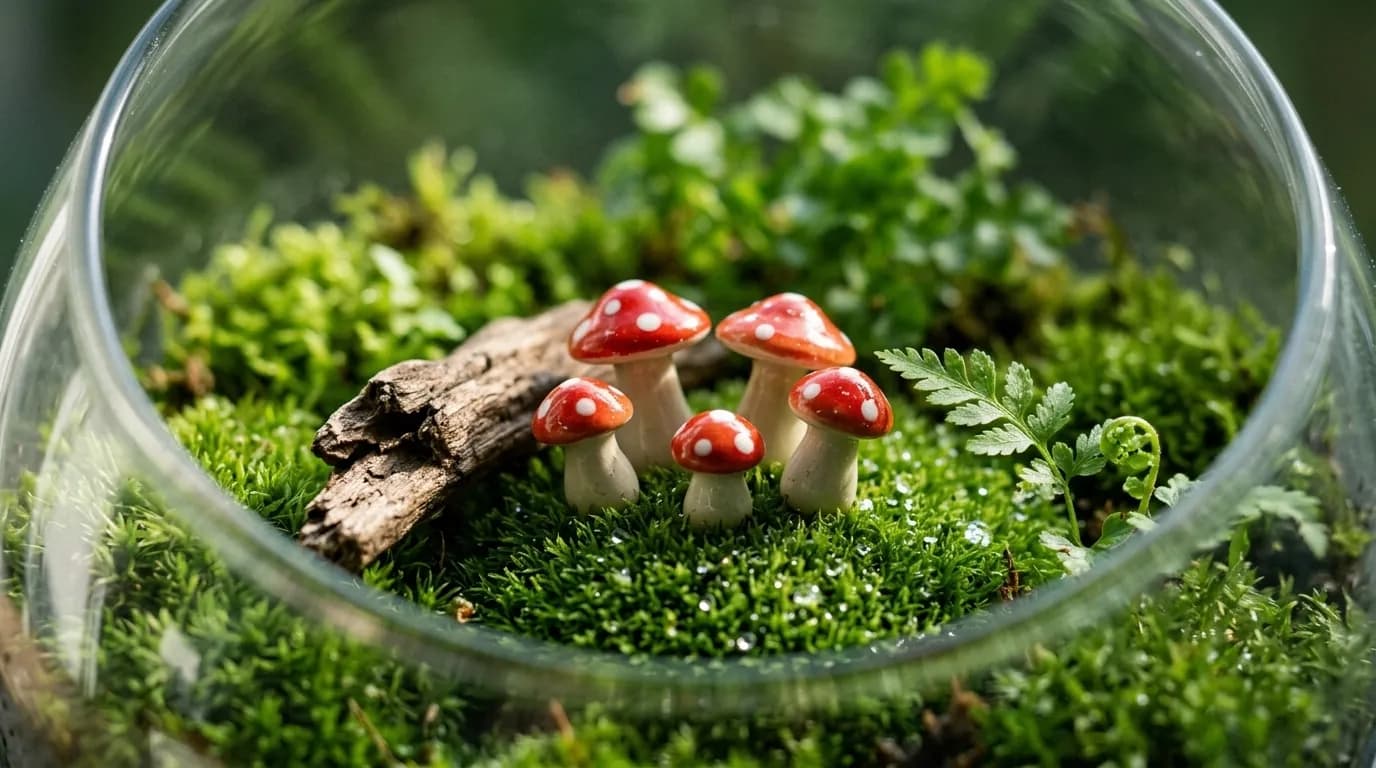
Moss is the first warning sign. If it dries out and loses its colour, lift it out, soak it in water for a few moments, then put it back. Light misting, when the air in the room is dry, helps fine foliage. Calathea is often the plant least tolerant of dry air: check it first.
Our size M open kit brings together a jar 16 cm across and 30 cm high, with a cork stopper that rests on top without sealing, a calathea makoyana and a fittonia White Tiger.
For quantities, which water to use and how it differs from a closed jar, see our guide to watering a terrarium.
Light, and the quarter turn
An open terrarium lives on light. Succulents need the most: place them as close as possible to a bright window. Tropical plants want bright light but no direct sun, which would heat the glass.
Plants lean towards the window. Turn the container a quarter turn every week or two: they grow straight and keep a balanced shape. If a rosette opens out, pales and stretches, it is short of light. Move it closer to the window in several steps, to avoid scorching.
Glass, dust and dead leaves
Without a lid, dust settles on the leaves, on the sand and on the inside of the glass. It blocks part of the light.
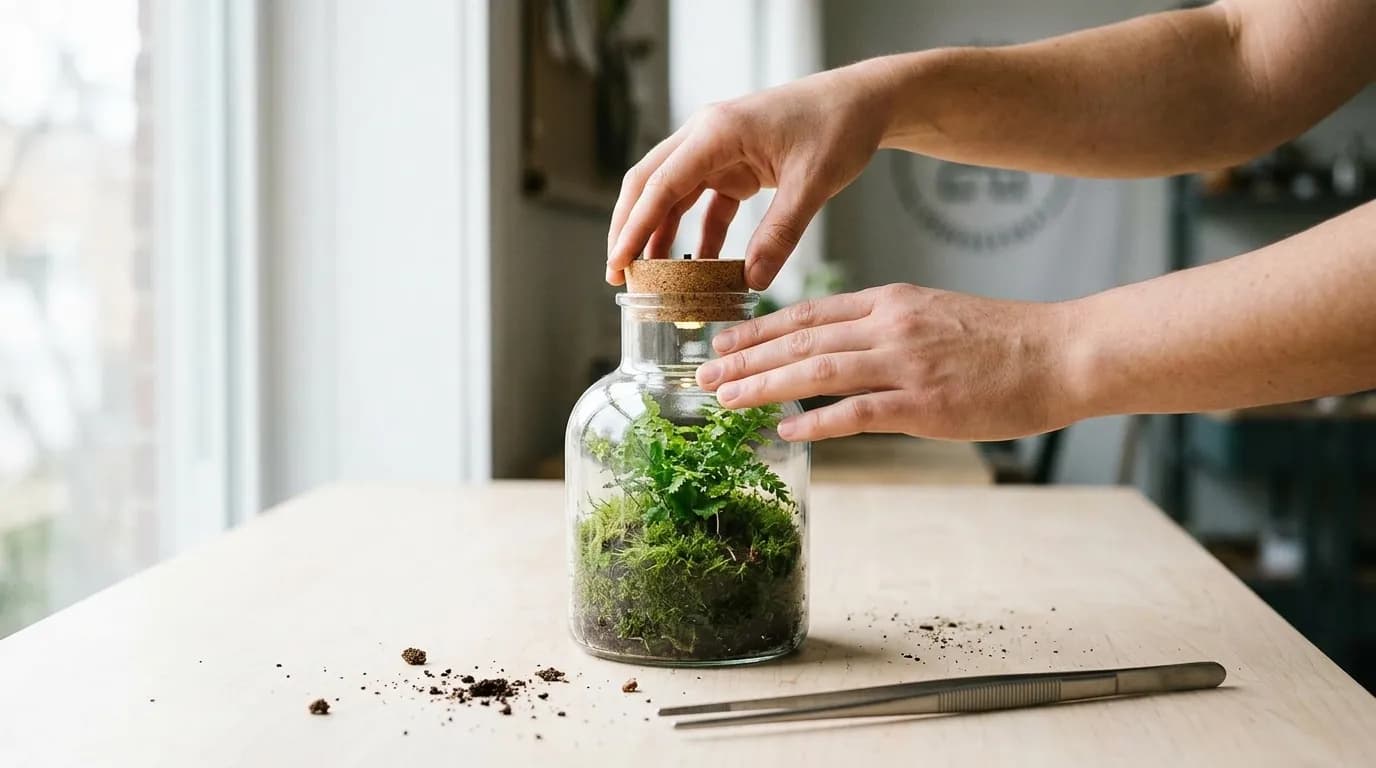
- The glass: outside, a soft, slightly damp cloth. Inside, a dry brush or a folded paper towel held in tweezers. No household cleaner.
- The leaves: a soft brush is enough for succulents. The large leaves of a calathea can be dusted with a barely damp cloth.
- Dead leaves: remove them as soon as you see them. Dry, they look untidy. Soft, they rot and attract gnats.
White marks on the glass often come from lime in the watering water. Our guide to dirty terrarium glass explains how to remove and prevent them.
Pruning and thinning
A tropical plant that touches the glass or grows out of the opening is cut back just above a leaf, with small clean scissors. Healthy trimmings can be used as cuttings. The method is in our guide to pruning a terrarium.
Succulents need almost no pruning. Some, however, produce offsets at their base. When a clump gets too crowded, separate a rosette that has its own roots and replant it elsewhere. Haworthia is propagated this way, as our haworthia guide explains.
Winter: less water, no radiator
In winter, light drops and growth slows. Plants drink less.
- Succulents and cacti: the RHS recommends a rest from November to early March for most indoor cacti and succulents, in a cool room, with just enough water to keep the plants from shrivelling.
- Tropical plants: keep them away from radiators. Hot, dry air dries the compost out in a few days, and the glass can heat up. Check the moss more often.
For other seasonal precautions, see our guide to the terrarium in winter.
Common problems
Soft or translucent base on a succulent. Too much water. Stop watering and let it dry. If water is standing at the bottom, remove it with a pipette or a rolled paper towel.
Wrinkled leaves on a succulent. The plant is short of water. Give it a few spoonfuls, then go back to the normal rhythm.
Curled leaves or dry edges on a calathea. The air is too dry, or the compost has dried out. Water, and mist lightly.
Fittonia collapsing all at once. It is thirsty. Water it: it often stands up again within a few hours. Our fittonia guide covers this behaviour in detail.
Small flies above the compost. These are often fungus gnats, drawn by compost that is too wet and by organic debris. Let the surface dry and remove the dead leaves. Our guide to gnats in a terrarium describes the other solutions.
White, cottony clusters on a succulent. These are often mealybugs. Remove them with a cotton bud and isolate the plant.
If several plants decline despite these corrections, the substrate may be exhausted. Our guide to redoing a terrarium explains how to save the plants and start again on a healthy base.
Closed or open: what changes
A closed terrarium recycles its water: you watch it more than you water it. An open terrarium needs regular watering, but it lets air through and forgives an occasional excess of moisture more readily. For the care of a closed jar, see our complete guide to the closed terrarium.
In short
- Identify your plants: succulents or tropical, the routine changes.
- Succulents: a few spoonfuls of water every two to three weeks in season, once a month at most in winter, always on dry substrate.
- Tropical plants: slightly moist compost, light misting if the air is dry, never water standing at the bottom.
- A quarter turn every week or two, and clean glass.
- Dead leaves come out as soon as you see them.
Sources
- Cacti and succulents: growing indoors, Royal Horticultural Society
- Bottle gardens and terrariums, Royal Horticultural Society
- Houseplants: Get Started, Illinois Extension
- Manufacturer's technical sheets (container dimensions, kit contents)
Frequently asked questions
How often should you water an open terrarium?
It depends on the plants. An open succulent terrarium gets a few spoonfuls of water per plant every two to three weeks in spring and summer, and once a month at most in winter. An open tropical terrarium dries out faster: keep its compost slightly moist, and never leave water standing at the bottom.
Should you mist an open terrarium?
Only if it holds tropical plants or moss. Light misting helps them when the air in the room is dry. A succulent or cactus terrarium is never misted: water sits on the leaves and encourages rot.
How do you clean the glass of an open terrarium?
With a soft, slightly damp cloth on the outside, and a dry brush or a folded paper towel held in tweezers on the inside. Use no household cleaner: its residue stays in a container where plants live.
Does an open terrarium need fertiliser?
Rarely. Terrarium plants are meant to stay small, and fertiliser pushes them to grow. If a plant turns pale after several years in the same substrate, a very dilute feed in spring is enough.