Haworthia care: light and watering for this small succulent
A bright room, infrequent watering, a cool winter, free-draining substrate, offsets and open terrariums: how to care for haworthia, the succulent that accepts softer light.
In this guide
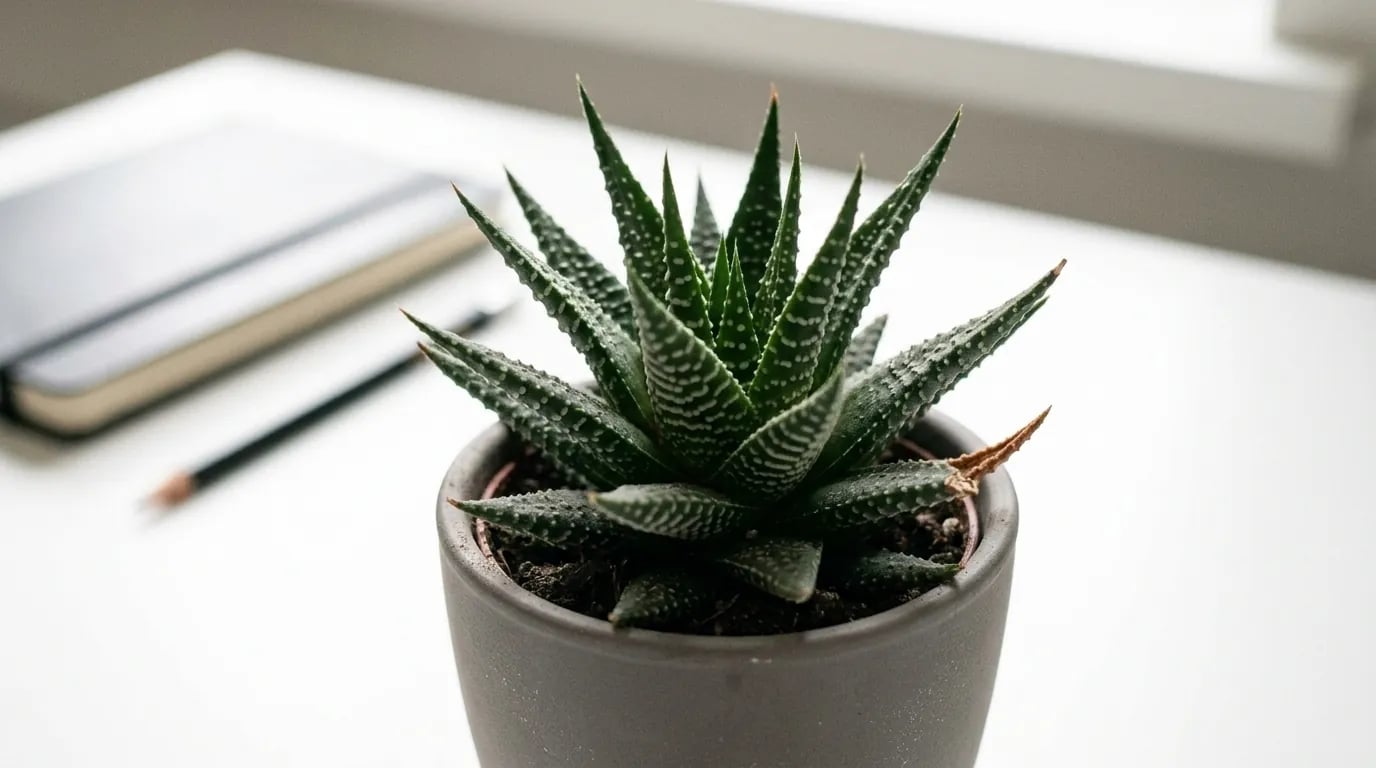
Haworthia is a small succulent that accepts slightly less intense light than most others: a bright room, without direct sun all day, is enough for it. It needs very little water, a substrate that dries quickly and a drier winter. It never goes in a closed terrarium.
Profile
| Botanical name | Haworthia (genus), and hybrids such as ×Gasworthia |
| Origin | South Africa |
| Shape | Compact rosette, thick pointed leaves |
| Light | Bright, without direct sun all day |
| Watering | Infrequent, substrate dry all the way down |
| Terrarium | Open only |
| Difficulty | Easy |
In the wild, haworthias grow in South Africa, in harsh conditions. NC State Extension says they are often found partly buried in sand. Their thick leaves hold a store of water. This is why they cope with drought much better than with too much water.
Our haworthia is a hybrid between haworthia and gasteria, sometimes called "×Gasworthia". It arrives in a 5.5 cm pot and is 10 to 15 cm tall. It is sold singly or in threes. The shape and structure of the leaves vary a little from one plant to the next.
Light: a bright room is enough
Haworthia tolerates softer light than most succulents. A bright room, without direct sun all day, suits it very well. NC State Extension says it prefers bright light, direct or indirect, and tolerates a little shade. Bright light brings out the colors of the leaves.
A dark room does not suit it. Without enough light, the plant stretches and turns pale. If the rosette opens out and the leaves get longer, move it closer to a window.
After months in a dim room, do not put it straight behind a window in full summer sun. Move it closer to the window in several steps.
Watering: infrequent, and always on dry substrate
This is the most important point. A haworthia that lacks water wrinkles, then recovers after watering. A drowned haworthia rots.
- In spring and summer: a few spoonfuls of water per plant every two to three weeks, when the substrate is dry all the way down.
- In autumn and winter: once a month at most, or not at all in a cool room.
To check, push a wooden stick down to the bottom of the pot. If it comes out moist, wait. Pour the water at the foot of the rosette, not into the center of the leaves. The RHS points out that a succulent pot must never stand in water.
The drainage hole matters a lot. Illinois Extension says that potted plants without a drainage hole are more at risk of root rot. The manufacturer does not say if our ceramic pots, in the Madrid set and in the trio, have a drainage hole. Check when they arrive. Without a hole, water with even more care, and empty any water left at the bottom.
Winter: cooler and drier
In winter, growth slows down. Haworthia needs much less water. The RHS recommends a rest period from November to early March for most indoor cacti and succulents, with nights between 8 and 10 °C. During this rest, it recommends giving just enough water to stop the plant from wrinkling.
In a heated living room, these temperatures are rarely reached. Then water once a month at most. In a cool room, you can skip watering altogether.
Substrate and repotting
Haworthia needs a substrate that dries quickly. The RHS recommends a cactus compost, or a potting compost lightened with grit. Grit can make up to 30% of the volume. It also recommends covering the surface with a thin layer of grit.
Repot in spring, when the roots fill the pot. Choose a pot that is only slightly larger. The RHS explains that a pot that is too large holds too much wet soil, and the roots rot.
Over time, haworthia forms a clump of small rosettes. When you repot, you can separate a rosette that has its own roots. NC State Extension lists division, leaf cuttings and seed to propagate it.
Open terrarium, never closed
Haworthia dreads the stagnant humidity of a closed terrarium: its base rots. Use an open, well-ventilated terrarium, or leave it in its pot. The steps to build one are in our succulent terrarium tutorial. The differences between the two formats are in our closed or open terrarium comparison.
It goes well with other compact succulents. Our succulent trio brings together three living plants 8 to 12 cm tall, each in a ceramic mini pot 6 cm in diameter and 6 cm tall, white or blue. Our set of assorted succulents comes as 3, 6 or 12 plants, in 6 cm pots. In both sets, the assortment changes with each shipment.
If you mix several succulents in the same container, place the haworthia on the less exposed side. It copes better with the softer light there than its neighbors do.
Common problems
Soft, translucent base. This is too much water. Stop watering and let the substrate dry. If the base is black, remove the affected rosette.
Wrinkled, thin leaves. The plant lacks water. Give it a few spoonfuls of water, then go back to the normal rhythm.
Stretched, pale rosette. This is lack of light. Move it closer to a window, in several steps.
White, cottony clusters. NC State Extension lists mealybugs as the main pest. Remove them with a cotton bud and isolate the plant.
In short
- A bright room, without direct sun all day, is enough for haworthia.
- Water a few spoonfuls every two to three weeks in season, once a month at most in winter.
- Water only when the substrate is dry all the way down, and check the drainage hole.
- A free-draining substrate and a pot only slightly larger than the root ball.
- An open terrarium, never a closed one.
Sources
- Haworthia, NC State Extension Plant Toolbox
- Cacti and succulents: growing indoors, Royal Horticultural Society
- Houseplants: Get Started, Illinois Extension
- Manufacturer data sheets (dimensions of the plants and the pots, contents of the sets)
Frequently asked questions
Can a haworthia live away from a window?
It accepts slightly less intense light than most succulents: a bright room, without direct sun all day, is enough. A dark room does not suit it. Without enough light, the plant stretches and turns pale.
How often should I water a haworthia?
In spring and summer, a few spoonfuls of water per plant every two to three weeks, when the substrate is dry all the way down. In autumn and winter, once a month at most, or not at all in a cool room.
Does haworthia go in a closed terrarium?
No. It dreads the stagnant humidity of a closed terrarium: its base rots. Keep it in a pot, or in an open, well-ventilated terrarium.
How do I propagate a haworthia?
The simplest way is division. Haworthia gradually forms a clump: when you repot, separate a rosette that has its own roots, then plant it in a small pot of free-draining substrate. NC State Extension also lists leaf cuttings and seed.