Plant stand: choosing the right height, top and spot
Low riser, tall stand, side table or trolley: how to measure the pot, choose the height for your window, use a stand indoors or outside, and keep it from tipping.
In this guide
A plant stand is a support that raises a plant. It brings the plant closer to the light, shows it off, or creates several levels in a corner of the room. To choose one well, measure three things: the base of the pot, the height that suits the spot, and the floor space. This guide helps you take these measurements, then set up the stand safely.
The formats: from low riser to tall table
The term “plant stand” usually means a tall, narrow support. It is also used for lower supports. Here are the formats we offer, with the measurements given by the supplier:
| Format | Height | Top | Material |
|---|---|---|---|
| Low wooden stands, set of 2 | 12 cm and 17 cm | Ø 25 cm | natural wood |
| Low wooden stand, single | 17 cm | Ø 25 cm | natural wood |
| Pot stand | 78 cm | pot of Ø 23 cm | not specified |
| Round side table | 98 cm | Ø 42.5 cm | black metal |
| Round side tables, set of 3 | about 75 cm | Ø 33 cm | black metal |
| Plant trolley on castors | 8 cm | Ø 29 cm | pine wood, polypropylene, rubber |
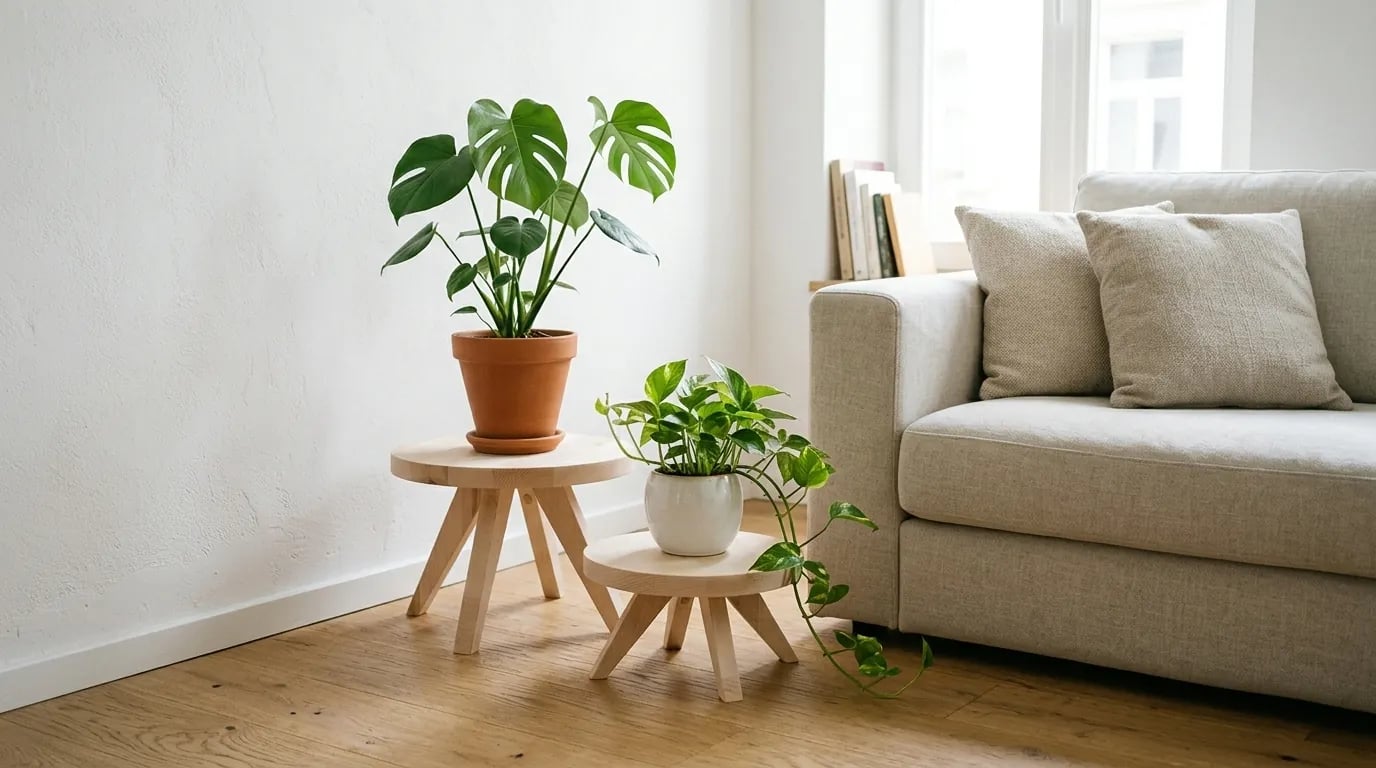
A low stand shows off a plant on a piece of furniture or a windowsill. A tall stand or a side table lifts a floor plant to eye level.
Measure the pot before you choose
The measurement that counts is the base of the pot, with its saucer. Take it at the widest point, where the pot touches the top.
- On a round top, the base must be smaller than the diameter of the top. On our wooden stands, it must fit within 25 cm.
- On our 78 cm pot stand, the supplier gives an accepted pot diameter: Ø 23 cm.
- On the trolley, the base of the pot or planter must stay within the 29 cm of the top.
Think about the foliage too. A large, wide plant can tip a narrow stand, even if the pot sits well on the top.
Weight counts as much as size. The supplier gives no maximum load for our side tables or for the trolley. A pot of watered compost weighs much more than a dry one. Our guide to the plant shelf explains how to spread out heavy pots.
Height and light
A plant stand does not bring any light by itself. It helps when it brings the plant closer to the glass. The University of Illinois classifies the light in a room by the direction the window faces and the distance from it:
- Bright light: right in front of an east or west window, or up to about 1.5 m from a south window.
- Medium light: right in front of a north window, a few steps from an east or west window, or 1 to 3 m from a south window.
- Low light: further into the room.
So place the stand near the window if the plant likes bright light. A plant that prefers shade can stay further away. On the floor, below the windowsill, a plant often gets less light than at the height of the glass: a tall stand can lift it back into the light.
Turn the plant a quarter turn from time to time. The University of Illinois advises turning plants so that growth stays even. A plant that lacks light makes small leaves and long, thin stems towards the window. Its older leaves can turn yellow and fall.
Wood or metal: indoors, and outdoors
The natural wood stands go on a windowsill, on a piece of furniture or on the floor, according to the supplier. It does not list them for outdoor use. Always put a saucer under the pot: water stains wood.
The black metal side tables are listed for indoors, the balcony or the terrace. The supplier does not specify any rust treatment. Shelter them from rain if they stay outside.
The 78 cm pot stand is listed for indoors, the balcony or the terrace. The supplier does not specify its material, only that it is sturdy.
The plant trolley is for indoor use only.
In every case, water the plant with care, or carry it to the sink. Water that overflows runs onto the top, then onto the floor.
Combine several heights
A group of plants at different heights looks better than a row at the same level. A few simple ideas:
- Two low stands, 12 and 17 cm, side by side on a piece of furniture. The same stand also comes in 27 cm, with the same 25 cm top.
- A tall stand next to a floor plant, for a two-level plant corner.
- Three identical side tables, grouped or spread around the room. The set of three 75 cm tables makes for an even plant corner.
Choose cachepots in the same colour family: the whole group stays calm. Our guide to the decorative cachepot gives pointers for matching them.
The plant trolley
The trolley is a low top on four swivel castors. It raises the plant only a little, by 8 cm, but it makes it mobile. It also protects the floor under a large pot.
It is useful for:
- moving a large pot closer to the window in winter, without carrying it;
- cleaning the floor under the plant;
- moving a heavy pot from one room to another.
The base of the pot must stay within the 29 cm diameter. The supplier gives no maximum load.
A stable, safe plant stand
- Set the stand on a flat floor, without a thick rug under just one foot.
- Keep heavy pots low, on the low stands or the trolley.
- Avoid walkways, where people bump into the stand as they pass.
- Place a tall stand against a wall if children or pets often go by.
- Do not let the foliage hang far over the top on one side.
And for a terrarium
Our wooden stands are designed for a plant or a terrarium. A raised terrarium is easier to see. Place it in bright light, but never in direct sun: the glass heats up fast. Our guide to the terrarium in a flat helps you find the right spot.
In short
- Measure the base of the pot, with its saucer, and compare it to the top.
- Place the stand near the window if the plant likes bright light.
- Turn the plant from time to time.
- Put heavy pots on the low stands, and shelter metal from rain.
- Set the stand on a flat floor, out of walkways.
Sources
- Lighting, University of Illinois Extension
- Make sure houseplants get enough light this winter, University of Illinois Extension
- Manufacturer data sheets (dimensions, materials, indoor or outdoor use, accepted pot diameter)
Frequently asked questions
How do I know if my pot fits on a plant stand?
Measure the base of the pot, with its saucer, at the widest point. This measurement must be smaller than the top of the stand. If the saucer sticks out over the top, the pot becomes unstable.
How much weight can a plant stand hold?
For our plant stands, side tables and trolley, the supplier gives no maximum load. Use pots of ordinary size, and keep the heaviest pots on the lowest stands. A watered pot weighs much more than a dry one.
Can I put a metal plant stand on a balcony?
The supplier lists our black metal side tables for indoors, the balcony or the terrace. It does not specify any rust treatment: shelter them from rain if they stay outside.
Does a plant stand help a plant get more light?
It can help, if it brings the plant closer to the window. Light drops quickly as you move away from the glass. A stand at the back of the room gives the plant no extra light.