Plant shelf: which plants on top, which below, and how to water them
Light drops fast as you move away from the window, and a watered pot is heavy. How to arrange a plant shelf: where each plant goes, trailing plants on top, water, weight, real and artificial.
In this guide
To get a plant shelf right, place it near a window, put the trailing plants on top and the heavy pots at the bottom, and set each pot in a watertight cache-pot. Light, weight and water matter more than the choice of plants.
One note: Small Eden does not sell shelves. This guide helps you fill your own.
1. Light decides everything
A plant lives on light. Yet light drops very fast as you move away from the glass. A shelf against the wall opposite the window gets far less light than a windowsill.
Look at where your shelf is, shelf by shelf. The top of a shelf unit is often darker than the middle, because light comes in through the window and not through the ceiling.
One sign to watch: a plant that lacks light stretches, and its stems become thin. The University of Illinois gives this sign as a clue to a lack of light. It also points out that light drops in winter: a plant well placed in summer can lack light in December.
2. Weight: think of the watered pot
A pot of wet soil weighs much more than a dry pot. Three pots on one shelf quickly add up to a serious load.
- Wall shelf. Read the maximum load given by the maker. It also depends on the wall and the wall plugs. A plasterboard partition needs plugs made for it.
- Freestanding shelf unit. Put the heaviest pots at the bottom: the unit is more stable. Fix the top of the unit to the wall if children live in the home.
- In every case. Prefer plastic pots slipped into light cache-pots, rather than large terracotta pots.
3. Water: nothing must drip
A grow pot has holes. That is necessary: the University of Maryland points out that a houseplant must never sit with its roots in water. But on a shelf, the water that leaves the pot falls on the shelf below.
The solution:
- Put each pot with holes in a watertight cache-pot, or on a saucer.
- After watering, wait a few minutes, then empty the water left at the bottom.
- Take the pots on top down to water them, in the sink or in the shower. Watering a pot above your head means watering without seeing.
Before watering, push a finger into the soil. If it is dry deep down, water. If not, wait. Our guide to watering houseplants details the method.
4. Which plant at which height
On top: trailing plants
A trailing plant needs empty space below it. The top of the shelf is its place.
- Pothos: the University of Illinois classes it among low-light plants.
- Climbing philodendron: heart-shaped leaves. The same source also classes it as low light.
- Chlorophytum, or spider plant: it makes offsets at the end of long stems.
- Tradescantia: striped or purple foliage. It needs stronger light to keep its colours.
- String of hearts (ceropegia): thin stems and small leaves. It wants plenty of light and little water.
Pothos and philodendron are toxic to cats and dogs if they chew them. Place them out of reach.
In the middle: compact plants
At eye level, put what you want to look at closely: a pilea, a peperomia, a small fern, a terrarium.
At the bottom: heavy pots and tall plants
Large plants and big pots go at the bottom. They get light from the side, and they steady the unit.
5. Dark corners: terrarium and artificial plants
Every shelf has a badly lit level. Two solutions last over time.
A closed terrarium
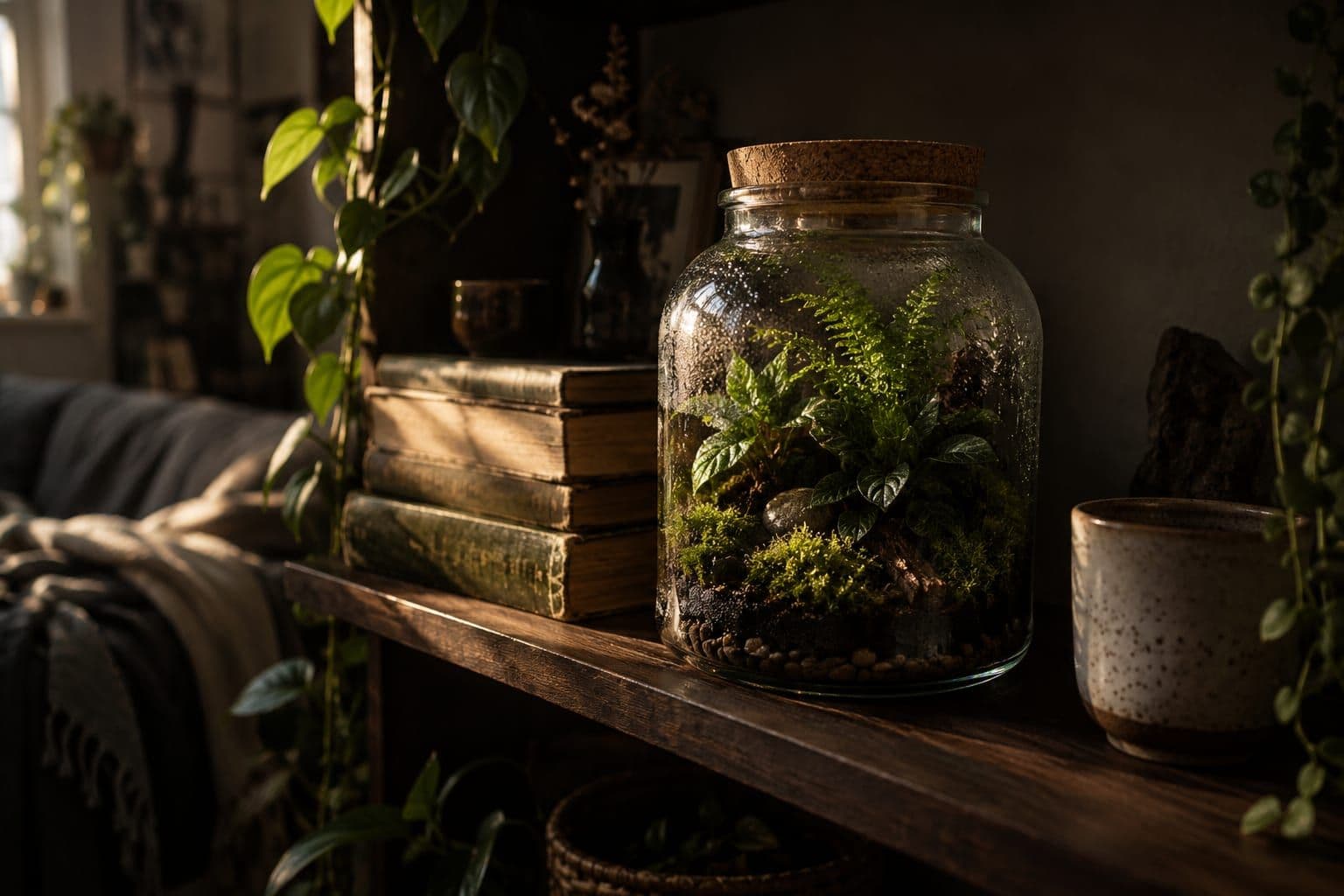
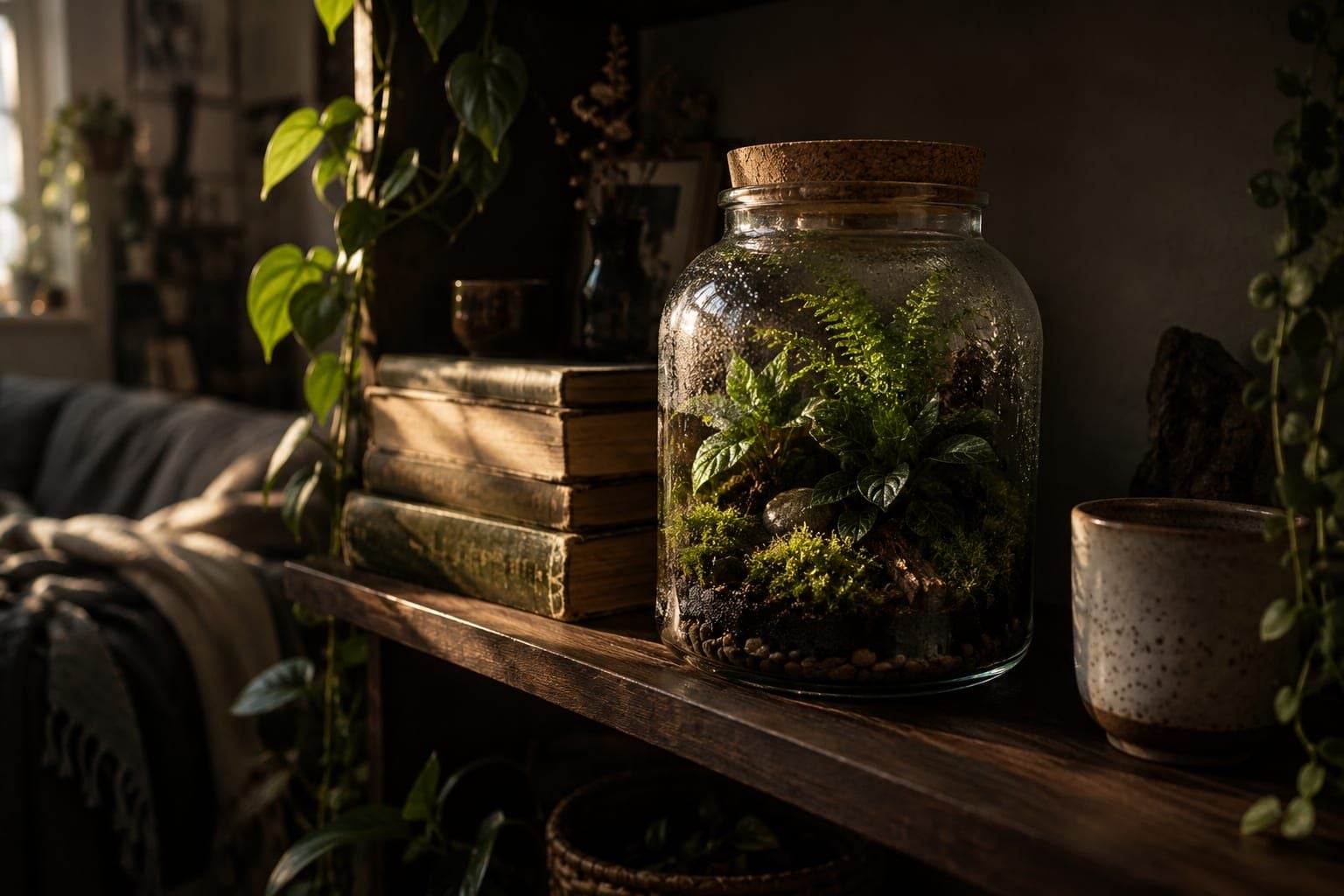
A closed terrarium recycles its water. It has no saucer and does not leak: it is the cleanest living object for a shelf. It needs light, but no direct sun.
Our size M cork-stopper kit is a recycled glass bottle 19 cm in diameter and 20 cm tall, with a live fern and a live fittonia. These plants want light shade. A dim room suits them, a room with no window does not. The kit is watered once or twice a year, and the bottle is opened for a few hours once a month.
Check the free height between two shelves before you order: you need more than 20 cm. To choose the size, read our guide to the terrarium in a flat.
Artificial plants, mixed with real ones
An artificial plant needs no water and no light. It goes where a real plant cannot last: the top shelf in a hallway, the corner against the wall.
The mix goes unnoticed if you follow three rules.
- Real plants go near the light, at eye level. They are the ones people look at closely.
- Artificial ones go on top and at the back. They are seen from a distance.
- Dust them. A dusty leaf gives away the artificial plant. A dry cloth is enough.
Our artificial mini pilea is 15 cm tall. It comes as a stem, with no pot: slip two or three stems into a small vase to fill a gap between two pots.
To fill a whole dark shelf, our Urban Jungle L set brings together five artificial plants from 25 to 120 cm. Two are made for the shelf: a trailing ficus pumila of 80 cm, supplied as a stem, and a potted pilea of 25 cm. The other three are larger and stand at the foot of the unit or on a low piece of furniture: a monstera of 40 cm, a palm of 90 cm and a monstera on a support pole of 120 cm.
6. Putting it together
- Vary the heights. One plant that falls, one that rises, one that makes a ball.
- Leave empty space. One shelf in three stays half free.
- Repeat the pots. Two or three colours of cache-pots at most, coming back across the whole shelf.
- Add an object that is not a plant: an empty vase, a pile of books. The models are on the design vases page.
In summary
- Place the shelf near a window.
- Check the load, and put the heavy pots at the bottom.
- A watertight cache-pot under each pot.
- Trailing plants on top, compact in the middle, tall at the bottom.
- Closed terrarium or artificial plants for the dark shelves.
Sources
- Houseplants and Indoor Lighting, University of Illinois Extension
- Watering Indoor Plants, University of Maryland Extension
- Technical data sheets from the maker of the artificial plants and the bottle (dimensions, materials)
Frequently asked questions
Which plants should I put on a shelf?
On top, trailing plants such as pothos or climbing philodendron. In the middle, compact plants. At the bottom, the heaviest pots. Choose each plant according to the light it gets.
Which trailing houseplant needs little light?
Pothos and climbing philodendron are the most tolerant. They accept low light, but then they grow slowly. No living plant lasts in a corner with no daylight.
How do I water shelf plants without making a mess?
Put each pot in a watertight cache-pot or on a saucer. Water, wait a few minutes, then empty the water left at the bottom. For the pots on top, take them down to water them.
Do you sell plant shelves?
No. Small Eden does not sell shelves. We sell what you put on them: terrarium kits, vases, pots and artificial plants.