Porcelain or ceramic vase: porcelain, earthenware, stoneware, polyresin
Porcelain, earthenware, stoneware or polyresin: what sets these materials apart, what it changes for a vase, and how to choose by what you put in it and where it stands.
In this guide
Porcelain is the densest ceramic: it absorbs almost no water, and it lets a little light through when it is thin. Earthenware is a porous clay, made watertight on the surface by a glaze. Stoneware sits between the two. Polyresin, for its part, is not a ceramic. For a vase for dry decoration, all of them work: the choice comes down to look, weight and shape.
Ceramic: the word that covers everything
“Ceramic” refers to all objects made from a clay body, shaped and then fired. Porcelain, stoneware and earthenware are three ceramics. They differ in their body and their firing.
So a “ceramic vase” can be made of porcelain, stoneware or earthenware. To know what it is made of, read the material on the product page. On our product pages, it is always stated. When the manufacturer does not give it, the product page says so.
Porcelain, stoneware, earthenware: what changes
The Canada Border Services Agency classifies ceramics by how much water their body absorbs. The Victoria and Albert Museum in London also describes these materials. Here is the essential.
| Porcelain | Stoneware | Earthenware | |
|---|---|---|---|
| Body | almost fully vitrified | partly vitrified | porous |
| Water absorbed by the body | 0.5% at most | 3% at most | permeable to liquids |
| Appearance | white, translucent when thin | opaque | opaque |
| Surface | glazed or unglazed | usually glazed | covered with a glaze |
“Vitrified” means the body has become compact, like glass, during firing. The Victoria and Albert Museum gives a firing of about 1,200 to 1,450 °C for hard-paste porcelain. The result is a white, hard, non-porous body.
Earthenware, according to the same museum, is fired clay covered with a glaze, usually white, with a painted decoration. It is this glaze that makes its surface watertight. The body underneath stays porous.
Waterproof does not mean “vase for water”
Porcelain absorbs almost no water. That is not enough to say a vase holds water. The piece must also be closed at the bottom, with no crack, and the manufacturer must have designed it for this use.
For our porcelain vases, the manufacturer gives a clear use: dried flowers, decorative branches or artificial flowers, or the vase on its own. It does not say whether they hold water. So we do not recommend them for fresh flowers or for a living plant.
For earthenware, the same caution applies. If the glaze is scratched or crazed, water reaches the porous body.
Our vases, material by material
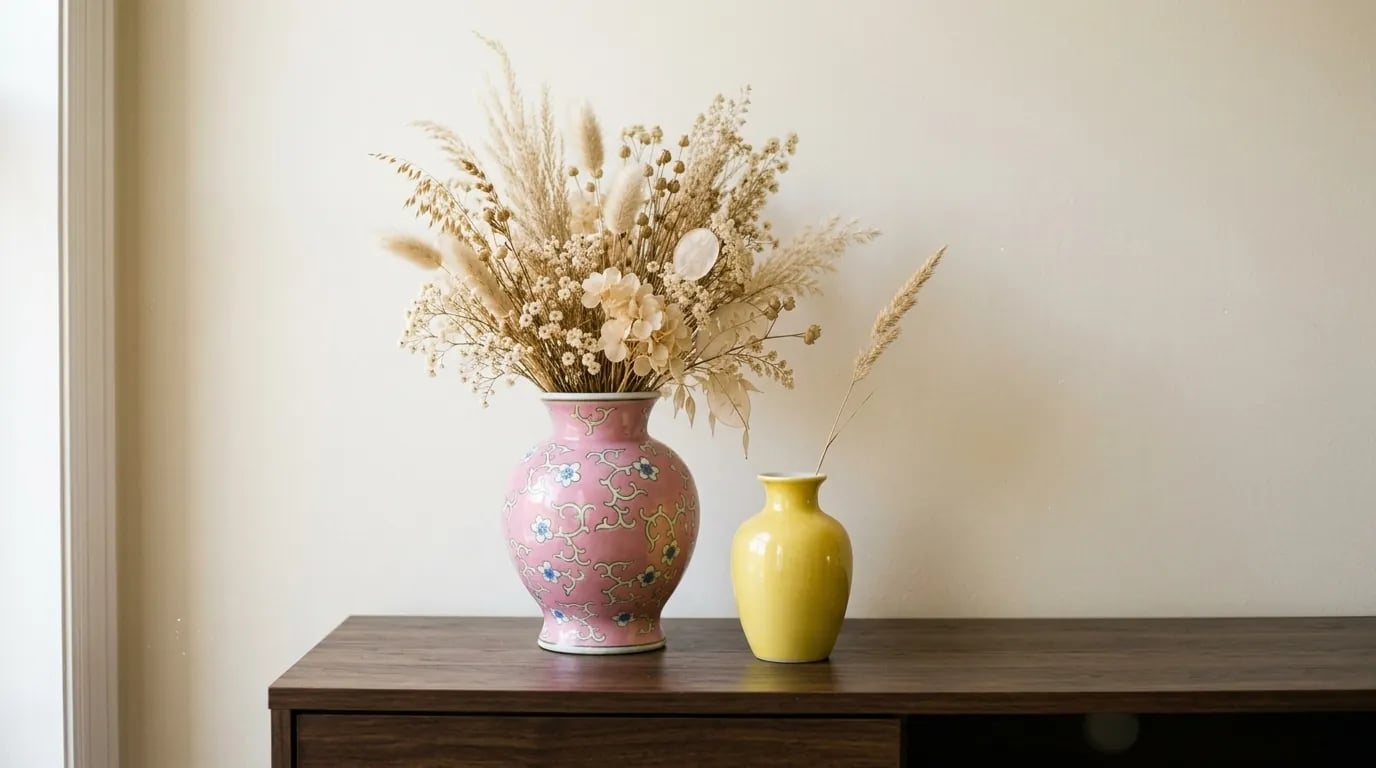
- Pink porcelain vase, 22.5 cm tallØ 16.5 × H 22.5 cm€64.90
- Yellow porcelain vase, 20.5 cm tallØ 10 × H 20.5 cm€36.90
- Mingus, trio of design vases in yellow, pink and greenØ 12 × H 17.5 cm, Ø 9.5 × H 15 cm and Ø 11.5 × H 10.5 cmFrom €79.90Choose
- Face vase Charlotte, pink beret and strawberry blouse, 24 cm20.1 × 13.7 × 24.2 cm€68.90


Porcelain
Our Mingus line is made of smooth porcelain, in yellow, pink and green. The 22.5 cm pink vase has a diameter of 16.5 cm: it is the widest of our porcelain vases. It takes a full dried bouquet.
The 20.5 cm yellow vase is narrower: 10 cm in diameter. Its slender shape goes well with a few branches.
The colour trio brings together a pink, a yellow and a green vase, of 17.5, 15 and 10.5 cm. The same smooth porcelain links them.
Earthenware
Our Charlotte face vase is made of earthenware. It is a woman's bust with a pink beret and a strawberry blouse, 24.2 cm tall. The opening is at the top of the head. The manufacturer gives neither its diameter nor whether the vase holds water.
Polyresin
Polyresin is a moulded resin. It is not a ceramic. It allows fine details and painted colours, but it is sensitive to knocks. Most of our face vases are made of this material, such as Summer, with a pink hat and round glasses, 28.5 cm tall.
Stoneware
We do not have a stoneware vase at the moment. If you are looking for one, remember that it is opaque and less porous than earthenware.
Choosing by use
| What you want | Material to favour | With us |
|---|---|---|
| A smooth vase in a plain colour | porcelain | the Mingus line |
| A full dried bouquet | wide porcelain | the pink vase of Ø 16.5 cm |
| One or two slender branches | narrow porcelain | the 20.5 cm yellow vase |
| A figurative object with painted decoration | earthenware or polyresin | the face vases |
| Living succulents | face vase, plants left in their nursery pot | the face vase and succulents set |
For the last row, the method is in our guide planting succulents in a face vase. For a single stem in a small vase, see the bud vase.
Care and precautions
- Porcelain: a soft cloth, dry or barely damp, as our product pages say.
- Earthenware: the same cloth. Avoid leaving water at the bottom.
- Polyresin: a dry cloth. Place the vase away from the edge of the furniture: it is sensitive to knocks.
Our product pages give no other instructions. To be safe, do not use a dishwasher or an abrasive cleaner.
To choose the size of a vase for your furniture, read which design vase to choose. All our models are on the design vases page.
In short
- Porcelain, stoneware and earthenware are three ceramics. Polyresin is not one.
- Porcelain is the densest: it absorbs almost no water.
- Earthenware is porous under its glaze.
- A waterproof material does not make a vase for water: read the intended use on the product page.
- Our vases are intended for dry decoration: dried flowers, branches or artificial flowers.
Sources
- Classement tarifaire des porcelaines et autres céramiques, Canada Border Services Agency (in French)
- An A–Z of Ceramics, Victoria and Albert Museum
- Manufacturer data sheets for the vases (dimensions, materials, intended use)
Frequently asked questions
What is the difference between porcelain and ceramic?
Ceramic is the large family of objects made of fired clay. Porcelain is part of it, as are stoneware and earthenware. Porcelain is the densest of the three: it absorbs almost no water.
Does a porcelain vase hold water?
The material is almost waterproof, but that is not enough to say a vase holds water. For our porcelain vases, the manufacturer does not say: we recommend them for dried flowers, branches or artificial flowers.
Do you have stoneware vases?
No, not at the moment. Our vases are made of porcelain, earthenware or polyresin. The material of each vase is stated on its product page.
Is polyresin a ceramic?
No. It is a resin that is moulded, then painted. It allows detailed shapes, like our face vases, but it is sensitive to knocks.