Decorative cachepot: choosing the size and material, and watering well
Pot or cachepot, inner diameter, drainage hole, watering without standing water, materials and colours: how to choose a decorative cachepot and set a plant in it.
In this guide
A decorative cachepot is an ornamental pot into which you slip a plant that stays in its nursery pot with drainage holes. To choose one well, measure the plant's pot: the inner opening of the cachepot must be wider. After each watering, empty the water left at the bottom. This guide also explains how to read the measurements of our pots. Their product pages do not say whether they have a drainage hole.
Pot or cachepot: the difference
A nursery pot has one or more holes in the bottom. Excess water drains out, and the soil gets air again. The University of Illinois points out that this hole is essential: roots need air, and most plants cannot bear standing water. Waterlogged soil rots the roots, and the plant rarely recovers.
A cachepot is a decorative pot. It often has no hole. You do not put soil in it: you slip the plant in, still in its nursery pot. This method is called double potting. It has two advantages:
- the plant keeps a pot with drainage holes, and its roots can breathe;
- you take the nursery pot out to water, without disturbing the roots.
Our pots: with or without a hole
For our ceramic pots, the manufacturer does not say whether they have a hole in the bottom. We prefer to say so rather than assume. Check when you receive it: turn the pot over and look at the bottom.
- The pot has a hole: you can plant directly in it, with a saucer underneath. You can also use it as a cachepot.
- The pot has no hole: use it as a cachepot, with the plant in its nursery pot with drainage holes.
The cachepot remains the simplest solution in both cases. It works with all our pots.
Measuring: the diameter that counts
The manufacturer does not give the inner diameter of our pots. If the figure on the product page is taken on the outside, the opening is a little smaller, because of the thickness of the wall. So measure when you receive it.
Here is how:
- Measure the plant's nursery pot at the top rim, from one side to the other.
- When you receive it, measure the inner opening of the cachepot, from one inside edge to the other.
- Compare. The inner opening must be wider than the nursery pot.
- Measure the depth too. The rim of the nursery pot should sit just below the rim of the cachepot.
An example: a 6 cm nursery pot does not fit well into a Ø 6 cm cachepot. You need a smaller pot, or a cutting.
If the cachepot is too deep, put a layer of gravel at the bottom, under the nursery pot. The University of Illinois says that, in a deep enough cachepot, a little water can then collect there without touching the roots.
Watering a plant in a cachepot
- Take the nursery pot out of the cachepot.
- Water it at the sink, until water runs out of the bottom.
- Let it drain for a few minutes.
- Put the pot back in the cachepot.
If you water without taking the pot out, look at the bottom of the cachepot a quarter of an hour later. The University of Illinois advises taking out the inner pot and emptying the water as soon as it collects at the bottom. A plant must never sit with its roots in water.
To know when to water, our guide watering indoor plants explains how to check the soil.
Planting directly in a pot with no hole
We advise against it. A layer of gravel at the bottom does not replace a hole. The University of Illinois explains why: water stays in the soil above the gravel, and only goes down into the gravel once the soil is saturated. The roots then lack air.
If you still want a plant without a nursery pot, choose a pot with a hole. The University of Illinois also says you can drill a hole in a pot that has none. This needs a tool suited to ceramics.
Size: not too big, not too small
A cachepot can be a little bigger than the nursery pot: it holds no soil. Only the opening and the depth count.
For repotting, it is different. The Royal Horticultural Society (RHS) advises a new pot 2.5 to 5 cm wider than the old one, and not much deeper. A pot that is too big holds too much wet compost after watering, and the roots may rot. The signs: yellow or brown leaves, leaves that drop, a plant that wilts, soggy soil on the surface.
Materials, shapes and colours
Our pots are made of ceramic or glazed stoneware. Each model has its own character:
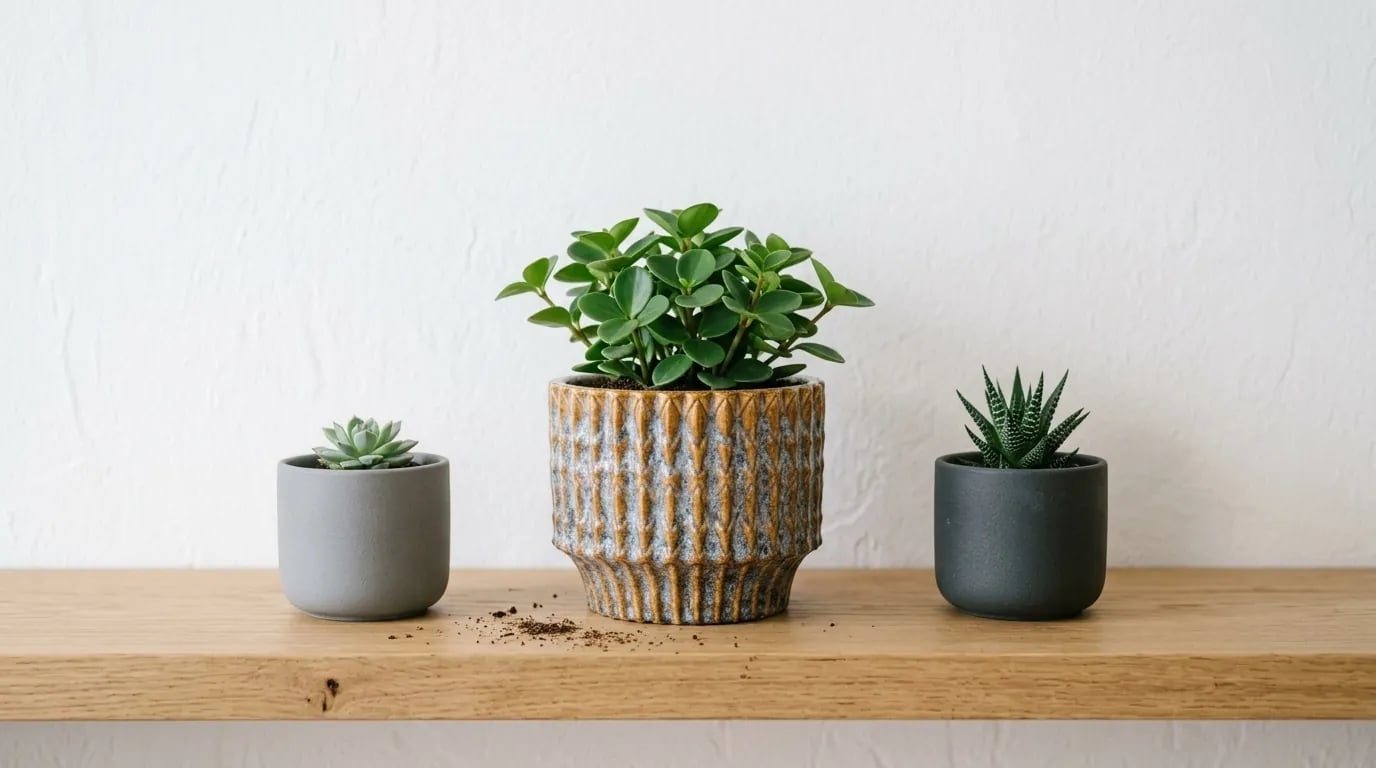
- Ceramic with a relief pattern, blue and brown mixed, Ø 10 cm, 9 cm tall. The manufacturer suggests it for a small fern, an aloe vera or a compact cactus.
- Glazed stoneware in a tulip shape, purple-red with touches of green, Ø 10 cm, 11 cm tall. Its wavy rim recalls petals. It can also stand empty, as an object or a small dish.
- Small matte ceramic ball pots, Ø 6 cm, in grey or anthracite. Anthracite brings out the green of the foliage. For a small succulent, a cutting or a mini plant.
- Set of 6 mini ceramic pots, Ø 7.2 cm, 6.3 cm tall, with varied patterns in warm tones.
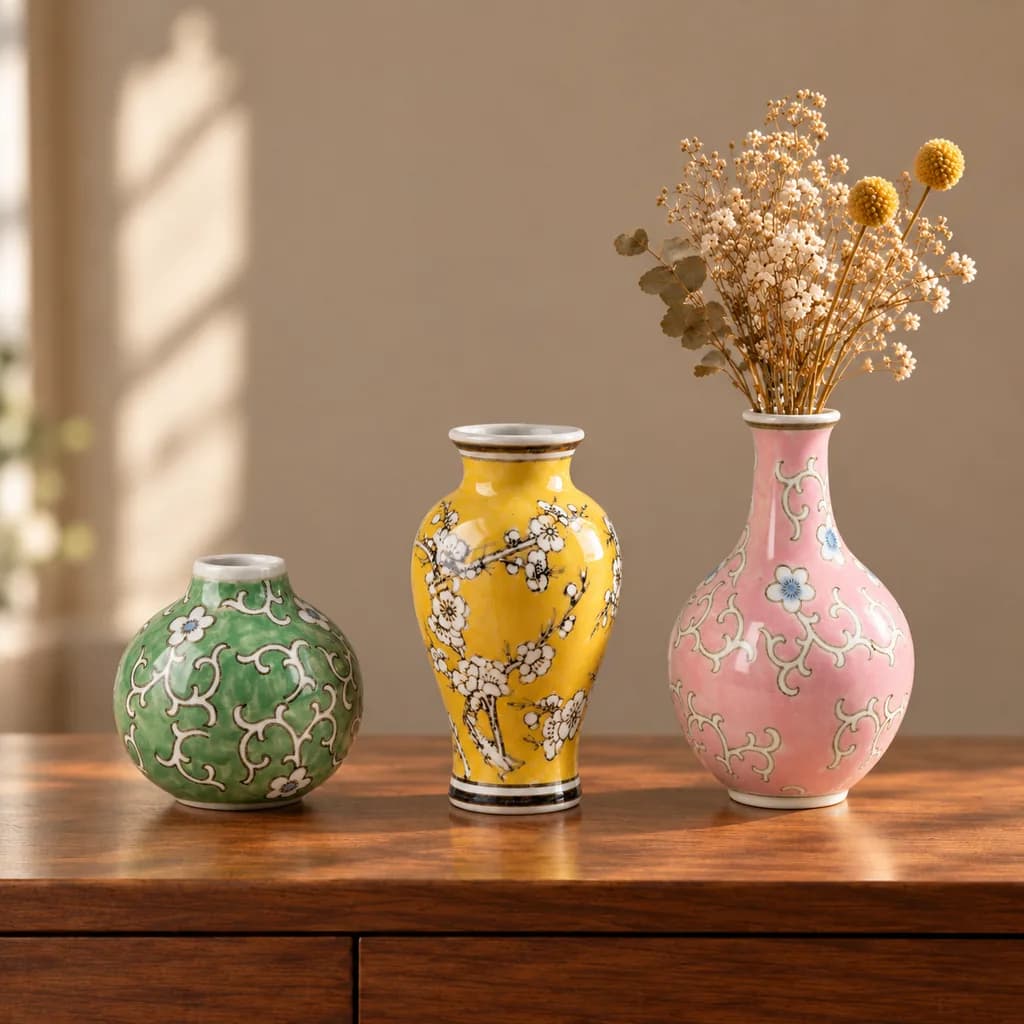
- Trio of small ball pots, Ø 6 cm, 6 cm tall, in two colour schemes: red, pink and yellow, or pastel pink, yellow and ivory.
Putting a group together
A group of small pots looks better than a single pot. A few pointers:
- Stay within one colour family. The warm tones of the set of six pots go together, even with different patterns.
- Play with three heights. Set one pot on a low stand, another on the furniture, a third in front. Our guide to the plant stand gives ideas for stands.
- Keep plants of the same size in a row of small pots, for example cuttings of the same age.
The small 6 cm pots suit cuttings well. A stem that has rooted in water goes into a small pot with a drainage hole, which you slip into the cachepot: our guide to propagating cuttings in water explains the method.
In short
- A cachepot holds the plant in its nursery pot with drainage holes.
- The manufacturer does not say whether our pots have a hole: check when you receive them.
- The inner diameter is not given: measure the opening when you receive it.
- After watering, empty the water left at the bottom of the cachepot.
- A layer of gravel does not replace a hole in the bottom.
- For repotting, choose a pot only slightly bigger than the old one.
Sources
- Container drainage options, University of Illinois Extension
- Overpotting, Royal Horticultural Society
- Manufacturer data sheets (outer dimensions, materials, colours, suggested plants)
Frequently asked questions
What is the difference between a pot and a cachepot?
A nursery pot has holes in the bottom: excess water drains out. A cachepot is a decorative pot, often with no hole, into which you slip the plant still in its nursery pot. It hides the plastic pot and holds the water that drains out.
Do your ceramic pots have a drainage hole?
The manufacturer does not say. Check when you receive it, by turning the pot over. If there is no hole, use it as a cachepot, with the plant in its nursery pot with drainage holes.
What size of cachepot should I choose for my plant?
Measure the plant's nursery pot at the top rim. The inner opening of the cachepot must be wider. The manufacturer does not give the inner diameter of our pots. Measure the opening when you receive it.
Can I plant directly in a cachepot with no hole?
We advise against it. Without a hole, excess water stays in the soil, and the roots lack air. The University of Illinois points out that roots rot in waterlogged soil. Keep the plant in its pot with drainage holes.