

Vertical growing tower care: what comes round every week
Reservoir level, pH, pump filter, turning the column and changing the solution: the real routine of a hydroponic tower, and the failures it heads off.
In this guide
A vertical growing tower needs about ten minutes a week: top the reservoir up with clean water, check the pH, rinse the pump filter and turn the column round. The nutrient solution itself is changed completely every two to three weeks. Everything else is a matter of observation: a pump that changes note, or a tier that yellows, shows itself long before it becomes a problem.
The maintenance calendar in one table
| Task | Frequency | What to look for |
|---|---|---|
| Top up with clean water | Once or twice a week | The reservoir never drops below half |
| Check the pH | Every week | Between 5.5 and 6.5 |
| Rinse the pump filter | Every week | Steady trickle down to the bottom tier |
| Turn the tower a quarter turn | Every two days if the light comes from one side | Similar foliage all the way round |
| Change the whole solution | Every two to three weeks | Clear water, no deposit, no smell |
| Deep clean the reservoir and filter | At every change | Walls smooth to the touch |
| Take out a net pot and look at the roots | Once a month | Roots pale and firm |
These figures are for a twenty-four plant tower with a 20 litre reservoir. On a smaller system the tasks are the same, at a slightly slower pace. The principle of growing without soil is set out in our guide how hydroponics works.
The maintenance tasks, one by one
Topping up: clean water, never solution
A tower loses water far faster than a small kitchen tank. The plants transpire, the column trickles constantly and some of it evaporates on the way. In summer, or near a radiator, the level can drop by several centimetres in a few days.
Always top up with clean water, never with nutrient solution. Roots take up water faster than minerals: as the level falls, the solution concentrates on its own. Adding feed at that point amounts to doubling the dose without noticing, and it shows up later on the leaves, whose tips and edges dry out.
Never let the reservoir fall below half. A small volume warms up faster, holds less oxygen and sees its pH move far more. With twenty-four plants to 20 litres, each plant has only about eight tenths of a litre: the margin is thin.
pH, the reading that decides everything else
Minerals are not taken up in the same way depending on how acid the water is. Most plants grown without soil take them up best when the pH of the solution sits between 5.5 and 6.5. Outside that range, a solution that is correctly dosed still produces deficiencies: pale leaves, veins standing out, growth slowing down.
Test strips are enough to start with. Always measure after topping up, never straight after a correction: let the pump stir things for a quarter of an hour, then check again. Write the figure down somewhere. It is the series of readings, not the isolated one, that tells you whether your water runs high or low.
Nutrient dosing follows the label: on a two-part formula, allow 2 mL of A per litre of water, then 2 mL of B, poured one after the other and never mixed neat. For seedlings and young plants, half strength is enough for the first two weeks.
Changing the solution, every two to three weeks
Topping up is not the same as changing. Over the days, plants draw some elements faster than others and the solution goes out of balance, even if the level stays right.
- Unplug the pump and let the column drain for a few minutes.
- Empty the reservoir. These nutrients are formulated for water alone: do not count on the old solution to feed your plants in pots.
- Scrub the walls with hot water, without scented detergent, then rinse thoroughly. A slippery film on the bottom is the sign it should have been done sooner.
- Rinse the pump filter and pull out any rootlets caught in it.
- Refill with water at room temperature. Cold water straight from the tap chills the roots all at once.
- Add A, stir, then B, stir.
- Check the pH, correct it if needed, let it run for a quarter of an hour, then check again.
In summer, evaporation is stronger: stay closer to two weeks. In winter, in a cool room and with plants growing less, three weeks pass without harm.
The pump: the part that fails first
On a tower, the pump lifts the solution to the top, from where it trickles down over the roots before falling back. It is a small submersible pump, of the order of 6 W, and its filter clogs with rootlets and limescale.
The first sign is not a stoppage, it is a dry tier. If the trickle no longer reaches the top module, the flow has already fallen. Rinse the filter in clean water; once a month, at the time of the change, leave it to soak in diluted white vinegar, then rinse at length.
A pump must never run dry. That is the quickest way to destroy it. If you are away for several days, fill the reservoir to the brim before leaving rather than switching the power off: bare roots dry out within hours.
The lower tiers, light and rotation
A tower 140 cm tall is not lit the same way over its whole height. In front of a window, the top modules take everything and the lower ones grow spindly: long stems, widely spaced leaves, plants leaning over.
Turn the column a quarter turn every two days when the light comes from one side. It is the most rewarding task in the whole routine, and the one most often forgotten.
Towers are not sold with lighting. Two light bars set either side, 20 to 30 cm from the plants, give far more even growth than a single lamp overhead. Allow twelve hours a day for leafy houseplants, fourteen to sixteen hours for lettuces and herbs, on a timer. Distances and durations are covered in our guide indoor grow lights.
Read the symptoms before acting
| What you see | Most likely cause | What to do |
|---|---|---|
| Pale leaves on every tier | Solution exhausted or pH out of range | Measure the pH, change the solution |
| Leaf tips and edges dry and brown | Solution too concentrated | Top up with clean water, go back to the stated dose |
| Roots brown, soft, with a strong smell | Lack of oxygen, circulation stopped | Check the pump, clean, change the solution |
| Top tier dry | Filter or pump clogged | Rinse the filter |
| Plants all leaning the same way | Light coming from one direction only | Turn a quarter turn every two days |
| Greenish film in the reservoir | Light reaching the solution | Make the reservoir opaque, clean it |
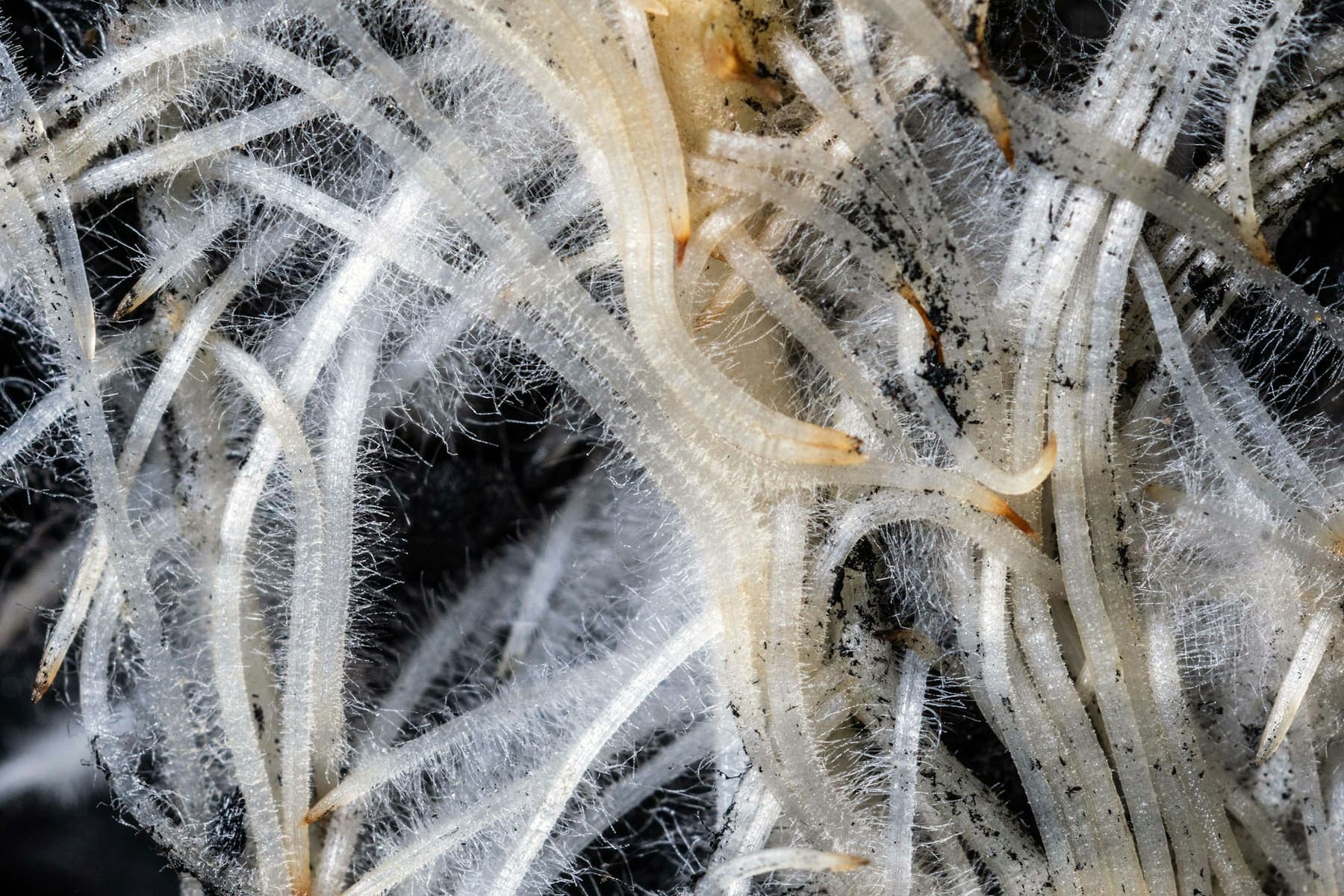
All roots need oxygen. If one plant wilts while the reservoir is full, take out its net pot before anything else: healthy roots are pale and firm, brown soft roots are short of air.
What is better left undone
- Topping up with nutrient solution instead of clean water.
- Raising the feed dose because the plants are growing slowly: the cause is nearly always the light.
- Mixing A and B neat in the same cap before diluting them.
- Cleaning with washing-up liquid without rinsing at great length.
- Harvesting a whole tier at once: leave some foliage and the plants come back.
And next
If you are looking for what to put in the net pots, our selection of easy hydroponic plants gives the species that forgive a shaky start, and the guide basil in hydroponics sets out the pruning that makes herbs branch. The hydroponics section brings together nutrients, starter media and systems.
Sources
Frequently asked questions
Can a hydroponic tower be left alone over a holiday?
A week goes by without intervention if the reservoir is filled to the brim before you leave and the lamp timer stays programmed. Beyond that the level falls too far and the solution concentrates. For a longer absence, ask someone to top the level up with clean water, without touching the dosing.
Should the pump be switched off at night?
It is not necessary on a trickle-fed tower, where the circulation also brings oxygen to the roots. If the noise is a nuisance in a living room, a timer can alternate short cycles, as your system's instructions allow. Never switch the pump off for several hours at a stretch: bare roots dry out fast.
Is tap water suitable for a growing tower?
In most cases, yes. Let it stand for a few hours at room temperature before making up the solution, then measure the pH once the nutrients are in: hard water pushes the pH up and calls for more frequent correction. It is the repeated readings, not the initial analysis, that show how your water behaves.
What should be done if the solution turns cloudy or greenish?
A green film means light is reaching the solution and algae are growing in it. Empty the reservoir, scrub the walls, rinse, then make the reservoir opaque and check that the lid closes properly. Algae do not kill plants directly, but they use up oxygen and clog the pump filter.