

Indoor grow lamps: choosing the right one for seedlings and herbs
Real wattage, spectrum, coverage, distance and lighting duration: the practical benchmarks for choosing and setting an LED grow lamp, without the jargon.
In this guide
For seedlings, microgreens or herbs indoors, a white LED strip light the length of your shelf is enough in most cases. Hang it around fifteen to thirty centimetres above seedlings, a little higher for mature plants, and set it for roughly 14 to 16 hours of light a day. The figure that matters is the power actually drawn, not an "equivalent" wattage printed large on the box. Here's how to choose and set one up without getting lost in spec sheets.
Do you actually need a lamp?
Not always. In spring and summer, a window facing south or west may be enough for hardy herbs. A lamp becomes useful in three situations:
- in autumn and winter, when days shorten and light loses intensity;
- away from a window, on a kitchen or living-room shelf;
- for seedlings, which need plenty of light as soon as they emerge.
Plants tell you when light is lacking: stems lengthen, turn pale and become fragile, leaves space out further apart and everything leans towards the window. This is called etiolation. Etiolated seedlings stay weak, even once you move them back into good light.
The criteria that really matter
Real wattage, not "equivalent" wattage
Many boxes display figures like "600W" or "1000W" for lamps that actually draw a few dozen watts. These are marketing equivalences, with no shared definition. Look for the actual power drawn, given on the spec sheet or the power supply's label. That's what lets you compare lamps of the same technology, and work out your bill.
Even better: if the manufacturer publishes the amount of light useful to plants (PPFD, see below) at a given height, that's the most reliable information for knowing what the lamp actually delivers.
Spectrum: white or purple?
Plants mainly use blue and red light, hence the purple lamps that combine these two colours. They work, but turn a living space into a lab-like setting and make it hard to check on the leaves. A full-spectrum white LED also contains blue and red: it grows herbs and seedlings very well, while staying pleasant to live with.
For a kitchen or living room, choose white. Purple only makes sense in a cupboard or utility room where no one spends time.
Coverage
A lamp lights intensely directly below it and much less at the edges. Choose a length close to that of your shelf. For a deep shelf, two parallel strip lights are better than one more powerful one.
The timer
This is the most underrated accessory. Plants need a consistent period of light and darkness: don't leave the lamp on continuously. A built-in timer or a programmable plug prevents missed switches and lit-up nights.
Heat and safety
LEDs generate little heat, but their power supply must stay clear of splashes. Near a hydroponic tray or a misted tray, check the protection rating shown on the product and fix the cables so they don't hang over the water.
Lumens, lux, PPFD: what to remember
Lumens and lux measure light as perceived by the human eye, which is more sensitive to green. They only imperfectly describe the light useful to plants.
PPFD, expressed in µmol/m²/s, measures the amount of light useful for photosynthesis reaching a surface. Two benchmarks published by university extension services:
- around 200 to 400 µmol/m²/s for vegetable seedlings, according to Utah State University;
- around 250 µmol/m²/s in the microgreen production example given by Virginia Tech, with 18 hours of lighting in professional production.
If the manufacturer publishes a PPFD chart for a given height, set the distance from that. Otherwise, the distance benchmarks below are enough for home growing. Phone light-meter apps give a trend, not a precise value.
Distance and duration by crop
- Microgreens: around 15 to 30 cm above the foliage and roughly 16 hours of light a day, once the seeds have germinated and the tray is uncovered, according to the University of Maryland.
- Seedlings of herbs or vegetables: lamp close by, raised as they grow, around 14 to 16 hours a day. The University of Illinois recommends 16 hours, and 18 hours maximum for seedlings.
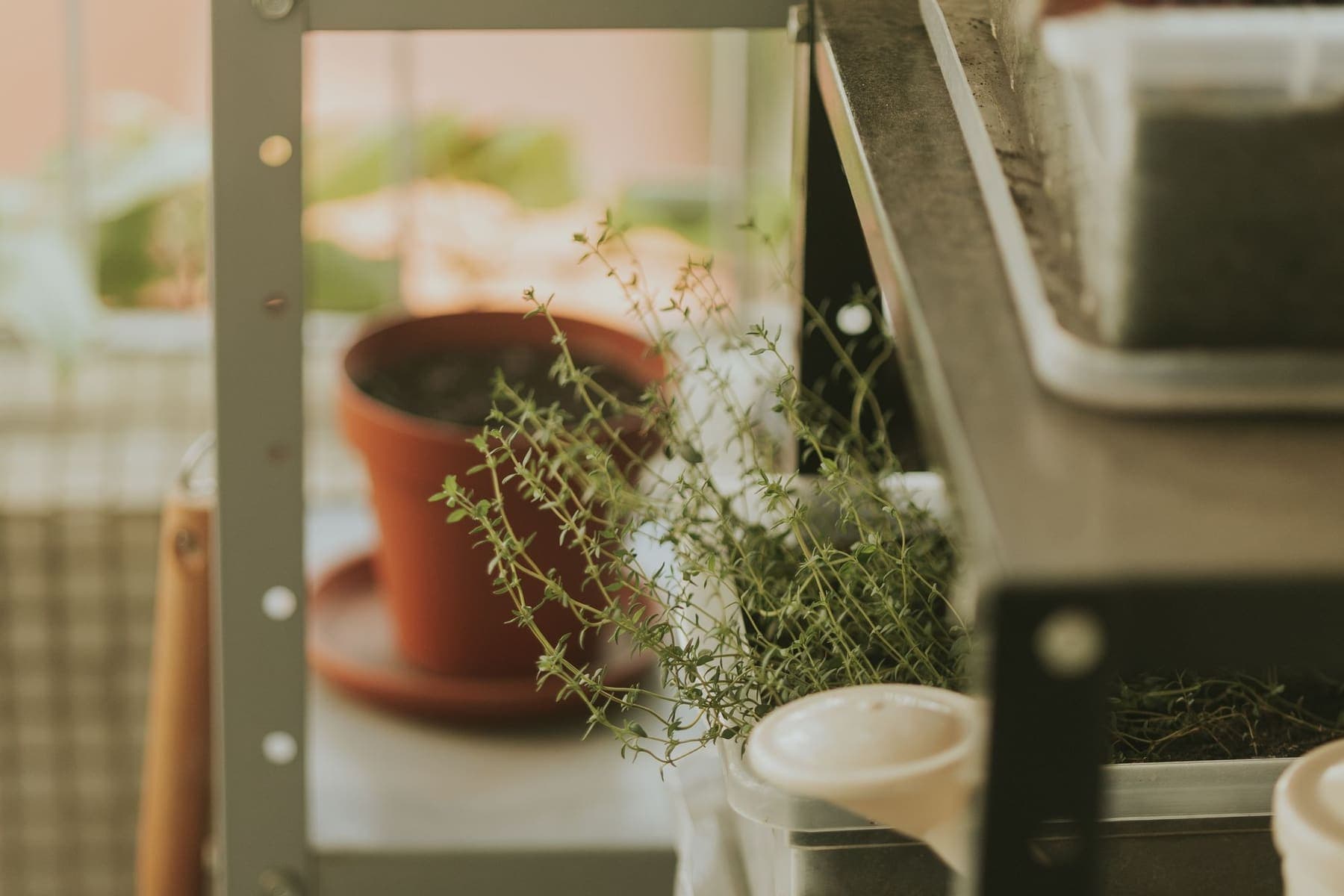
- Mature herbs: basil, parsley, chives, coriander, with the lamp a little higher than for seedlings and 14 to 16 hours a day.
These figures are starting points: the right distance depends on the lamp's power, and the manufacturer's instructions take priority. If leaves fade, yellow or curl at the top of the plant, move the lamp a few centimetres further away. If stems lengthen, bring it closer or extend the duration.
Installing the lamp
- Choose an adjustable fixing, using suspension cables or a chain, to adjust the height as growth progresses.
- Centre the lamp above the crop, parallel to the shelf.
- Make the most of light surfaces: a white wall or a pale shelf backing reflects some of the light back onto the plants.
- Set the timer from day one, for example 7am to 10pm for 15 hours.
- Check a week later how the leaves and stems look, and adjust the distance.
How much does a grow lamp consume?
The calculation is simple and you can do it yourself. Multiply the real wattage by the number of hours of lighting. For example:
- a 24W lamp switched on for 16 hours consumes 384Wh a day, roughly 0.38 kWh;
- over 30 days, that comes to around 11.5 kWh.
Multiply that total by the price per kWh on your electricity contract to work out the monthly cost. That's the value of thinking in real wattage: the calculation becomes impossible with an "equivalent" wattage.
A worked example: kitchen basil in winter
Take a 60cm kitchen shelf, three metres from a north-facing window. Without a lamp, basil there gets leggy: it stretches out and loses its leaves. With a white LED strip the length of the shelf, set from 7am to 10pm, it keeps a more compact habit and produces new leaves.
The simplest approach is to start from seed. Sow into seed compost, keep it evenly moist, and place the lamp above the tray as soon as the seedlings emerge.
Once the seedlings have a few pairs of leaves, transplant them into pots. Then pinch out the stems above a pair of leaves to encourage branching, water when the surface of the compost is dry, and raise the lamp a few centimetres as the plants approach it. To know when to start your seeds by species, see our indoor sowing calendar.
Common mistakes
- Choosing a lamp based on equivalent wattage: only the drawn wattage tells you about the real lamp.
- Leaving the lamp on day and night: plants need a period of darkness.
- Placing the lamp too high: a small strip light quickly loses effectiveness as you move it further away.
- Never raising the lamp: plants that touch it can get marked.
- Relying on an ordinary desk lamp: its light is too weak and too localised for seedlings.
Going further
For a fast first harvest under a lamp, follow our guide to microgreens or our variety-by-variety guide. To grow herbs without soil, read indoor hydroponics without the jargon. Our indoor sowing calendar tells you what to sow and when, and the Seeds section presents our seeds.
Sources
- Growing Microgreens and Baby Greens Indoors — University of Maryland Extension
- A Primer to Supplemental Lighting for Indoor Seed Starting — University of Illinois Extension
- Starting Vegetable Seeds Indoors: II. Materials — Utah State University Extension
- Introduction to Microgreen Production in Indoor Vertical Farms and Greenhouses — Virginia Cooperative Extension
Frequently asked questions
How far above seedlings should an LED lamp be placed?
For a domestic LED strip light, allow roughly fifteen to thirty centimetres above the seedlings, then raise it as growth progresses, following the instructions. If leaves fade at the top, move it further away; if stems lengthen, bring it closer.
How many hours a day should you light herbs?
Around 14 to 16 hours a day under a grow lamp, with a timer and a genuine period of darkness. For seedlings, the University of Illinois recommends 16 hours, and no more than 18.
What does "600W" mean on an LED grow lamp?
It's usually a so-called equivalent wattage, with no shared definition. The lamp actually consumes much less. Go by the real power drawn, shown on the spec sheet: it lets you compare lamps and work out consumption.
Does a grow lamp have to be purple?
No. A full-spectrum white LED also contains the blue and red light plants need. It grows seedlings and herbs very well, while staying pleasant in a kitchen or living room. Purple mainly makes sense in a space no one lives in.