

Growing microgreens successfully first time: the beginner's guide
Easy varieties, sowing density, light, watering and harvesting in 7 to 14 days: the complete method for growing your first microgreens successfully, and finally telling mould from root hairs.
In this guide
To succeed with microgreens on your first attempt, four things are enough: an easy variety (radish, rocket, pea or sunflower), a dense but non-overlapping sowing, a few days in the dark followed by plenty of light, and regular airing. Allow roughly one to two weeks between sowing and harvest, depending on the species. Here's the method, step by step, and the mistakes that trip up most first attempts.
Microgreens or sprouted seeds: what's the difference?
Sprouted seeds are eaten whole, root included, after a few days in a jar. Microgreens, by contrast, grow on a medium (a thin layer of compost or a plant-based mat) until they develop their first leaves, the cotyledons, then the beginnings of true leaves. They're cut with scissors above the medium: only the above-ground part is eaten. They need more light than sprouted seeds, but remain one of the fastest indoor crops.
Choosing easy varieties to start with
Four varieties forgive the rough edges of a first attempt. The durations below are those cited by the Virginia Tech and Clemson extension services:
- Radish: quick to germinate, ready in around 6 to 12 days. Peppery flavour, stems sometimes pink or purple.
- Rocket: small seed, quick to germinate, harvest between 6 and 14 days depending on conditions. Peppery taste.
- Pea: large seeds that need soaking for six hours, harvest in 8 to 15 days. Tender shoots with a fresh-pea flavour.
- Sunflower: soaking recommended, harvest in 8 to 12 days. Crunchy texture, hazelnut flavour.
Leave basil or coriander for later, as they're slower. Use seeds sold for microgreens or sprouting, or labelled "untreated": some vegetable seeds are coated with a treatment that has no place on a plate. For a successful first duo, follow our step-by-step guide to sunflower and radish microgreens.
The equipment you need
A perforated tray set inside a solid tray, a growing medium, a spray bottle and a light source are enough.
For the medium, two options work well. Fine compost, spread 2 to 3cm deep, is the easiest to find: choose a seed compost, never garden soil or compost, which can contain bacteria. A plant-based mat (hemp, jute) is cleaner to handle and can be composted after use.
For light, a bright window facing east or west is enough in spring and summer. In winter, a grow lamp prevents leggy, pale shoots: the University of Maryland recommends around 16 hours of light a day in total. To set up a grow lamp (distance and duration), follow our guide.
The step-by-step method
Prepare the seeds
Large seeds benefit from soaking in cool water, then rinsing: allow six hours for pea and twelve hours for sunflower, the timings from the Utah State University guide we use in our variety-by-variety guide. Small seeds (radish, rocket) are sown dry: soaked, they form a sticky mass that's hard to spread.
Sow densely, without stacking
Moisten the medium, then spread the seeds in a single layer: they can touch, but never overlap. A sowing that's too sparse gives a poor harvest; one that's too dense traps moisture between the seeds and encourages mould. For your first attempt, follow the dose given on the seed packet, then adjust from one crop to the next.
A few days in the dark
Mist, then cover with a second tray or an opaque lid. A light weight placed on top helps the roots anchor and the shoots come up evenly. Uncover once most of the seeds have germinated, generally after two to five days. During this phase, mist without soaking and lift the lid each day to refresh the air.
Move into the light
As soon as the shoots lift the lid, uncover them and place them in full light. Water from below from now on, pouring a little water into the solid tray: the leaves stay dry and the risk of rot goes down. For sunflower, remove any seed hulls still attached to the leaves.
Harvest at the right moment
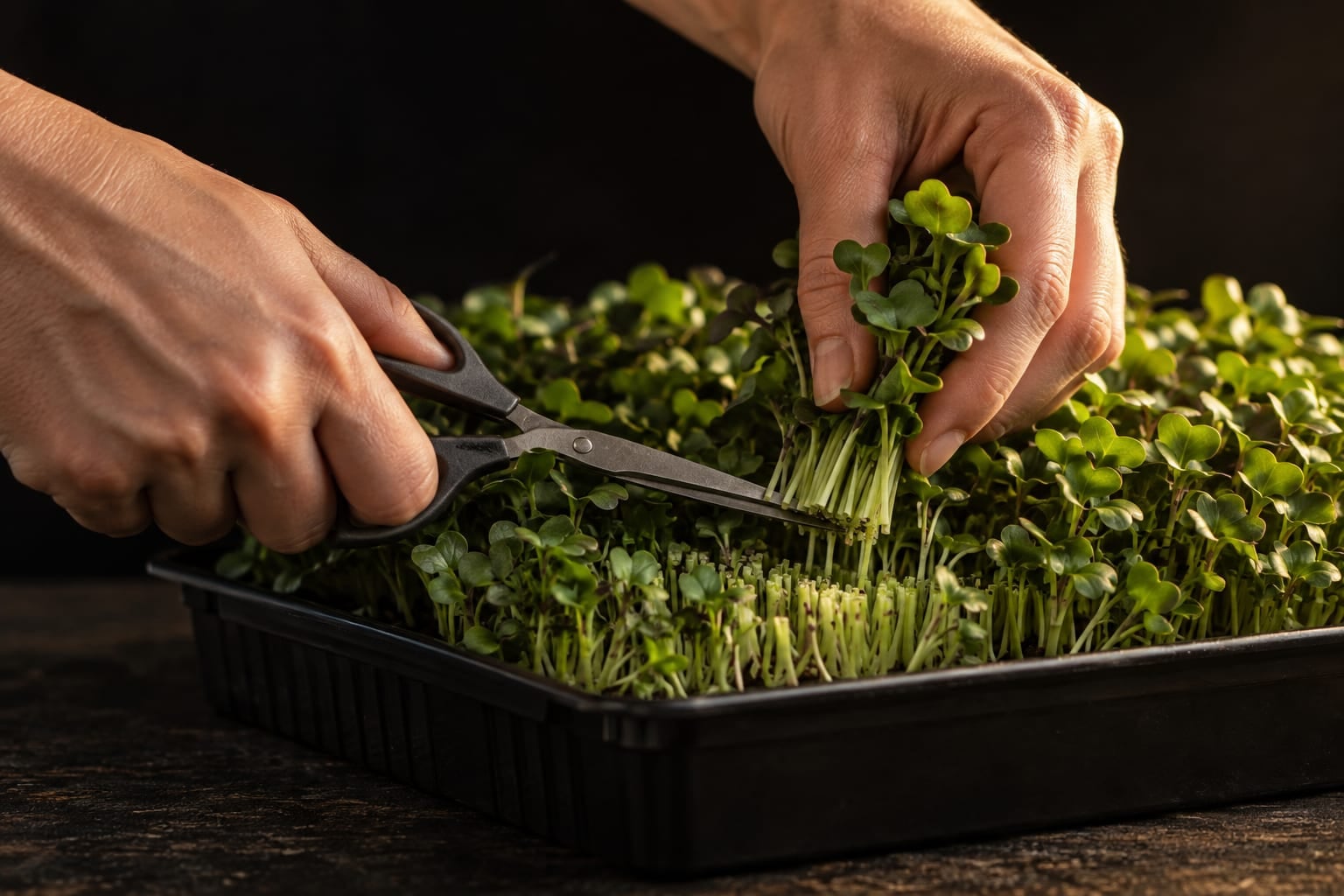
Cut with clean scissors, just above the medium, once the cotyledons are fully open and the first true leaves appear. Microgreens keep for a few days in the fridge, dry, in a clean box or bag.
Mould or root hairs: telling the difference
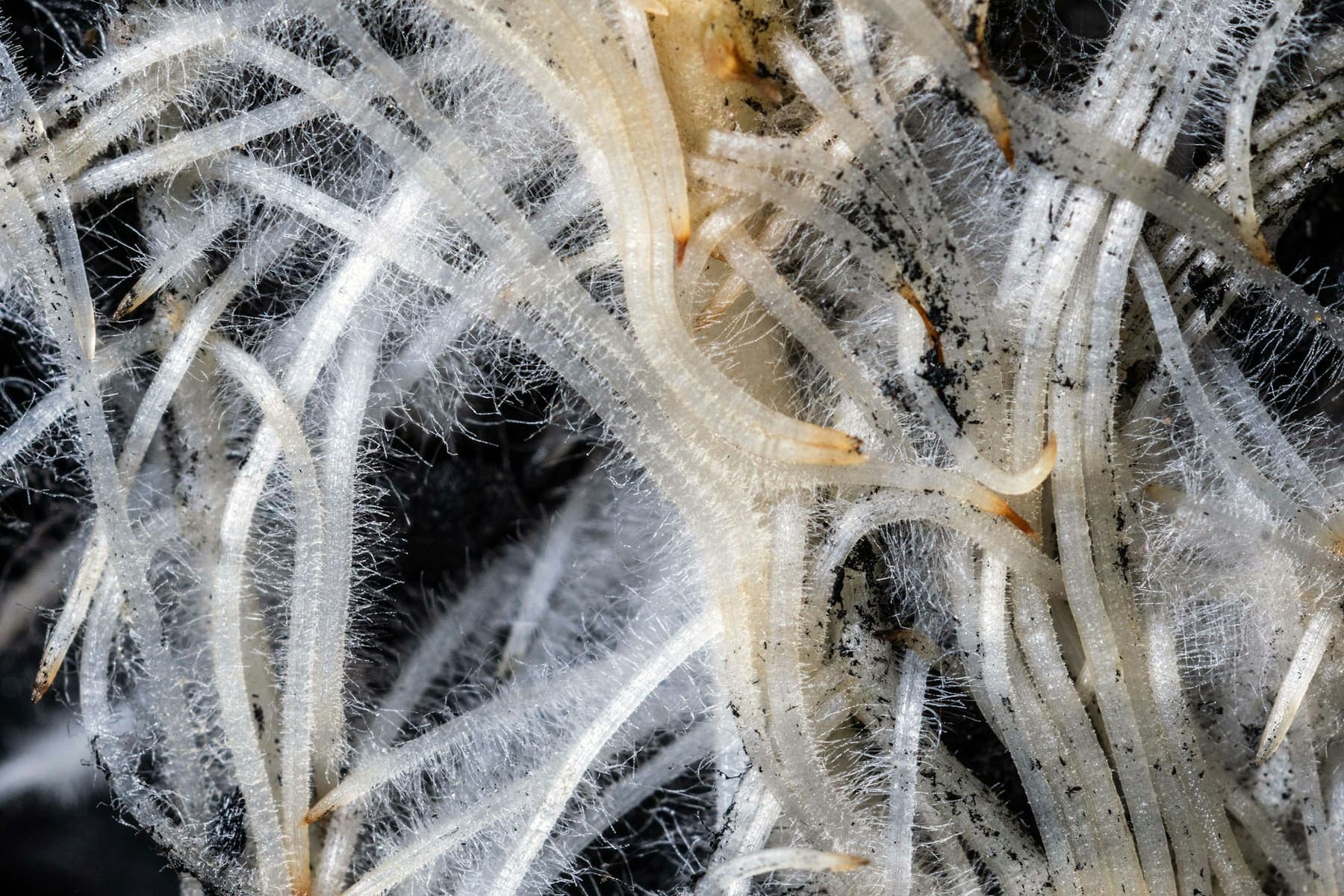
This is the most common worry. Around the second or third day, a white fuzz often appears at the base of radish or rocket shoots. This is usually root hairs: fine, regular filaments growing from the root that capture water. Mist them: they flatten out and become almost invisible.
Mould behaves differently. It forms a cottony or greyish veil that spreads from one seed to another like a web, doesn't disappear when misted and often gives off a musty smell. If a small area is affected, remove it generously. If the mould spreads over a large part of the tray, compost the crop and start again on a cleaned tray.
Common mistakes
- Too much water: a waterlogged medium suffocates the roots. It should stay moist without being saturated, like a wrung-out sponge.
- Not enough air: a lid never lifted or a stuffy room encourages mould. Air it every day; a light movement of air is enough.
- Too little light: long, pale shoots that flop over. Move the lamp closer or change position.
- Excess heat and humidity: a warm, stuffy room speeds up mould. A mild room is best; university guides cite temperatures of around 16 to 24°C.
- Poor hygiene: wash trays and scissors in hot soapy water between crops, and wash your hands before sowing.
What about after the first harvest?
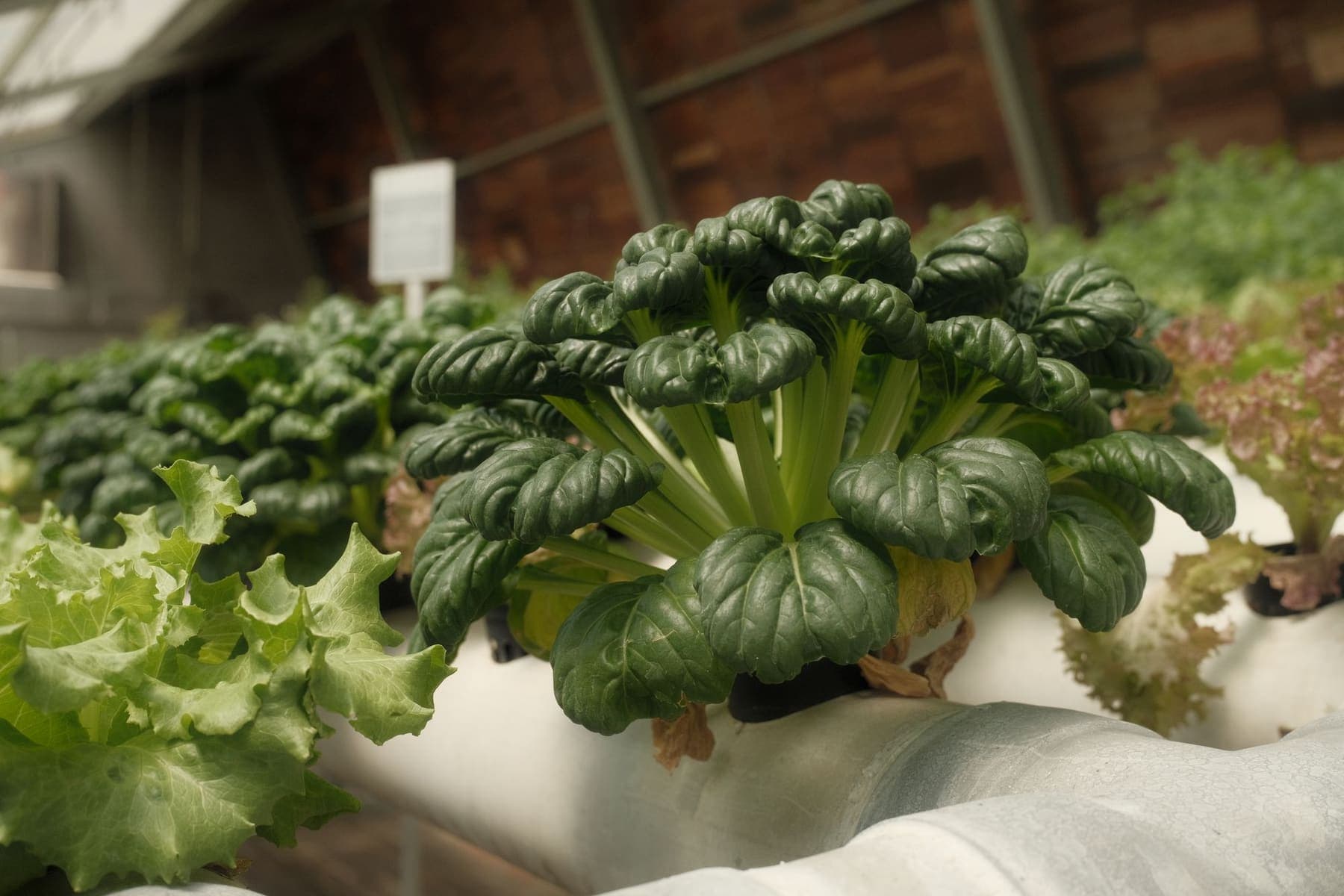
Most microgreens don't regrow after cutting: you sow again. For a steady supply, start a small tray every four to five days. Once you've got the technique down, you can move on to slower varieties or add herbs grown in indoor hydroponics. Seed compost is available in our Pots and growing media section.
Torn between several projects? Our Find my project questionnaire will guide you in a few questions.
Sources
- A Step-By-Step Guide for Growing Microgreens at Home — Penn State Extension
- Growing Microgreens and Baby Greens Indoors — University of Maryland Extension
- Introduction to Microgreen Production in Indoor Vertical Farms and Greenhouses — Virginia Cooperative Extension
- Growing Microgreens — Clemson Home & Garden Information Center
- Grow Your Own Microgreens — Utah State University Extension
Frequently asked questions
How long does it take to grow microgreens?
Generally one to two weeks depending on the variety: around 6 to 10 days for radish, 8 to 12 days for sunflower, 6 to 14 days for rocket and 10 to 15 days for pea.
Is the white fuzz on my shoots mould?
Not necessarily. Fine, regular filaments around the roots, which flatten when misted, are root hairs. A cottony or greyish veil that spreads between the seeds, persists and smells musty is mould.
Do microgreens regrow after cutting?
In most cases, no: the cut is made below the first leaves. You need to sow again. Starting a small tray every four to five days gives you a steady harvest.