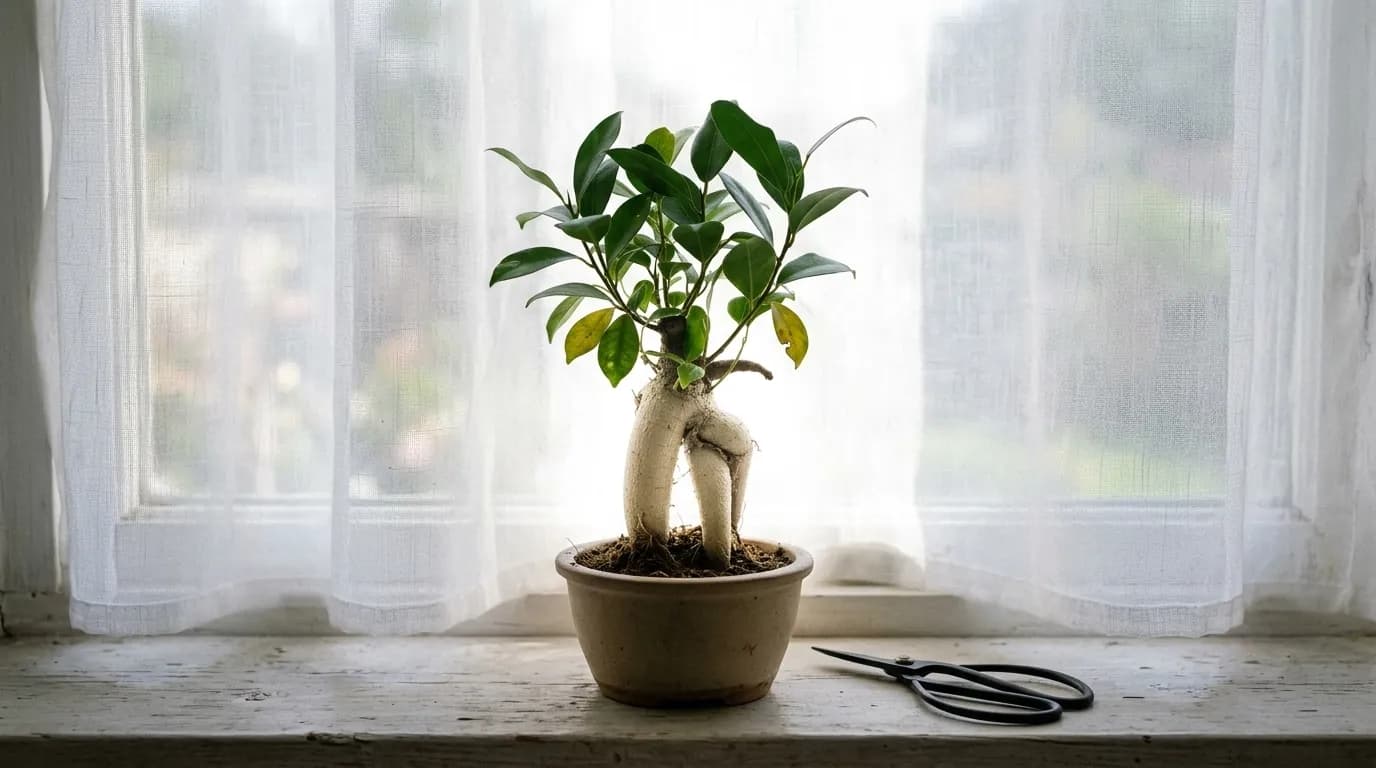
Pruning a ficus ginseng: when, where to cut, and how far
Maintenance pruning for a ficus ginseng bonsai, step by step: the right season, the leaf rule, the sap, aerial roots, and pruning a ficus under glass.
In this guide
You prune a ficus ginseng in spring and summer, while it is growing. The rule fits in one sentence: let a branch grow six to eight new leaves, then cut above the second or third. Never remove more than a third of the foliage at once, and wear gloves: the white sap irritates the skin. The rest of this guide covers each step.
What pruning is for
The ficus ginseng (Ficus microcarpa) is sold as a bonsai: a swollen trunk and a small crown of leaves. Without pruning, the branches get longer, the crown opens up and the shape is lost. Maintenance pruning does three things:
- keeps the crown compact, by forcing the branches to branch out;
- lets light reach the heart of the tree;
- keeps the tree in proportion to its pot, or to its jar if it lives under glass.
The right time
| Period | What to do |
|---|---|
| Spring (March to May) | Main pruning, repotting if needed |
| Summer (June to August) | Regular pinching of shoots that grow too long |
| Autumn | Light touch-ups only |
| Winter | Nothing, apart from dead wood and damaged leaves |
A ficus pruned in full growth regrows leaves within a few weeks. Pruned in winter, in the weak light of a flat, it stays bare for a long time.
Pruning step by step
- Look at the tree from the front, at eye level, and spot the branches that stick out of the outline.
- Count the leaves on each shoot. At six to eight, cut above the second or third, just above a bud.
- Cut cleanly, with clean, sharp scissors. A crushed cut heals badly.
- Dab the sap with damp paper. It stops on its own within a few minutes.
- Remove branches that cross or grow towards the inside of the crown.
- Stop before a third. A ficus that loses too many leaves at once grows weaker.
For a thick branch, cut close to the trunk and let the wound dry. A bonsai wound sealant is only useful for wide cuts.
The sap, the only real trap
The ficus ginseng contains a white latex. It sticks to blades and can irritate the skin and eyes. Wear gloves, do not rub your eyes while pruning, and wash the scissors in hot water afterwards. Keep the cuttings out of reach of cats and dogs: ficus are on the ASPCA list of plants toxic to them.
Aerial roots
Thin roots sometimes grow down from the branches. They appear when the air is humid, which is a good sign. Leave them if you like them: over time, some thicken and reach the soil. Only shorten the ones that hang in the air or touch the glass.
A ficus ginseng under glass
In a terrarium, the ficus grows in a limited space. Pruning becomes a matter of room:
- cut any leaf that touches the glass, as it rots in contact with condensation;
- remove the cuttings with tweezers, so they do not go mouldy on the moss;
- prune more often and more lightly, rather than one heavy pruning a year.
Long terrarium tools help here: scissors with long blades fit through the neck. Our Bonsaï Zen kit is built around a ficus ginseng, with everything needed to keep it under glass.
For the rest of its care (light, watering, leaf drop), see our ficus ginseng care guide. To change its pot, our guide to repotting a ficus ginseng explains how.
After pruning
Put the tree back in its place, in bright light without direct sun. Do not add fertiliser the following week, and water as usual, by touch. New buds appear within two to four weeks in spring.
In short
- Prune in spring and summer, almost never in winter.
- Leave six to eight leaves, cut above the second or third.
- Never more than a third of the foliage at once.
- Gloves and clean tools: the sap irritates.
- Under glass, prune often and remove all cuttings.
Sources
- Royal Horticultural Society (RHS), Ficus microcarpa profile and advice on pruning indoor bonsai.
- ASPCA, list of plants toxic to cats and dogs (Ficus).
Frequently asked questions
When should you prune a ficus ginseng?
In spring and summer, while it is growing. That is when it regrows leaves fastest after a cut. In winter, just remove a dry branch or a damaged leaf.
How many leaves should you leave on a branch?
The most common rule: let the branch grow six to eight new leaves, then cut above the second or third. The branch then branches out from the remaining buds.
Does a ficus ginseng bleed when pruned?
Yes. Like all ficus, it oozes a white sap, a latex that can irritate the skin. Wear gloves, dab the cut with damp paper and wash your tools after pruning.
Should you cut the aerial roots?
No, unless they are in the way. They are part of the ficus ginseng's charm and help it in humid air. If one grows towards the glass or out of the pot, you can shorten it cleanly.