

How does hydroponics work? The principle of soil-free growing
Nutrient solution, root oxygen, supports and DWC, NFT, drip or wick systems: how hydroponics works, explained simply, for a flat.
In this guide
Hydroponics means growing plants without soil, feeding them with mineral salts dissolved in water. Three things make it work: a complete nutrient solution, oxygen around the roots, and a support that holds the plant. The various systems, whether called DWC, NFT, drip or wick, are just different ways of delivering these three things to the roots. Once you understand this principle, choosing a system for your flat becomes simple.
What does soil do, and how does hydroponics replace it?
In a pot, soil plays several roles at once. It holds the plant upright. It stores water and minerals between waterings. And, between its particles, it holds air, which the roots breathe.
Hydroponics separates these roles and hands each one to a part of the system:
- Support is provided by an inert medium or a mesh pot.
- Water and food arrive via the nutrient solution, in direct contact with the roots.
- Air is supplied by the system's design: bubbles, water circulation, drainage or the space left above the liquid.
The plant itself doesn't change. It still needs light, a suitable temperature and care. Indoors, supplemental lighting is often necessary.
The nutrient solution: what the plant eats
The nutrient solution is water in which a fertiliser designed for hydroponics has been dissolved. According to the Royal Horticultural Society, it combines the major elements, nitrogen, phosphorus, potassium, magnesium and sulphur, with very small amounts of trace elements: copper, boron, iron, manganese, molybdenum and zinc. With no soil to make up the difference, nothing must be missing: that's why a fertiliser formulated for this purpose is used, dosed according to its label.
Two measurements let you control this solution:
- pH indicates its acidity. Most plants absorb nutrients best between 5.5 and 6.5; in professional production, the target is often 5.8 to 6.2. Outside this range, some elements become less available, even in a rich solution.
- Conductivity, or EC, reflects the amount of dissolved salts, and so the concentration of the fertiliser. It helps avoid a solution that's too dilute or too concentrated.
Plants don't absorb every element at the same rate. Over time, the solution becomes unbalanced: you top it up with clean water and renew it completely from time to time. Our guide indoor hydroponics without the jargon covers this routine in detail.
Oxygen: why the roots don't drown
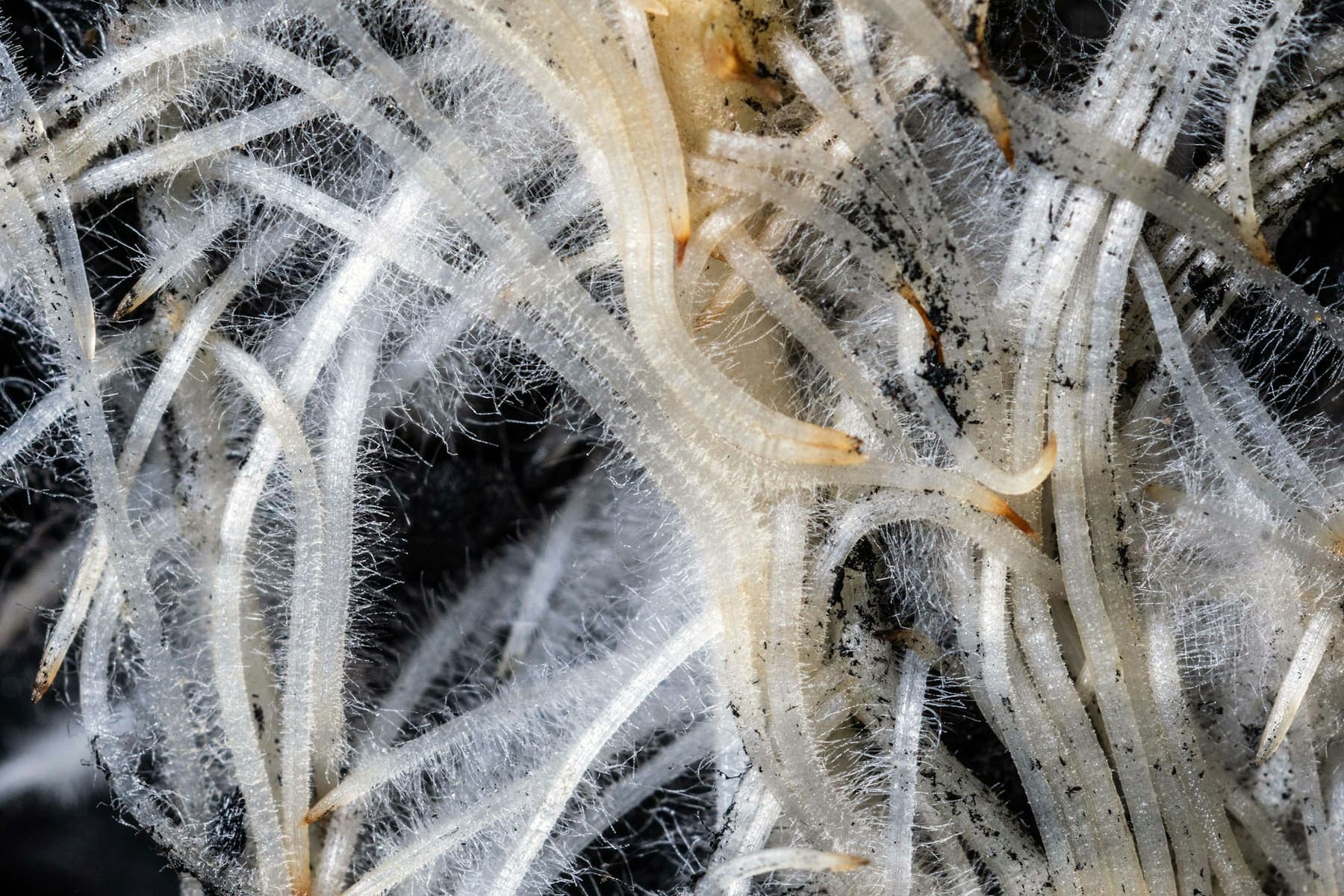
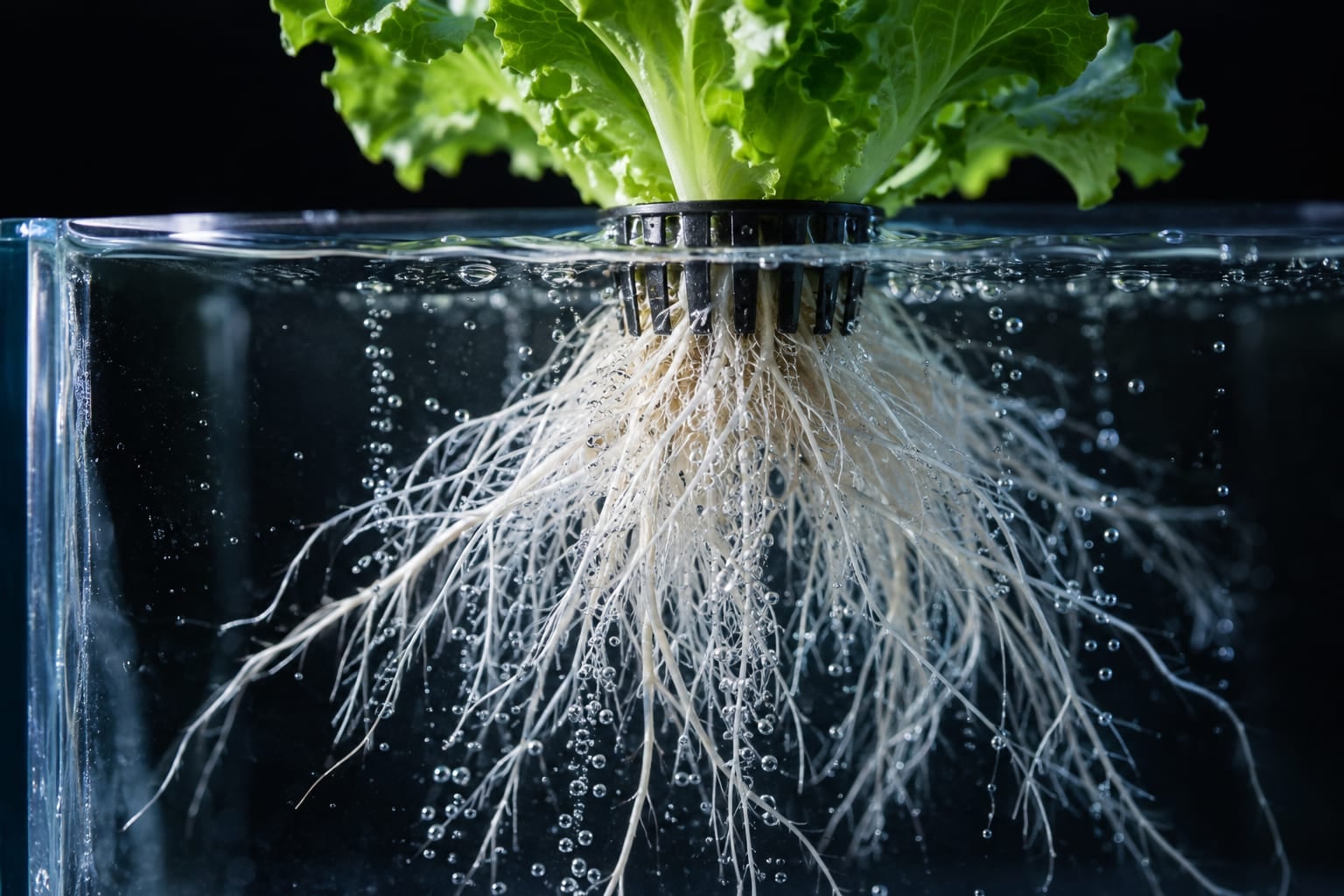
This is the point that's most often overlooked. All roots need oxygen: in hydroponics, the root zone must be moist and fed, but also very well aerated. The RHS states it plainly: the roots of most plants die in stagnant water.
Each system tackles this problem in its own way. Bubbles are pumped into the water, a thin film of liquid is kept flowing, the medium is allowed to drain between feeds, or a humid air gap is kept between the solution and the basket. When comparing two systems, always ask yourself: how do the roots breathe?
Supports: what replaces the soil
The support holds the plant, retains a little moisture and lets air circulate. The most common are coconut fibre, perlite, vermiculite, rockwool, pumice and expanded clay pebbles. Some systems do almost without one: the roots then hang directly in the water, and the support is limited to the plug used for sowing.
To start seeds, sowing plugs are handy: you sow directly into them, then slide the plug into the system's basket once the roots grow out of it.
The main systems, from simplest to most technical
The wick
An absorbent wick dips into the reservoir and draws the solution up by capillary action into the medium, often perlite, vermiculite or coconut fibre. The system is passive: no pump, no electricity. It's the simplest to build, but suits mainly small, low-water plants.
The non-circulating method, known as "Kratky"
Developed at the University of Hawaiʻi, this method uses neither pump nor electricity. You fill a container with nutrient solution just once. The baskets, holding a medium and a young plant, dip only at their base. Over the weeks, the level drops as the plant drinks, but the roots have had time to grow down. The part of the roots left in the humid air, under the lid, then serves to breathe. You harvest before the solution runs out, then clean and start again. The method suits crops that use little water: lettuce, coriander, spring onions, pak choi or watercress.
Deep water culture (DWC)
The plants, held in baskets, float on the nutrient solution, and their roots bathe in it permanently. To keep the water oxygenated, it's generally aerated with an air pump and diffuser, as in an aquarium. The system is simple to understand and well suited to leafy plants.
Nutrient film technique (NFT)
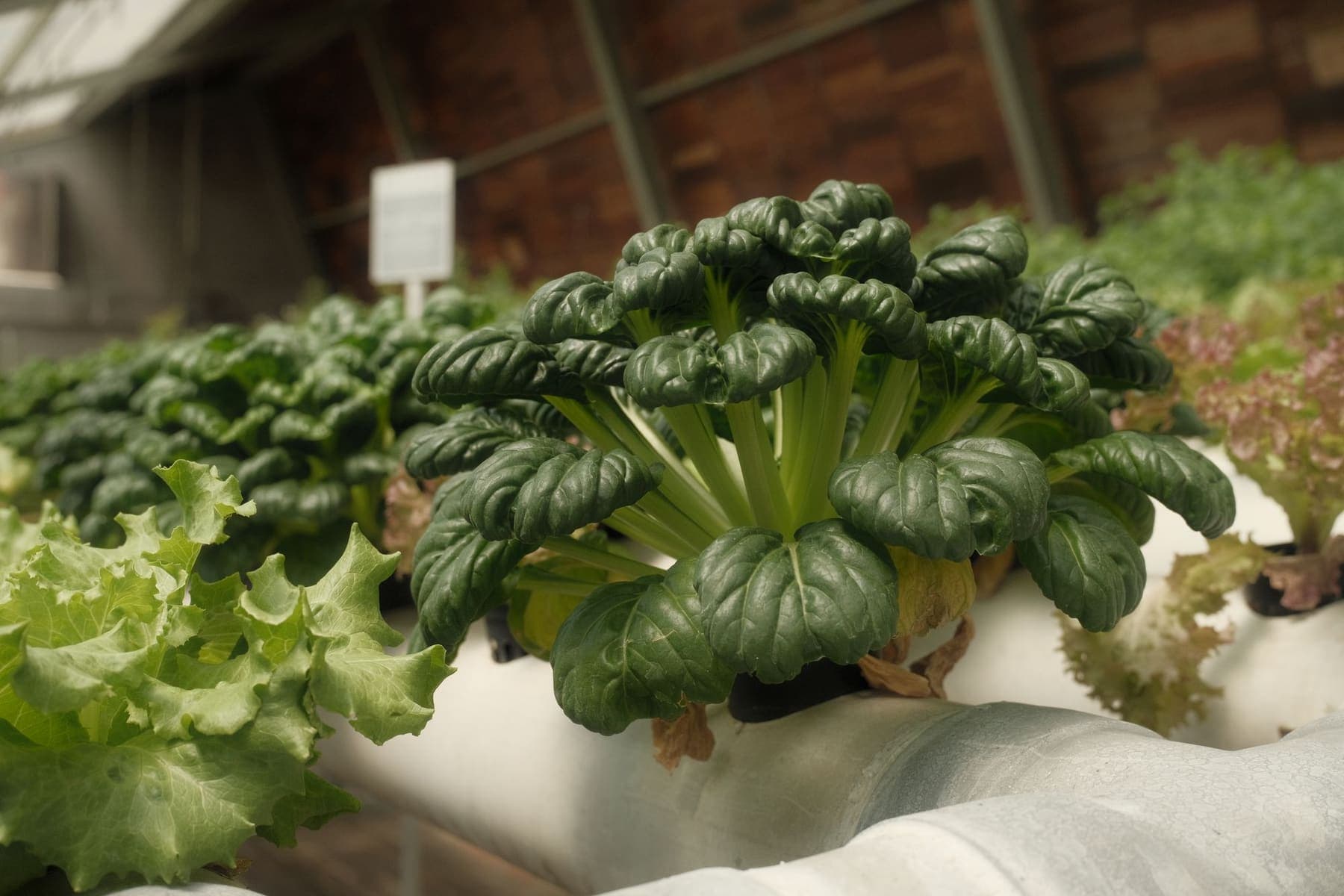
Plants are lined up in slightly sloped, covered channels, along which a thin film of solution flows continuously. Roots draw water from below and air from above. It's efficient, but fragile: with no medium to retain moisture, if the pump stops, the plants wilt very quickly.
Drip irrigation
A pump sends the solution from a reservoir to the base of each plant, held in a medium such as perlite or rockwool. Any surplus can be lost or, more economical and less wasteful, returned to the reservoir via a channel. This principle is found in many compact indoor gardens and in vertical growing towers.
Ebb and flow
Pots, filled with medium, are placed in a tray that is flooded at regular intervals, then drained. Roots get water during flooding and air during draining.
Aeroponics
Roots hang in the air, inside a sealed chamber, and the solution is sprayed onto them. It's the most sophisticated technique, and the most dependent on its equipment.
Which system for a flat?
It all depends on what you want to learn and how much you can tolerate failure.
- To understand the principle at low cost: an opaque jar using the Kratky method, or a wick system, with a lettuce or a few herbs. No noise, no power socket.
- For a regular supply of kitchen herbs: a small pump-driven system, deep water culture or drip, supplemented with a lamp.
- For later: NFT and aeroponics, more productive but more sensitive to power cuts. A prolonged outage can kill the plants.
Whatever the system, keep the reservoir away from light: algae take hold in a lit nutrient solution and clog up the circuit.
What hydroponics doesn't do for you
Hydroponics doesn't do away with the need for light or warmth. Its setup costs more than a pot and a bag of compost, and it needs regular monitoring of the water level, concentration and pH. In return, plants often grow faster, using less water, and soil-borne diseases and pests cause fewer problems. To weigh the pros and cons, read our comparison hydroponics or soil.
To choose your first crops, see our guide to easy plants for hydroponics, then browse the hydroponics section.
Sources
- Hydroponics — Royal Horticultural Society
- Growing crops with hydroponics — Royal Horticultural Society
- Growing without soil: getting started with hydroponics at home — University of Illinois Extension
- A Suspended Net-Pot, Non-Circulating Hydroponic Method for Commercial Production of Leafy, Romaine, and Semi-Head Lettuce — University of Hawaiʻi, CTAHR
Frequently asked questions
Do you always need a growing medium in hydroponics?
No. In deep water culture or nutrient film systems, the roots bathe directly in the solution. A small support, often the sowing plug, is only there to hold the plant in its basket.
Does hydroponics use a lot of water?
Quite the opposite: according to the University of Illinois, a hydroponic system can use up to 90% less water than growing in soil, since water that isn't absorbed stays in the circuit instead of draining away.
What happens during a power cut?
It depends on the system. Wick or non-circulating methods don't rely on electricity. In a nutrient film system with no medium, the roots dry out quickly if the pump stops, and a prolonged outage can kill the plants.