


Mould or root hairs? Telling the two apart on microgreens
The misting test, the look, the smell, the moment it appears: five criteria to decide in seconds, and to know when to bin a tray or keep it.
In this guide
Mist the fuzz: if it flattens and becomes almost invisible, these are root hairs, and the crop is fine. If it stays cottony, grey or greenish, if it links the seeds together like a web and gives off a musty smell, it is mould. This ten-second test settles almost every case, and it works with the naked eye, without throwing anything away in advance.
The ten-second test
- Take a mister filled with clean water and mist the doubtful area, from close up.
- Look straight away. Root hairs are very fine, clump together on contact with water and lie down against the root: the fuzz all but disappears.
- Look again an hour later. Root hairs come back as they dry, which often causes needless alarm. Mould, on the other hand, has not moved at all since the misting.
- Smell it. A healthy tray smells of cut grass and damp earth. A cellar, musty or fermented smell almost always goes with real mould.
If the doubt persists, one last clue decides it: root hairs never leave the root zone, against the growing medium. Anything climbing the stems or spreading over the seeds is something else.
Two very different things
What root hairs are
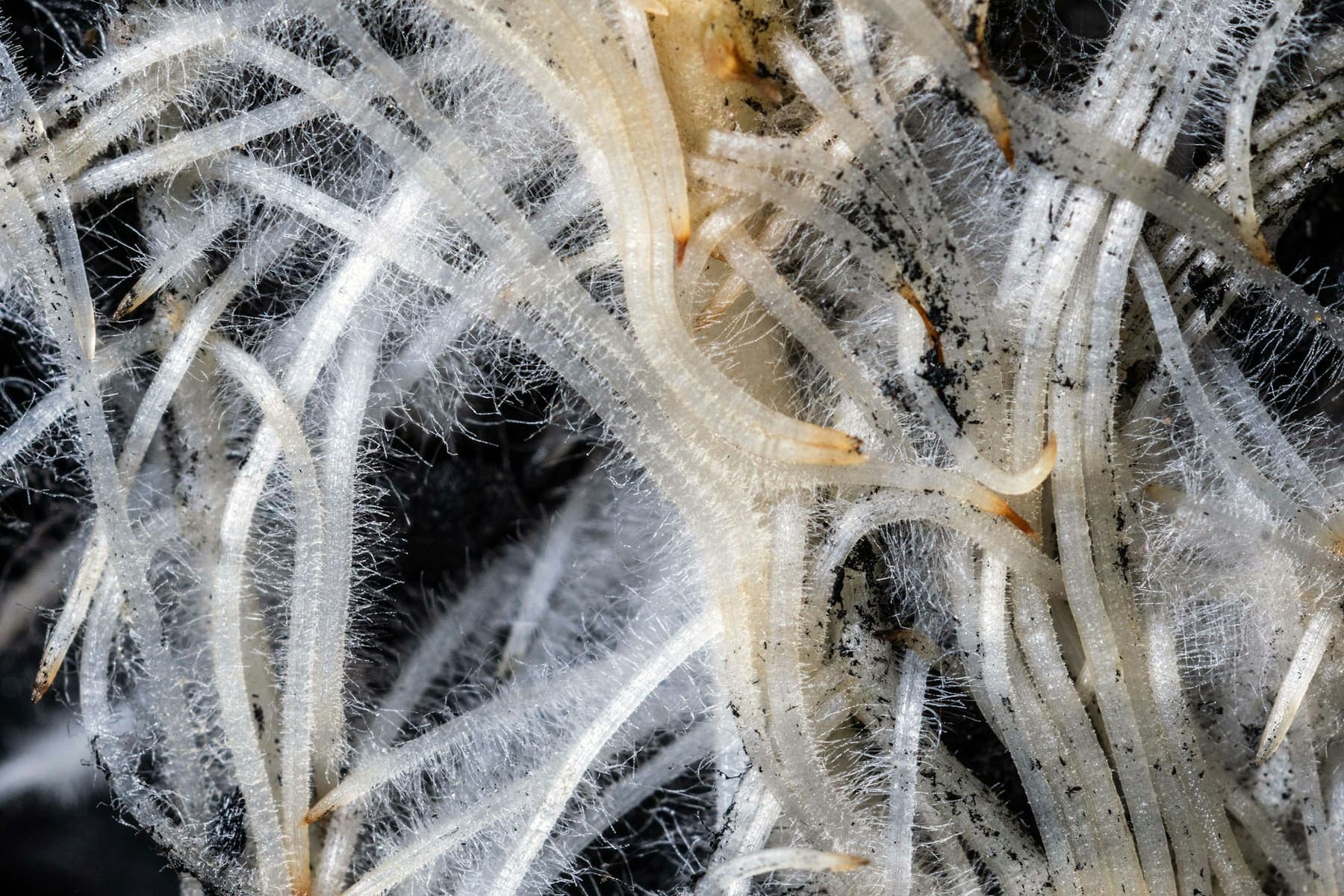
These are microscopic extensions of the root that increase the surface through which the plant takes up water. Every plant makes them; on microgreens you simply see them, because the roots are out in the open on a thin medium.
Their look is distinctive: a regular, symmetrical halo centred on each root, like a very fine white down. Every seedling has its own, and these halos do not join up. They usually appear around the second or third day, on fast-germinating varieties: radish, rocket, cabbage, broccoli.
A halo of root hairs is not a sign of too much water. Rather the opposite: a root looking for moisture makes more of them. On a very wet medium they are often less visible.
What mould is
Mould is a fungus that develops on whatever organic matter is available: dead seeds, seed coats, damaged roots, a medium that has already been used. It does not start from a root: it starts from a point and spreads.
Its look is irregular, cottony or felted, often grey, sometimes greenish, bluish or blackish as it ages. It forms bridges between the seeds, climbs the stems, and advances from one day to the next. It generally takes hold later, after the dark phase, when the tray stays enclosed and damp.
On a densely sown tray, you cannot identify a species of fungus with the naked eye. That is why the rule is cautious: established mould goes on the compost, it does not get rinsed off.
The differences in one table
| Criterion | Root hairs | Mould |
|---|---|---|
| Reaction to misting | Flatten, all but disappear | No change |
| Shape | Regular halo around each root | Irregular cottony veil, in patches |
| Location | Only at the base, against the medium | On the seeds, the stems, the medium |
| Progress | Stable, tied to growth | Spreads from one day to the next |
| Colour | Pure white | Dirty white, grey, greenish, bluish |
| Smell | Cut grass, damp earth | Musty, cellar, fermentation |
| When it appears | Second or third day | Rather after the dark phase |
No single criterion is enough on its own: the pure white of early mould looks like root hairs, and misting alone can mislead on a tray that is already very wet. Cross-check at least the look, the location and the smell.
The five causes of real mould
- Sowing too densely. Seeds piled on top of each other hold water between them and never dry at the surface. This is the first cause, well ahead of the others.
- Watering from above. It wets the stems and leaves, which stay damp for hours. From the end of the dark phase onwards, water through the tray underneath.
- A soaking medium. It should stay at the consistency of a wrung-out sponge: your hand is wet when you press it, but nothing runs out.
- Still air. A lid never lifted, a closed cupboard, a stuffy room. The Utah State University guide recommends gentle, continuous ventilation.
- A medium or a tray reused without cleaning. Roots left in the fibres of a mat feed the next crop.
Warmth plays a part too: a warm, stuffy room speeds the whole thing up markedly. The university guides work in a range of about 16 to 24 °C, the Utah figures being 20 to 23 °C depending on the phase.
What to do in each case
If these are root hairs: nothing. Carry on as normal, water from below and let a little air circulate. They disappear of their own accord once the roots anchor into the medium.
If a small area has gone mouldy:
- Remove it generously, along with the seeds and medium around it, without shaking the tray over the rest.
- Cut back the watering and switch to bottom-watering if you were not doing so already.
- Improve the airflow: uncover, move the tray away from the wall, open the room up a little.
- Check twice a day. If the patch comes back, the tray is lost.
If the mould takes over a large part of the tray: compost the whole crop, mat included. Wash the tray in hot soapy water with a brush, rinse, dry. Do not salvage the shoots from the healthy area: the fungal threads spread further than what you can see.
What is neither one nor the other
- Seed hulls still stuck on, above all on sunflower. They come off by hand before cutting and are nothing like a disease.
- Ungerminated seeds, which go brown and soft. They are not mouldy yet, but they will end up that way: remove them if there are many.
- A whitish crusty deposit on the rim of the tray, which is limescale left by the water as it evaporates. It does not spread, has no smell, and comes off with diluted white vinegar.
- A green film on the medium, which is algae, not mould. It shows a medium left soaking too long in full light.
Avoiding the problem on the next crop
- Weigh the seed instead of sowing by eye. The rates variety by variety are in our microgreen growing sheets and, for brassicas, in our guide to rocket, spinach and cabbage.
- Lift the lid every day during the dark phase; a few seconds is enough.
- Water from below as soon as the shoots are uncovered.
- One mat, one crop. The fibres keep roots that become the ground for the next bout of mould.
- Wash trays and scissors in hot soapy water between two crops, and wash your hands before sowing: this is also what Anses recommends for sprouting at home.
A stainless-steel tray is easier to clean and holds neither smells nor stains, which limits mould coming back from one crop to the next.
For the full method, from sowing to harvest, see our guide getting microgreens right first time. Trays, mats and seed are in the microgreens section.
Sources
Frequently asked questions
Can you eat the healthy shoots from a partly mouldy tray?
Better not, once the mould goes beyond a small area. Fungal threads spread through the medium well past the visible patch, and nothing lets you identify the species with the naked eye at home. If a single small area is affected and the rest of the tray has no smell, remove generously around it and keep watching; at the slightest doubt, compost the lot.
Does the white fuzz appear on every variety?
It shows mainly on fast-germinating varieties with fine roots, such as radish, rocket, cabbage and broccoli. On pea and sunflower, whose roots are thicker, it is far less noticeable. Its absence does not mean something is wrong, and its presence on a tray of radish on the third day is on the contrary a good sign.
Do trays need disinfecting between two crops?
A careful wash in hot soapy water with a brush is enough in most cases, followed by a rinse and a thorough dry. Anses points out that trays and sprouters should be cleaned and disinfected carefully between two crops; if you have had mould, a wipe with diluted white vinegar before rinsing is a reasonable precaution. Drying counts as much as washing.
Does a small fan really help against mould?
Yes, and it is one of the most effective measures. A light, continuous movement of air dries the surface of the medium and the stems between two waterings, which denies the fungus the moisture it needs. Put the fan at a distance, aimed beside the tray rather than over it, on the lowest speed: it must not flatten the shoots or dry the medium out.