




Rocket, spinach, cabbage: three microgreen profiles
Seed quantity, time in the dark, harvest time and flavour: the markers for rocket, the cabbages and spinach as microgreens, including what no source puts a figure on.
In this guide
Rocket is the quickest of the three: about 10 g of seed per standard tray, no soaking, one to two days in the dark and a harvest six to eight days after sowing. The cabbages follow close behind, with about 28 g per tray and a harvest between eight and twelve days. Spinach is the only one of the three that poses a real problem: it comes up slowly, unevenly, and none of the university guides we work from gives it a profile with figures.
What the three have in common
The equipment and the actions do not change from one variety to another: a perforated tray sitting in a solid one, a growing medium dampened to the consistency of a wrung-out sponge, a dense sowing with no overlap, a few days in the dark under a second tray, then plenty of light and watering from below. If those steps do not mean anything to you yet, start with our guide getting microgreens right first time.
The quantities below are for a standard horticultural tray, the so-called "1020", about 25 × 50 cm. Packets sold for small 30 × 20 cm trays carry their own quantity: follow it for a first attempt, then adjust from one crop to the next.
The growing medium can be seed compost, coir or a growing mat. The mat has the advantage of giving a clean harvest, with no particles of soil on the stems, and goes on the compost heap with the roots after cutting.
Three growing profiles
Rocket: the quickest of the three
No soaking. Rocket seed is tiny; soaked, it forms a gelatinous mass that is impossible to spread out.
About 10 g per standard tray. This is the lowest quantity of all the common microgreens, and the easiest to exceed. Sowing too thickly holds moisture between the seeds, which encourages mould.
One to two days in the dark, with the tray weighted for the first half of that time, then turned over to cover the shoots without touching them.
Harvest between six and eight days. Another university source widens that range to about a fortnight; the difference comes mainly from the temperature of the room and the stage at which you decide to cut.
The flavour is peppery and clean, like adult rocket but more concentrated. It goes on a pizza straight out of the oven, or on hot pasta.
Cabbage: brassicas with no nasty surprises
The word "cabbage" covers several microgreens that behave in the same way: kale, red cabbage, kohlrabi, swede. All belong to the same family as radish, broccoli and mustard, a family the extension services describe as the quickest to germinate and grow.
No soaking, a quantity of about 28 g per standard tray, one to two days in the dark, and a harvest between eight and twelve days.
Kale has a pronounced brassica flavour, with a note of hazelnut. Red cabbage is milder and gives purple stems that hold up well on the plate; in ready-mixed blends it is often cut at around eight to ten days, at the same time as the radish and mustard that go with it.
Spinach: the one that calls for patience
This is the honest profile in this guide: we have not found, in the university extension guides we rely on, any figures for spinach as a microgreen. The tables listing rocket, broccoli, kale, pea or sunflower do not mention it.
What is documented, on the other hand, explains the difficulty. Spinach does not belong to the cabbage family but to that of beetroot and chard, and the Maryland extension service states that plants in this family germinate and grow more slowly than those in the cabbage family. Added to this is a thick seed coat, which takes up water slowly and unevenly.
In practice, expect:
- staggered emergence, with seeds coming up several days after the first ones;
- a harvest time of one to two weeks, longer in a cool room;
- a higher proportion of seed that never germinates than with rocket or cabbage, and therefore a slightly denser sowing;
- a greater risk of rot, because the seeds that stay inert break down in a damp medium.
If you do try spinach, give it a tray of its own, sow on fresh medium, air it every day and take out the areas that start to break down without waiting. It is not a microgreen for a first attempt.
The three side by side
| Variety | Soaking | Quantity per 25 × 50 cm tray | In the dark | Harvest | Flavour |
|---|---|---|---|---|---|
| Rocket | None | About 10 g | One to two days | Six to eight days | Peppery, clean |
| Kale | None | About 28 g | One to two days | Eight to twelve days | Pronounced brassica, hazelnut |
| Red cabbage | None | Comparable to kale | One to two days | Eight to twelve days | Mild, purple stems |
| Spinach | Not documented | Not documented, sow a little denser | Not documented | One to two weeks, uneven emergence | Mild, slightly mineral |
The figures for rocket and kale come from the Utah State University guide, which already serves as the reference for our variety-by-variety growing profiles. Those for spinach are orders of magnitude, given for want of a source with figures.
Can they be sown in the same tray?
The rule is simple: only put together varieties that share the same soaking, a similar time in the dark and the same harvest date.
- Kale and red cabbage: same family, same markers, an easy pairing.
- Rocket and cabbage: possible, but the rocket is ready two to four days earlier. Sow it in a band along one side of the tray so that you can cut it without disturbing the rest.
- Spinach with anything else: best avoided. Its uneven emergence and its need for air make it incompatible with a faster neighbour, which smothers it before it has finished coming up.
Sowing in bands rather than as a mixture remains the better habit: you harvest one variety without damaging the other.
Light, temperature, air
After the dark phase, they need plenty of light. The Utah guide gives eighteen hours of light a day, followed by six hours of darkness. A well-placed window may be enough in spring and summer; in winter, a lamp prevents long, pale shoots. Our guide indoor grow lights gives the distances and the durations.
A moderate temperature is enough. The markers from the same guide are about 23 °C during germination, 22 °C with the lamp on and 20 °C with the lamp off. In a cooler room, allow a few extra days on each profile.
Air matters as much as water. Gentle, continuous ventilation greatly limits mould. Lift the cover every day during the dark phase, then let a little air move around the tray afterwards.
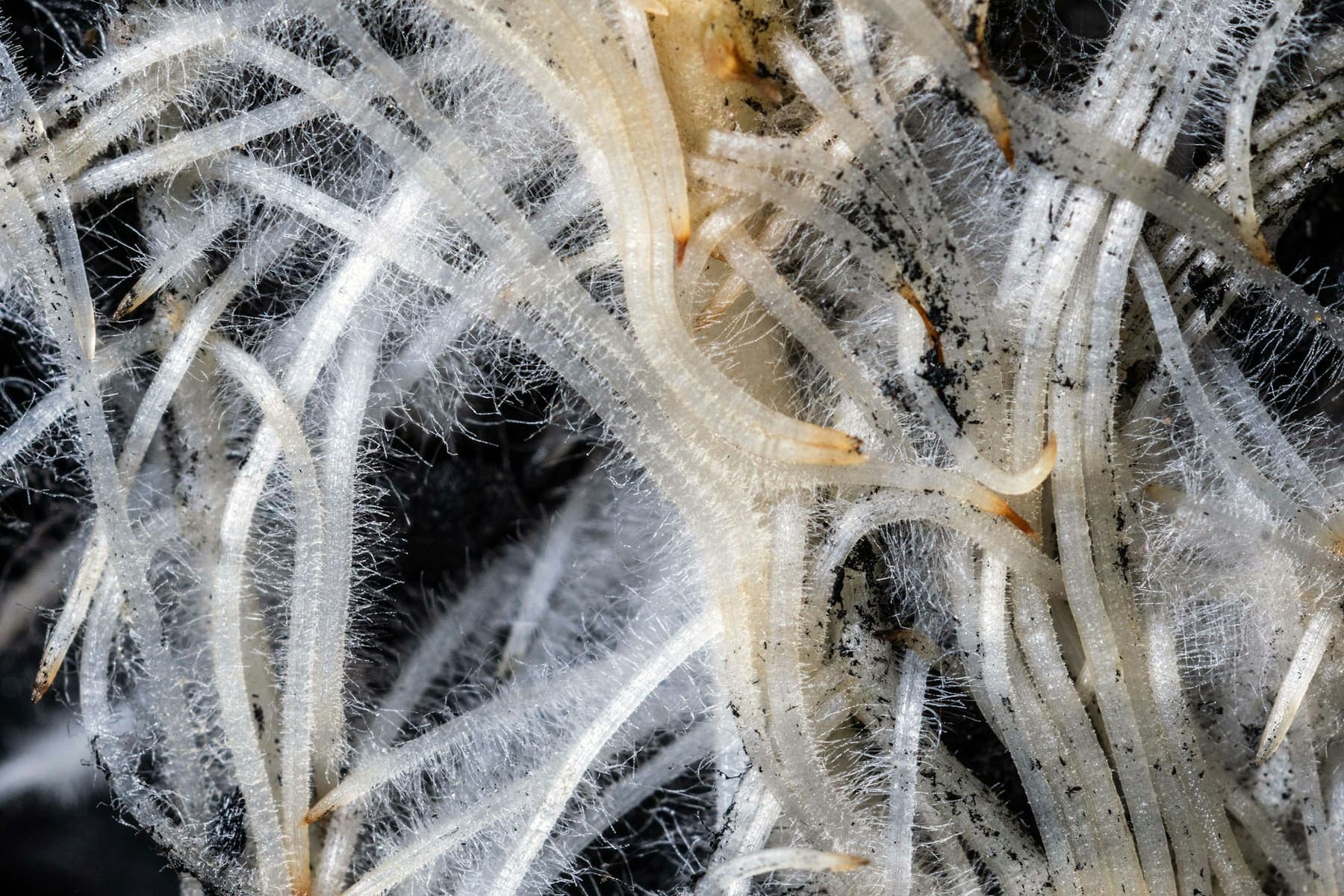
White fuzz at the base of the stems is not necessarily mould. Our guide mould or root hairs explains how to tell the two apart in seconds.
Harvesting and keeping
Cut with clean scissors, just above the medium, once the seed leaves are well spread and the first true leaves are appearing. These three varieties do not grow back after cutting: you sow again.
Do not rinse before storing. Residual moisture shortens their keeping time noticeably: rinse just before serving. Kept dry in a closed box lined with kitchen paper, the shoots last a few days in the fridge.
Seed, trays and mats can be found in the microgreens section.
Sources
- Grow Your Own Microgreens — Utah State University Extension
- Growing Microgreens and Baby Greens Indoors — University of Maryland Extension
- Introduction to Microgreen Production in Indoor Vertical Farms and Greenhouses — Virginia Cooperative Extension
- Growing Microgreens — Clemson Home & Garden Information Center
Frequently asked questions
Are spinach microgreens the same thing as the baby leaf sold in bags?
No. Shop-bought baby leaf is spinach grown for several weeks and then cut before maturity, with true leaves already formed. A microgreen is cut far earlier, at the seed-leaf stage or at the very first true leaves, and is rarely sold in supermarkets because it does not keep well. The flavour of the microgreen is more concentrated and its texture more tender.
Can cabbage seed from the vegetable shelf be used for microgreens?
Only if the packet says the seed is untreated. Some vegetable seed is coated with a treatment intended for the soil, which has no place on a plate. Seed sold for sprouting or for microgreens carries a food-use guarantee, and its germination rate is usually higher.
Can a tray of rocket be harvested twice?
In the great majority of cases, no. The cut is made above the medium but below the growing point, and the plant has no reserves to start again from. A few stems may put out a feeble regrowth, of no interest on the plate. For a steady supply, sow a new small tray every four or five days rather than waiting for a second cut.
Why do my cabbage microgreens stay yellow?
Because they are short of light. During the dark phase the shoots are normally yellow and stretched: that is expected. They should green up within one or two days once uncovered. If they stay pale, the light source is too weak or too far away, or the cover was left on too long.