


When to change the nutrient solution in a hydroponic tank
Every two to three weeks for a small system, and sooner if the water smells, turns green or foams: the renewal rhythm, what separates it from a simple top-up, and the drain step by step.
In this guide
For an indoor hydroponic garden the nutrient solution is renewed in full every two to three weeks: that is the rhythm given by the University of Illinois extension service, and the one repeated in the instructions that come with small systems. Between two changes you do nothing but top the level up. Some signs, though, mean the job has to be brought forward without waiting for the date.
Why a solution goes out of balance
A fresh nutrient solution holds every element in carefully worked-out proportions. Three weeks later it is no longer what it was, for three reasons that add up.
Plants pick and choose. They do not take up the elements at the same rate: nitrogen and potassium go quickly, others stay behind. The University of New Hampshire extension service puts it plainly: over time the concentration of the elements drifts away from the starting recipe. A reservoir can therefore be full and short of nutrients at the same time.
The water leaves, the salts stay. Evaporation and the plants' transpiration bring the level down, but dissolved minerals do not evaporate. The solution slowly concentrates, and all the faster if the room is warm and dry.
The medium is alive. Roots release organic compounds, bacteria settle in, algae appear as soon as light reaches the water. None of that is serious in itself, but together it ends up using up oxygen and clogging the pump.
Renewing is therefore not a comfort chore: it is what puts the crop back to its starting conditions. The exact role of the solution is set out in how hydroponics works.
The rhythm, system by system
| System | Reservoir | Full renewal | Topping up |
|---|---|---|---|
| Worktop garden, 6 plants | About 2 L | Every 2 to 3 weeks | Every week |
| Kitchen station, 12 plants | About 4.5 L | Every 2 to 3 weeks | Every week |
| Vertical tower, 24 plants | About 20 L | Every 2 to 3 weeks | Once or twice a week |
| Large recirculating system monitored on EC | Several tens of litres | Once or twice a year | Continuously, with adjustment |
The last row deserves a word of explanation. The New Hampshire extension service states that a large recirculating system may need only one or two full renewals a year. That regime only holds up with regular monitoring of conductivity and pH, and with fertiliser readjusted along the way. For a kitchen tank with no measuring instrument the two-to-three-week rule stays the right one: it replaces measurement with regularity.
Topping up is not renewing
This is the most widespread confusion, and the one that ruins the most crops.
Topping up means bringing the level back with clear water, or with a diluted solution if the fertiliser instructions allow for it. The operation makes up for the water that has gone, nothing more. It rebalances nothing and, done with tap water, it even pushes the pH slowly upwards.
Renewing means emptying the reservoir, rinsing it, and making up a complete solution again. That one gesture, and no other, resets the concentration and the proportions.
A reservoir topped up for ever and never emptied ends up in the same state every time: water heavily loaded with the elements the plants no longer want, and poor in the ones they are calling for. The symptoms then look like a deficiency, and the temptation is to add yet more fertiliser. Before you conclude anything, measure the pH: the guide on nutrient solution pH explains how to read it and how to correct it.
Write the date down, or it gets lost. A label stuck on the reservoir with the date of the last renewal beats a good memory. Three weeks go by quickly, especially when the tank is running well and nothing visible is asking for attention. Most solutions that end up turning were not neglected out of indifference: they were simply topped up so regularly that the renewal was pushed back from one week to the next.
The signs that call for an early drain
- The water smells. A silty, marshy smell points to a lack of oxygen and a bacterial life well settled in. Drain at once.
- The reservoir has gone green. Algae multiply as soon as light reaches the water. They use up oxygen and clog the pump.
- A slimy deposit lines the walls or the baskets. That is a biofilm, and it spreads quickly once it has taken hold.
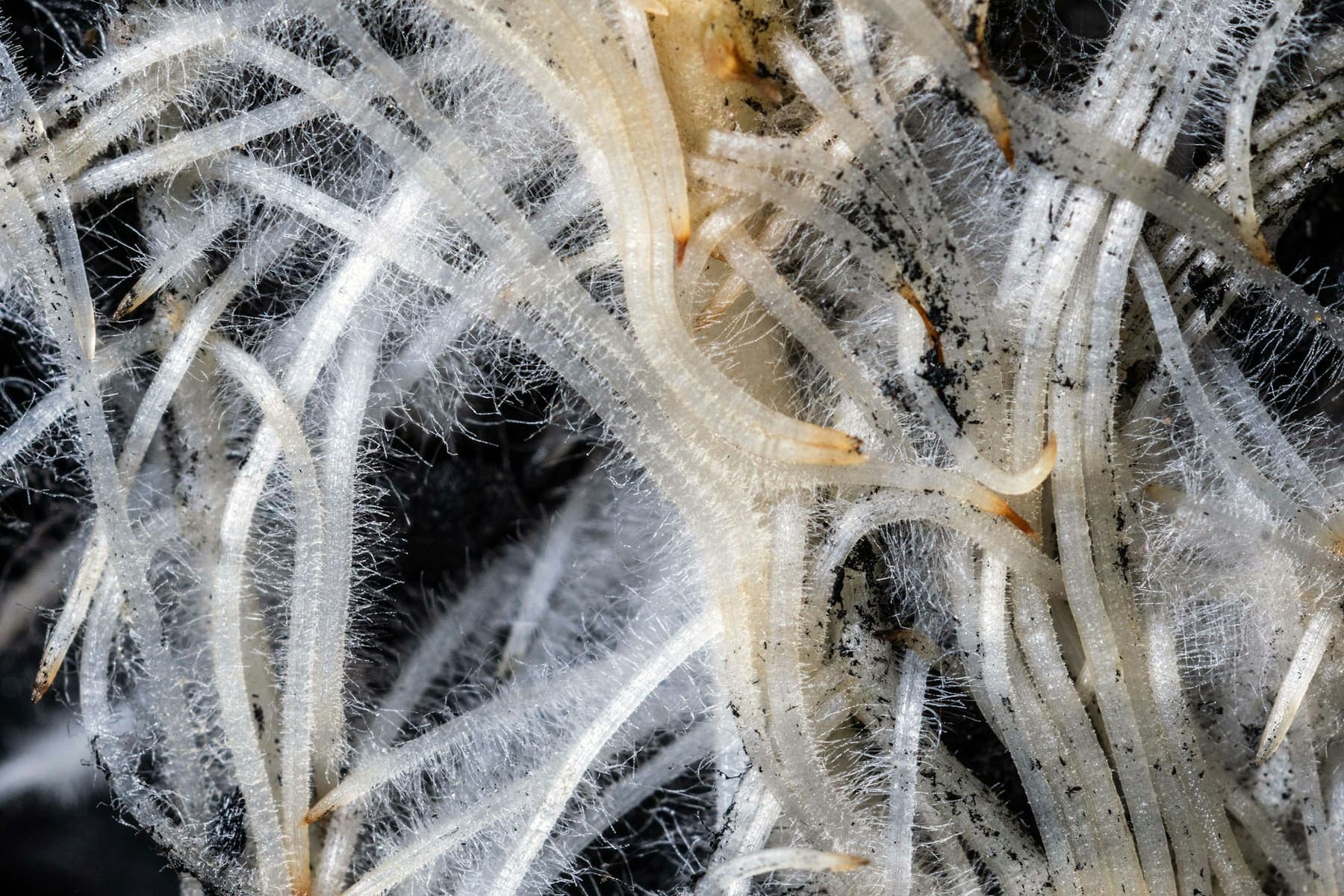
- The roots are no longer white. Healthy roots are white or cream. Brown, soft and foul-smelling, they are short of air: drain, clean, and check the pump before making up a new solution.
- A lasting foam forms on the surface. It often goes with too much organic matter in the water.
- The leaf tips are turning brown. The solution is too concentrated: emptying and starting again works better than diluting blind.
- A crop has just been pulled out. A diseased plant taken out leaves behind enough to contaminate the ones that follow.
Take the chance to look at the roots. The drain is the only moment when they are visible from end to end, and they tell you more than any instrument about the rhythm to keep. Roots that are white or cream, supple and plentiful under the basket point to a crop doing well and a rhythm that suits it. Roots still pale but short and barely branched signal a young plant, or oxygenation that is only just sufficient. Brown, soft roots that come apart between the fingers mean the next drains have to come closer together and the pump has to be checked. Rinse them with clear water while the reservoir is empty, without untangling or pulling at them, then put the baskets straight back: a few minutes in dry air are enough to damage the finest rootlets.
Draining step by step
- Stop the pump and unplug the power supply before handling any water.
- Take the baskets out and set them on a tray, roots upwards, for the length of the job. Take the chance to look at their colour.
- Empty the reservoir. The old solution does the job of a lightly fertilised watering for the potted plants of the house.
- Rinse the reservoir with clear water, scrubbing the walls with a clean sponge kept for that purpose alone. Clean the pump filter, which fills up with roots and deposits.
- Fill with water at room temperature, around 18 to 22 °C. Warmer water holds less dissolved oxygen.
- Pour in part A, stir, then part B, stir. Never mix the two concentrates with each other: some elements would precipitate.
- Measure the pH and correct it if need be, to stay between 5.5 and 6.5.
- Put the baskets back in place and plug the pump in again. Check that the solution is circulating properly before you close everything up.
For young plants set in less than two weeks ago, halve the fertiliser dose: a full-strength solution is too strong for roots that have only just come out of the seed plug.
Between two crops, the full clean
Once every plant has been harvested the system is cleaned right through before it is started again: reservoir, tubing, baskets and lid, with hot water, then a generous rinse. That is the recommendation of the University of New Hampshire extension service, which also points out two things that are often overlooked.
First, the nutrient solution must not come into contact with the parts that are eaten: it sits for several days at room temperature in an open container. Harvest above the level of the baskets, and rinse the leaves before you use them.
Second, if root rot has broken out, a simple rinse is not enough. The system has to be emptied, cleaned, disinfected and started again from nothing, rather than hoping to save the plants in place.
Starting a new crop is also the moment to change plants: see which plants to grow hydroponically to put the next tank together, and indoor hydroponics without the jargon for the full weekly routine. The consumables are in the nutrients and accessories aisle.
Sources
Frequently asked questions
Can you just add more fertiliser instead of emptying the reservoir?
No, and it is the most common mistake. Plants do not use every element at the same rate: some run out in a few days, others build up. Adding fertiliser to a solution that is already out of balance raises the concentration of the elements the plant no longer wants, without making up for the ones that are missing. The usual result is water very heavily loaded with salts, burnt leaf tips, and a deficiency that persists in spite of a full reservoir.
What should you do with the old nutrient solution?
It can be poured without any trouble on the potted plants of the house or the balcony, where it does the job of a lightly fertilised watering. That is the best possible use for it, since it still holds mineral elements the plants can use. Dilute it by half with clear water if it has stayed a long time in the reservoir. The only thing to avoid is emptying it in the same spot of the garden every time, so that salts do not build up there.
Does the solution need changing more often in summer?
The renewal rhythm stays the same, two to three weeks for a small system, but topping up becomes far more frequent. Evaporation is stronger, and water that warms up holds less dissolved oxygen, which raises the risk of root rot. In hot weather, keep the reservoir away from any source of heat and check the level twice a week. If the water stays above room temperature for any length of time, bring the drain forward rather than putting it off.
Does the system need disinfecting between two crops?
A full clean with hot water, followed by a generous rinse, is enough in most cases, and that is what the University of New Hampshire extension service recommends between two growing cycles. Disinfecting does become necessary after an episode of root rot: the system then has to be emptied completely, cleaned, disinfected and started again from nothing. Rinse very thoroughly afterwards, because no residue of any product should end up in a solution meant for plants you are going to eat.