




Nutrient solution pH: why it moves, how to set it
Aim for 5.5 to 6.5, measure after dosing the fertiliser and correct in small touches: what makes the pH of a reservoir drift, and how to bring it back without making waves.
In this guide
In an indoor hydroponic garden the pH of the nutrient solution should stay between 5.5 and 6.5; a value up to 7 is still acceptable at home. It moves because the roots exchange ions with the water all the time, because the level drops and gets topped up, and because a small volume puts up no resistance to those swings. Measure it at least once a week, always after adding the fertiliser, and correct it in small successive doses.
What pH really changes
pH is not a nutrient: it feeds nothing. It decides what the plant can take from a solution that is otherwise correctly dosed.
Each mineral element is only available for uptake within a certain range of acidity. Outside it, the element is still there in the water but in a form the roots cannot take up. Iron is the first to drop out as the pH rises, and it shows: the young leaves yellow between the veins, which stay green, even though the reservoir has just been filled with fresh solution.
A pH out of range therefore looks like a deficiency. That is what makes the mistake expensive: you add fertiliser, the solution concentrates, the leaf tips burn, and the original problem has not shifted an inch. Faced with unexplained yellowing, the first thing to measure is the pH, not to add fertiliser.
The range to aim for and how often to measure
The extension services of the universities of Florida, Illinois and New Hampshire agree on the same domestic range: 5.5 to 6.5. New Hampshire adds that a value up to 7 suits a home system, and that fine adjustment, costly and difficult, belongs to commercial production, where the target tightens to 5.8 to 6.2.
How often depends on how dense the planting is:
- Once a week for a small garden of six to twelve plants, at the same time as the level check.
- Twice a week as soon as the system is dense compared with its volume of water, for instance a twenty-four-plant tower on a twenty-litre reservoir.
- At every change of solution, without fail, after dosing the fertiliser.
- Immediately if leaves yellow for no obvious reason.
Write down the value and the date somewhere. A single pH reading says little; three readings in a row show a direction of drift, and it is the direction that points to the cause.
Always measure under the same conditions. A figure is only worth what it says against the previous one. Take the sample from the same place, in the reservoir rather than at the pump outlet where the water has just been stirred, and let it come back to room temperature before reading. A solution just topped up with cold water gives a misleading value.
Rinse the probe or the strip in clean water before and after each use, and wipe the probe without rubbing it. A pH meter put away with a crusted tip drifts within a few weeks and goes on showing clear figures that are wrong. Strips, for their part, read badly in a solution already coloured by the fertiliser: compare the shade in daylight and not under the grow light, whose spectrum distorts how colours look.
The five reasons it moves
The roots themselves. A plant does not take up elements in the order they are dissolved. To keep its electrical balance, it releases an ion into the water each time it absorbs another. Depending on whether nitrogen is taken up as nitrate or as ammonium, that release acidifies or alkalises the solution. This is the underlying cause, and it is unavoidable: it is the sign that the crop is working.
The hardness of the starting water. Water rich in bicarbonates, that is, hard water, resists correction: the pH climbs back to its original value within a day or two, whatever dose of acid you add. Conversely, very soft or reverse-osmosis water has almost no buffering capacity and the pH jumps in all directions for the sake of a few drops.
Topping up the level. Between two changes, the plant drinks and the water evaporates. Every top-up made with tap water brings bicarbonates back in and pushes the pH up, while slowly concentrating the salts that remain.
The growing medium. Coir plugs sit around pH 6 and have no noticeable effect. New rockwool, on the other hand, is slightly alkaline and has no buffering capacity: it pushes the pH of a reservoir up until it has been soaked beforehand in acidified water.
Algae in the reservoir. A reservoir exposed to light turns green. Algae consume dissolved carbon dioxide during the lit hours, which drives the pH up over the day, then ease off at night. They also clog the pump. An opaque reservoir and blanked-off empty slots settle the problem at source.
Correcting without making waves
- Measure first, and on a complete solution. Fill the reservoir, pour in part A, mix, pour in part B, mix, let the pump blend it for a few minutes, then measure.
- Take a glassful of solution rather than pouring the corrector straight into the reservoir. That way you judge the real effect of a small dose.
- Add the corrector drop by drop, never by the capful. pH− and pH+ products are concentrated, and an overshoot is made good by adding the other one, which needlessly loads the solution with salts.
- Wait a quarter of an hour, then measure again. The pH of a stirred solution takes a few minutes to settle.
- Repeat in stages until you are back in range, without chasing a value to the decimal point.
- Note the dose that worked. With the same water and the same fertiliser, it will be the same at the next change.
If the pH heads back up within two days every time, the problem is not the correction but the water: try a mix of tap water and deionised water to lower its buffering capacity, or accept living at the top of the range, which has no consequences for herbs and salads.
Read the table before drawing conclusions
| What you see | Most likely cause | What to do |
|---|---|---|
| The pH rises steadily | Hard water, frequent top-ups | Correct, and top up with softer water |
| The pH falls steadily | Dense planting, heavy uptake | Correct, and bring the change forward |
| The pH jumps both ways | Reverse-osmosis water with no buffering | Cut it with tap water |
| The pH climbs as soon as you start up | New rockwool, not pre-soaked | Soak the medium before use |
| The pH is fine, the leaves yellow | This is not the pH | Check the fertiliser dose and the light |
What is not a pH problem
Leaf tips and edges turning brown. This is the sign of a solution that is too concentrated. Go back to the dose on the label and change the solution: a richer solution does not grow plants faster.
Long stems with widely spaced leaves. This is a lack of light, covered in our guide on grow lights for indoor growing.
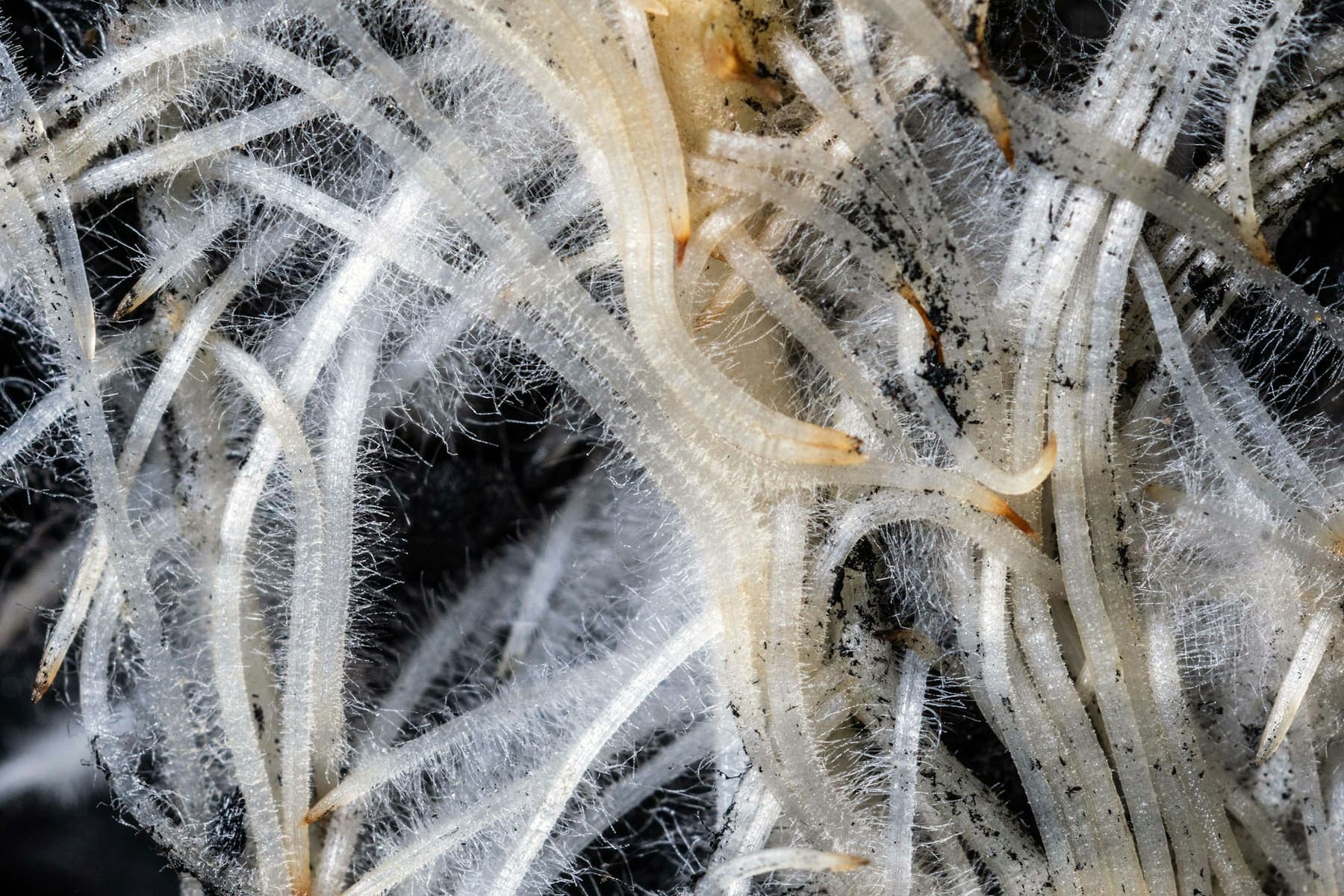
Brown, soft roots although the reservoir is full. They are short of oxygen. Healthy roots are white or cream. Check the pump and the water temperature rather than the pH.
A slow drift between two changes. That is normal. The pH is not meant to stay fixed for three weeks: it is the regular renewal of the solution that resets the counters, as indoor hydroponics without the jargon explains. To understand the exact role of the solution in the system, see also how hydroponics works, and for the equipment, the nutrients and accessories section.
Sources
Frequently asked questions
Should you aim for an exact pH value?
The reference range is 5.5 to 6.5, the one quoted by the extension services of the universities of Florida, Illinois and New Hampshire. The last of these even notes that at home a value up to 7 remains acceptable: fine adjustment is only worth it in commercial production, where the target is more like 5.8 to 6.2. In other words, do not chase the exact value, aim to stay inside the range. A slow, steady drift between two changes of solution is normal.
Can the pH be corrected with vinegar or bicarbonate of soda?
White vinegar works to bring the pH down, and the University of Florida extension service mentions it for a home water garden. Its effect is brief, however: acetic acid is used up quickly and the pH often climbs back within a day or two. The correctors sold for hydroponics last longer, because they are based on mineral acids and bases. As for bicarbonate of soda, bear in mind that it adds sodium, which plants have no need of: choose a pH+ corrector formulated for growing.
Are test strips enough, or do you need a pH meter?
Colorimetric strips are enough to get started and to spot a clear drift, to within about half a unit. They become limiting as soon as you need to tell 6.2 from 6.6, and they are awkward to read in a solution already coloured by the fertiliser. An electronic pH meter clears both difficulties, provided it is calibrated regularly with reference solutions and rinsed in clean water after each reading. A meter that is never calibrated gives figures more misleading than strips.
Should the pH be set before or after adding the nutrients?
Always after. Hydroponic fertilisers change the pH of the water themselves, sometimes by more than a unit, so an adjustment made on clean water is lost the moment the feed goes in. The right order is: fill the reservoir, add part A and mix, add part B and mix, then measure and correct if needed. Let the pump run for a few minutes between each step so that the mix is even.