

Thyme and rosemary indoors: Mediterranean shrubs under a lamp
Drainage, light, rare watering and light pruning: how to keep thyme and rosemary alive in a flat, and why they almost always die of too much water.
In this guide
Thyme and rosemary almost never die of thirst in a flat: they die of too much water, of a pot that drains badly, or of a winter spent in a heated, dark room. They are shrubs of full sun and free-draining soil, not herbs for the edge of the sink. Three things save them: a loam-based compost lightened with grit in a pot with plenty of holes, the brightest place in the house or a lamp, and water only when the compost is dry well down.
Two shrubs, not two annual herbs
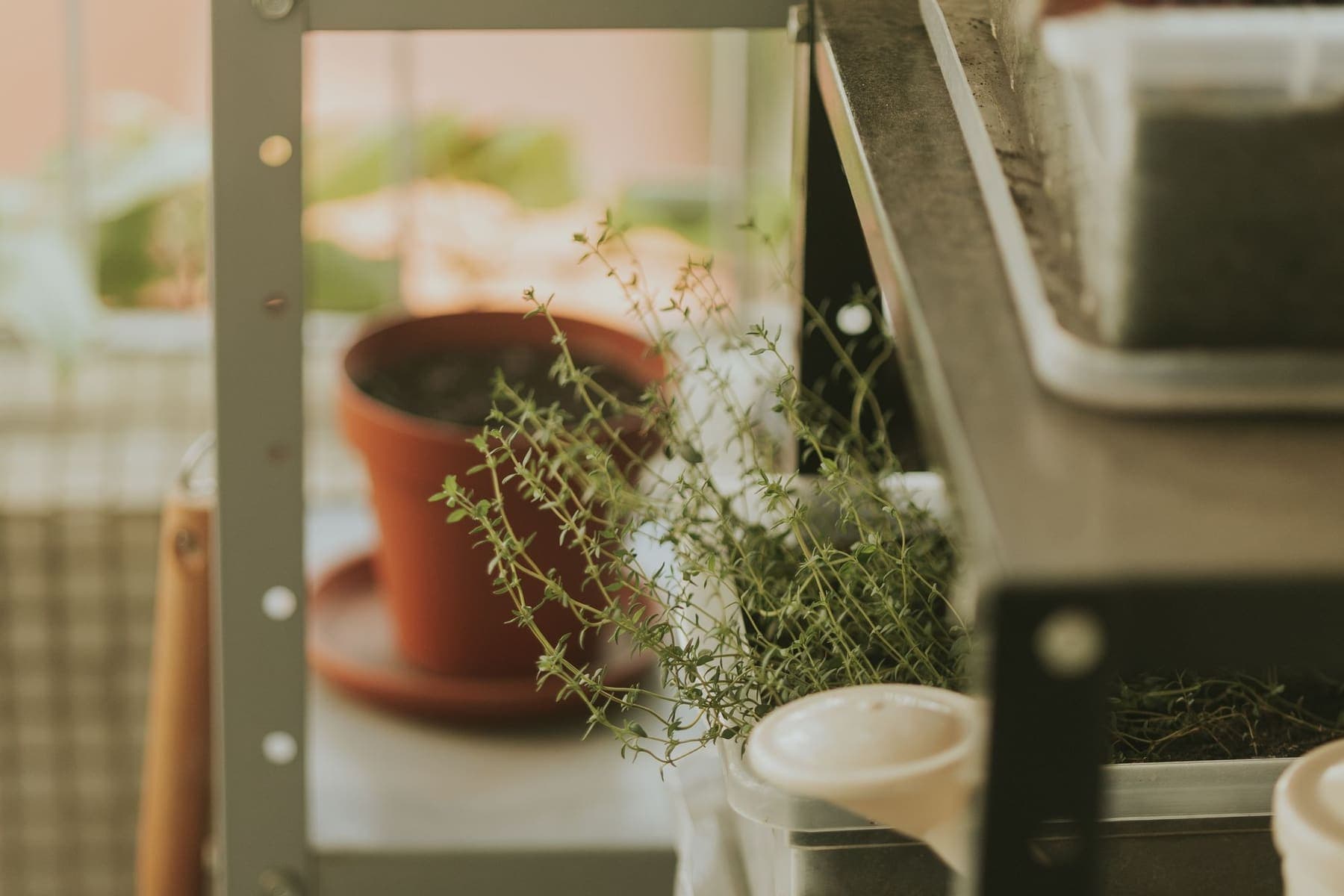
Common thyme (Thymus vulgaris) makes a small bush of about thirty centimetres. Other thymes creep along the ground: more ornamental, but less practical to harvest. For the kitchen, the bushy forms are the handiest.
Rosemary is a shrub in its own right. Its botanical name today is Salvia rosmarinus; it is still often sold under the old name Rosmarinus officinalis. In a pot it lives several years, then goes bare at the base.
Both are evergreen: their foliage stays on all year, which means sprigs can be picked in January as readily as in July. And both share the same intolerance: roots that stay wet, above all in winter, rot.
Thyme or rosemary: what sets them apart
| Thyme | Rosemary | |
|---|---|---|
| Habit in a pot | Low bush, up to about 30 cm | Shrub, often a good deal taller |
| Pot size | At least 15 cm across and 10 cm deep for one plant | At least 30 cm across and deep |
| Sowing | Germinates at 15–20 °C, in a fortnight or so | Possible, but several years before harvesting |
| Easy propagation | Cuttings, layering, division | Spring or summer cuttings, layering |
| Watering in a pot | Rare, only in hot, dry weather | A little more in the first year, never soaked |
| Pruning | Light, late spring and after flowering | After flowering, never hard |
| Useful lifespan | A few years, then replace | Often seven to eight years before replacement |
The ranges above come from the growing guides of the Royal Horticultural Society. They describe plants grown outdoors in a temperate climate: indoors, light is the factor that departs most from those conditions.
The pot, the compost, the drainage
These plants do not ask for a rich compost. They ask for a compost that lets water go.
- Choose a pot with plenty of drainage holes. Several holes are better than one. Rosemary must never stand in water.
- Take a loam-based compost rather than a light houseplant compost: it holds up better over time for a shrub in a pot.
- Add horticultural grit, up to a quarter of the volume. That is the RHS recommendation for thyme as for rosemary, and it is the single thing that most changes the chances of survival.
- Do not plant too deep. The top of the rootball stays barely covered.
- Forget the full saucer. Empty it twenty minutes after watering.
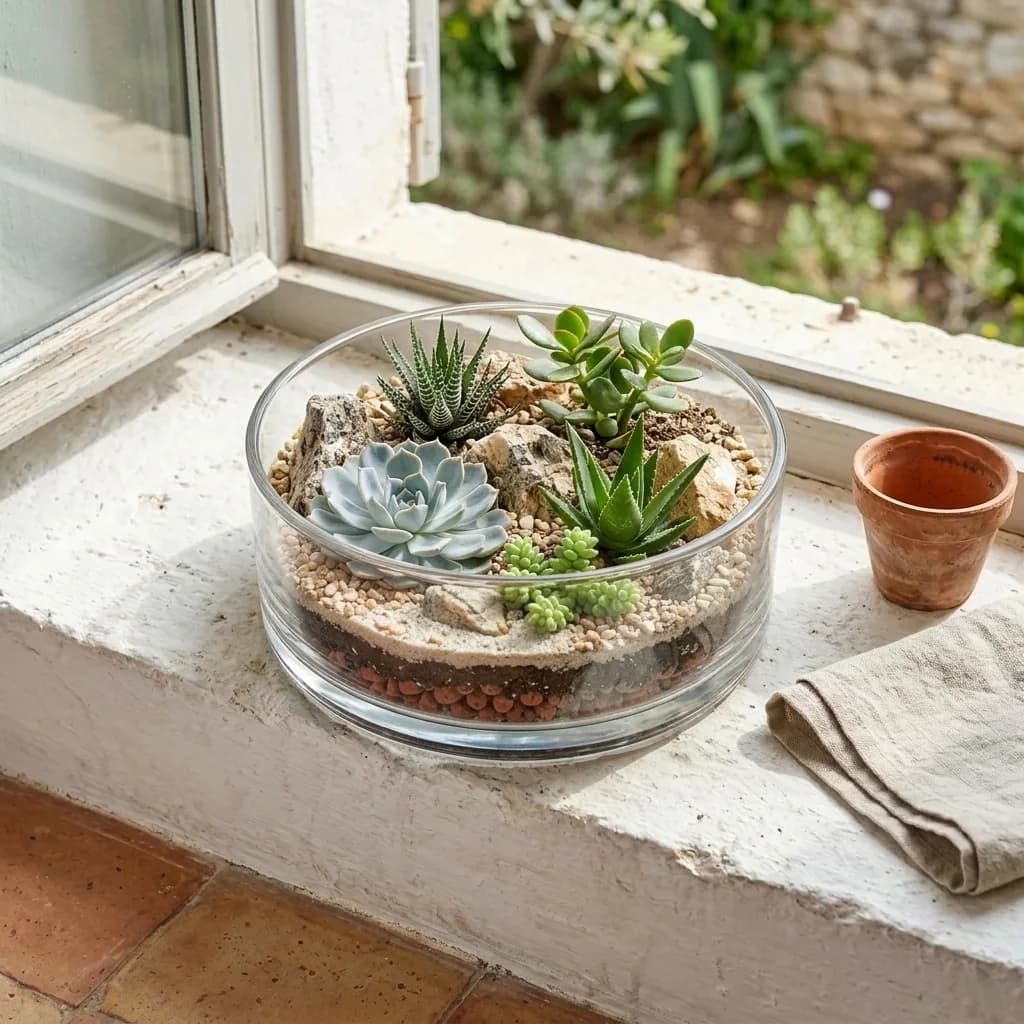
An unglazed terracotta pot helps: the wall breathes, the compost dries more evenly, and that evenness is exactly what these two plants are asking for.
Light: the real limiting factor in a flat
Thyme and rosemary grow in the sun. Behind a pane of glass they get far less light than it looks, and the result is always the same: stretched internodes, soft stems, fading scent.
Give them the brightest window, due south if possible, and turn the pot a quarter turn each week so that they do not lean towards the glass.
In winter a grow light closes the gap. Allow twelve hours a day to tick over, fourteen to sixteen hours for active growth, on a timer. A light bar goes 30 to 40 cm above plants that are already established. The distances and durations are gathered in our guide to grow lights indoors.
Watering: the thing that kills them
Thyme is drought-resistant and hardly ever needs watering, except when it has just been planted or when it is growing in a pot in hot, dry weather. Too much water is far more likely than too little, and it rots the roots.
Rosemary is equally drought-tolerant once established. In a pot it does need a little water in dry spells, because a container dries out quickly, but the compost must never stay sodden.
The method that works indoors: push a finger three or four centimetres into the compost. If it is still cool, do not water. If it is dry, water generously, let the surplus drain away, and empty the saucer.
In winter, leave still longer between waterings. That is the season when most plants are lost, not to cold but to standing damp.
Sowing, taking cuttings or buying a plant
Thyme sows without any difficulty. Sow in spring in small pots or trays, in a moist seed compost. The seed germinates well between 15 and 20 °C, somewhere warm and bright, in a fortnight or so. Water regularly but without excess: seedlings are prone to damping off, the disease that makes young stems collapse in compost that is too wet. As soon as each seedling carries several leaves, move it into its own pot.
A terracotta pot suits this stage particularly well: the porous wall lets the compost dry between waterings, which is precisely what keeps damping off at bay.
Rosemary, on the other hand, is rarely sown. It takes several years to reach a size worth harvesting. Start from a bought plant or from a cutting taken off an existing one, softwood in spring or early summer, semi-ripe in summer. Layering works too: a low stem held against the compost roots on its own.
One point deserves attention when buying: rosemary is susceptible to the bacterium Xylella fastidiosa, a quarantine organism present in several regions of southern Europe. Choosing plants raised locally, from a professional who knows where they came from, limits the risk of moving the disease about.
Pruning and harvesting
Pruning to avoid bare wood
Without pruning, both plants go bare at the bottom and end up as dry wood topped with a tuft of leaves.
- Bushy thyme is pruned lightly, in late spring or just after flowering, to keep it compact.
- Rosemary is pruned after flowering, always moderately. It does not come back well from a hard cut into old wood: better to prune a little every year than a lot once.
- An old, bare plant is replaced. For rosemary, the RHS talks of renewal every seven to eight years. A cutting taken the year before saves having to buy again.
A rosemary that has spent more than a year in the same pot appreciates a slow-release feed in late spring or early summer. Thyme does without feeding in most cases.
Harvesting all year round
Evergreen foliage can be picked in any season, but the tender young shoots of spring and summer have the most flavour. Cut sprigs as you need them, from different points on the plant, rather than stripping one branch. Thyme flowers are edible too, and they draw bees when the pot spends the summer outdoors.
These two herbs are not suited to hydroponics: their roots cannot stand being held permanently in water. If you are hesitating between the two approaches, our comparison of hydroponics or soil explains which plants each method makes sense for. For the herbs that run to seed too fast instead, read coriander and dill indoors. Pots and composts are in the pots and composts aisle.
Sources
Frequently asked questions
Can rosemary spend the winter in a heated flat?
It rarely comes through it well. Rosemary is hardy over much of the country and fears winter wet more than cold. A heated room with little light offers it the worst possible mixture: not much light, a great deal of heat, and therefore drawn, etiolated shoots. Prefer a conservatory, a cool stairwell or an unheated windowsill, and leave much longer between waterings.
Why is my thyme going bare in the middle?
Because it has not been pruned. A thyme left to itself turns woody and hollows out in the centre: the base stops making young shoots. A light prune every year, in late spring or just after flowering, keeps the plant compact. An old plant already hollow cannot really be brought back; it is replaced by a cutting or by division.
Do thyme and rosemary need a terracotta pot?
It is not compulsory, but it helps a great deal indoors. Unglazed terracotta lets water evaporate through the wall, so the compost dries more evenly and the roots stay wet for less time. In a plastic pot the same watering keeps the compost moist for far longer: you then have to water less often and take even more care over drainage.
Do thyme and rosemary grown indoors have less flavour?
Often, yes, and the main cause is light. The essential oils that make the scent form better under strong light. A plant grown behind a north window, or without a lamp in winter, gives larger, paler leaves with a faint scent. Putting the pot out on a balcony from May to September is usually enough to bring the flavour back.