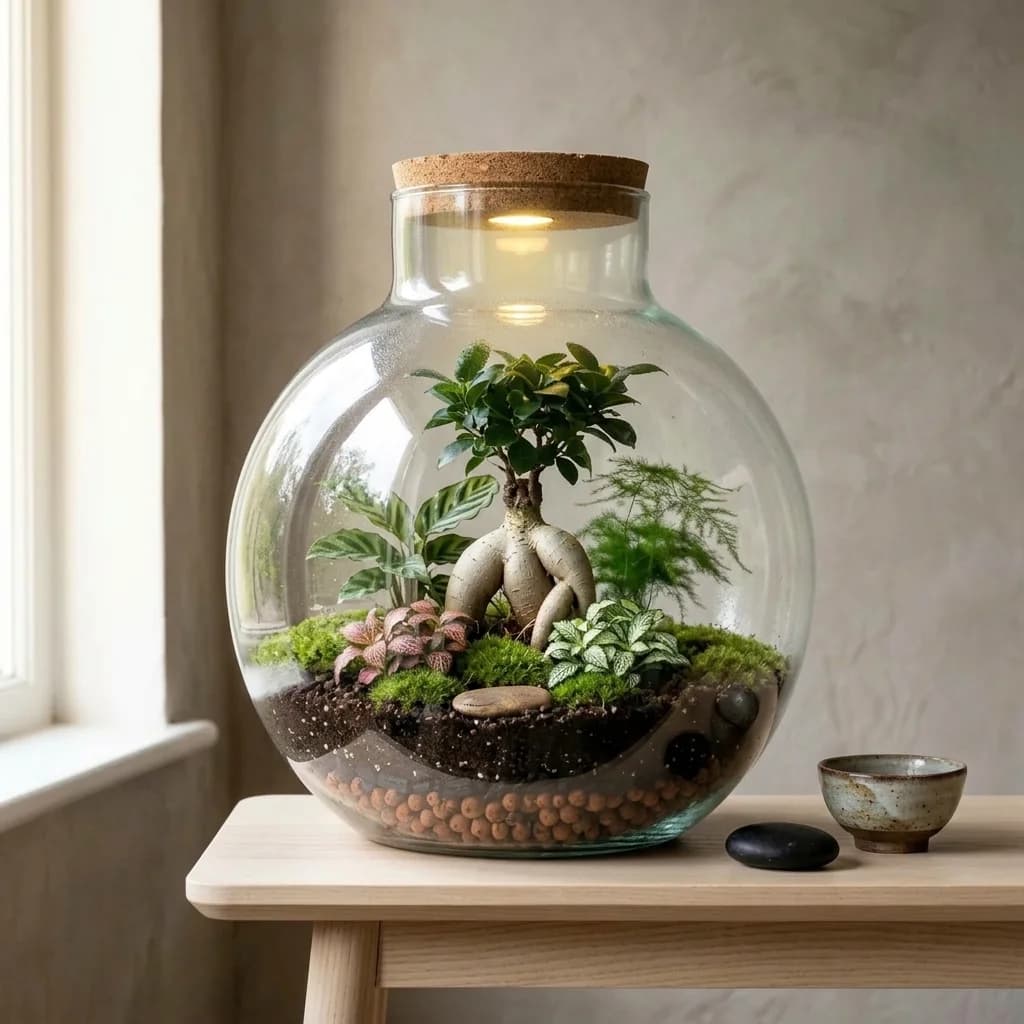
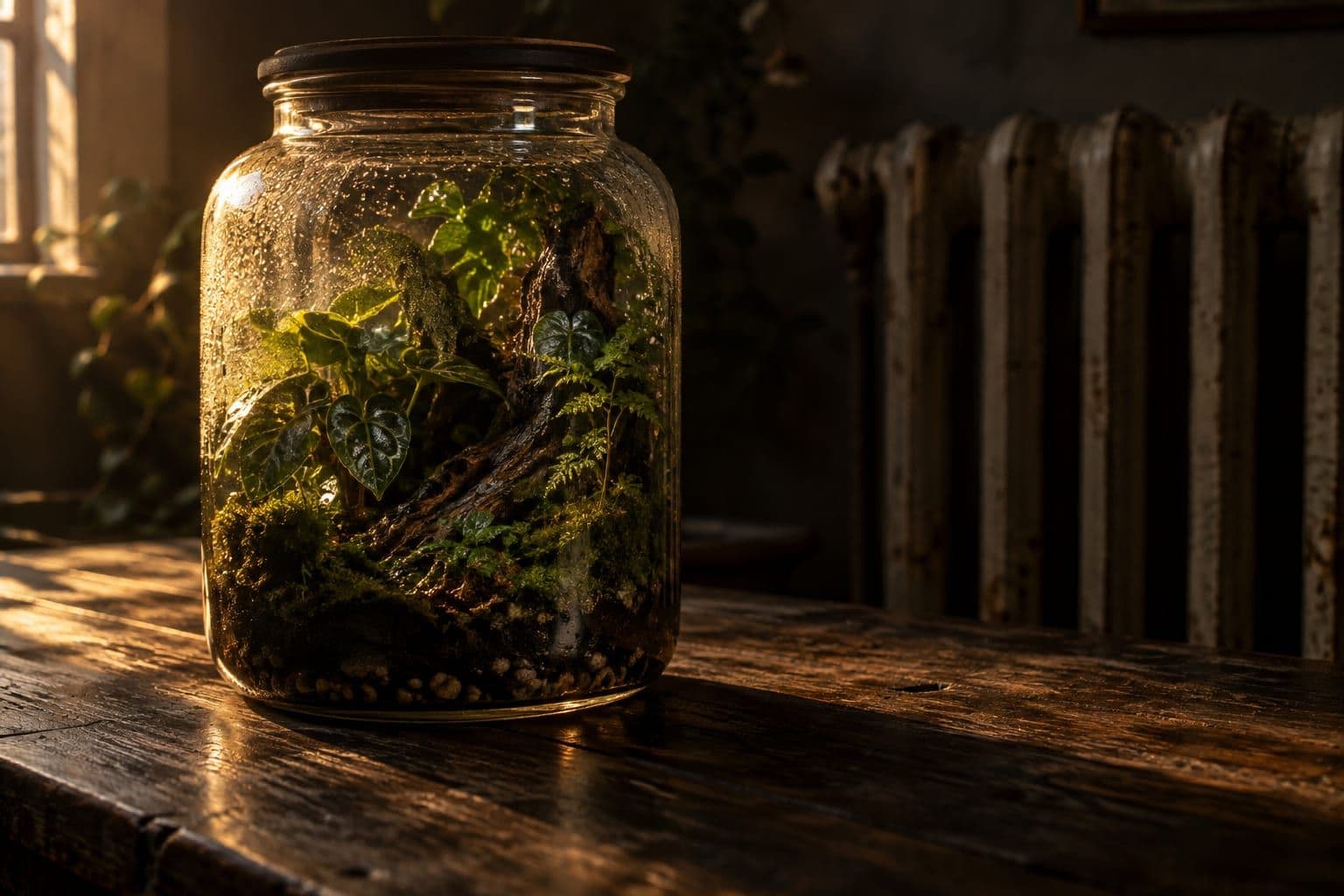
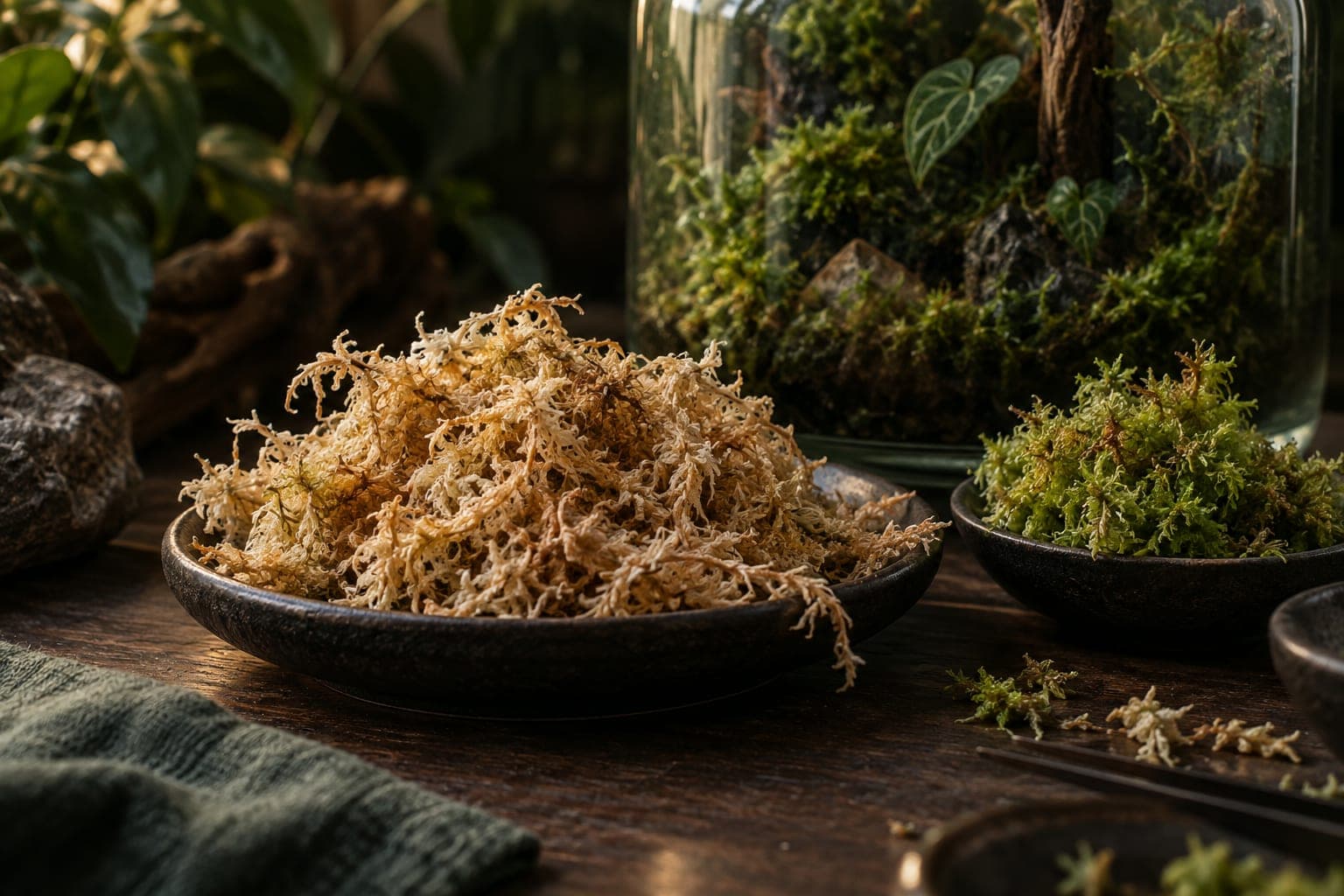
Terrarium kit, or buying everything separately?
Real cost, quantities, freedom of composition, gifting: the honest comparison between a ready-to-build kit and a terrarium assembled piece by piece.
In this guide
For a first terrarium, or as a gift, a kit is almost always the right choice: it gives you the container and the right quantities, without buying a bag of substrate you will use a fifth of. For a second terrarium with a reused container, or if you have a precise composition in mind, buying separately becomes more interesting: you already have the leftovers, and you choose each plant yourself.
The comparison
| Kit | Buying separately | |
|---|---|---|
| Cost of a first terrarium | Equivalent, often slightly less | Equivalent, with leftovers |
| Cost of the second | Same price | Less than the first, not always less than the kit |
| Quantities | Exact | Whole bags, substantial leftovers |
| Choice of plants | Fixed or limited | Complete |
| Decision time | None | Several hours |
| Risk of a mistake | Low | Real: incompatible plants, wrong substrate |
| As a gift | Excellent | Awkward |
Working out the quantities
This is the point you only discover when you add it all up. A closed terrarium of 20 to 25 cm uses roughly:
| Item | Actual quantity | Usual pack size |
|---|---|---|
| Drainage | 0.8 to 1.2 L | Bag of 5 to 10 L |
| Substrate | 2 to 3 L | Bag of 5 to 20 L |
| Charcoal | 50 to 100 g | Pack of 500 g |
| Moss | 1 to 2 portions | Sheet |
| Plants | 3 plants | Sold individually |
In other words, on three items out of five you are buying three to ten times what you need. That is not wasted if you build a second terrarium — and most people do build a second. But for a one-off, it is money tied up.
The item-by-item detail is in How much does a terrarium cost.
What a kit saves you
The decisions. What volume? Which substrate? Which plants go together? These questions have answers, and they are in Your first terrarium: the beginner's guide — but they take an evening to untangle.
The mistakes. The two most common are mixing plants with opposite needs, and using ordinary shop compost, which holds far too much moisture under glass. A kit does not let you make either.
Carrying it home and finding space. One box instead of five bags.
What buying separately gives you
The exact choice of plants. This is the real argument. If you want a precise composition — a mossarium with no vascular plants, a scheme dominated by selaginella, a creeping fig climbing over a root — no kit offers it. The terrarium plants shelf lets you compose your own.
The container you want. A 10-litre carboy, a cloche on a base, a jar found second-hand. The glass containers shelf is independent of everything else.
The cost of the second one. Once you have the substrate, the drainage and the charcoal, a new terrarium costs only the glass and the plants. That is where buying separately catches up with the kit, especially with a reused jar.
The gift case
The kit wins clearly. Giving a finished terrarium is giving an object. Giving a kit is giving an activity — two enjoyable hours, and a result the recipient can say they made themselves.
It is also the only format that does not ask you to guess someone else's taste in plants. See Giving a terrarium as a gift.
Tools, a separate matter
Neither route makes them essential. For a wide-mouthed jar, a long-handled spoon and the fine scissors you already own will do. Tools become necessary as soon as the neck narrows — a carboy, a bottle — and there they are not optional.
In short
First terrarium, or a gift → kit.
Second terrarium, or a precise composition in mind → buy separately.
Narrow-necked container → plan for the tools either way.
If you are still unsure about the type of project, the quiz Which little living world should you create? answers in four questions, and DIY terrariums: the equipment you need lists what is essential and what is not.
Sources
Frequently asked questions
Does a kit cost more than buying separately?
Not necessarily. For an equivalent container, a kit often costs the same or slightly less, because it only charges you for the quantities you need. From the second terrarium onwards, buying separately only becomes worthwhile if you reuse the container or are set on specific plants.
How much is left of a bag of substrate after one terrarium?
A great deal. Shop bags often hold several litres, while a 20 cm jar uses two or three. The rest goes into the next terrarium, or is wasted if you never build another.
Does a kit make a good gift?
That is its best use: a box, an object to make yourself, and nothing for the recipient to choose. That is what makes it a gift that holds up.
Can the composition of a kit be changed?
Yes, nothing is sealed. The kit gives you the container and the right quantities: you can swap a plant or add a moss without upsetting anything.