

How to lay moss in a terrarium
Moss is not planted, it is laid. Preparing the substrate, cutting, contact, misting: the method that gets it to take and stay green.
In this guide
Moss is not planted: it has no roots. It anchors itself by fine filaments to the surface of whatever it touches. So the whole job comes down to one idea: make contact. You dampen the substrate, cut the moss to the shape you want, press it down firmly with the flat of your hand, and mist. Moss that is simply set down lifts off as it dries and turns brown.
Before you start
Get three things ready: the moss, a substrate already in place and damp, and a fine-jet mister. Ordinary scissors are enough for the cutting; long tweezers become useful if the neck of the container is narrow.
Moss goes in last, after the drainage, the substrate, the relief and the plants. It is what closes the composition and hides the root balls.
Step 1 — Dampen the substrate
Mist the substrate until it is evenly darker, without water gathering at the bottom. Moss laid on a dry substrate does not anchor: its filaments need moisture to develop.
If the substrate is very loose, firm it down lightly with the back of a spoon. A slightly firm surface gives better contact than a powdery one.
Step 2 — Cut the moss
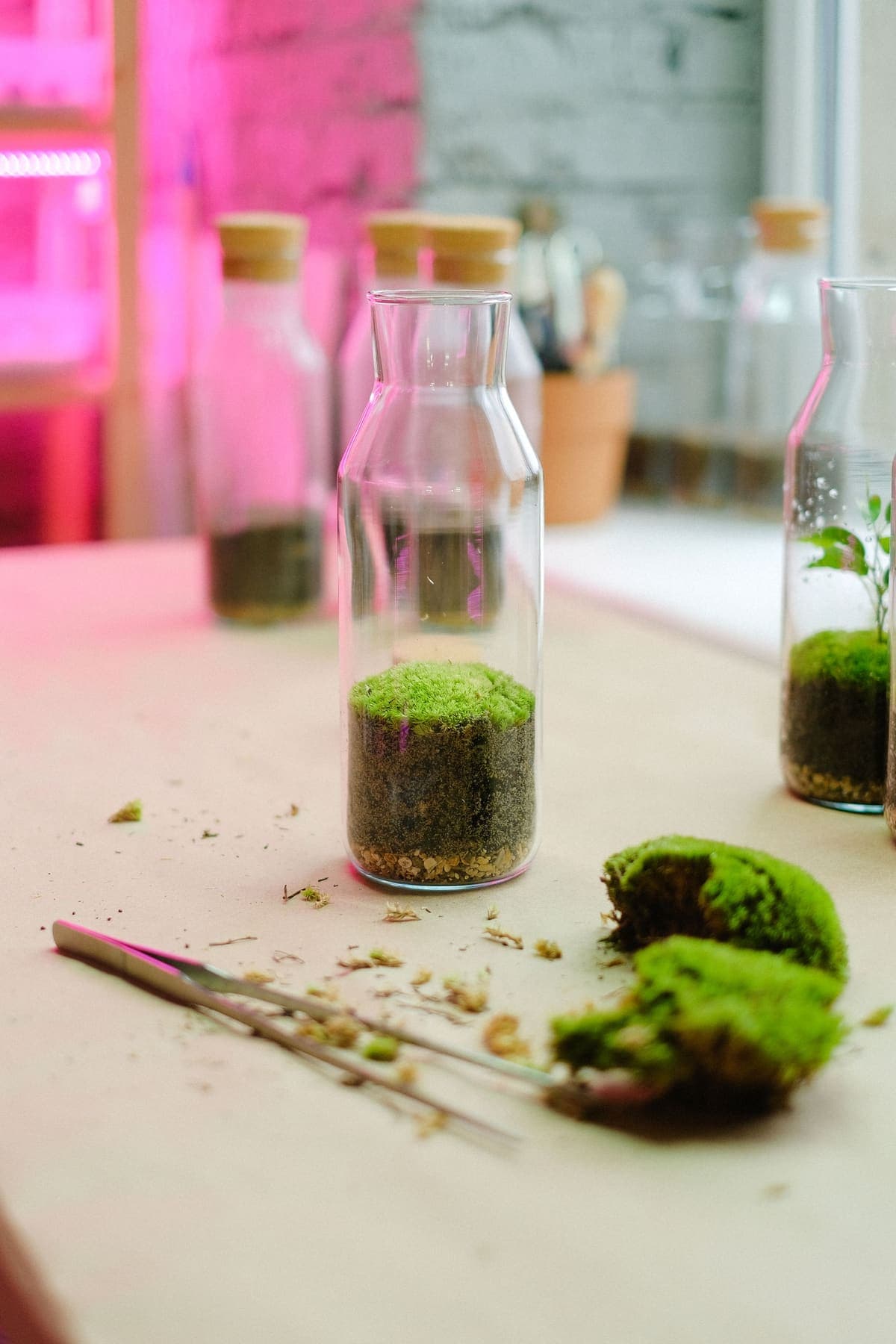
Lay the sheet of moss face down on your work surface and cut it with scissors, as you would fabric. Take the chance to remove the plant debris, the twigs and the soil left underneath: the less dead matter there is, the less mould there will be in a closed environment.
Cut pieces slightly larger than the area to cover, so you can fit them edge to edge. The joins close up within a few weeks if the pieces touch; a gap of one centimetre stays visible for a long time.
Step 3 — Lay it and press it
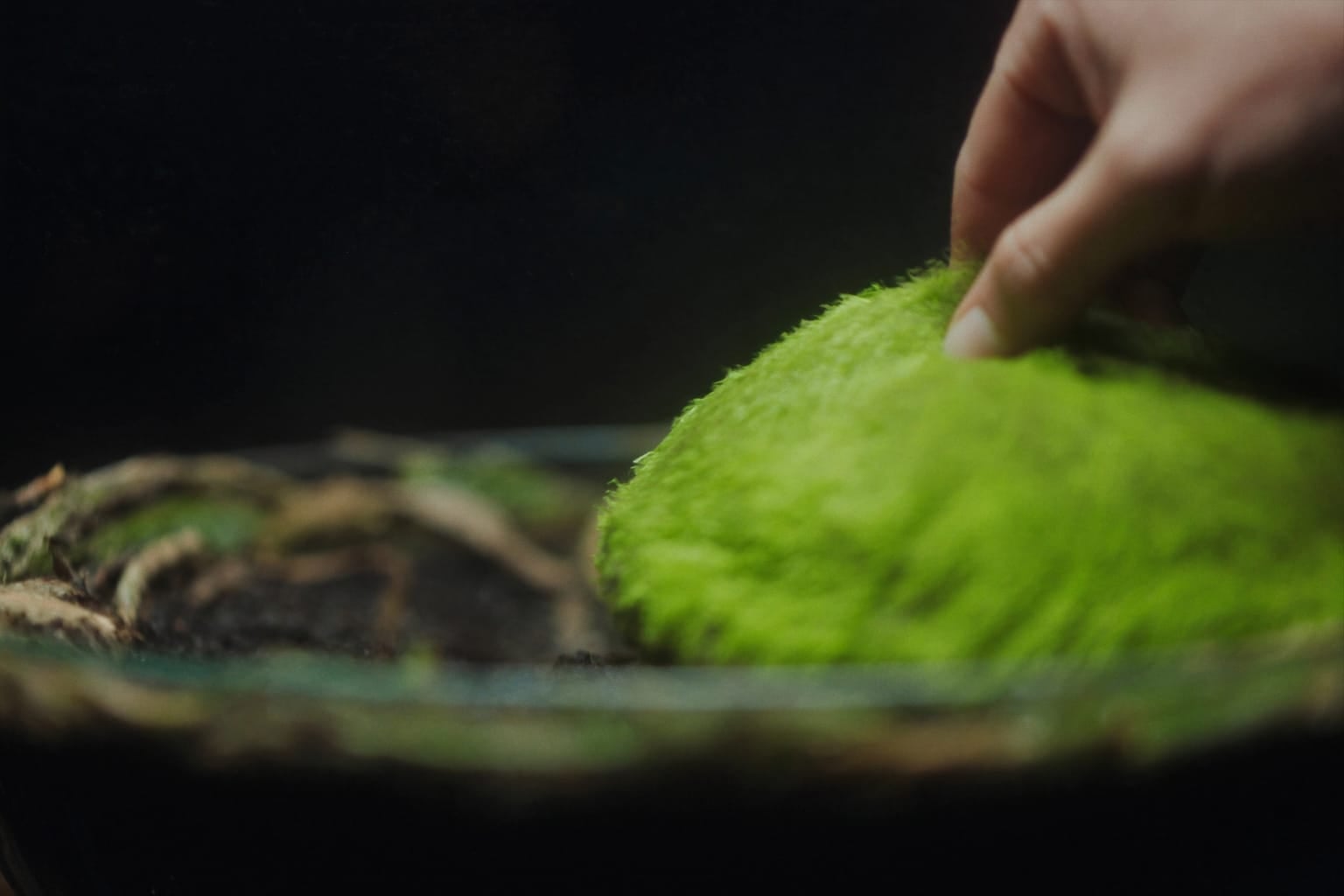
Lay each piece down, then press firmly with the flat of your hand or the back of a spoon. This is the step people rush, and it is the one that decides the outcome. The moss should stay in place when you tilt the container slightly.
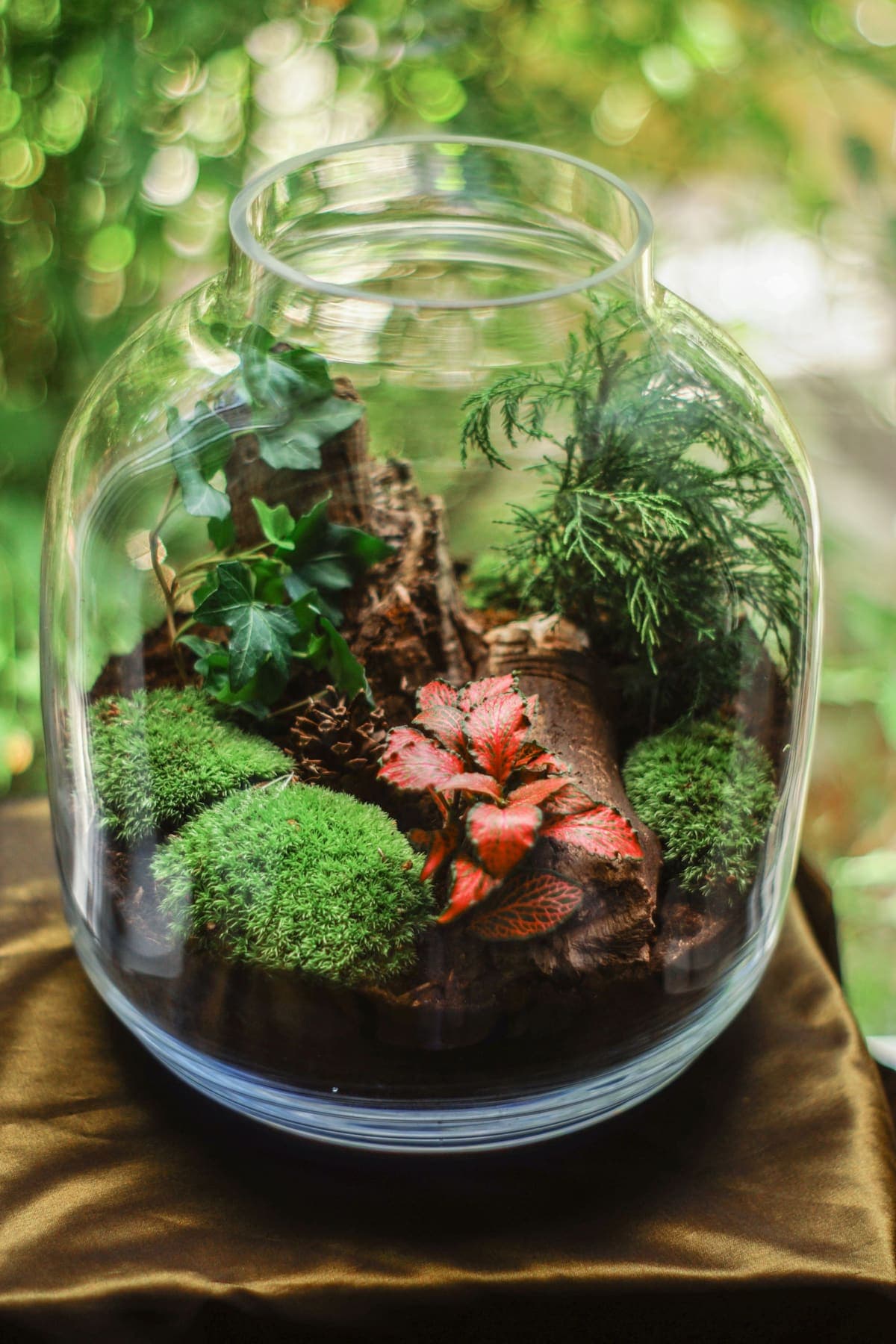
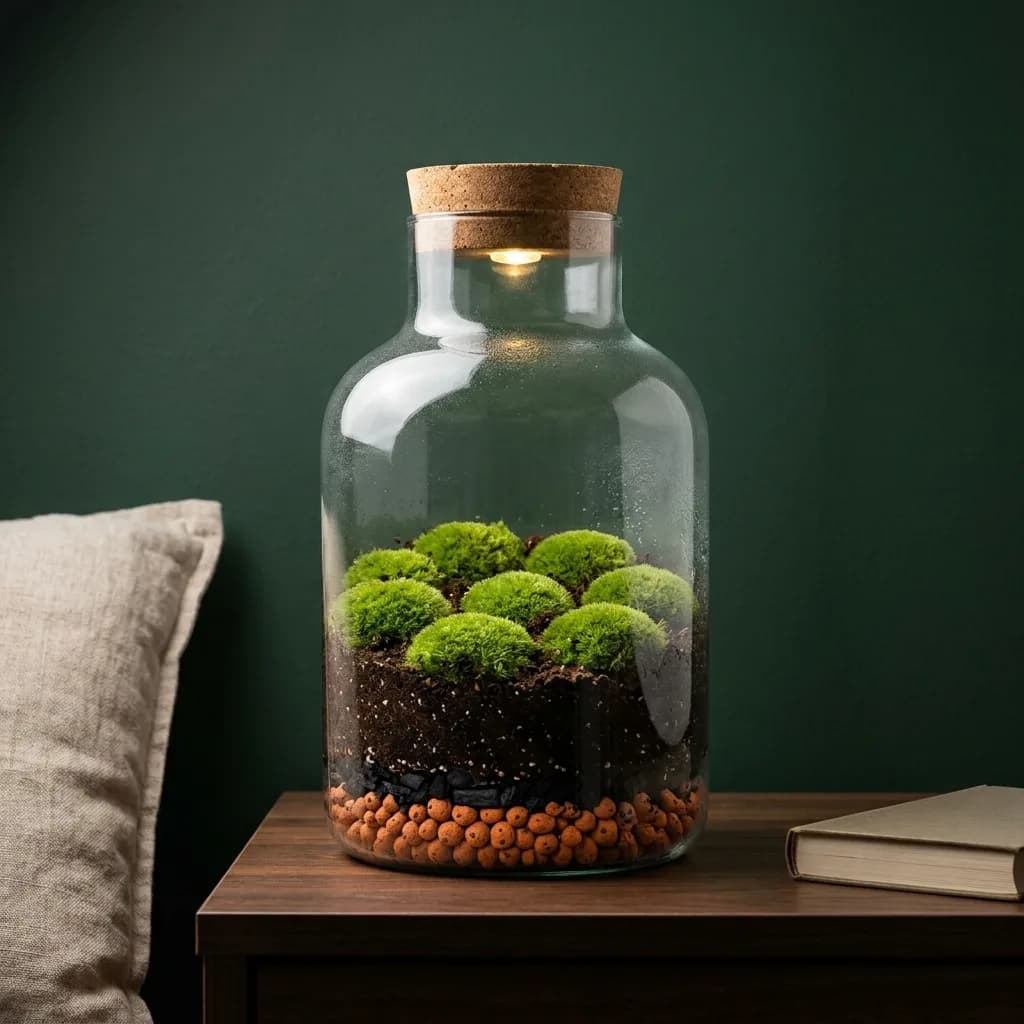
For relief, work with the shape: cushion moss sits in domes on mounds of substrate and stands in for hills; flat moss covers surfaces and gives the continuous ground. The species and their uses are set out in Moss for terrariums.
Step 4 — Mist, clean, close
Mist the moss until it is damp at the surface, without soaking it. Then clean the inside of the glass with a brush or a clean cloth — splashes of substrate left on the wall show, and dry into marks.
Close the terrarium up. In the first few days the moss can look dull: it is reacting to the change of conditions. It greens up again and starts growing from its tips within two to four weeks.
On wood or on a stone
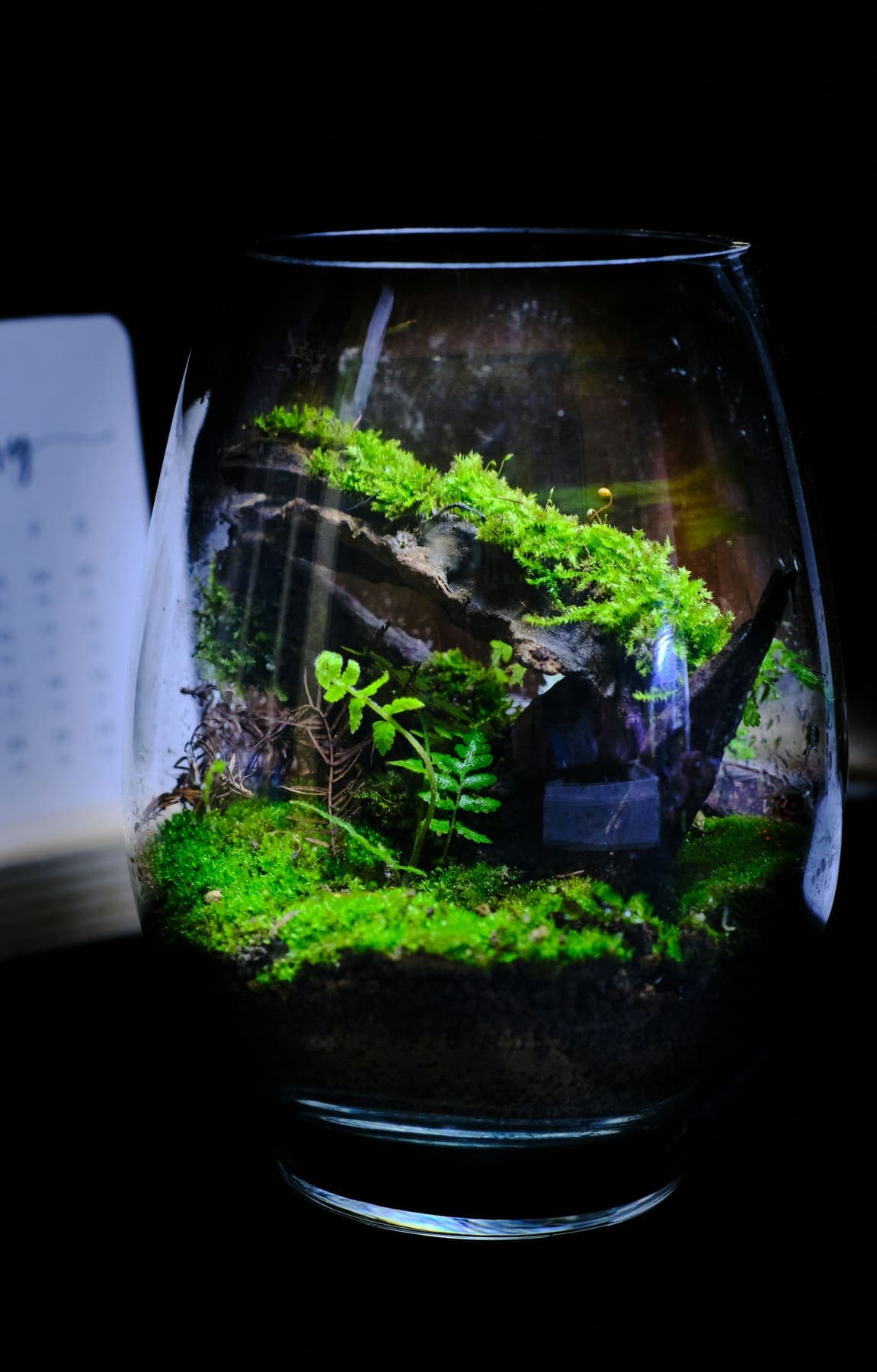
The effect is striking and the principle stays the same. Hold the moss against the support with cotton thread or fine fishing line, in turns spaced apart. It grips within four to six weeks, after which the tie comes off — cotton ends up breaking down on its own.
Choose a dry wood with no bark, which will not ferment in a closed damp environment.
Why it turns brown, and what to do
Two causes dominate, and both can be corrected.
Not enough light. The moss pales first, then turns brown. Move the terrarium closer to a bright window, out of direct sun.
Air too dry. In the open air, moss dries out within a few days. It belongs to the closed terrarium; in an open container, it does not last.
The browned parts do not green up again, but the moss starts growing from its tips once the cause is corrected. If a white cottony veil appears instead, it is no longer the moss but mould: see Mould in a closed terrarium.
Why we do not gather moss in the forest
Taking it is regulated in many natural areas, and it damages a habitat that is slow to recover. There is also a practical reason: gathered moss arrives with mould spores, larvae and pests. In a closed terrarium, nothing keeps them in check, and the problem shows up a few weeks later. Our mosses are cultivated.
Sources
Frequently asked questions
Should moss be buried in the substrate?
No, never. Moss has no roots: it anchors itself by fine filaments at the surface. Buried, it rots. You lay it on an already damp substrate and press it down to make contact.
How long does moss take to settle in?
Two to four weeks for it to anchor and start growing again from its tips. In the first few days it can look dull: that is normal, it is reacting to the change of conditions.
Can you lay moss on wood or a stone?
Yes, and the effect is very good. Hold it in place for a few weeks with cotton thread or fine fishing line, long enough for it to grip, then take the tie off.
Is moss from my garden suitable?
We advise against it. Gathered moss brings moulds, larvae and pests into a closed terrarium, where nothing keeps them in check. Cultivated moss arrives clean and settles in better.