

Creating an aquascape in a 20 to 30-litre nano-aquarium
Style, substrate quantity, rock, light and plants at scale: the method for composing an aquatic landscape in 20 to 30 litres, and getting it safely through its first eight weeks.
In this guide
A 20 to 30-litre aquascape is achieved with a simple idea, few elements and a lot of consistency. Choose a style that fits a small frame, a nutrient-rich substrate in a thicker layer at the back, a single type of rock, small-leaved plants and an adjustable LED light bar. Then let the tank mature for several weeks, with short lighting and frequent water changes, before introducing any animals. Here's the method, step by step.
What changes in a small volume
Proportions and scale
In a 30-centimetre cube, every element counts double. A rock that's too big overwhelms the composition, a wide-leaved plant makes the tank look smaller than it is. So the principle is to work to scale: rocks of varied but modest sizes, small-leaved plants, a clear foreground. It's this contrast in sizes that creates the illusion of depth.
Also think about height. Substrate that's higher at the back than the front visually "pushes back" the rear of the tank. Always leave an open space: a strip of bare substrate, a gap between two rocks. Without empty space, a nano-aquascape quickly becomes a jumble.
Water stability
The less water there is, the faster everything changes: temperature, waste, nutrients. Overfeeding or a day of sunlight on the glass has a much bigger effect in a 30-litre tank than in a large one. And the actual volume is smaller than the stated volume, once the substrate and rock are in place.
The practical consequence: a small aquascape takes less work each time, but demands more consistency. Ten minutes every week is better than one long session a month.
What style should you choose for a 30-litre aquascape?
A simple iwagumi. Three to five stones, one main stone placed off-centre, and a carpeting plant in the foreground. It's the most graphic style, and it suits a cube well. It's also the most demanding: the slightest algae film shows up on bare substrate.
A root forest. One or two branching roots rising towards the surface, with mosses and epiphytes attached to them. This style is more forgiving, since slow, undemanding plants find their place there. It's often the best choice for a first nano-aquascape.
A vertical landscape. In a tank taller than it is wide, you build a rock wall or mountain that fills the height. Before buying a tank of this shape, check the manufacturer's instructions to make sure it's designed to be filled with water: some tall containers are meant for terrariums or paludariums. The effect is spectacular, but the light has to reach further down to the substrate: plan for a fairly powerful light bar and undemanding plants at the bottom.
Equipment: what do you need for a 30-litre aquascape?
The tank
Extra-clear glass renders colours without a greenish reflection. The Dennerle Nano Cube Opti-White, at 30 litres, measures 30 × 30 × 35 cm: a square format, easy to light and maintain. Place it on a stable, perfectly flat piece of furniture.
The substrate
To know how much to buy, Tropica gives a simple formula: length × width × depth, in centimetres, divided by 1,000, gives the volume in litres. For a 30 × 30 cm cube with an average depth of 5 cm, that's 4.5 litres. For a 25 × 25 cm tank, about 3 litres is enough. Build up the back and keep the front lower. Our guide which substrate for a planted aquarium compares the options.
The rock
Choose a single type of stone for a cohesive composition. Dragon Stone (Ohko) offers very pronounced texture, at nano scale. Brush and rinse it in clean water, without any product, to remove clay lodged in the crevices. If you're unsure about a limestone rock, pour a few drops of vinegar on it: a stone that fizzes risks hardening the water.
The light
The Chihiros WRGB II Slim comes in several lengths. According to the manufacturer, the 30 cm model is designed for tanks from 30 to 45 cm long and produces 1,200 lumens for 23 W. On a 30-litre tank, that's around 40 lumens per litre at full power, the top of the range Tropica associates with "medium" plants. For easy plants, without CO₂, reduce the intensity from the app. Our guide which light for a planted aquarium covers these settings.
Filtration and CO₂
Choose a filter sized for a small volume, with a flow rate you can moderate: too strong a current uproots young plants and disturbs shrimp. CO₂ isn't essential with easy plants. It becomes useful for a dense foreground carpet. You'll find filters and accessories in the equipment section.
How do you build the hardscape step by step?
- Work dry. With the tank empty, lay the nutrient substrate on a slope, then arrange the rocks and root. Take your time: the layout can no longer be moved once the plants are in place.
- Place the main element first. Off-centre, around a third of the way along the length. Secondary rocks orient towards it, veins running the same way.
- Bury the rocks in the substrate. A rock placed on the surface looks like it's "floating". Buried by a third, it looks like it's growing out of the substrate and stays stable.
- Check from the front, at eye level. That's how you'll be looking at the tank. A black-and-white photo helps spot unbalanced masses.
- Keep offcuts. Small rock chips are useful for filling slopes and holding back substrate behind larger rocks.
Which plants stay in scale in 30 litres?
Plant densely from the start, with few different species. Three to five species is enough in a nano.
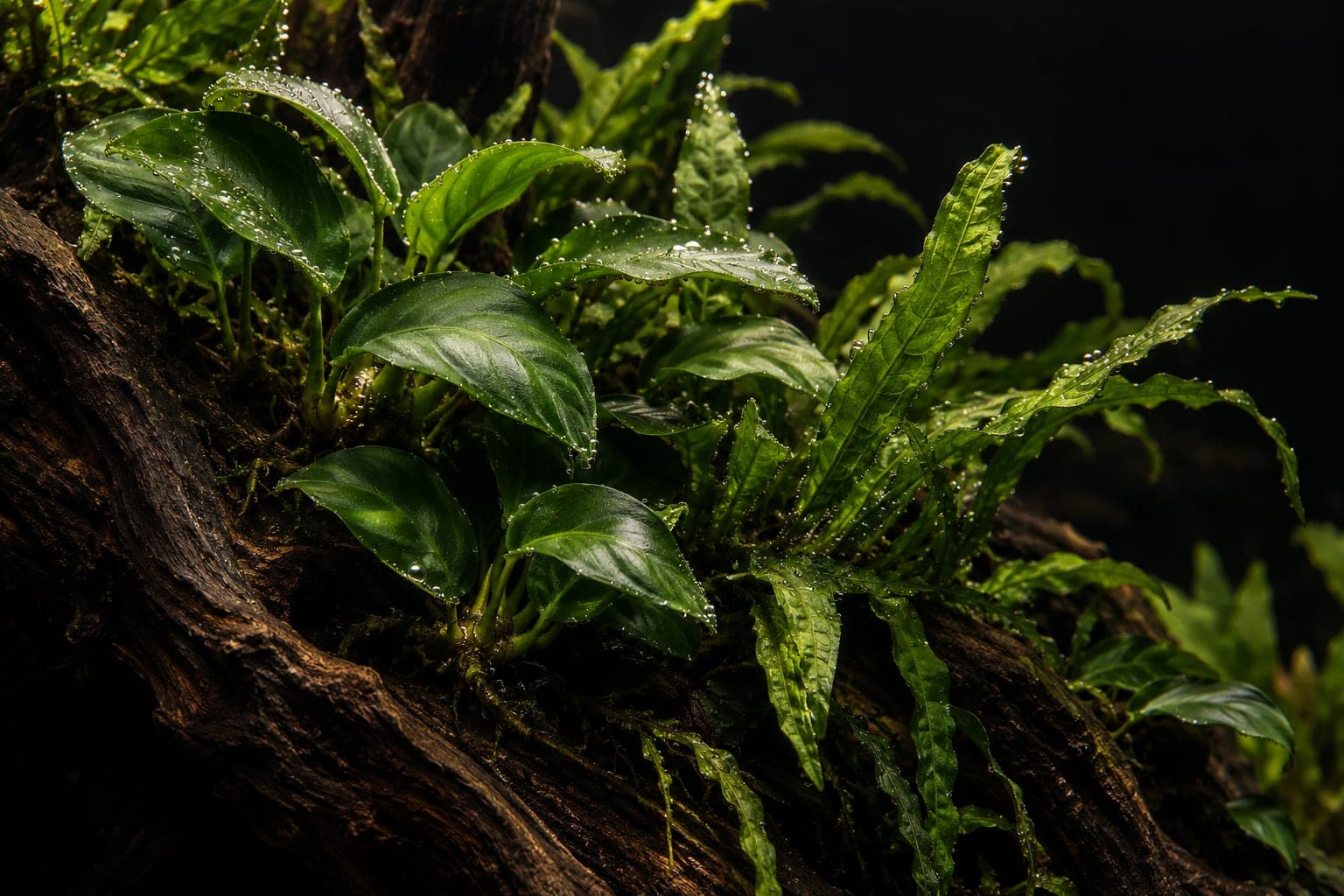
- Epiphytes, for the midground and decor. Anubias nana is an easy, slow-growing plant that's undemanding in terms of light. Attach it to a rock or root, without ever burying its rhizome, the thick stem the leaves grow from: it rots. The Tropica Anubias nana on wood is already attached to a piece of wood.
- Mosses, to soften the rock. Java moss attaches to rocks and roots, with fishing line while it takes hold. Trim it regularly to keep its shape.
- A foreground carpet. Micranthemum "Monte Carlo" forms a light-green carpet. Tropica states it gives its best results with moderate to strong light and CO₂, but that it survives in more modest conditions, growing more slowly. The Monte Carlo and Eleocharis in-vitro duo lets you try it.
For planting, Tropica recommends leaving just a few centimetres of water at the bottom and misting the plants while you work. Divide carpeting plants into small portions, spread across the whole area to be covered, and press them in with tweezers. For more, see our selection of easy CO₂-free aquarium plants.
The first eight weeks
Weeks 1 to 3. Tropica recommends limiting lighting to 6 hours a day for the first three weeks, with a timer. For new nutrient substrate, the manufacturer also recommends changing 25 to 50% of the water at least twice a week for the first four weeks. Remove any melting leaves: this is common while the plants adapt.
Weeks 3 to 6. Gradually extend the lighting, without exceeding 8 hours a day. The tank goes through the nitrogen cycle: bacteria establish themselves to convert toxic waste. Track nitrites with test kits, as explained in our guide to the nitrogen cycle. A brown film or a few filaments are common at this stage. Our guide to algae in a nano-aquarium will help you identify them.
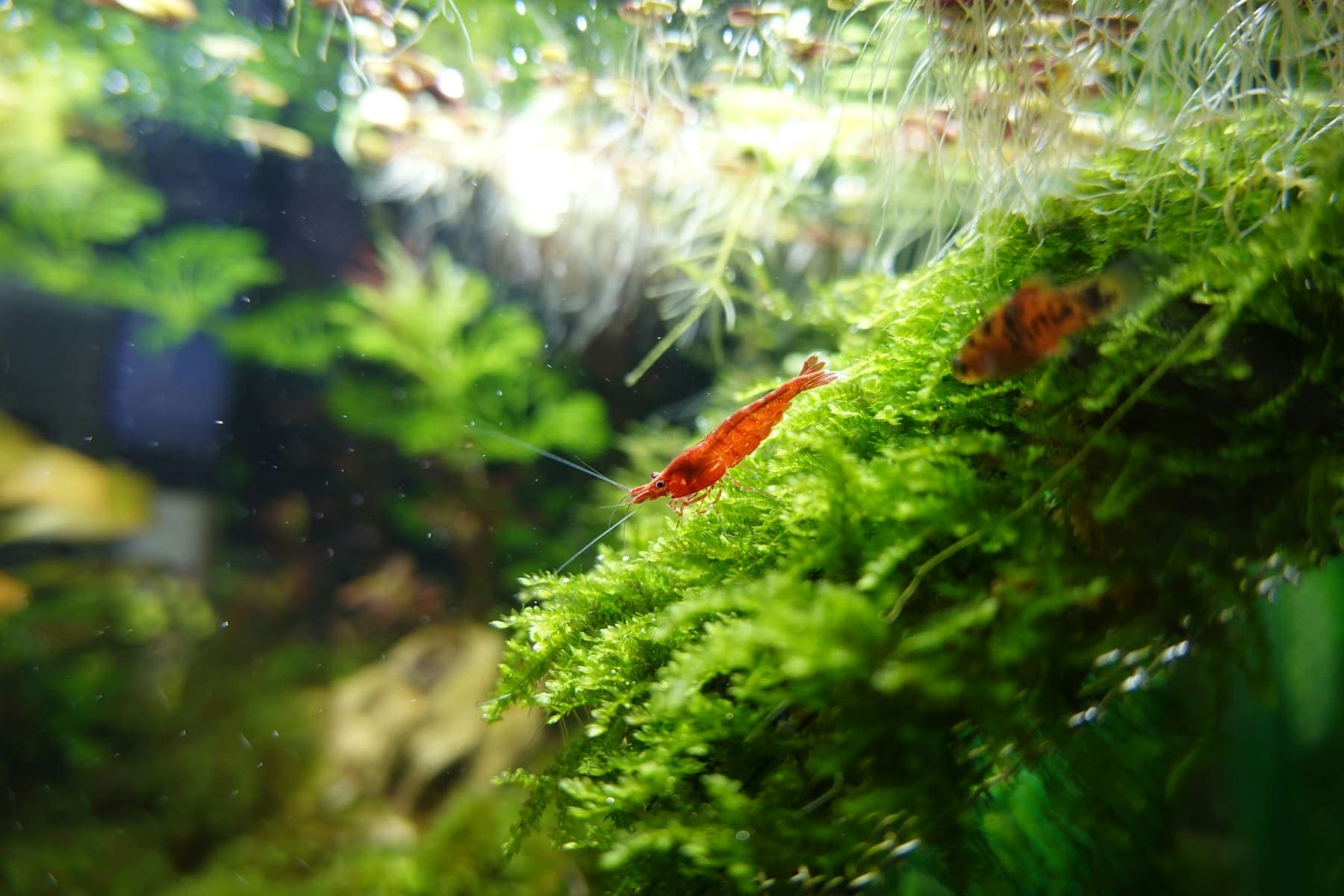
Weeks 6 to 8. First trims, first animals if the tests confirm it. In a 30-litre tank, Neocaridina shrimp are a good first choice: our comparison which shrimp for a nano-aquarium will help you. Introduce them in small numbers.
Common mistakes
- Too many rocks, too large. The tank looks smaller and there's no room left for plants.
- Full power from day one. A brightly lit nano without CO₂ favours algae.
- Too many plant species. The composition loses its clarity and each plant fights for its place.
- Burying the anubias rhizome. It rots within a few weeks.
- Animals before the cycle ends. Wait until tests confirm the absence of nitrites.
- Placing the tank in the sun. Even a few hours unbalances a small volume.
Rocks, substrates and tools can be found in our aquascaping section. And if you're still unsure about tank size, read our guide to 60-litre aquascaping.
Sources
Frequently asked questions
Can you make an aquascape in a 20-litre aquarium?
Yes, as long as you keep it simple: a single root or a few rocks, mosses and epiphytes, and very regular maintenance. The smaller the volume, the faster the water changes, so consistency matters even more.
Do you need CO₂ in a 30-litre aquascape?
No, not for easy plants like anubias and mosses, under moderate light. CO₂ becomes useful if you want a dense foreground carpet, which grows faster and denser with a CO₂ supply.
What animals can you put in a 30-litre aquascape?
Neocaridina shrimp are a good start, once the nitrogen cycle is finished. For fish, choose very small species suited to this volume, and check each one's needs before buying.
How long does it take for a nano-aquascape to look good?
Allow several weeks, and often a few months, before the plants cover the layout. Epiphytes and mosses grow slowly. The first few weeks are mainly for stabilising the water.