

Easy aquarium plants without CO₂: our selection for beginners
Anubias, Java fern and Java moss, cryptocoryne, floating plants: the plants that grow without CO₂ injection, and how to combine them in a small tank.
In this guide
Several aquarium plants grow very well without CO₂ injection: Anubias nana, Java fern, Java moss, Cryptocoryne wendtii "Green" and the floating plant Limnobium laevigatum. The grower Tropica classes them all as easy plants, with low light and CO₂ requirements. What they have in common: slow to moderate growth, which makes do with the CO₂ naturally present in the water. Here's how to choose, set up and combine them.
Why can some plants do without CO₂?
All plants use carbon dioxide for photosynthesis. In an aquarium without injection, the water already contains a little: it comes from the respiration of animals and bacteria, and from exchanges with the air at the surface. This amount is small, but it's enough for slow-growing species.
Fast-growing plants, and especially carpeting foreground plants, need much more. Tropica gives some benchmarks: a medium requirement corresponds to around 10 to 15 mg of CO₂ per litre, a high requirement to 15 to 30 mg per litre. Without injection, you stay below that. Hence the value of choosing species classed as "low requirement".
The real secret to a CO₂-free tank is balance. Strong light makes plants want to grow fast; without CO₂, they can't keep up, and it's the algae that benefit from the light and nutrients. Our guide on algae in a nano-aquarium covers this mechanism in detail.
Epiphytes to attach: anubias, fern and moss
An epiphyte is a plant that grows attached to a support, a rock or a root, rather than planted in the substrate. It's the easiest family to start with.
Anubias nana
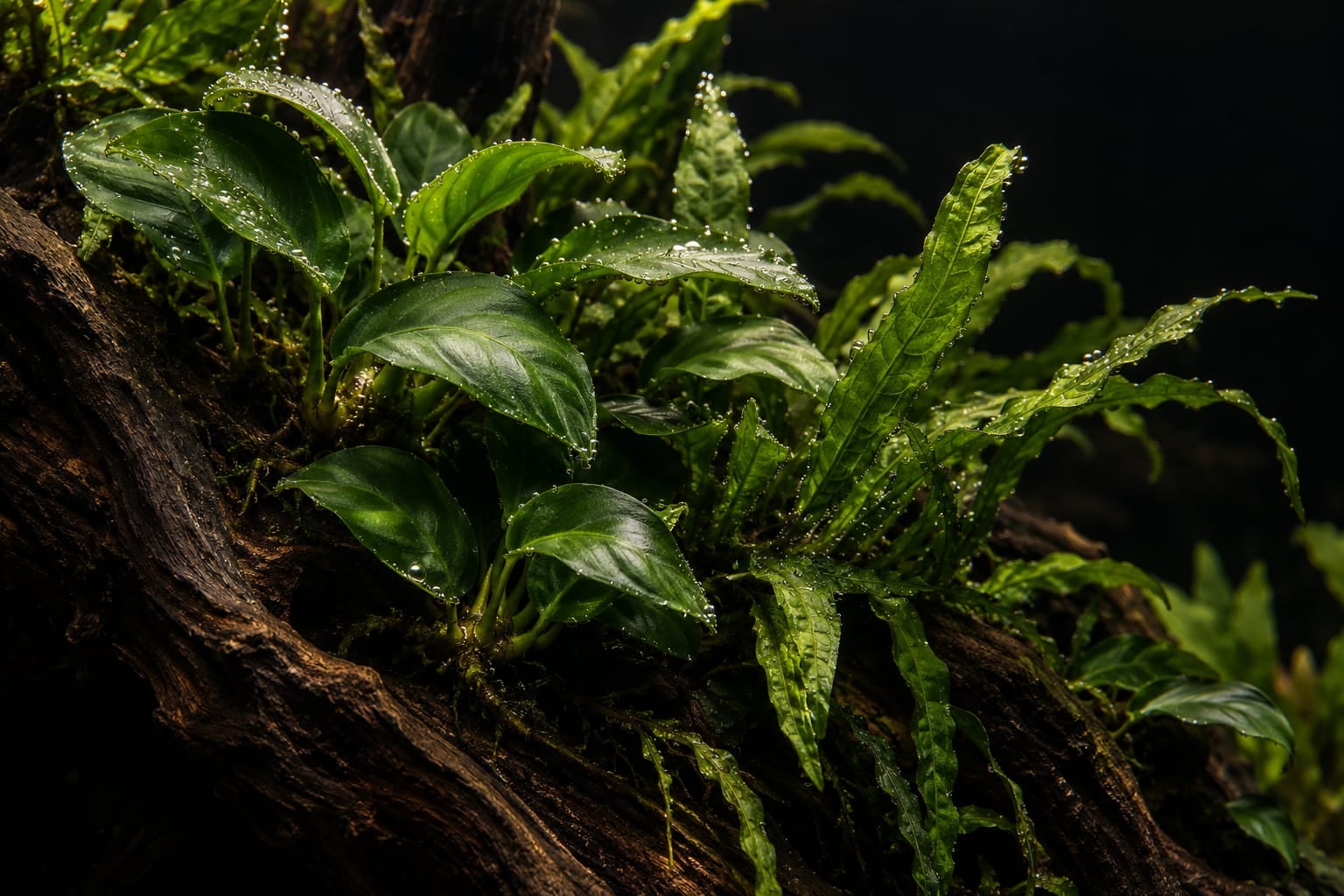
Native to Cameroon, Anubias barteri var. nana stays small: around 5 to 15 cm tall, sometimes more, according to Tropica. It grows slowly, tolerates shady spots where other plants fail, and even flowers underwater. Its thick leaves aren't eaten by herbivorous fish.
Two rules for success:
- Attach it to a rock or root, with fishing line while it takes hold.
- Never bury its rhizome, the horizontal stem from which leaves and roots grow: buried in the substrate, it rots.
Its slowness has a downside: its leaves live a long time and algae can settle on them. Moderate light limits this risk.
Java fern
Microsorum pteropus comes from Asia and reaches 15 to 30 cm, sometimes more. Tropica classes it as easy, slow-growing. It attaches like anubias, with fishing line, and its rhizome must likewise not be buried. The black dots that appear under its leaves aren't a disease: they're its reproductive organs. It's propagated by dividing the rhizome.
Java moss
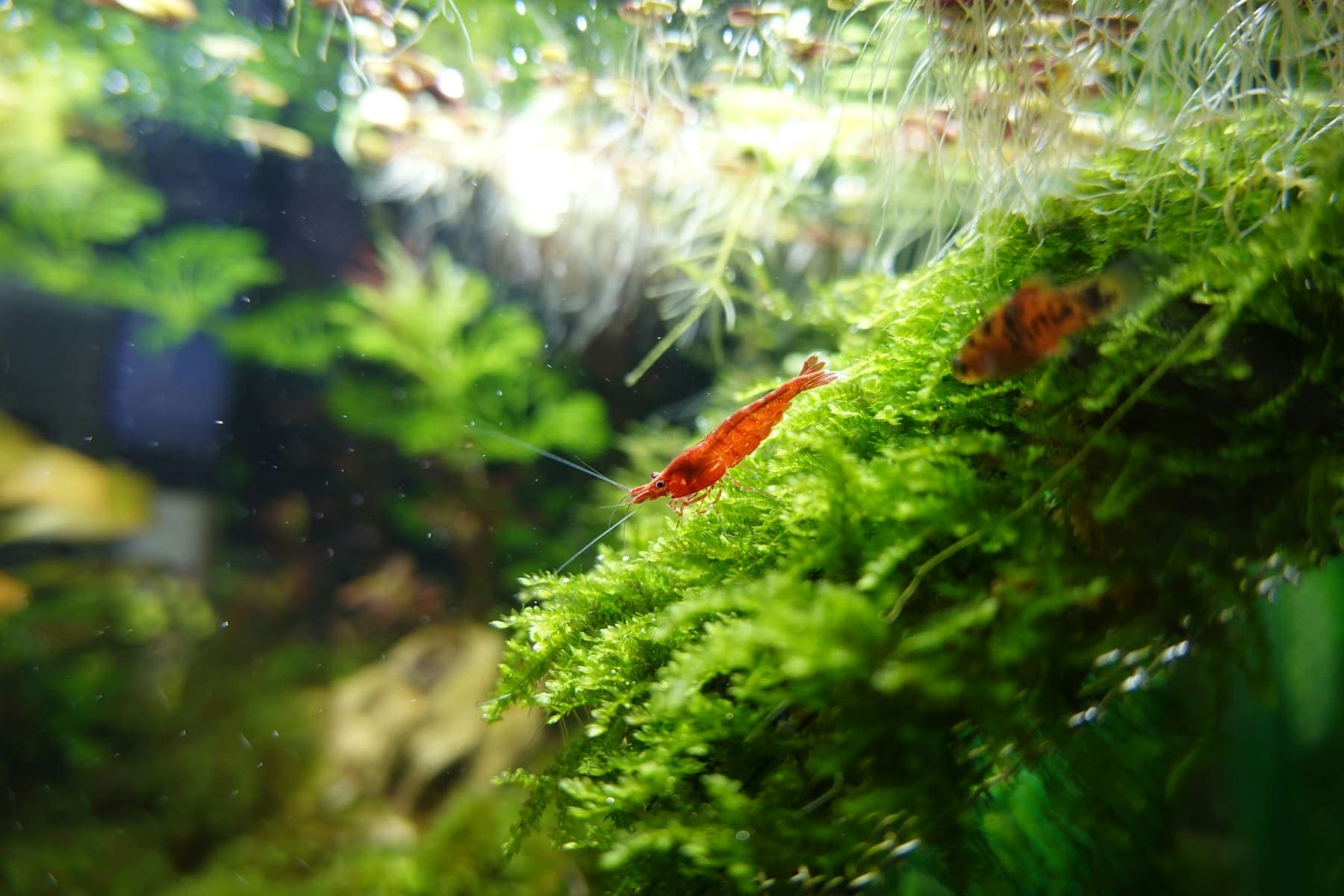
Taxiphyllum barbieri forms a cushion 3 to 10 cm thick. It clings to almost anything: rocks, roots, décor. Tie it on with fishing line or cotton thread while it takes hold, then trim it with scissors if it becomes too bushy. In a tank with shrimp or fry, it provides a much-appreciated refuge.
Easy rooted plants
If you also want plants in the substrate, cryptocorynes are the classic choice. Cryptocoryne wendtii "Green" is classed as easy by Tropica, with low light and CO₂ requirements. It forms a rosette of green leaves, thrives even in the shade of larger plants, and grows well in hard water. In an open space, its leaves spread almost flat across the bottom.
Unlike epiphytes, a cryptocoryne draws much of its nutrition through its roots. A nutrient-rich substrate helps it settle in: our guide Which substrate for a planted aquarium? compares the options.
Floating plants
Limnobium laevigatum, native to South America, forms rosettes of round leaves at the surface and trails long, fine roots. Tropica classes it as easy, with low light and CO₂ requirements. Its leaves, in contact with the air, don't have to draw all their CO₂ from the water, which gives it an advantage in a tank with no injection.
It provides two benefits:
- It competes with algae by using up nutrients dissolved in the water.
- It acts as an indicator: when its growth slows down noticeably, the water is running low on nutrients.
Remove the excess regularly: if it covers the whole surface, the plants underneath lack light. And never throw the surplus into a pond, pool or waterway: it's an exotic plant, which has no place in the wild.
Which plants to combine in a 30-litre tank?
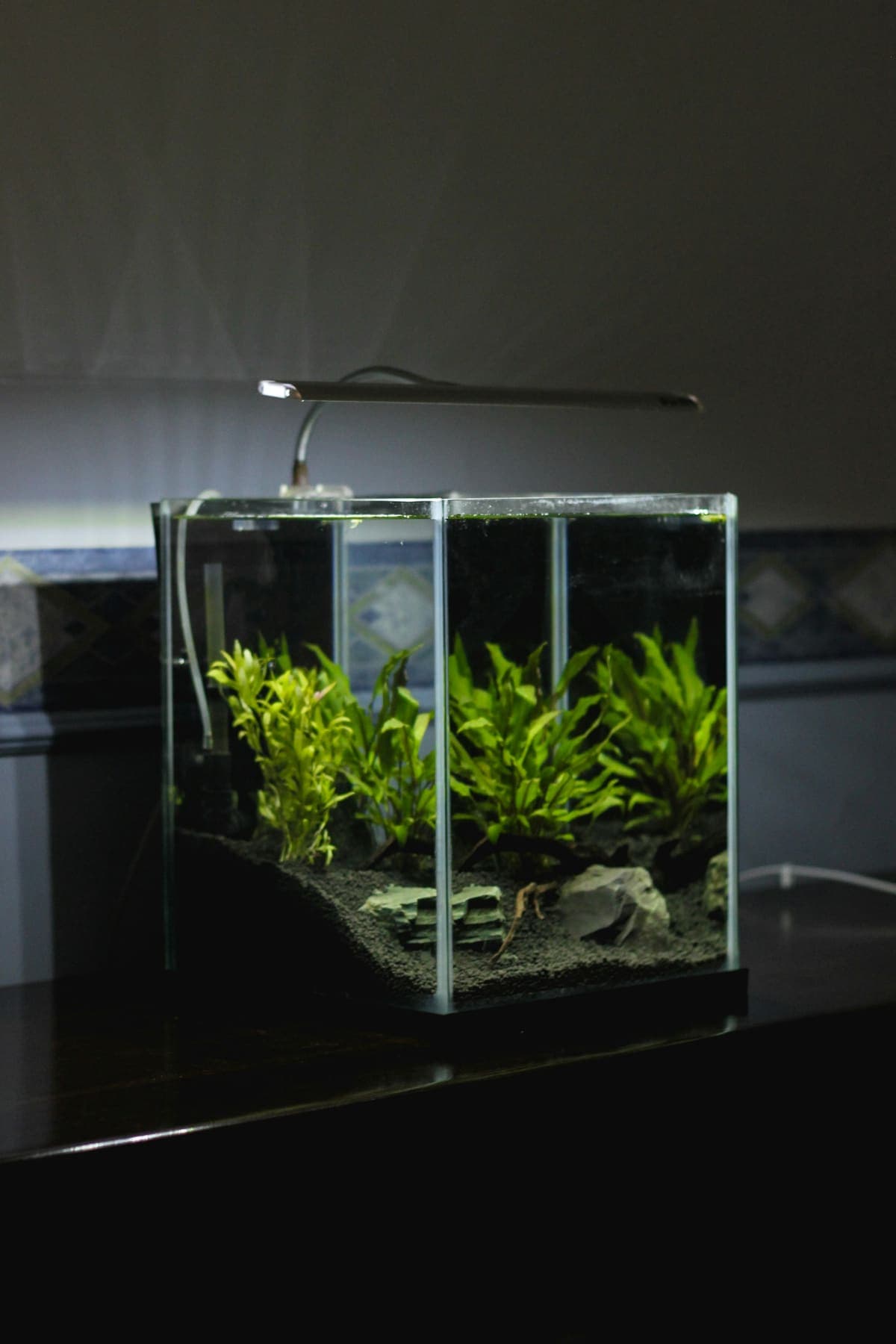
Here's a simple, CO₂-free planting scheme for a nano-aquarium of around 30 litres:
- The décor first. A root and a few rocks provide the structure.
- In the middle, on the décor. One or two Anubias nana attached to the base of the root, a Java fern on a rock towards the back, for height.
- On the branches. A few tufts of Java moss, which will soften the lines within a few months.
- On the substrate, at the sides. Two or three cryptocorynes, spaced out so they can spread.
- At the surface. A few Limnobium rosettes over only part of the surface, to keep some light coming through.
Set moderate lighting and avoid direct sunlight. Our guide Which lighting for a planted aquarium? helps you find the right level, and Setting up a 30-litre aquascape covers the composition in detail.
In-vitro or potted plants: which to choose?
Many easy plants are sold in two forms: potted, with rockwool around the roots, or "in vitro", in a small sealed pot containing a nutrient gel. Tropica's 1-2-Grow in-vitro plants are very young plants produced in a laboratory. The grower guarantees them free of snails, algae and pesticides, which makes them safe for shrimp and sensitive fish.
Their only drawback is their starting size. An in-vitro portion looks modest on planting day and takes a few weeks to establish. Before planting, gently remove the gel around the roots by rinsing it off in water: left in the tank, it breaks down. Then divide the portion into small tufts, to attach or spread around in several spots.
Common mistakes
- Burying the rhizome of an anubias or a fern: it rots.
- Lighting too brightly and for too long: without CO₂, excess light mainly feeds algae.
- Overdosing fertiliser: whatever the slow plants don't absorb also benefits the algae.
- Covering the whole surface with floating plants: the plants below become leggy.
- Choosing demanding carpet plants hoping they'll adapt: without CO₂, they just sit there.
- Being impatient: these plants grow slowly, and that's what makes them easy.
Equipment to get started
These three plants are enough to start a first CO₂-free tank. The Anubias comes already attached to a piece of mangrove wood, and both the Java moss and the Limnobium are grown in vitro by Tropica.
These plants feature in the project A nano shrimp tank, a simple, CO₂-free planted aquarium designed for beginners.
All our plants are presented in the aquatic plants section.
Sources
Frequently asked questions
Can a planted aquarium without CO₂ still look good?
Yes, provided you choose slow plants and accept that it will fill in over a few months rather than a few weeks. Anubias, ferns, mosses and cryptocorynes allow for very dense tanks.
Can you plant an anubias in sand or gravel?
Its roots can go down into the substrate, but its rhizome must stay clear, never buried, or it will rot. The simplest approach is to attach it to a rock or root.
Can you add CO₂ later to an easy planted tank?
Yes. Easy plants tolerate it and then grow faster. However, you need to increase light and fertilising gradually at the same time, and keep an eye on the animals, especially shrimp.