

60-litre aquascaping: choosing the tank and composing your landscape
The 60-litre is many aquascapers' favourite format. Tank, style, hardscape, plants, filtration and lighting: everything you need to get it right.
In this guide
For a 60-litre aquascape, choose a tank around 60 cm long, in extra-clear glass, placed on furniture designed for its weight. Build a hardscape from a single type of rock, on a nutrient substrate that's thicker at the back. Add an external filter sized for this volume, an LED light bar the same length as the tank and adjustable, and plants chosen according to the light available. This format offers enough space for real perspective and enough water to forgive small mistakes. Here's how to approach it.
Why is the 60-litre such a good format?
Length creates depth. With a 60 cm front, you can place a main subject, secondary elements and a breathing space. That's hard to do in a 30 cm cube, where everything happens within a few centimetres.
Volume stabilises the water. Twice as much water as a nano means twice as much margin: overfeeding or a hot day dilutes further. Our guide getting started with aquascaping actually recommends a tank of 30 to 60 litres for a first project.
Maintenance stays reasonable. A water change can still be done with a bucket, and you can reach the bottom of the tank with long tweezers.
The trade-off is weight. A litre of water weighs about one kilogram, plus the glass, substrate and rocks. A full 60-litre aquarium doesn't go on an ordinary shelf.
Which tank should you choose for a 60-litre aquascape?
Dimensions
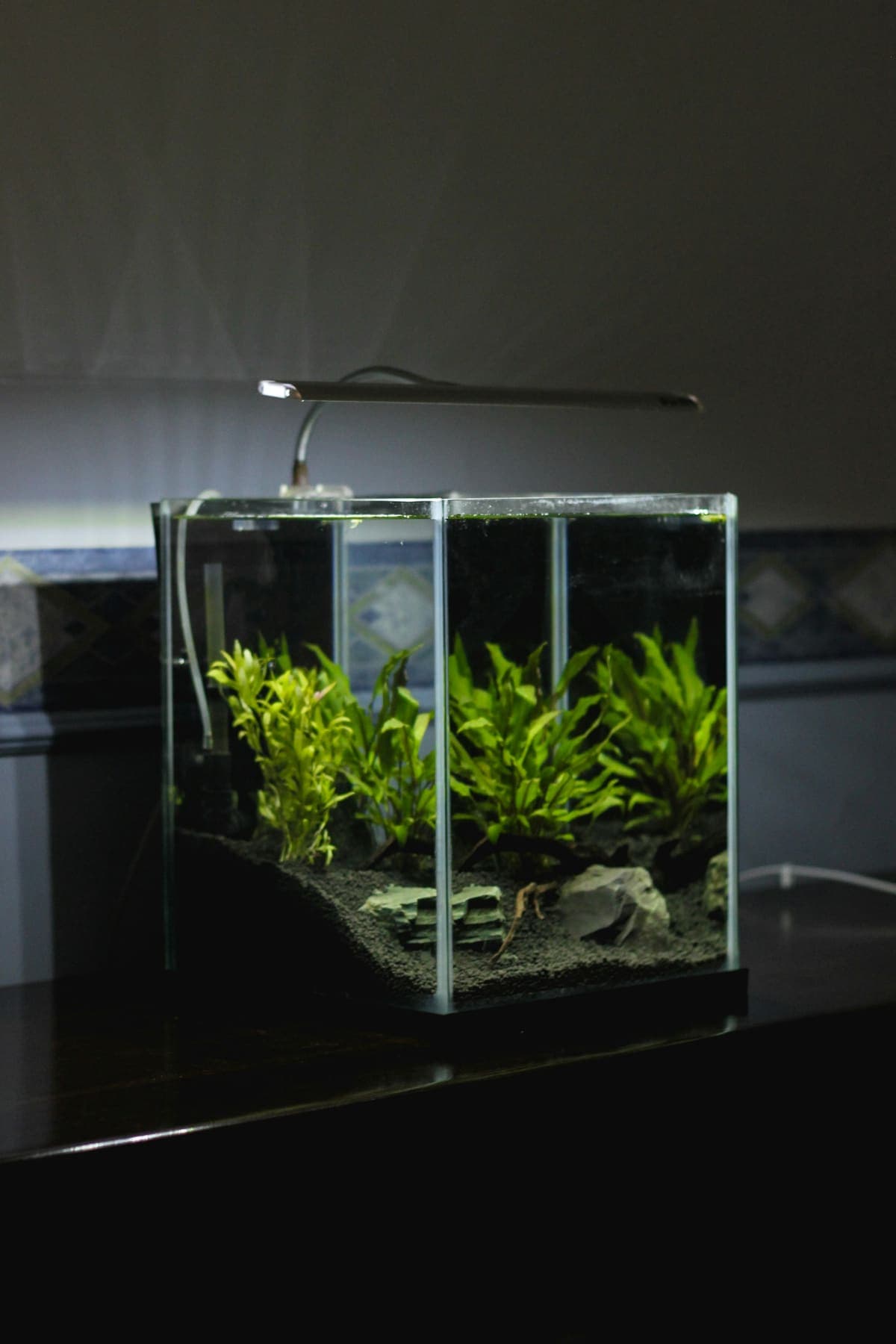
The 60 × 30 × 36 cm format is a classic. Its 30 cm depth leaves room for a foreground, midground and background. Its moderate height makes lighting easier: light reaches the substrate without needing a very powerful bar. A taller tank, at 45 cm, holds more water but needs more light for the plants at the bottom and longer arms for maintenance.
Glass and finish
Extra-clear glass, known as Opti-White, renders colours without the greenish tint of ordinary glass. A frameless tank, with polished edges, shows the landscape off well. Place it on a protective mat, on perfectly flat furniture: a hard point under the bottom pane can weaken it.
Which style for a 60-litre tank?
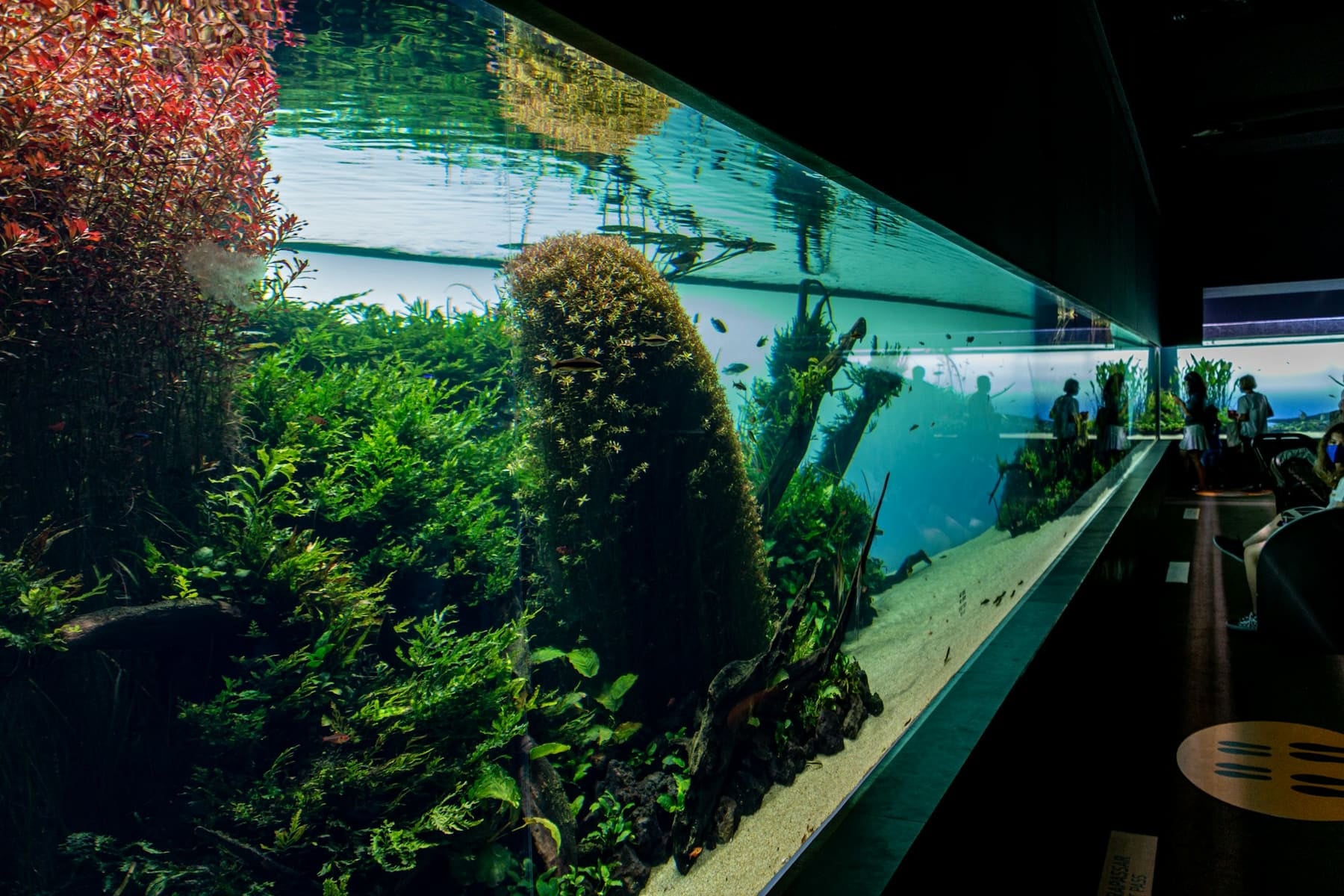
- The "nature" style. It recreates a terrestrial landscape, a hill or a riverbank, with rocks, wood and plants mixed together. The 60 cm length lets you create a real slope and a path leading towards the back.
- Iwagumi. A few stones, one main stone placed off-centre, and a carpeting plant. In 60 cm, you can compose a main group and a secondary group that interact. It's the style that demands the most rigour on light and CO₂.
- The "jungle" style. A central root, plants spilling over. It's more forgiving and suits a CO₂-free tank well.
Choose before buying the rock and plants: the style determines the quantities.
How do you build the hardscape?
The substrate
Tropica's formula lets you calculate the quantity: length × width × depth, in centimetres, divided by 1,000. For a 60 × 30 cm tank with an average depth of 6 cm, you need about 10.8 litres of substrate. A 9-litre bag is therefore a little short: it's enough for an average layer of 5 cm, with a moderate slope. Tropica recommends building up the layer towards the back pane, for the sense of depth. The Tropica Aquarium Soil, 9-litre bag can be used on its own, without another layer.
Rocks and wood
Work dry, with the tank empty. Place the main element first, around a third of the way along the length, then the secondary rocks, of different sizes, veins oriented the same way. Bury each rock by a third: it looks like it's growing out of the substrate and stays stable.
There's no fixed rule for how much rock to use: a jungle style needs little, an iwagumi that spans the length needs much more. Present the composition dry before buying extra. Dragon Stone (Ohko), with its very jagged texture, suits mountain landscapes well. Brush and rinse it in clean water to remove clay.
A root needs pre-soaking: it must stop floating, and it releases tannins that tint the water amber.
Which plants for a 60-litre aquascape?
Split the planting into layers, and plant densely from the start.
- At the back: stem plants that grow fast and hide the equipment. They consume a lot of nutrients and leave less room for algae.
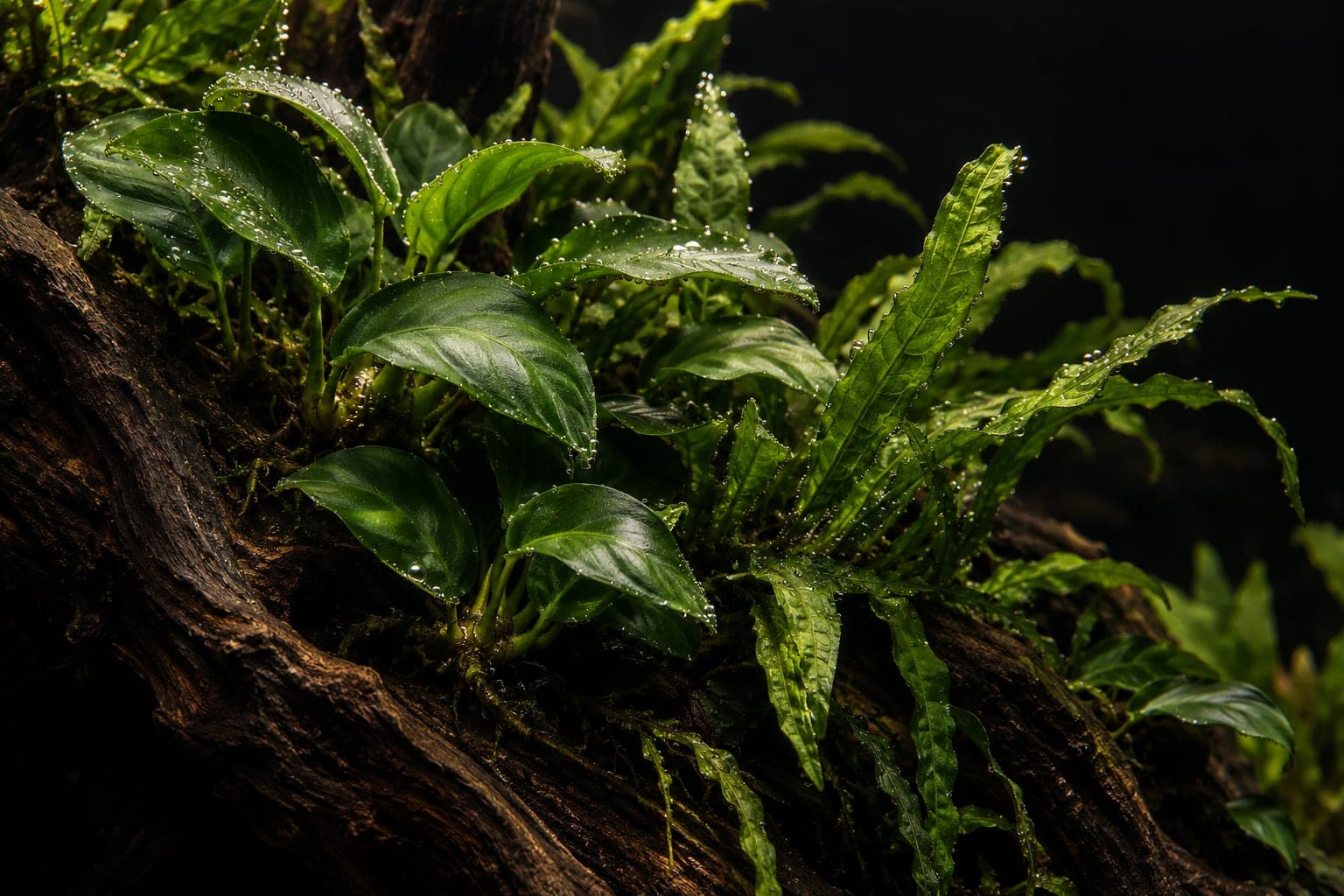
- In the middle: epiphytes like anubias nana and mosses, attached to rock or wood. These are easy, low-light plants.
- In the foreground: small tufts or a carpet. Micranthemum "Monte Carlo" gives its best results, according to Tropica, with moderate to strong light and CO₂. It survives without, but grows more slowly. The Monte Carlo and Eleocharis in-vitro duo lets you compose this foreground.
Without CO₂, stick to slow, hardy plants: our selection of easy CO₂-free aquarium plants will help you choose.
Equipment: filter, lighting and CO₂
Filtration
The filter hosts a large part of the bacteria that break down waste. For a 60-litre tank, an external filter is comfortable: it frees up space in the tank and stays quiet. EHEIM states that its classic 150 suits aquariums of around 50 to 150 litres, with a flow rate of 300 litres per hour and one litre of filter media. Angle the outlet to create a gentle current that circulates throughout the tank, without uprooting plants.
Lighting
Choose a light bar the same length as the tank. Chihiros states that its 60 cm WRGB II Slim is designed for tanks from 60 to 80 cm and produces 2,400 lumens for 45 W. On a 64-litre tank, that's around 37 lumens per litre at full power. Tropica classes 10 to 20 lumens per litre for easy plants, 20 to 40 for medium plants, and more than 40 for the most demanding. Without CO₂, reduce the intensity from the app. Our guide which light for a planted aquarium covers duration and settings in detail.
CO₂
It isn't essential for a jungle style or easy plants. It becomes useful for a dense carpet and demanding plants, with stronger light. The EHEIM CO2Set400 CO₂ kit is a good starting point if you choose this route.
The first weeks of a 60-litre tank
The method is the same as for a small tank, with a little more margin: short lighting at first, frequent water changes while the nutrient substrate is new, and no animals before the end of the nitrogen cycle. For new nutrient substrate, Tropica recommends changing 25 to 50% of the water at least twice a week for four weeks. If algae appear, our guide to algae in a nano-aquarium applies to this volume too.
Common mistakes
- Undersized furniture. A full 60-litre tank weighs far more than its water volume.
- Not enough substrate. A layer that's too thin at the back flattens the landscape.
- Two types of rock. The composition loses its unity.
- A light bar that's too short. The ends of the tank stay in shadow.
- Full light without CO₂. It's the most direct route to algae.
- Too strong a current. It uproots young plants and stirs up the substrate.
Prefer a more compact format? Our guide to aquascaping in a 20 to 30-litre nano-aquarium adapts the method. Rocks, substrates and tools are gathered in the aquascaping section.
Sources
Frequently asked questions
60-litre aquarium or 30-litre nano to start aquascaping?
A 60-litre tank forgives more, since a larger volume of water changes more slowly. A 30-litre tank costs less and takes up less space, but demands more consistency. If you have the room and suitable furniture, the 60-litre is more comfortable.
Do you need a heater in a 60-litre aquascape?
It depends on the animals planned and the temperature of the room. Every fish or shrimp species has its own temperature range: check it before buying, and watch a thermometer over several days to see whether your room stays within that range.
How many plants should you buy for a 60-litre aquascape?
There's no fixed number: it all depends on the style and the amount of rock. The principle is to plant densely from the start, with few different species, so the plants occupy the ground before the algae does.
Can you put a 60-litre aquarium on ordinary furniture?
Only if it's designed to bear that weight: the water alone weighs about 60 kg, not counting the glass, substrate and rocks. Check the furniture's load capacity and flatness before filling the tank.