

What light for a planted aquarium? Choosing the right LED bar
Intensity in lumens per litre, spectrum, lighting duration and the link with algae: the benchmarks for choosing and setting your planted aquarium's LED light.
In this guide
A planted aquarium needs an LED light the length of the tank, with light close to daylight, and an intensity matched to the plants you've chosen. Tropica gives a simple benchmark: 10 to 20 lumens per litre for easy plants, 20 to 40 for medium plants, more than 40 for the most demanding. On duration, the same manufacturer advises 6 hours a day for the first three weeks, then 8 hours maximum, with a timer. Beyond that, you're mainly feeding the algae. Here's how to choose and set your lighting.
How much light do your plants need?
Think in lumens, not watts
Watts measure electricity consumed. Lumens measure light produced. With LEDs, two lights of the same wattage can light very differently. Tropica therefore recommends looking at lumens and relating them to the tank's volume.
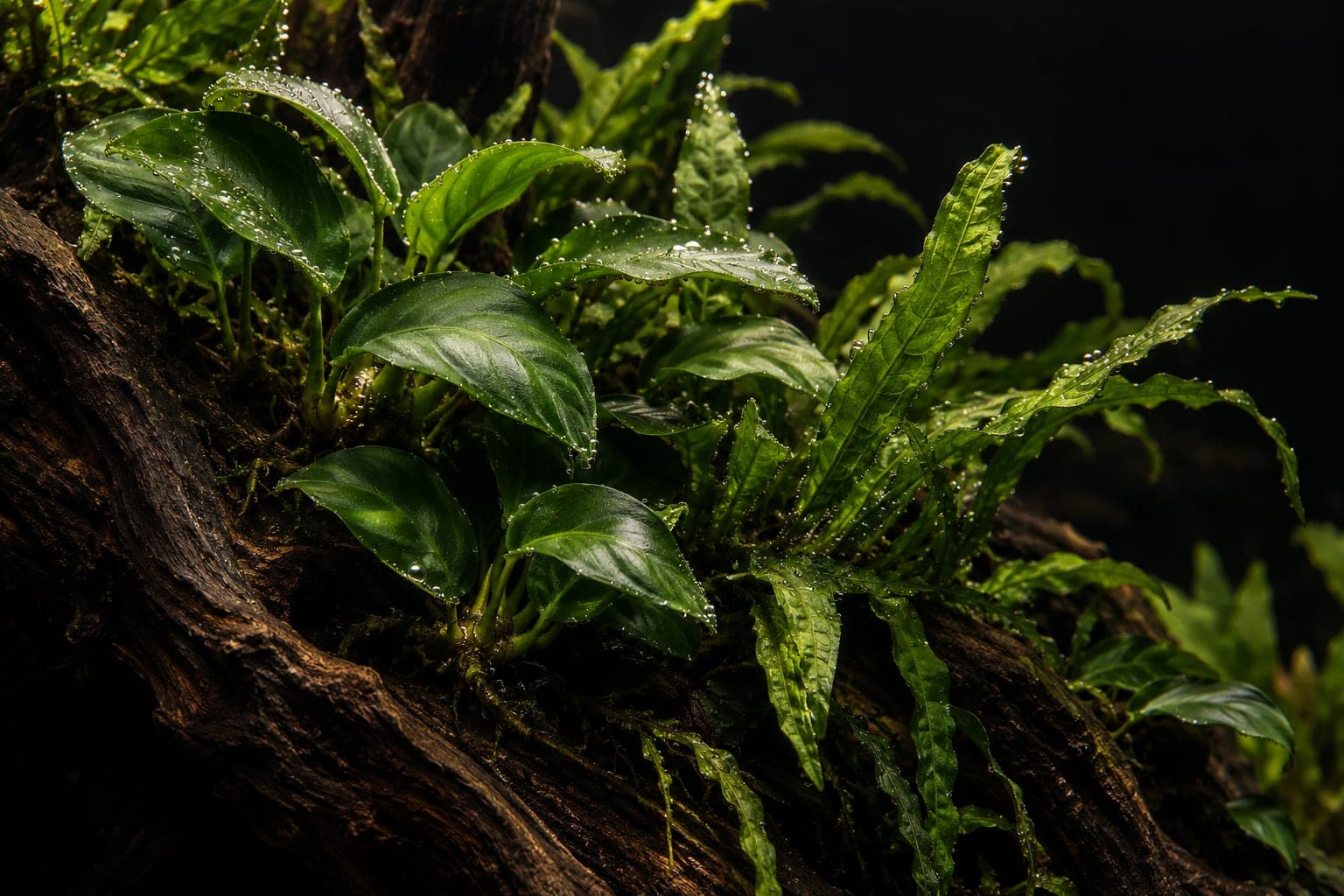
- Easy plants (anubias, mosses, floating plants): 10 to 20 lumens per litre.
- Medium plants (many stem plants, some carpeting plants): 20 to 40 lumens per litre.
- Demanding plants: more than 40 lumens per litre.
Two worked examples
Chihiros states that its 30cm WRGB II Slim produces 1,200 lumens. On a 30-litre nano aquarium, that's around 40 lumens per litre at full power. The 60cm model produces 2,400 lumens: on a 64-litre tank, around 37 lumens per litre.
These two lights are therefore more than adequate for medium plants. For a tank of easy plants without CO₂, you'd need to turn them down. That's the whole point of a dimmable light: start low, increase if the plants call for it.
This calculation remains a rough guide. Light loses strength as it passes through water, and a tall tank gets less light at the bottom than a shallow tank of the same volume.
What spectrum should you choose for a planted aquarium?
Light close to daylight
Tropica recommends a colour temperature of 5,500 to 6,500 kelvin, close to daylight. Above 8,000K, the light looks bluish; below 4,000K, it leans towards yellow or red. The manufacturer also recommends a colour rendering index (CRI) of at least 90: the higher it is, the more natural the colours of plants and animals appear.
RGB lights
Many planted-aquarium lights combine white LEDs with red, green and blue ones. You then adjust each colour separately, often from an app. This setting brings out the red in certain plants and the green of the carpet. Stay measured: overly coloured light distorts your perception of the tank and can mask the early signs of a deficiency.
Aquasabi also notes that red light is absorbed quickly by water, while blue penetrates further. In a tall tank, the plants at the bottom therefore receive different light from those at the surface.
How many hours of lighting per day?
At start-up: 6 hours a day for the first three weeks, according to Tropica. The plants are adjusting, the substrate is releasing nutrients, and algae take advantage of the slightest excess of light.
After that: gradually extend, up to 8 hours a day maximum, still according to Tropica. Aquasabi cites 8 to 10 hours for "nature style" aquariums. Reserve these durations for a stable tank where the plants are growing well.
If algae appear: Aquasabi advises going back to around 6 hours a day.
In every case, use a timer. A consistent duration every day matters as much as the duration itself. And the night must stay dark: plants and animals alike need a genuine day-and-night cycle.
What's the link between light and algae?
Light drives plant growth. But a plant can only use more light if it also has enough CO₂ and nutrients. When light exceeds what the plants can use, algae take over. That's why high intensity without CO₂ or fertilisation almost always favours algae.
Three habits limit the risk:
- Match intensity to the plants, not the other way round.
- Start short and low, then increase in small steps, one at a time.
- Remove direct sunlight. Even an hour of sun on the glass is enough to unbalance a small tank.
Floating plants help too. They consume nutrients and provide a little shade. Tropica notes, though, that they need thinning out regularly, so the plants underneath still get light. If algae have already taken hold, our guide to algae in a nano aquarium helps identify the cause.
How to choose an LED aquarium light
- Length. The light should span the tank from end to end. Manufacturers give a range of tank lengths for each model.
- Lumens. Relate them to your tank's volume and compare against Tropica's benchmarks.
- Adjustability. A variable intensity and a built-in schedule are essential for starting low and keeping a consistent duration.
- Height. Aquasabi shows that the higher the lamp sits above the water, the more the light spreads out and the less intense it is at the centre. Suspending the light lets you adjust it without touching the settings.
- Protection from moisture. The light sits above the water: check it's designed for aquarium use and install it away from splashes.
- Open or covered tank. A glass lid filters out some of the light and mists up: an open tank makes better use of the light.
The gear
The Chihiros WRGB II Slim is adjusted via Bluetooth from an app. According to the manufacturer, the 30cm model suits tanks from 30 to 45cm (23W, 1,200 lumens), the 45cm model suits tanks from 45 to 60cm (35W, 1,800 lumens), and the 60cm model suits tanks from 60 to 80cm (45W, 2,400 lumens). Check the length listed on the product page before ordering.
If you're aiming for demanding plants and strong light, CO₂ becomes the logical complement: it lets the plants make use of that light instead of leaving it to the algae.
An easy floating plant that's undemanding on light according to Tropica, Limnobium helps balance a young tank.
Filters, lighting and CO₂ are all together in our equipment section.
Common mistakes
- Full power straight from installation. The first month is when algae take hold most easily.
- Extending the duration to "grow faster". Beyond what the plants can use, only algae benefit.
- Switching on and off by hand. Missed switches create irregular days.
- Choosing on watts. Look at the lumens and the length range given by the manufacturer.
- A light that's too short. The ends stay in shadow and the plants there struggle.
- Changing several settings at once. You won't know which one worked.
To put together the tank that will sit under this light, read our guide to a 20–30 litre nano aquascape or our guide to 60-litre aquascaping. And for plants happy with moderate light, see our selection of easy aquarium plants without CO₂.
Sources
Frequently asked questions
How many watts per litre for a planted aquarium?
Tropica still gives an equivalence of 0.25 to 0.5 watts per litre for easy plants, but that rule dates from fluorescent tubes. With LEDs, rely on lumens instead: 10 to 20 lumens per litre for easy plants.
Can I leave my aquarium light on for 12 hours a day?
It's not advisable. Tropica recommends 8 hours maximum once the tank is established, and Aquasabi cites 8 to 10 hours for "nature style" aquariums. A longer duration mainly benefits algae.
Is sunlight enough for a planted aquarium?
No, it's impossible to control. Direct sun heats the water and favours algae, especially in a small tank. Place the aquarium away from sunny windows and light it with a timed light bar.
Should I turn off the aquarium light at night?
Yes. Plants and animals alike need a regular alternation of day and night. A timer guarantees the same schedule every day, even while you're away.