




Protecting a nest box from predators: cat, woodpecker, marten
A nest box is protected by putting it out of reach, never by going after the predator. Height and siting, a reinforcing plate around the hole, enough depth below the entrance, and the calendar of the work, all of it outside the breeding season.
In this guide
Protecting a nest box means making it impossible to get into, never going after the animal that takes an interest in it. Three measures cover the essentials: put the box up at least 2 m from the ground, well away from any horizontal branch that would act as a bridge; reinforce the entrance hole with a metal plate drilled to the right diameter; and keep at least 15 cm between the hole and the floor, so that the nest stays out of reach. All this work is done in autumn or winter, on an empty box.
Who takes an interest in a nest box, and how
Every predator has its technique, and each one calls for a different answer.
- The domestic cat watches the parents coming and going, jumps from a branch or a low wall and catches the bird in passing. It rarely reaches the brood itself, but an adult killed while the young are being raised usually condemns the clutch.
- The great spotted woodpecker and the red squirrel enlarge the entrance hole with beak or teeth, until they can get a head or a paw through.
- The beech marten, the pine marten and the rat climb up a trunk or a wall and slide a paw through the opening to reach what is inside the box.
- The magpie and the jay land on a perch or a ledge and probe the entrance with their beak.
The great spotted woodpecker and the red squirrel are protected species. There is therefore no question of keeping them out by any means other than making the box resistant, and the same goes in principle for all the others: predation is part of how a living garden works. This guide is only about the strength and the siting of the box.
The calendar: everything is done on an empty box
This is the rule that comes before all the others. No work on an occupied box, not even to fit a protective plate, not even "just to check". Disturbance can lead the parents to abandon the clutch, and the order of 29 October 2009 forbids deliberate disturbance of protected birds, particularly during the breeding season.
The working window is therefore the same as for the annual clean: from the end of September to October, once the last broods have flown, and on through the winter. A box reinforced in autumn also has time to be spotted by birds before spring. The cleaning method, to be carried out at the same time, is described in Cleaning a nest box.
If a predator has shown up in the middle of the season, the only acceptable response is to watch from a distance with binoculars, and to note what will have to be put right the following autumn.
Against cats: siting comes first
A well-placed box settles most of the problem.
The height. At least 2 m in a garden, more if the target species allows: the LPO gives 2 to 5 m for the blue tit and 2 to 6 m for the great tit.
The clear space. No horizontal branch, no stake, no cable, no wall top in the immediate surroundings of the entrance. A cat jumps a great deal further than you would think; what counts is that there is no launching point level with the box.
The trunk. On an isolated tree, a smooth metal collar fitted round the trunk, set well above the ground and covering a band at least 50 cm deep, stops anything climbing. It has to be loosened regularly so that it does not strangle the tree, and it is no use at all if a low branch or a neighbouring hedge allows it to be bypassed.
As for the animal itself, bird protection organisations advise keeping cats indoors at dawn and dusk, the times when they hunt most, and particularly from March to August, while the young are being raised. How well a bell on the collar works is still debated, and it excuses none of the precautions above.
Against woodpeckers and squirrels: reinforce the hole
An entrance hole a few millimetres wider changes everything: it lets larger species in, and sometimes a paw.
The answer is mechanical. A metal plate drilled to the exact diameter of the hole, screwed to the front, stops the entrance being widened. The LPO recommends it anywhere woodpeckers, squirrels or garden dormice are present. The drilled diameter has to match the target species: 26 to 28 mm for the blue tit, 25 to 27 mm for the coal tit, 32 mm for the great tit.
Two details also help:
- Solid, thick wood, about 2 cm and never less than 1 cm, resists far better than plywood. Oak and larch are common choices.
- A roof with a generous overhang, which stops an animal sitting on it from reaching the entrance from above.
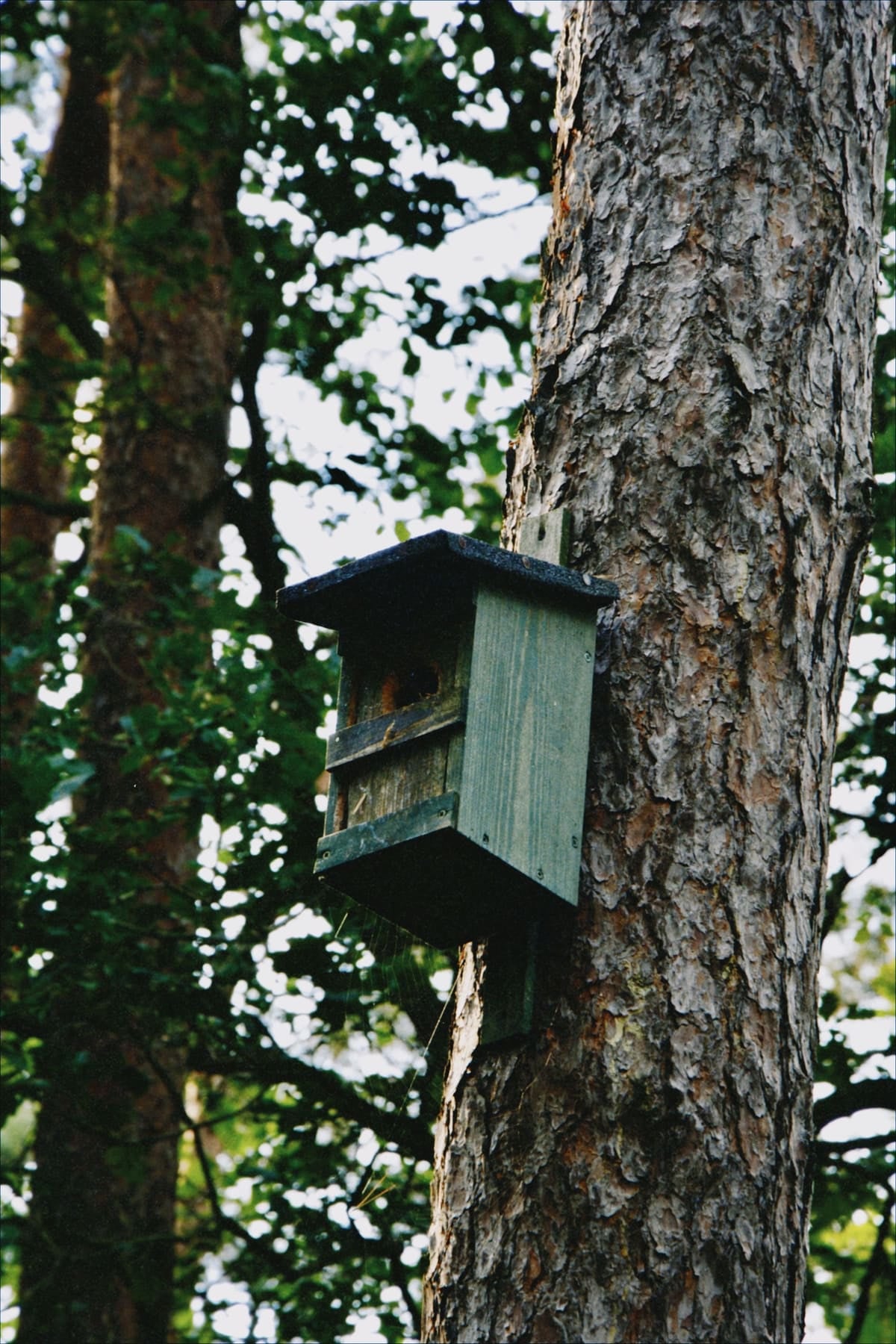
This model shows the two points that matter: walls of 20 mm and a hole set 17 cm above the floor, beyond the minimum of 15 cm advised by the LPO. Choosing the diameter by species is set out in Which nest box to choose?.
Against martens and climbers: depth
A predator that has reached the front of the box tries to get a paw through the hole. What stops it is the distance between the entrance and the nest.
- At least 15 cm between the entrance hole and the floor, according to the LPO. That is the figure to check before any purchase; many decorative boxes are far too shallow.
- No perch under the hole. It is of no use to tits, which fly straight in, and it gives a magpie, a squirrel or a cat a perfect foothold. If there is one, saw it off flush.
- A thick front, or a short entrance tunnel fitted on the inside, makes the way in longer still.
- A solid fixing, on a trunk or a wall, rather than a hanging box that swings: a box that moves is easier to raid.
| Predator | What it tries | The answer |
|---|---|---|
| Domestic cat | Watches the adults from a foothold nearby | Height, clear space, collar round the trunk |
| Great spotted woodpecker | Enlarges the hole with its beak | Drilled metal plate, thick wood |
| Red squirrel | Gnaws the entrance, moves into the cavity | Metal plate, overhanging roof |
| Beech marten, pine marten | Puts a paw through the opening | At least 15 cm below the hole, no perch |
| Magpie, jay | Probes the entrance with its beak | Perch removed, thick front |
| Rat | Climbs the trunk or the wall | Smooth collar, feeders kept away |
One point about layout: it is better to keep the box away from the feeding station. A feeder concentrates the coming and going, fallen seed attracts rodents, and having the two installations right next to each other makes the box more conspicuous. A few metres between them is enough in an ordinary garden.
What not to do
- Trapping, catching or moving an animal. It is neither the subject nor the solution, and some of the species concerned are protected.
- Coating a trunk with grease, tar or any sticky product. Birdlime and sticky products are banned; they injure the animal aimed at and every other one, and they damage the tree.
- Fitting barbed wire or sharp mesh around the entrance or the trunk: birds are the first to be injured by it.
- Adding a perch to "help" the birds get in.
- Opening the box during the season to see the damage.
- Putting identical boxes side by side. The LPO advises 15 to 20 m between two blue tit boxes and 40 to 50 m between two great tit boxes; pairs packed close together disturb one another and draw attention to the spot.
A box that has stayed empty is not necessarily a box a predator has visited: the aspect, the height or the date it went up explain most failures, as A nest box that stays empty sets out. And for everything that brings tits to a garden, see How to attract tits to the garden.
Sources
Frequently asked questions
How do you stop a cat catching the birds at the nest box?
Siting does nearly all of it: at least 2 m up, no foothold within jumping distance, no horizontal branch and no wall top near the entrance. On an isolated tree, a smooth metal collar round the trunk stops anything climbing, as long as it is loosened as the tree grows. The LPO also advises keeping cats indoors at dawn and dusk, above all from March to August. How well a bell on the collar works is still debated.
A woodpecker has enlarged the hole of my nest box, what should I do?
The repair waits until the end of the breeding season, in autumn. A metal plate drilled to the diameter you want is then screwed to the front, over the widened opening: 26 to 28 mm for the blue tit, 32 mm for the great tit. If the wood is split over any length, it is better to replace the front, or even the box. The great spotted woodpecker is a protected species: there is no question of keeping it away by any other means.
Can an occupied nest box be protected?
No. Any work on an occupied box risks the clutch being abandoned, and deliberate disturbance of protected birds during the breeding season is against the law. The only possible course is to watch from a distance with binoculars, and to note what will have to be put right. The work is done between the end of September and winter, on an empty, cleaned box.
Should the nest box be kept away from the feeder?
It is better that way. A feeder concentrates the traffic and fallen seed attracts rodents, which brings more predators into the area. Clearly separating the two installations also limits quarrels between birds at nesting time. The two have different siting constraints in any case: the box wants quiet, the feeder an open spot.