

Attracting butterflies: host plants and nectar plants
A butterfly garden works on two fronts: the flowers that feed the adults, and the host plants the caterpillars can grow on. Which species to plant, where to put them and what to avoid doing.
In this guide
A garden full of nectar-rich flowers can produce no butterflies at all. The reason is simple: adults sip nectar, but caterpillars eat only a few very specific plants, often wild species with no ornamental appeal. Attracting butterflies therefore means putting two things together at once — nectar flowers from April to October, and a patch of host plants left alone — in a garden free of insecticide.
Two menus for one insect
A butterfly's life runs through four stages: egg, caterpillar, chrysalis, adult. Food needs change completely between the caterpillar and the adult.
The caterpillar eats leaves, and usually the leaves of a single plant family, sometimes of a single species. The female lays only on that host plant; without it, no breeding can happen on site.
The adult drinks nectar, and is far less fussy: it visits a wide range of flowers, as long as they are single rather than double. Double-flowered garden varieties, however generous they look, are almost always out of reach or barren of nectar.
That gap is where the commonest mistake comes from: plant a nectar border, watch butterflies pass through, and never see them settle.
A third need, quieter than the other two, goes with them: somewhere to spend the winter. Depending on the species, that means an egg stuck to a stem, a caterpillar tucked into the leaf litter, a chrysalis fixed under a leaf or an adult folded up in a dry cavity. Those four situations have one thing in common: they assume that part of the garden is neither mown, nor raked, nor cut back between autumn and spring. It is often the move that costs least and changes most.
Host plants, the ones caterpillars depend on
| Host plant | Butterflies concerned | Where to put it |
|---|---|---|
| Common nettle | Peacock, red admiral, small tortoiseshell, map butterfly, painted lady | Sunny patch of at least 1 m², never in shade |
| Fennel, wild carrot, dill | Swallowtail | Vegetable bed or border, in full sun |
| Native grasses (fescues, cock's-foot, meadow-grass) | Meadow brown, gatekeeper, marbled white | Strip of unmown lawn |
| Bird's-foot trefoil, lucerne, clover | Common blue, coppers | Flowering meadow, poor bank |
| Alder buckthorn and purging buckthorn | Brimstone | Informal hedge, woodland edge |
| Ivy | Holly blue | Wall, trunk, fence |
| Cuckooflower, garlic mustard | Orange tip, whites | Cool spot, edge of a hedge |
| Wild sorrel, dock | Small copper | Corner of meadow, poor soil |
The nettle patch deserves a mention of its own. It is the most productive host plant in gardens in our part of the world, but it is used only if it stands in the sun: a bed of nettles in the shade of a hedge is next to useless. Allow a square metre at minimum, in full daylight, and cut only half of it at the end of summer, so that tender new growth stays available.
Host plants are rarely beautiful. That is the price, and it can be managed: the back of the garden, a corner behind the compost, the foot of a hedge. The swallowtail is the exception, since it lays on fennel and dill, which have every right to be in the vegetable bed. Its host plants and its life cycle are covered in the swallowtail and its host plants.
Nectar flowers, April to October
What counts is not the number of species but an unbroken succession of flowers. A three-week gap in high summer is enough to send the adults away.
- Late winter and spring: goat willow, lungwort, cuckooflower, hawthorn, blackthorn, deadnettle. These are the first resources available to butterflies that have overwintered as adults.
- Summer: wild marjoram, sweet marjoram, lavender, sage, scabious, field scabious, knapweed, yarrow, hemp agrimony, musk mallow.
- Late summer and autumn: sedum, aster, goldenrod, and above all ivy in flower, one of the few nectar sources left in October.
A word about buddleia, often sold as the butterfly bush. It does draw in a great many adults, but it is the host plant of none of our species: it feeds butterflies passing through without letting them breed. It also self-seeds very readily and counts as invasive, particularly along watercourses and on waste ground. A bed of marjoram, scabious and hemp agrimony does the same job without that drawback.
The simplest way to cover the whole season is still a mix of local wild flowers, combining annuals and perennials.
Sow from March to May or in September and October, at 3 g/m², on soil cleared of existing grass and with no feed whatsoever: poor soil gives a more flowery meadow. Soil preparation, germination and the first few years are set out in sowing a nectar-rich wildflower meadow, and the choice of species by flowering period in plants for pollinators.
Mow less, and not everywhere at once
Mowing is the single act that destroys the most caterpillars and chrysalises in an ordinary garden.
- Set aside an unmown area, however small, where the grasses can run to seed heads and wild flowers can bloom.
- Cut once a year, in late summer or autumn, once the seed has set.
- Cut in a mosaic where the area allows: in June, cut only a third of the meadow, to about 8 cm high, ideally along a path. The rest waits until autumn, and insects always have somewhere in flower.
- Let the hay dry where it lies for two or three days before taking it away, long enough for insects to work their way back down to the ground.
- Do not use a flail mower: it kills everything held in the vegetation. A scythe, a brushcutter with a blade or a mower set high do less damage.
What makes butterflies disappear
- Insecticides, including the ones called natural. Pyrethrum, spinosad and white oils draw no distinction between an aphid and a swallowtail caterpillar. No treatment is compatible with a butterfly garden.
- Pulling up every nettle, thistle and dock, which removes the most useful host plants of all.
- The autumn tidy-up. Chrysalises overwinter attached to a dry stem, under a dead leaf or in a log pile. A garden stripped bare in November starts empty in spring.
- Close mowing and treated lawns, which leave neither a grass in seed head nor a clover flower.
- Permanent outdoor lighting. It disorientates moths, which make up the great majority of species. A lamp on a sensor, aimed at the ground, cuts the nuisance considerably.
Butterfly shelters: what they do and what they do not
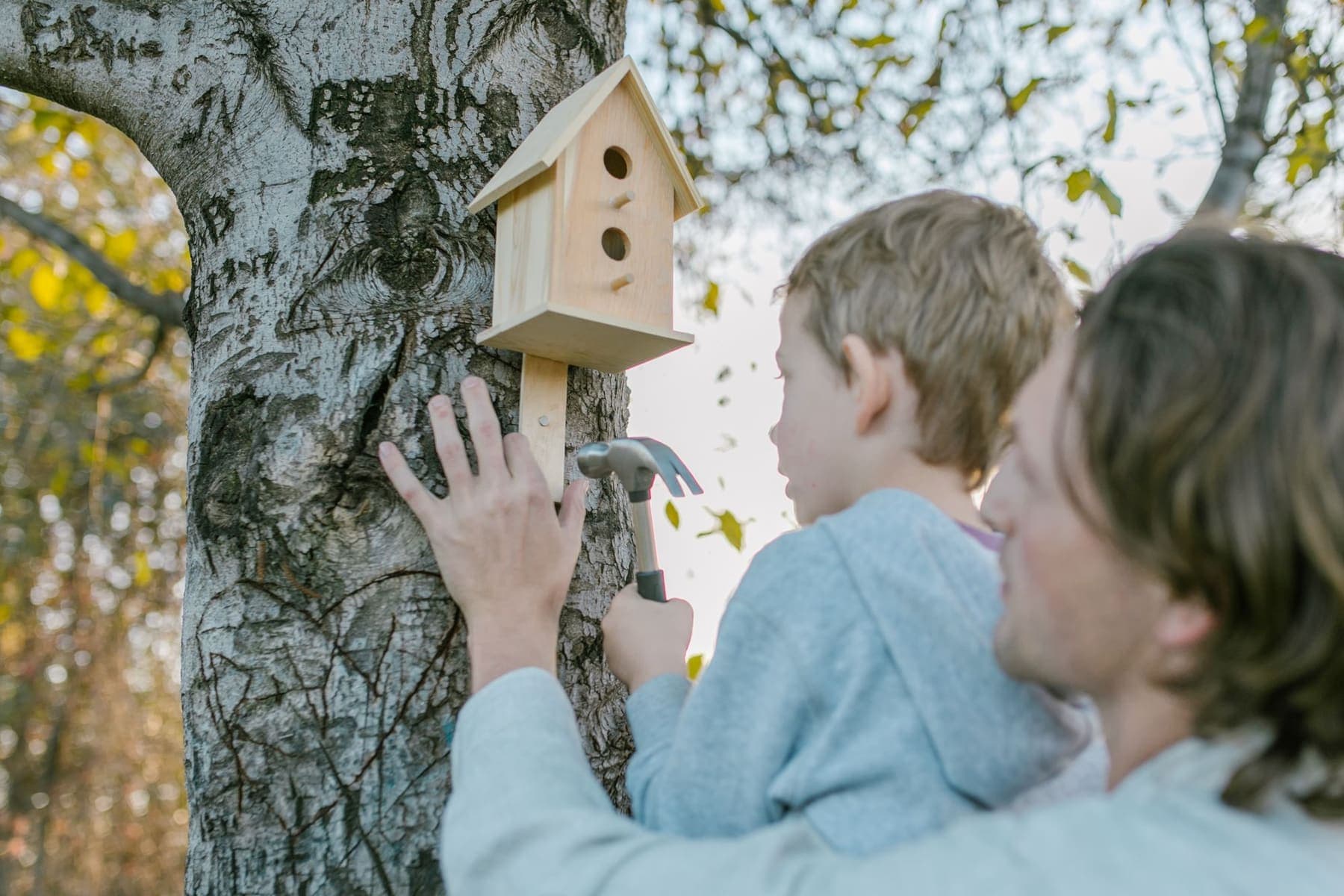
A few species overwinter as adults — the brimstone, the peacock, the small tortoiseshell — hidden in a hollow tree, a log pile or a shed. A shelter offers them a dry, dark cavity, which also helps during summer downpours.
Let us be clear about what to expect from one: a shelter is an extra, and it is not always occupied. Butterflies depend above all on flowers, on host plants and on the absence of pesticides. Fitted 1 to 1.5 m off the ground, out of the wind and catching the morning sun, surrounded by nectar plants, it still has its place — if only as a spot to watch from.
The same thinking applies to solitary bees, hoverflies and bumblebees: it is all gathered in the Insects section.
Sources
Frequently asked questions
Which plant attracts the most butterflies?
For adults in summer, marjoram and scabious are among the most heavily visited flowers, and ivy in flower takes over in October. But no nectar plant on its own lets butterflies breed. If the aim is to see them hatch in the garden, a nettle patch in the sun is what makes the difference, because it feeds the caterpillars of four or five common species.
Should nettles be kept in the garden?
Yes, as long as they stand in the sun: they are the host plant of the peacock, the red admiral, the small tortoiseshell and the map butterfly. A square metre is enough, in a quiet corner. Nettles in the shade of a hedge are almost never chosen as a place to lay. Cut half of the patch at the end of summer rather than all of it.
What should I do about caterpillars on the cabbages?
They are most often the caterpillars of whites, which attack only brassicas. The simplest answer is a fine mesh net put over the bed before the first flights, which stops the eggs being laid without any product. Picking the caterpillars off by hand is still workable on a few plants. An insecticide, even one approved for garden use, would hit every other butterfly species too.
How long does a butterfly live?
It depends on the species and the season. Most day-flying butterflies live two to four weeks as adults. The species that overwinter as adults, such as the brimstone or the peacock, live far longer, up to ten or eleven months counting the hibernation period. The caterpillar stage generally lasts three to six weeks, depending on temperature.