

The swallowtail: how to spot it and feed its caterpillars
The swallowtail lays only on Apiaceae: fennel, carrot, dill, parsley. How to tell it from the scarce swallowtail, which host plants to sow, and the tidying jobs that destroy caterpillars and chrysalides without anyone noticing.
In this guide
To see swallowtails in the garden, nectar flowers are not enough: you need the plants the female lays on. The swallowtail (Papilio machaon) places its eggs almost exclusively on Apiaceae — fennel, wild or cultivated carrot, dill, parsley, parsnip, angelica — as well as on common rue. A few plants tolerated in the vegetable bed, left to put on leaf and never sprayed, are often enough to bring caterpillars in the first season.
Identifying the swallowtail, and not confusing it with the scarce swallowtail
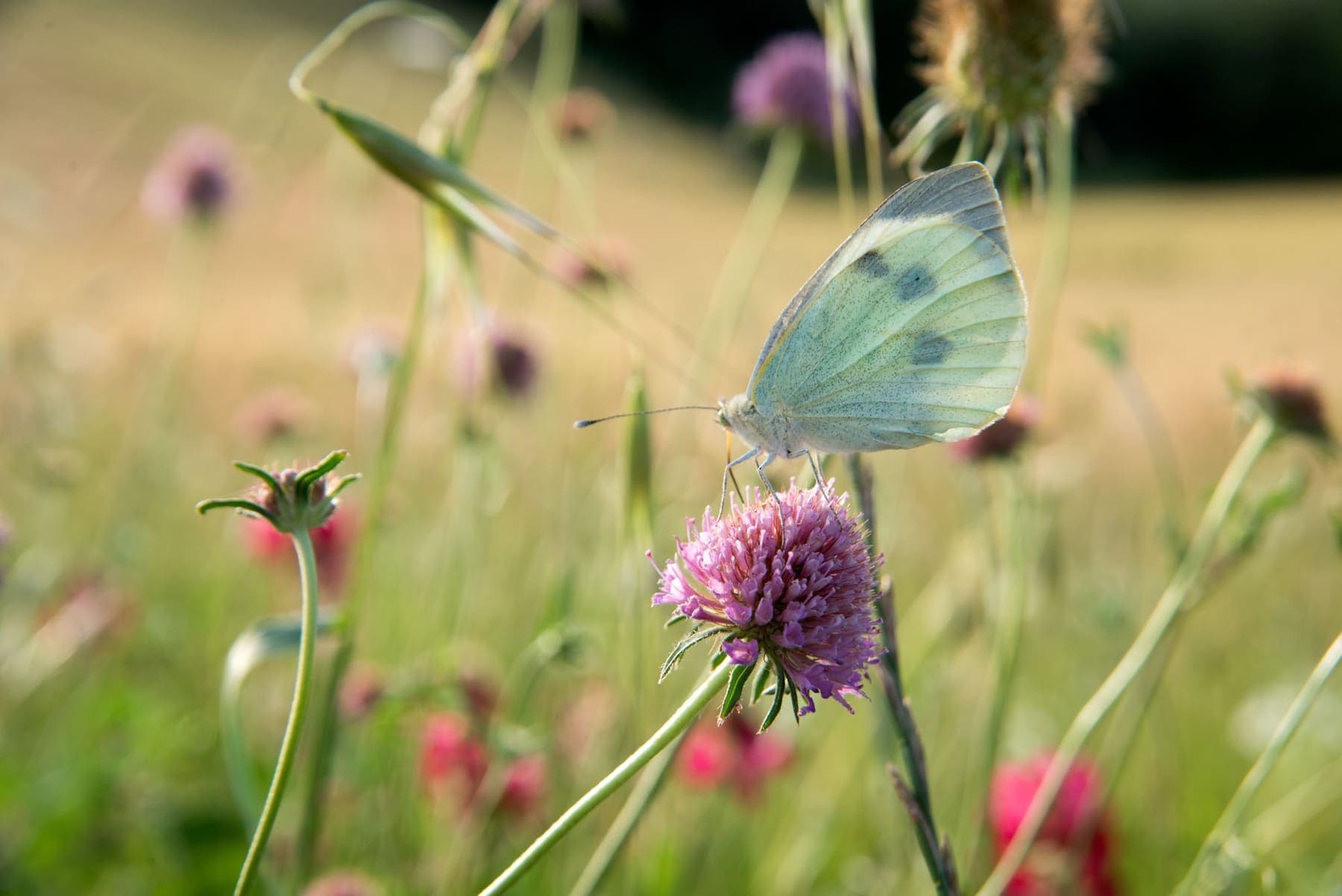
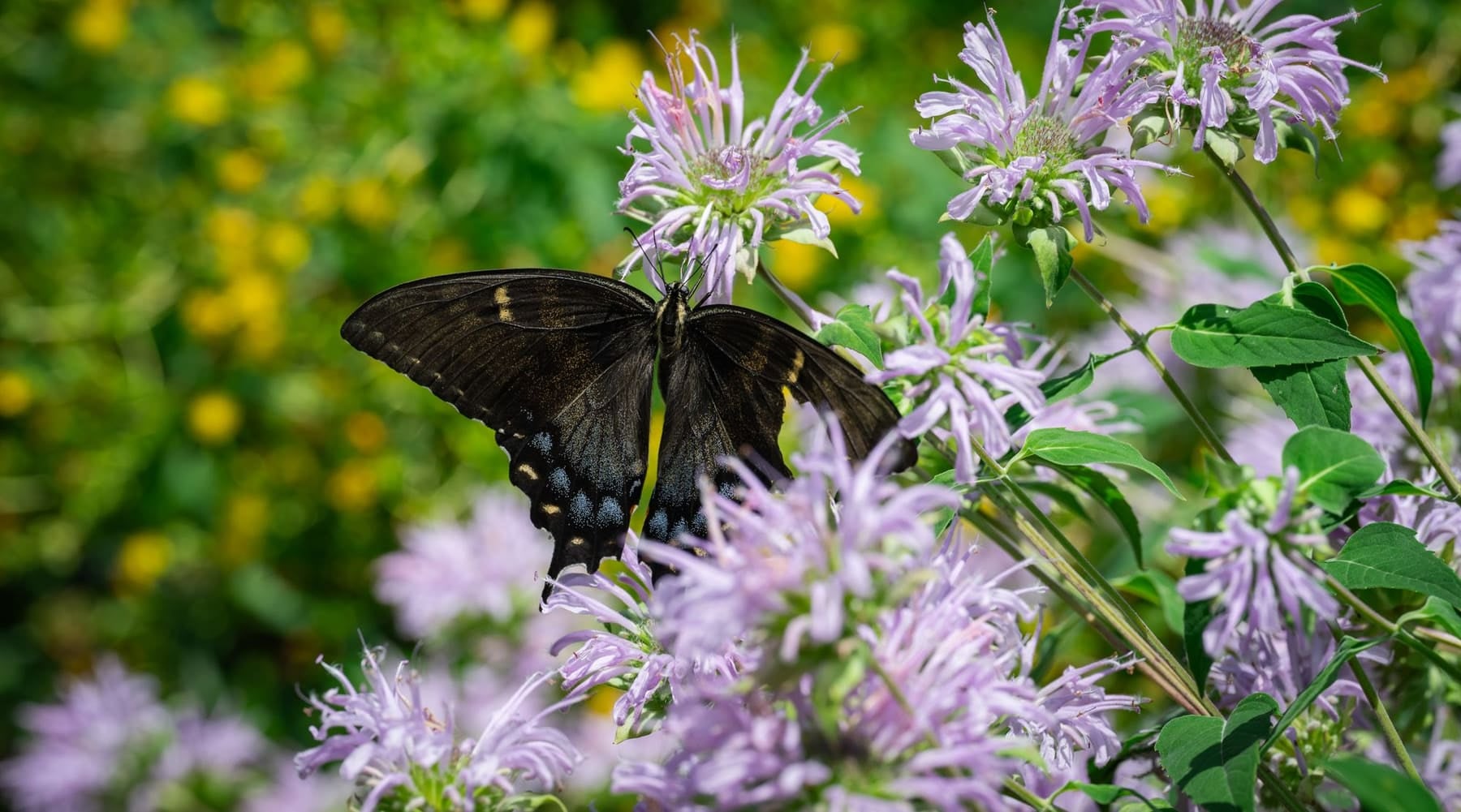
The swallowtail is a large, pale yellow butterfly marked with black veins and bands, with a blue-tinged border and an orange eyespot ringed in black at the angle of each hindwing, which is drawn out into a fine tail. Its wingspan runs from about 6 to 9 cm depending on the individual and the generation.
The confusion is almost always with the scarce swallowtail (Iphiclides podalirius), the other large tailed butterfly of French gardens. Both fly at the same times of year and visit the same flowers, but everything separates them once you look at the markings and, above all, at the host plants.
| Swallowtail | Scarce swallowtail | |
|---|---|---|
| Wing pattern | Black veins and broad black blotches on a yellow ground | Parallel black bands, like zebra stripes, on a cream ground |
| Tails | Short, broad at the base | Long and slender |
| Orange eyespot | Clear, ringed in black, one per hindwing | Smaller, often bluish |
| Host plants | Apiaceae: fennel, carrot, dill, parsley, parsnip | Blackthorn, hawthorn, stone fruit trees |
| Where to look | Vegetable gardens, flower meadows, rough ground | Dry slopes, blackthorn hedges, orchards |
The caterpillar, for its part, resembles nothing else. Green, ringed with black and dotted with orange, it reaches 4 to 5 cm in its final stage and sits in full view on the umbels. When alarmed, it pushes a small orange forked organ out from behind its head, the osmeterium, which gives off a sharp smell. Impressive, but entirely harmless: this caterpillar does not sting and causes no irritation, unlike processionary caterpillars, to which it is not related.
The life cycle: two generations and a chrysalis that overwinters
The swallowtail generally produces two generations a year in France, sometimes only one at altitude or in the north, sometimes three in the south in warm years. The adults of the first generation fly from late spring to early summer, those of the second in high summer and on into early autumn.
The sequence is always the same:
- The egg, pale yellow then darkening, is laid singly on a leaf or an umbel. It hatches in one to two weeks depending on temperature.
- The caterpillar goes through several stages. The first are black speckled with white and look like a bird dropping; the last take on the ringed green livery. It feeds for three to four weeks.
- The chrysalis forms on a stem, a stake, a wall or a fence post, held by a silk thread passed round its body. It is green or brown depending on what it is attached to.
- Winter is spent as a chrysalis. That is the decisive point for a gardener: next year's swallowtails are already there, fixed somewhere, motionless, from October to April.
The host plants: the carrot family
Everything turns on this family, recognisable by its umbels of flowers and its finely divided foliage.
- Fennel, wild or from the garden, is by far the most used host plant. A bronze fennel left at the back of a border does the job very well and stays ornamental.
- Carrot, wild as much as cultivated: a few plants left to flower in the vegetable bed feed the caterpillars and then draw a crowd of insects to the umbels.
- Dill and parsley, often the first to be found in a herb bed.
- Parsnip, chervil, angelica and lovage, less frequent but accepted.
- Common rue (Ruta graveolens), the only notable host plant outside the Apiaceae. Its sap is photosensitising: handling it in sunshine can cause skin burns, so plant it away from where people pass and prune it with gloves.
The practical rule comes down to one sentence: sow more than you need and accept sharing. Three or four parsley plants beyond what you eat, two carrots left to flower, a fennel at the end of a bed, and the caterpillars no longer threaten the harvest. A swallowtail caterpillar on a dill plant is not a pest, it is next summer's butterfly.
A mixture of native species supplies both wild carrot, a host plant, and the nectar flowers the adults need — knapweed, field scabious, oregano, oxeye daisy. The sowing and cutting method is set out in sowing a nectar-rich wildflower meadow.
Nectar flowers for the adults
The adult butterfly is not fussy: it feeds at flowers in full sun, with accessible corollas, and favours the high points of a garden. Oregano, knapweeds, field scabious, scabious, lavenders, sages, hemp agrimony, Verbena bonariensis, red valerian and, late in the season, ivy are among the most visited. The guide on which plants for pollinators sets out the full succession through the year.
A patch of damp earth or a corner of wet sand completes the offer: males settle on it to take up water and mineral salts, a behaviour easy to watch in hot weather.
What destroys caterpillars and chrysalides
This is where most of a garden's swallowtails are lost, often without anyone meaning to.
- Insecticides, including those described as natural or plant-derived: they do not tell a cabbage white caterpillar from a swallowtail caterpillar. One treatment of a herb bed is enough to remove a whole generation.
- Cutting dry stems before spring. Chrysalides spend the winter attached to dead stems, stakes or fence supports. Cutting, shredding or burning those stems in autumn or winter destroys them. Better to leave part of the garden standing until spring and put the tidying off to the end of March.
- Pulling up fennel and carrots that have run to flower, often done for the sake of neatness in late summer, while the caterpillars of the second generation are still feeding on them.
- Moving caterpillars. A caterpillar sitting on a parsley plant does not need rescuing or putting in a box. Taken off its host plant, it will not find its food again. In the same way, a chrysalis is left where it is: there is nothing to do but work around it.
- Frequent mowing and strimming of edges and rough ground, which removes both the host plants and the supports for chrysalides.
One point of honesty about this kind of shelter: it is meant for species that overwinter as adults, such as the brimstone, the peacock or the small tortoiseshell. The swallowtail, which overwinters as a chrysalis, will not use it. It is a useful addition for other garden butterflies, but not for this one — what really helps the swallowtail is still Apiaceae, nectar flowers and the absence of any spray, as the guide to a garden that favours biodiversity points out.
Sources
Frequently asked questions
Which plants does the swallowtail lay on?
Almost only on Apiaceae: fennel, wild and cultivated carrot, dill, parsley, parsnip, chervil, angelica, lovage. Common rue is the one notable host plant outside that family. A few plants left to put on leaf are enough to receive a batch of eggs.
Are swallowtail caterpillars dangerous?
No. They do not sting and they cause no irritation. The orange forked organ they push out behind the head when disturbed is simply a smelly means of defence. They should not be confused with processionary caterpillars, which do cause skin reactions and belong to an entirely different family.
Will the caterpillars strip my parsley?
They eat some of it, but rarely enough to threaten a harvest. The answer is to sow more widely: a few extra plants of parsley, dill or carrot left for them settles the matter without any treatment.
Where does the swallowtail spend the winter?
As a chrysalis, held by a silk thread to a dry stem, a stake, a wall or a fence post, from roughly October to April. That is why it is better to put off cutting dead stems until the end of March rather than clearing the garden in autumn.