

Which plants attract pollinators, in the garden and on the balcony?
Local flowers that take turns blooming from late winter to autumn, ideas for balconies, and the invasive plants you should never plant.
In this guide
To attract pollinators, plant varied, local wildflowers that follow on from one another from late winter to autumn. Willow and blackthorn in early spring, viper's bugloss, sages, clovers and marjoram in summer, ivy in autumn: it's the continuity of flowering that counts, more than the surface area. And a few plants that are nonetheless very good for bees should be avoided altogether: some are even banned in France.
Why choose local plants?
The wild plants of your region evolved over a very long time alongside the insects that live there. Their flowers are adapted to these pollinators, and some bees only collect pollen from a small group of plants. An exotic plant may be heavily visited, but it doesn't replace this relationship.
Local plants have other advantages: adapted to the climate and soil, they generally need less watering and maintenance. The French Office for Biodiversity (OFB) runs the Végétal local ["Local Plant"] label, which guarantees that seeds and plants come from wild populations collected within one of mainland France's 11 ecological regions, with controlled traceability.
Also think about caterpillars. A butterfly needs nectar, but above all it needs host plants to lay its eggs on. A patch of nettles in the sun, for example, feeds the caterpillars of the peacock butterfly and the small tortoiseshell.
Flowering from late winter to autumn
Pollinators don't all fly at the same time of year. Bumblebee queens and some bees emerge as early as late winter, when flowers are scarce. Other species fly in high summer, others still in autumn, and must build up reserves before winter. A garden that only flowers in June leaves these insects with no resource the rest of the year.
Late winter and spring
- Willows, such as goat willow: their catkins are among the first resources of the year.
- Blackthorn and hawthorn: two hedgerow shrubs that take over from each other in spring.
- Fruit trees: apple, pear, cherry.
- Dandelion, dead-nettles, bugle: let them flower in the lawn and at the foot of hedges.
Summer
- Viper's bugloss: a heavily visited flower that likes dry, poor soils.
- Meadow clary, marjoram, wild thyme: easy in sunshine, along borders or in a rockery.
- Clovers, bird's-foot trefoil: small legumes much loved by bumblebees.
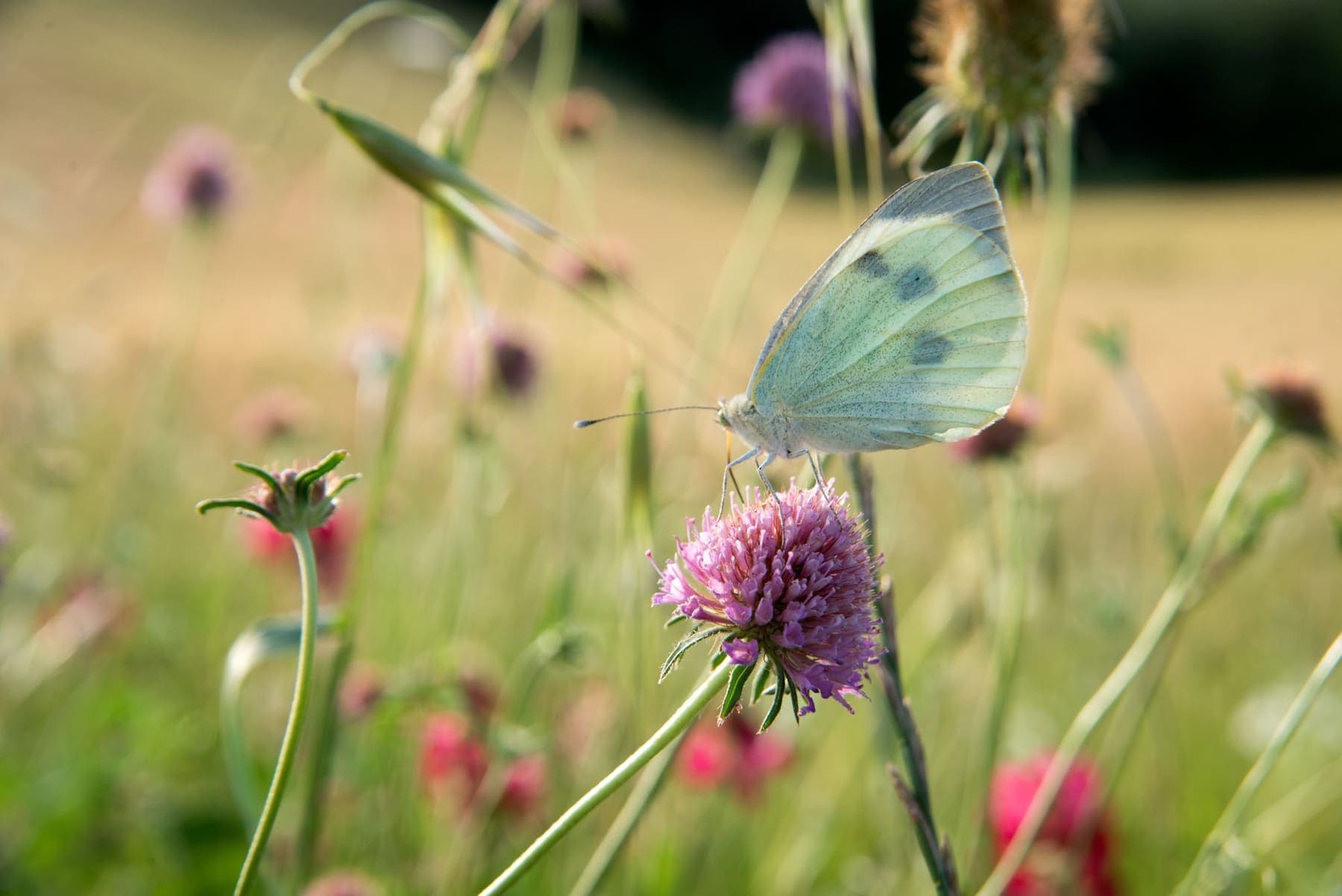
- Knapweeds, field scabious: for both bees and butterflies.
- Common mallow, yarrow, wild carrot: robust choices for a meadow or border.
- Bramble, at the edges: its flowers feed many insects, and its dry stems serve as nests for some bees.
Late summer and autumn
- Ivy: it flowers late, when almost everything else has faded. A solitary bee, the ivy bee, depends on it for pollen.
- Hemp agrimony, in moist soil: heavily visited by butterflies.
- Heather, common heather, on acid soil.
Which plants for a balcony?
A sunny balcony can feed bees and butterflies, provided you choose simple flowers and let them bloom.
- Herbs: thyme, marjoram, savory, rosemary, common sage, chives. Don't pick them all before they flower.
- Small plants for dry soil: bird's-foot trefoil, biting stonecrop, viper's bugloss in a deep pot.
- Simple annuals: wild cornflower and poppy, sown in a wide planter.
Group your pots together: several plants of the same species offer more flowers in one spot. And if your balcony is already full of heavily bred bedding plants, keep them, but add a few simple flowers alongside.
Double flowers and "flower fallow" mixes: watch out
In many double flowers, obtained through breeding, the stamens have been replaced by extra petals. The result: little pollen, and nectar that's hard to reach. A wild cornflower does far more for insects than a double one.
Also be wary of seed mixes sold as "flower fallow". Many are mostly made up of exotic species and horticultural flowers: very colourful in the first year, they offer less to local pollinators, and some exotic species can become invasive. Read the ingredients list, and prefer mixes of local origin.
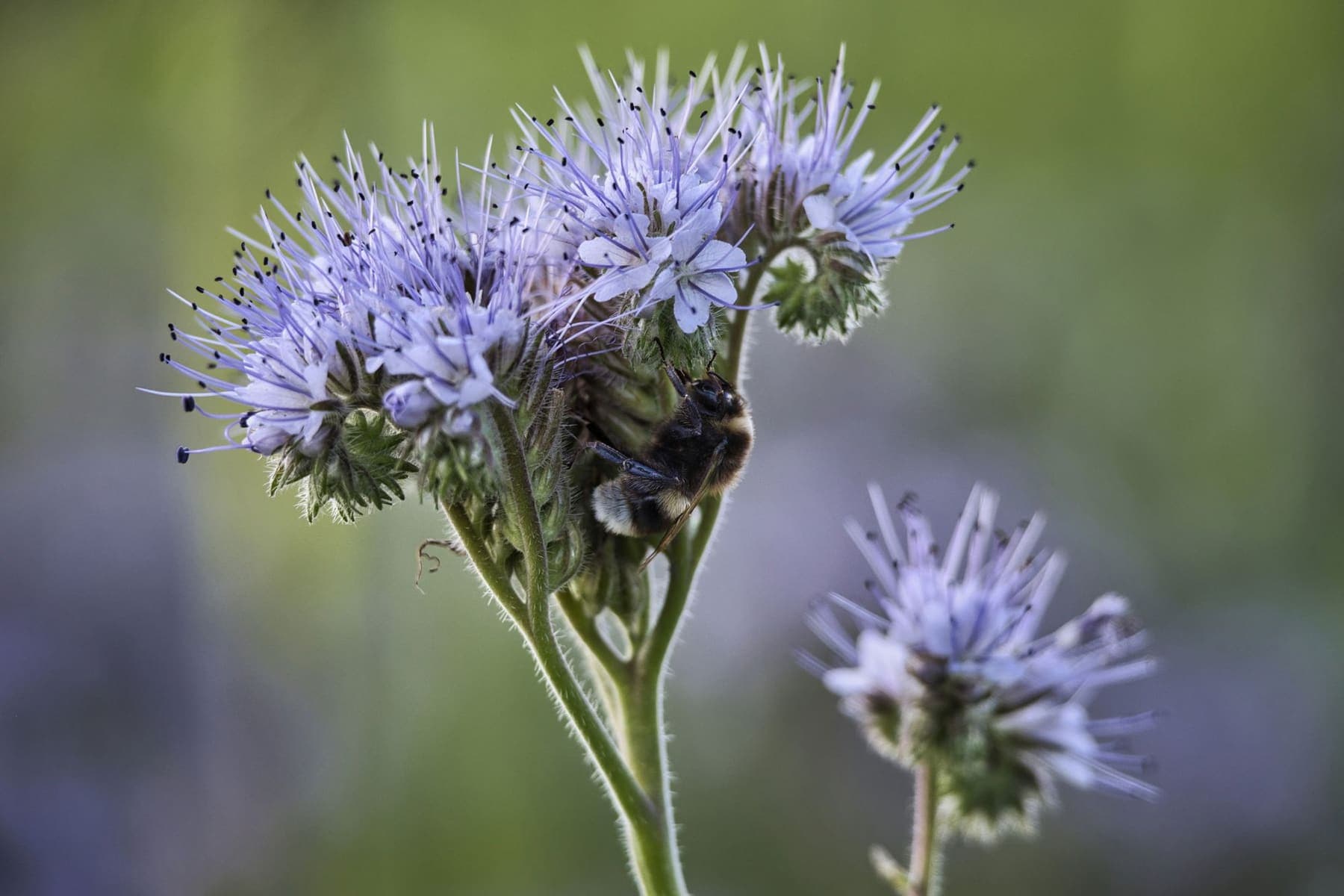
Phacelia is a special case. Native to North America, it's often sown as a green manure in vegetable gardens, and it's very popular with bees. It can complement local flowers, without replacing them.
Which plants should you not plant?
Species banned in France
Some invasive exotic plants are regulated at both European and French level. It's forbidden to introduce, plant, transport, sell, buy, exchange or keep them. Several are nonetheless good for bees, which is why they've been planted in gardens:
- common milkweed (Asclepias syriaca), also known as silkweed;
- Himalayan balsam (Impatiens glandulifera), heavily visited by bumblebees, but which takes over riverbanks;
- Japanese knotweed (Reynoutria japonica), which flowers late;
- giant hogweed (Heracleum mantegazzianum), whose sap causes severe burns in sunlight;
- tree of heaven (Ailanthus altissima), a very fast-growing tree.
If one of these plants is already growing in your garden, don't propagate it and never dispose of its waste in the wild. Check with your local council or the Invasive Alien Species resource centre for how to manage it properly.
Other invasives to avoid
- Butterfly bush (Buddleja davidii): it's classed as an invasive alien species in mainland France, where it colonises wasteland, riverbanks and railway verges. The OFB classes it as an invasive alien species for mainland France and recommends limiting its spread, so it's best not to plant it. Its flowers attract adult butterflies, but it barely serves as a host plant for their caterpillars.
- Cherry laurel: widely planted as a hedge, it's considered invasive. The LPO recommends a hedge of native species instead.
Where to find local plants?
- Végétal local producers: the label's online directory lets you search for seeds and plants by region.
- Wildflower nurseries: ask about the origin of the plants and seeds.
- Spontaneous flora: let whatever grows on its own come through, dandelions, clovers, dead-nettles or brambles at the edges, while keeping an eye out for invasive species.
Don't collect plants from the wild: some species are protected, and uprooting depletes wild populations.
Flowers aren't enough: think about shelter too
Flowers only cover part of the need. Most solitary bees nest in the ground, others in stems or dead wood, and many insects spend the winter in dry vegetation. Leave a patch of bare soil in the sun, dry stems over winter, and, as an addition, an insect house with tunnels near your flowers. Our guide how to attract solitary bees covers these arrangements in detail.
For a larger area, sowing a wildflower meadow is the most economical way to offer wild flowers in quantity. Shelters are gathered in the Pollinators section, and our guide creating a garden that supports biodiversity puts these plants back into the context of the whole garden.
Sources
- Végétal local — Office français de la biodiversité
- Je plante et préserve des variétés locales d'arbres et d'arbustes — LPO
- Liste des espèces réglementées — Centre de ressources Espèces exotiques envahissantes
- Buddleia du père David (Buddleja davidii) — Office français de la biodiversité
- Fleurs sauvages et prairies fleuries pour nos pollinisateurs, guide technique — Arthropologia
Frequently asked questions
What's the best plant for bees?
There isn't just one. Wild bees fly at different times and don't share the same preferences: several local species that take turns from spring to autumn are better than a large area of a single plant.
Does lavender attract pollinators?
Yes, it's heavily visited by bees and butterflies. It grows naturally in the south of France; elsewhere, pair it with local flowers so the garden isn't limited to a single summer bloom.
Should you let dandelions flower?
Yes, if you can. Dandelions flower early, when resources are scarce, and feed bumblebee queens in particular as they emerge from winter. Mow around them rather than over them while they're in bloom.
When should you plant a hedge for pollinators?
In late autumn or early winter, in soil that isn't frozen: the LPO recommends November and December. Water generously at planting time, ideally with rainwater.